Tuesday, June 28, 2011

Enough Preaching

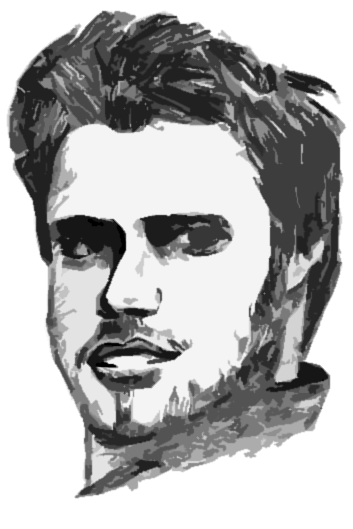
Some art, I'm looking at doing get going on some animation projects.

For some reason I like taking on lost causes. I don't think it's masochistic as such, though I do think I certainly have masochistic tendacies. But I mean there are these 'Holy Grails' out there, that just the dreaming of achieving fills me with excitement.

For example, drawing a cute girl with a prominant nose. Leonardo managed it, once and I can't be bothered inserting a picture of the sketch where he pulled it off. At any rate I feel a little defeated everytime I have to go back and erase the bridge of a girls nose in a picture to 'fix' it. It's a challange that captivates and perplexes me, because in my time I have met many beautiful women with quite defined noses.

Another is doing good animation with realistic characters. In many ways the 3D computer animation is 'catching up' with 2D because they build models with realistic proportions and it is only the past couple of years that most have realised they should go back to the simple geometric constructions of traditional 2D animation, particularly Golden Era.

But if anybody came close to pulling off that holy grail, it was Milt Kahl with his dance sequence in Disney's Sleeping Beauty. The old school Disney Animators were the fucking shit, and I've read some of them wound up living in caravans and stuff, which is a tragedy given the lasting legacy and beauty of their work.

But I mean that's what I love about Art, we've been drawing on cave walls for over 32,000 years or something and there's still all these frontiers with something as simple as putting lines on paper. Since everything in a 2D image is an illusion, as pointed out beautifully in the below Magritte painting:

The french reads 'this is not a pipe' which is true, it's a painting of a pipe.

I remember seeing maps of the world as a kid, and as was replicated in the Truman show, thinking 'man, everywhere has already been discovered.' and you know looking wistfully at history when you had frontiers of the unknown, trails to blaze and a whole 'New World' as stumbled upon by Collumbus. That's the when I wanted to be in (though not to butcher and infect indigenous populations) but just to go somewhere where you had literally no fucking idea what was over the crest of the next hill.

When I look at all the artwork I want to do, it's full of Holy Grails, and Everests that I must attempt to climb 'because it is there'. Simple things like drawing a nose on a lady, or animating somebody that is built like a real person, it is a wild and untammed country.

Sunday, June 26, 2011

Decider

This is no post for false modesty, in my brief working life I have recieved advancements and promotions relatively quickly and frequently.

I have in my time turned down two promotions, one recently and one many years ago. And in both cases I made the right decision.

I'm thinking about these incidents because today I decided to take my dog for a walk and read this:

"You are rich if and only if money you refuse tastes better than money you accept." ~ Nassim Nicholas Taleb, The Bed of Procrustes


I have a feeling NNT wouldn't like me, or my blog. But I do feel rich, there are times when I contemplate seeing a psychologist about money's inability to motivate me. I have read somewhere else that people enjoy being flattered even when they know they are being flattered. In a similar manner, I think many people enjoy taking a promotion without really thinking about whether it would be good firstly A) for them, B) for their career C) for the company.

The first one is distinct for the second because it is holistic, work is but a facet, an important one for life but as it starts to usurp your time outside of it you need to consider that even though my career may advance my life may be deteriorating.

The first time I turned down a promotion it was at hurdle B, and admittedly A, and probably C as well. The company needed somebody to fill the role of shipping clerk, which for an importer was pretty crucial, and the departing employee was highly valued for their expertise and intimate knowledge of a crucial excel document. (That I hope has been replaced). I was in the sales department, sales is not my natural forte (I am an introvert and find social interaction exhausting, though I've gotten better at it), and this may blow your mind, but most companies are organised in a pyramid. Slow down egghead! What's with the geometry, well if you built a highway like a pyramid it would be very ineffecient at getting people to where they want to go.

There is the lane though on this pyramid highway that goes to the top, and that lane ran through the sales department, not shipping and logistics. So while the promotion was genuine, it was a dead-end one. After that there was one more step for (logical) advancement. There were other factors as well, it takes time to build up relationships with customers. After 6 months in sales, I still recieved calls from wholesale customers that weren't aware I had replaced 'Nic' my predecessor. The sales mangers were happy with me, and shifting me after only 6 months and forcing them to have to get used to a new person was possibly not in the best interests of the company.

The point is, companies can make mistakes when offering promotions as well. In this case I think they saw an urgent, but in the long run, unimportant position to fill and felt I was the quickest fix. But really it was a job where you talk to almost nobody and quietly dick around with an excel sheet in a corner and your view is of a wall. It would have been bad for me straight out. I remember helping them for a week and it nearly crushed my soul completely. I was ill suited to the work, and the work was ill suited to me.

More recently, I was offered a promotion that for most people would be an easy decision to take it, and subsequently was difficult for me to turn down. The thing is, that I didn't need extra money, and thankless (actually that's not true, you would be amazed at how many people thank me during the course of a shift, the ratio between thank-yous to 'fuck-offs' is in excess of 100:1, I've never really thought about that before) though my job is it has its advantages. The first is that it rotates me through interactions with amazing people that in perhaps one of life's greater mysteries even a prestigious job would struggle to recreate. I don't know whether I will be sitting next to an actuary or a musician from one shift to the next and sometimes a person can literally be both.

Before I got this job I was in a slump of an existential crisis. I had no direction or structure to my life and was living off the considerable savings of my former career (where I also turned down a promotion). The primary benefit of my job is the social opportunities it provides. In the context of the actual job I do, looking at the base isness of what it is - conducting repetitive surveys it is easy to dislike. The benefits and enrichment the work environment brings my life, more broadly I find hard to ignore and thus it is hard to resent my job.

In a sad irony, working in a call center has brought me more opportunities for happiness than the supposed 'real-job' I had. I am fitter, more social, happier (whatever that means) and more relaxed than I was at 23. I am more productive and achieve more of my won goals. In my particular case I identified my own needs and found the job that suited them. The dream can't last forever, I know, but it would have ended prematurely and foolishly had I accepted a promotion that isolated me from the primary benefit I recieve.

The promotion was real, it was more pay, more responsibility, more job security etc. But I don't have my job because of the pay (I can earn more full time), the responsibilitys make it harder if not impossible to overcome alienation from my peers and the job security is false because security doesn't really exist.

These decisions I have made, and I can never really know the features of the road not taken, but the money I refused tasted delicious.

Thursday, June 23, 2011

Optimism

A friend at work gave me this sketchbook she'd hand made using tracing paper instead of regular paper. It has 48 pages, and I have this idea of how to fill that many pages with a coherant illustrated story.

I don't wish to give too much away but in essence it will progress from page 1 to 48 going from my shallow superficial facade into my depths and what they are and how I try to represent them visual. Like a metaphysical anatomical guide for an aspiring surgeon of the subconscious. I probably gave too much away.

Anyway of necessity I am going to have to include those aspects I don't like about myself. My negatives. I am as prone to engaging in irrational behaviour as probably everyone, and by everyone I mean 'the norm' probably not say substance abusers or peeps with actual personality disorders. The substance I do abuse is food, my diet is aweful and I probably should arrest the behavior that has me consuming my own death.

That is a negative I possess that I could get rid of and not really bat an eyelid. Sure maybe once a year I will be drawn to Sydney Roads KFC for the artistic installation it's bad service and worse food is, but I can probably live quite happily without junkfood in my regular diet.

There are other negatives though I find curious as to why I keep them, I mean I keep them suprressed, I don't act on them (any more) and in accordance with the two-dogs proverb I learned from a Daredevil comic 'There are two dogs fighting in each of us, one that hates and one that loves. Do you know which one wins the fight? The one you feed the most.' my 'bad' nature I haven't fed for years. Yet I can't bring myself to kill it, nor am I sure I can. Maybe controlling our worst behaviour is the best we can do short of a lobotomy.

But I'm in a strange looping loopness of negativity. One part of my negative nature is that I can be quite ruthless, and I have been kind of ruthless in removing negative influences in my life. And by 'remove' I mean 'not spend time with' but I'm not sure if fighting negative with negative is the right way to go.

Some clarification, by negative it is based purely on how somebody makes me feel, I don't mind if people are arseholes to me (it is literally part of my job) and I subscribe to the view of conflicting emotional states, that the most consistent state wins out. At work when I call somebody who is pissed off, I am more or less constantly in a positive frame of mind, and I find that people come up to my positive state almost 99% more often than I sink down to theirs.

The qualities I'm talking about are people that are infectiously pessimistic, selfish, angry, boring, foolish, distrustful etc. it is not just that they are in a bad mood or act annoyed when I annoy them, it is integral to their world view.

I am optimistic when it comes to people including myself. Optimism lends itself to dissappointment sure, but what of it? Finding reasons to dislike somebody is the easiest thing in the world. I am not naive enough to think that people have any difficulty finding reasons to dislike me. What is not much harder though and infinitely more rewarding is finding reasons to like and love people.

Miki taught me this, and is truly master of it. Within 10 seconds of meeting Miki you are gaurunteed to recieve some massive compliment and find yourself feeling warm and fuzzy inside. I remember her meeting my former housemate Sabine and after the usual formal introduction 'Miki, Sabine, Sabine, Miki' she turned to me and said 'Wow! you are SO lucky to have her.' Such exuberance I am unlikely to be able to pull off and sound genuine like Miki did. And certainly Miki is capable of having negative opinions of people, however she is never and I mean NEVER particularly invested in them and these are deviations in her nature that always trues towards her entrenched habit of finding reasons to like people.

And getting entranced by sentimentality is also a trap, Miki has shortcomings (that like everyone else are easy to spot) just as I do. But what I admire about her is that she also possessed a tough, ruthless core. I am starting to suspect this is the secret.

What I mean is, if you take a pessimistic view of people, 1. it's easy. 2. you expectations will almost certainly be fulfilled. Reliable people are rare, but that doesn't mean some slim minority is worthy of your optimism, people let me down, even people that I love. But what of it, I'm not going to deny them the chance to come through for me, and when people do let me down...

it's no big deal. They will have their reasons, and fundamentally - I am optimistic enough about myself to know I will survive and thrive despite let downs. That's the secret, true strength isn't erecting an impenetrable barrier of defence against harm in life, it is being open to attack and just not caring. These are the people who cannot be hurt, those who cling to the defence of pessimism I have generally found to be much better at hurting themselves than almost anybody* else could be.

*the exception of course being dictators, tyrants and sociopaths.

Sunday, June 19, 2011

The Oath.

Kate was the first I heard to believe in me. I heard it third hand through our mothers gossiping mouths.

She and her mother had been walking the lake and she remarked 'Tom's* going to be famous isn't he?' with as much fidelity as three people's memories can provide.

And her mother said 'Tom* is famous he is on R#$e Ar&^nd the C#rn@r.' and then Kate said 'No. I mean really famous.'

I'm not sure if fame is what I seek or something even worth aspiring to, but I took that as a faith that I was worth paying attention too.

I woke up today to my first Monday as a full time aspiring artist, the day has been mostly clerical but I did make a list a few weeks back when going through a down faze of the people that really, truly believe in me and want me to succeed.

I'm sure it's not an exhaustive list, but it is list enoough to start with and more than any individual has a right to in ten lifetimes let alone one.

The number and calibre and amazingness of the people that believe in me humbles me. I am conscious of your support and thus this is what I swear to you:

I vow I will do my all to do your faith in me justice.

From this day forth I am going to dedicate my energy to realising your belief in me. I am going to believe in myself. I believe in myself as you believe in me.

*this was what I used to be called.

Saturday, May 28, 2011

Tough

I drew up a list of positive and negative influences in my life. Thankfully for me and years of working at it, my list of negative influences is very very short. My list of positive influences is inexhaustibly long. So for the most part it doesn't represent a dramatic reorganising of my life.

Just before Christmas last year I had the unpleasant task of telling my mother she was borderline negative influence on my life. She had returned home with the impact of an atom bomb, I can only speak for myself but I had survivors guilt (I moved out of home for the summer) and decided the only right thing to do was address it directly. So I told her she was a borderline negative influence.

She took it well, she approached me shortly afterwards to tell me it was the single most hurtful thing she'd ever heard in her life. I gave her a hug. I didn't get upset though to see her distress, the fact was that she had well and truly picked up the 'vibe' of it anyway.

Anyway that's in the past and now is now, after 4 months back overseas my folks have returned yet again, this time for 10 days. It's pushed me to the brink of sanity. I was going through a down period anyway and am in the middle (quite literally) of completing assignments. Because they are here only a brief time I am stuck in a dilemma.

Ideally I would just be able to suck it up and wait it out. Except Janice is in my hair, I can't live like this. I can't hack it I can't take it, it's killing me. Within 6 hours of her arrival I was ready to get all Meatloaf to her Gary Bussie.

I need all my self control to study, not stop myself from telling Janice where to go. She senses the cold shoulder though (which is as good as I can manage. Emotions are hard to hide) and has an almost pathological need to confirm it is there. By asking me inane questions which in turn is more infuriating and distracting and...

and...

I have tried being direct but nice and informing her I have assignments to do and if she would kindly leave me be, get out of my hair I would appreciate it. That didn't work.

I've fallen back on passive aggressive tactics, like describing how much I appreciate unsolicited advice. That was met with unsolicited advice.

I don't know what to do, but I'm afraid I'll do something, and it won't be pretty.

Friday, May 27, 2011

Ted Talks

So where's my life at right now? Let me tell you with the words of Theodore Roosevelt (See what I did there, with the title Shonesy knows what I'm talking about)

Far better it is to dare mighty things, to win glorious triumphs, even though checkered by failure, than to rank with those poor spirits who neither enjoy much nor suffer much, because they live in that grey twilight that knows neither victory nor defeat.


Death is always and under all circumstances a tragedy, for if it is not, then it means that life itself has become one.


Far and away the best prize that life has to offer is the chance to work hard at work worth doing.


It is not the critic who counts, not the man who points out how the strong man stumbled, or where the doer of deeds could have done better. The credit belongs to the man who is actually in the arena; whose face is marred by the dust and sweat and blood; who strives valiantly; who errs and comes short again and again, because there is no effort without error or shortcoming; who knows the great enthusiasms, the great devotions and spends himself in a worthy cause; who at the best, knows in the end the triumph of high achievement, and who, at worst, if he fails, at least fails while daring greatly; so that his place shall never be with those cold and timid souls who know neither victory or defeat.


I have already lived and enjoyed as much life as any nine other men I have known.


In any moment of decision the best thing you can do is the right thing, the next best thing is the wrong thing, and the worst thing you can do is nothing.


It may be true that he travels farthest who travels alone; but the goal thus reached is not worth reaching. And as for a life deliberately devoted to pleasure as an end — why, the greatest happiness is the happiness that comes as a by-product of striving to do what must be done, even though sorrow is met in the doing.


mmm...thematic.

...

Today I went to Slutwalk, and I was thinking as I walked along 'I really should do more research into who organises these protests and what they are actually about' I specifically had in mind the 'International Draw Mohammed Day' campaign, which though I fully believe in artist freedom, freedom of speech and that no body has the right to enforce their beliefs on others with violence, it was also a platform for hate that the organisers tore down (from facebook).

So I felt a bit worried I might be turning up to a protest that was endorsing the wrong brand of feminism - the sexuality is our power - type of feminism that isn't really feminism at all but an apology for the porn industry, run largely to benefit men (Hugh Heffner comes to mind).

But it was one of the best protests I've been to. There were good speakers and no terrible ones. What was said effected me. That I think is why I go, to learn and be affected, many of the causes I supposedly support I am actually woefully ignorant on.

I also just think nobody on earth should have to endure a substandard of life, not by design anyway.

There were a lot of women there. And there's something about standing in a crowd full of women that makes it different when you hear '1 in 5 women report having been victim of some form of sexual assualt by the time the are 16.' or something like that, I'm not sure about the age but I am certain of the ratio. Anyway, it made me realise that I was in the presence and probably always am, of women who have been sexually assualted in some way.

I can think of only one time in my life I called a girl a slut, and I didn't use the words just implied it to her. I loved her, she wasn't a slut, she was a cheater that was all and unlike most victims of sexual assualt I had brought that upon myself. So I really regret even implying that, that time, and that was the only time. It hurts me to think about it, but even then I don't think I ever actually believed that such a thing actually exists.

That is to say that somehow a woman's worth is diminished by how 'promiscuous' she is, that she loses something with every partner she takes on. It doesn't make sense to me, we gain something from every partner we have in some form or another.

I think a search of this blog may also turn up a post entitled 'something something insecure sluts' but even then, that word doesn't exist, that was a description of a self destructive emotional trap. Man or woman could easily stumble into such a trap, the trap I described was an abortive pursuit of love.

Slut's not a thing, it's a fairy tale. I apologise, for what it is worth, to everybody.

Wednesday, May 25, 2011

Assignments

I'm fucked. I'm completely fucking fucked. I'm totally fucked. I am, absolutely, fucked.

I've always claimed to never get stressed, yet I find myself now having to calm myself. But what are the symptoms if I am stressed?

I get hit with an intense wave of fatigue, I just want to give up and accept the negative consequences of my inaction feeling certain they cannot possibly be as bad as doing the work.

I look for distraction, 'productive procrastination' something to watch or read or anything that will allow me to avoid sitting down and doing the work I need to do.

Eventually I will sit up, take stock, maybe take some of the fallout on the chin, the consequences will not be so bad, I will gain a sense of purpose, of forward momentum and then just stop.

When I took my dog for a walk this morning the song my ipod was on was 'Falling to Pieces' by the time I rode home from work last night I evidently had lost all consciousness of what I was listening to.

Yet the song is entirely appropriate, my life is falling to pieces, I want it to fall to pieces, I want to get this last chunk of assignment done and out of the way.

But it is a crushing, brutal obstacle. For a subject of dubious value and a task that reflects a career path I have no desire to pursue (researching financial models) I have to reference and write and justify my point of view. These are just some of my most hated things.

And it's onerous, and complicated, and I just don't care. That's the worst part, my only motivation is to pass this subject. Every other subject I learned something from, found interesting, pleasant. This one was vague, demoralising and confusing.

It is eating my soul.

This is the melodrama I am sitting in right now, like a shallow bath that has turned cold.

Experience tells me I will sit up, pull myself together, remind myself I'm smarter than the average bear, put pen to paper get my momentum up and at the exact moment my confidence is restored I will take a break until I am stressed again.

But fuck it. I don't care. It has helped me realise what I actually care about in life, and studying the behaviour of other investors in order to try and make a profit off them is something I just don't give a flying fuck about.

Friday, May 20, 2011

There goes my hero...

The calibre of people that believe in me sort of obliges me to become something. Anything less would be to injure them, and they are amazing people that unprompted seemed to come forward all at once and tell me that they believed in me.

Having said that I went to check if Takehiko had given up on Vagabond which hasn't gotten past it's 300th issue. So I went to his website to see if he had announced any definitive break on the project and found his journal of working on a commission to draw a large folding screen portrait of a famous monk for a famous temple.

have to finish by tomorrow morning.
But it's already later then expected.

There was no more time to wait. Upon viewing my painting and realizing my
own shortcomings, I was extremely angry.

That's ego. My ego is not confident and is lashing out. I can do
something better. I have no time. I don't have enough experience. Leave
me alone when I'm drawing. I really can draw better. (I don't think)
that's the right image. It's somebody's fault. It's something's fault.

...

My lack of confidence is running wild. The design is messed up. I can
see all sorts of things wrong with it. My pride is telling me that my
skill will be questioned. Won't they laugh at me? Won't it embarass me?

That's ok. This wasn't to be called skilled. People can say what they
want. I don't know the rules. I drew with my own rules. Revealing the
person behind it is all that was done. Is that the type of person he is?
But that's ok. But if I do have my own true essence, deep inside, it
will be connected to other people.

There's only a little bit left. I'm excited. There's nothing like it.
Only I can complete this painting. I can make it even better. Only I can
do it.

I call for help from my pride. There's not much time. My ego is where I
get the power to make it through times like these.

I don't need a beuatiful painting. But one that will reach people's
hearts.

I'm going to work on the painting. The answer has appeared from within
the drawing. It doesn't matter even if it doesn't look too skilled. It's
a start.


If I worked twice as hard as Takehiko Inoue and wound up half as good I would not consider my life wasted. It's such a relief to know that an artist like him goes through the exact same emotions as I do when drawing a piece.

Thus like he, and the amazing people that believe in me, I have to start believing in myself.

Saturday, May 14, 2011

How to succeed?

All advice is autobiographical.

My degree is coming to an end, and I have quite literally 0 motivation to even look for a job in the profession. I just look forward to having time up my sleeve after graduating that I may draw, draw and draw some more.

The best advice, the advice that works for me actually has mostly come from Jerry Seinfeld. I'm not a particular fan of observational comedy, I was a big fan of the show, but mostly for George Costanza. Nevertheless Seinfeld has twice given the best advice I've heard in how to succeed.

A large part of what advice is right for you depends I guess on your definition of success. My definition of success is wanting to get out of bed in the morning and do your work and dreading the approach of retirement. If I could have that mindset on waking regularly I would call myself a success.

Money, fame etc don't really matter so much to me. The way I figure it, we are going to spend most of our waking hours in life at work, if you can enjoy most of your time in life (by enjoying what you do) then you don't really need much else.

Seinfeld first articulated this for me in his documentary 'Comedian' where he came into contact with Andy Orr the young aspiring comedian the documentary also followed. Andy was telling Jerry he was starting to question his career choice when he saw all his friends getting married and buying houses and stuff. Jerry couldn't believe it and told the story of some 'Big Band' group that were flying to a gig somewhere in winter and their plane was forced to land out of town in a snow covered field. The band dressed up in tuxedos had to tramp through the snow to the road and try and hitch a lift to their gig in the freezing cold. On the way soaking wet and freezing they passed this farmstead and looked in the window, there they saw a man with a beautiful wife in this Rockwellian scene cooking up a big family meal for their kids in their nice warm home and one of the band members commented 'man, how do people live like this?'

That's an anecdote I'll probably take to the grave. For me when I realised I want to draw, I also realised that to pursue any other path is moot. I cannot be happy, I could have a pleasant, comfortable life, but I can't be happy. Spreadsheets will never excite me the way drawing does. A nice home will not be enough consolation for having to leave it and go to a job I hate or worse find boring. Even if I love my children, I will never consider myself a proper role model if I hadn't pursued my dreams. They say 'don't have a plan B' this is generally good advice, I would only contend that you can't have a plan B.

I have described my failure in life as being a future where I have a high paying job in the finance industry. This isn't a plan b. This is failure for me. I'm not making a joke, I believe I can be well paid and a failure.

But can I be poorly compensated and a success? Here was Jerry's pearl of wisdom number two, on the HBO special 'Talking Funny' hosted by Ricky Gervais, Jerry was talking about his motivation for becoming a comedian. Specifically how after dying on stage the first time, how he got the motivation to go back. He said that he 'just wanted to be one of those guys.' He wanted to be a comedian, he wanted to associate with the group. He didn't care if he was a good or a bad one, he just wanted to identify himself as a comedian and that meant he had to perform stand up comedy.

When I look at Cheeks Galloway, Humberto Ramos, Francesco Herrara, Scottie Young, Takehiko Inoue, Eichiro Oda, Tim Sale, Bill Pressing, Matteo Scalera, Jake Parker, Alberto Ruiz, Alessandro Barbucci ... etc I just want to be one of those guys. I don't really care how good or bad I am, I just want to call myself a comic book artist. Or pin up artist, or even visual artist, illustrator.

You can make money being a 'bad' comic book artist. That is drawing one of Marvel or DC's lesser known titles and not blowing anyones mind with your artwork or style. That lifestyle would be success enough for me. Just to know I'm going to get up and draw a comic tomorrow, even if it is a contrived and poorly written 'Green Arrow' spin off series. Okay, maybe I misrepresent myself, what I mean is, so long as I'm drawing artwork to a standard I am proud of, and can live off that, that is success. I don't care if I'm not the greatest in the world, or most popular etc.

I just want to be one of those guys*.

*women can be comic artists too, they can even be phenomenal comic book artists, they just coincidently don't happen to populate the style of illustration I aspire to. I would like to be associated with women as well.

Sunday, May 01, 2011

And What To Make of It

Looking at the crowds gathered outside the white house triggers memories of newscoverage of Palistinians celebrating the destruction of the Twin Towers back in 2001, if I were president I'd find it hard to take pride in an office bestowed upon me by a people who rejoice in death whoever they are.
Another pointless war where two sides expend considerable human costs to trade symbolic victories and go nowhere.
I hope it means the relative non-threat of terrorism can begin to be forgotten today.

Obama's speech was neither stirring, inspiring or moving. It was clinical, which is probably appropriate.

Tuesday, April 12, 2011

Miasmic Therapy

An associates councilor gave them the following advice regarding friendships:

"If you use the word 'should' you probably shouldn't."

I think this is good advice, duty and obligation do not the basis of frienship make.

There is shit that eats up my time that I resent, like school assesment, that unfortunately you can't get the education (and qualification) without doing the minimum obligatory amount of assesment (which I still find onerous) but if a friendship or any relationship becomes a drag on your time and energy, betteroff alone.

Another piece of sound therapuitic advice to be plucked out of the air is this excerpt from a book I just read regarding people to avoid. I'm pretty good at avoiding the company of psychopaths and addictive personality types and the other obvious ones but this is worth taking note of as well:

"A group of people to be wary of do not fit any specific category of personality disorder. They do not, in general, seek to manipulate or disadvantage others. They are not necessarily self-absorbed or unkind, and their intentions are usually benign. And yet they are hard to be around for long. They are seldom insightful or reflective, though they may be intelligent and capable of useful work. They tend towards a loquaciousness and are not often good listeners. The quality of their thoughts combined with an irresistable need to communicate them are defining characteristics. They are fools." ~ Gordon Livingston


I am a pretty bad listener, having persisted through most of my life thinking I did listen by observing and remembering, without engaging or asking questions. Or for that matter even acknowledging people. But I try, and I shall endeavor not to be a fool.

Monday, April 11, 2011

Epiphanies in Summary

These are the epiphanies that have changed my thinking and hopefully subsequent behaviour in life. Summmarised and presented in neat autobiographical order for you:

1. Parents have no idea how to be parents.

As a post grad student mixing with pre-grad students I see the same sort of behaviour. It's a trust or assumption that the academic teaching you knows what practitioners are like. For me though red flags go up when a lecturer tells me 'in a professional business report, referencing is REALLY important.' my experience tells me this is a bold faced lie. In a professional report, the executive summary and/or the accompanying presentation is important. The rest of the report is just an insurance policy, and the frequency with which real decisions are made, means that they hardly if ever get read.
Similarly it was only when I became aware that there was a great disparity in parenting styles and outcomes that I had the blinding flash of obviousness that neither of my parents had gone to school to learn how to be a parent before having my older brother. They like most parents were just winging it, their foreknowledge of parenting was from the perspective of being a child and impressionistic observations.
This epiphany both increased my admiration for my parents and simultaneously destroyed the reverence/faith I had in their ability to parent. I'm lucky my parents did a good job of parenting. This doesn't mean they are or were infallible though. There is shit they messed up. You need to hold your parents to account, and as you mature increasingly hold them to the same standard as anybody else you choose to associate with. Some parents are bad, some parents are good, the import of the epiphany is that YOU don't have to become them.

2. Other People Don't Think Like You Do.

If I had any clout in management schools I would call this the the one hurdle criteria for being a manager. Some people, and honestly the least admirable, pleasant and desirable people in my experience cling to a belief that everyone thinks the same way they do, value the same things they do and everyone else is just getting it wrong.
It liberated me from a lot of frustration, anger and viscousness to realize that some people are introverts, some people are extroverts. Some years later I learned of Jungian personality types, Myers-Briggs is probably most famous and pretty cumbersom there is also the DiSC model which is pretty user friendly.
The ability to empathise, to put yourself in somebody else's shoes removes a lot of hostility from the world. Quite literally, you realise people aren't trying to frustrate annoy or destroy you, it just doesn't occur to them that you value different things, operate a different way.
Before you can put yourself in somebody else's shoes you have to first acknowledge the fact that other people wear different shoes in the first place.
Every environment seems hostile until you understand it, like playing a video game where an obstacle at first seems insurmountable, then you figure out the sequence and it becomes easy as pie. I can't guaruntee other people will become easy as pie once you understand them, but you will become kinder and it takes the edge off.

3. You have to live with yourself.

This was really productive for me, and it actually came probably before number 2 but who cares. I had 5 years where I was single for 2 months. I had had one girlfriend for the last 3 years of that period and then she dumped me. For the first time in my adult life I was confronted with myself and I didn't like it.
Thus I had to learn to be kind to myself, proud of myself and like myself. I actually made a conscious decision not to reenter a relationship until I had learned to do all these things. It took a lot of effort and I had to do a lot of stuff. But I did it, had another relationship and it was much better because of it. Instead of being a draining parasitical partner, I actually brought stuff to that table. I think the relationship was mutually beneficial and enjoyable. It still ended, but it was fun.

4. The Answer is not another person.

This had the same catalyst as above, but really broadly speaking, everyone is broken in some way. Everyone is messed up. Nobody is 'normal' it just doesn't happen. The people in life that have their shit together are the ones that realise something is broken and make an effort to fix it, and fix it themselves.
What I had been doing wrong was using other people to try and validate me and give me esteem. I eventually learned that self-esteem needs to be generated by me and is actually sustainable.

5. Truth is external and robust.

I have recieved much feedback in my life that I come across as a know-all. The incidence hopefully has been dropping over the past few years.
I used to think there was some greater truth, some universal meaning I could internalise that would give me some edge over the rest of humanity. I persued knowledge, I needed to be right.
I have given up on this notion. I still have genuine intellectual curiosity, and I revere the scientific method of learning about our world. But truth is external, it is the universe itself. It does not require our belief or understanding of it to feel validated and go on existing. It is in our interests to apply our full faculties to touch on that truth where we can, and we are all part of it.
But it is simply to large to ever internalise, thus we shouldn't wrap our egos up in it. We can be wrong, it's okay. We have a perfect right not to know things. We should even be willing to doubt our own knowledge and change our minds when confronted with new evidence. If the map doesn't match the ground, the map is wrong, not the ground.
I will now back down from arguments that I adopted without much thought, the old me was trained through the questionable academic darling of debating to defend arbitrary positions to the death. That so long as people thought we were right then we would be respected. Debating is almost the opposite of a life skill.

It's not much but I'm still young.

Sunday, April 10, 2011

Graffiti

So I just walked through the alcove that joins two crescents near where I reside and there are a crew of workers 'cleaning up' graffiti. Known I believe in graffiti circles as 'buffing.' One of them asked if I wanted to help paint over the graffiti, and it occurred to me that I couldn't imagine a bigger waste of time and resources than cleaning graffiti.

There isn't really any good graffiti around Kew anyhows, it's at best throw-up bubble lettered outlines, and mostly just shitty tags and scrawls. But this:

1. I used to be one of those philistines that said things like 'I don't mind good graffiti, but these tags and stuff are just bad.' But then I became enlightened, or at least had a blinding flash of obviousness and realised this is the equivalent of saying 'I enjoy good music but I can't stand these kids that are just learning to play.'
That is the status quo mentality of the casual graffiti observer is to think that good graffiti is produced by the visual arts equivalent of Mozart like prodigy, they aren't. It takes dozens of shitty pieces to get your head around the tools of the trade and work out your compositions.
Thus I don't really mind bad graffiti these days, because I understand you need it to get the good graffiti. And these aspiring graffiti artists need space.

2. Robert Doyle or Ted Ballieu or one of those liberal douchebags instigated this 'initiative' of cleaning up Graffiti, and while being sure to protect Melbourne's heritage listed and tourist attracting laneways, whose pavements are beaten daily by photogrophers with little talent photographing some of Melbourne's best art, and some glued up posters by Shephard Fairey, they pushed for removal of this 'vandalism.'
I could almost guaruntee, if the genealogy was possible that every featured artist in Melbourne's famous laneways, at St Kilda Junction station etc. have some crappy bubble lettered graffiti thrown up on the side of an abandoned milkbar in Melbourne's burbs somewhere sometime.
What would be nice is if these artists in the making could do their throwups freely, and indeed on top of one anothers. To put some method to the madness of where they choose to practice their graffiti.
If I was a council douchebag, a lord mayor or otherwise I would address graffiti with a piece of policy I call 'fair game.'
This can be observed from almost any of Melbourne's metropolitan train lines - Buildings are built that have slab concrete fronting onto our field of vision. Factories and what not.
Beyond railway facades, these buildings are everywhere anyway, footpaths with sheer concrete walls, 70's mustard coloured brick faces. Footpaths cutting behind a printers shop. It costs money to build pretty, and many build ugly 'direct to public' pasta and bubble wrap factories. These low cost utilitarian ugly facades I would have declared 'fair game' meaning if somebody wants to paint on a wall the property owner didn't bother to paint themselves then they are free to do so. At no risk of incarceration or community service, indeed they need not even seek permission to render a community service.
And if it's bad graffiti people can just paint better pieces over it. If the owner demands a certain standard of graffiti they can commission an artist of their liking to do it, and once painted it would no longer be 'fair game.'

3. Today Tonight or ACA or one of those garbage news programs ran a special report on train graffiti vandals, even from the promo (I didn't watch the story) laying blame at the feet of the graffiti artists for delays to our regularly scheduled train services. To me villafying graffiti artists seems pointless. This is a design challenge.
Metro opted for corporate branding that looks like a prepackaged microsoft office theme. They kept the cream interior and geometric upholstery of connex and added a geometric corporate blue exterior to the trains. They could have decorated their trains with colours and designs that would in effect make it very hard or time consuming for a graffiti artists work to become visible. Graffiti camouflage if you will.
Or again just commission graffiti artists to acctually paint your train. That way you can ensure a certain quality and specify shit like 'don't paint over the windows.' Graffiti artists for the most part seem to respect eachother, and you don't paint over another artists work, or crews tag lightly.

That's all I have to say on that.

Wednesday, April 06, 2011

Impostor Syndrome

The impostor syndrome, sometimes called impostor phenomenon or fraud syndrome, is a psychological phenomenon in which people are unable to internalize their accomplishments. It is not an officially recognized psychological disorder, but has been the subject of numerous books and articles by psychologists and educators. The term was coined by clinical psychologists Pauline Clance and Suzanne Imes in 1978.[1]
Despite external evidence of their competence, those with the syndrome remain convinced that they are frauds and do not deserve the success they have achieved. Proof of success is dismissed as luck, timing, or as a result of deceiving others into thinking they are more intelligent and competent than they believe themselves to be.
The impostor syndrome, in which competent people find it impossible to believe in their own competence, can be viewed as complementary to the Dunning–Kruger effect, in which incompetent people find it impossible to believe in their own incompetence


That was the most liberating thing I got out of this blog post.

I certainly suffer from this. I was talking to ah... Benjamin Beaumont yesterday about how some friend was my 'straight man' in the comedic sense and he remarked that I was his 'straight man' in the sexuality sense, but I think it's true in the comedy sense as well. Benjamin's run hasn't started on conversating (it's two months away) but in all of the runs I find myself to be the straight man. I say what is boring and predictable - to me at least.

In all honesty, I don't think this is imposter syndrome per se, I think I genuinely aren't as funny as Sarah, Benjamin and Bryce. But humour illustrates particularly well the foundations of imposter syndrome.

Humour is largely based on surprise, it is a pleasurable surprise our brain finds amusing. But when you are the author of a comment you have priveledged 'insider' information. Whatever you say or write or whatever seems quite predictable. When I think about that, and I believe it I don't really know how I can ever commit to trying to be funny - I guess over the years I have developed strong suspicions as to what I suspect other people will find funny. Curiously I also know when I've said something really obvious and not funny.

With my drawing though, I definetly have impostor syndrome. I feel like a complete fraud, again because of the priveledged information. I feel like I'm copying, stealing and impersonating other artists, even after the hours and hours of study I've put in and the leaps and bounds my style has created.

I can for example draw pretty cool pictures now with no reference material in front of me. But this still feels like stealing to me, I've internalised the reference. I can understand that if somebody was watching me draw, (a lay person, that is or non-drawer) they would think I have some skills. I probably do, but I find it hard to believe. The reason being I know exactly what the competence consists of.

I guess it's because no ability is magical. Other-worldy. When you are good at something it feels ordinary, the precise opposite of special. Straight forward and logical and consistent. It feels natural, whereas those 'real' artists you believe to be actually competent execute in a way that seems supernatural to you.

So is it any wonder I feel like a fraud. That I am not yet a 'real' artist? I guess I just have to believe in myself, and as I have said before believe other people that think I am competent.

Monday, April 04, 2011

Pantheon

Let's begin by talking about my mother. I bought Janice a book for christmas called 'All My Friends are dead.' and I read it while having dinner with the fams one night. It's a picture book and contains many funny pictures.

I liked the one of a baker that reads 'all my friends are bread' I find it especially tragic.

But then I turned to a page that had two bearded castaways sitting on a desert island.

I think it read 'All my friends are Ted.' and the other dude said something like 'thanks patrick.'

Then you flick the page and have the same image, but this time patrick is saying 'The only "ship" we need is friendship' and now Ted has his heads in his hands crying.

Sometimes an image speaks to you, and looking into Ted's cartoon desolation I felt an empathic epiphany:

This is what it would feel like to be stuck on an island with Bryce.

I immediately thought it would make for a good if odd daily comic, to just document life on a desert island with Bryce but stuck it on the backburner reason being I had twelvemoments comics to finish (still unfinished), a pile of commissions (still unfinished) and schoolwork presumably to do.

Much of the creative process though I have come to realise is just scaling a project back until it is doable.

The thing with Bryce is, that I love and hate him. I love unprofessional Bryce, 1am Bryce, Balifornian Bryce. But I can't rely on him being the Bryce that I love, so often he is the epiphany of charm and professionalism.

1am Bryce is unpredictably unpredictable. Something I cherish, someone surprising. For a long time this Bryce of the early hours of the morning that made me laugh messily into the face of Suzanne at the high school party we first made out at, was the only unpredictably unpredictable person I knew. Furthermore I thought it was a temporary state.

Time passes and I have since collected a grand total of 4 unpredictably unpredictable people I can call my friends. Furthermore I did not know such a thing could exist With Bryce I have 4.5 friends that I don't understand, can't understand and don't want to understand.

People whom I have to adopt a zen like mindset to converse with, to sway in the breeze like a suple reed rather than fight it like a brittle ah, stick.

If people can be divided into three categories: the predictably predictable, the unpredictably predictable/predictably unpredictable and unpredictably unpredictable. I feel I fall in the middle, I have tried to actively dissociate from the predictably predictable but sometimes they can at least be flattering if not surprising.

These are the people that routinely (and predictably) say: 'Man, what are you on?' to me as if I'm speaking in tongues. I fear for them as they seem to think my mind is complex and labrynthine, which to me seems consistent and rational.

But they are to me as I am to my 4.5 people whom I just don't understand, but admire. These people make me feel smaller in a good way, an inspiring way. A way that fills me with hope that universe is not as grey and drab as I fear it may be.

Somehow I roped 2.5 of them into my latest project, it is my pantheon of the highly unpredictable. I hope my 2D effigies give them the glory they deserve: lostartofconversating.wordpress.com/

Sunday, March 27, 2011

Shepard Fairey VS MIC

I've been taking public transport, and yes I have to say it is as bad as they say it is. Even in the eastern suburbs. But that's not what I want to bitch about today. Looking from the 109 tram windows as you leave the North Richmond station end of Victoria St heading up to Saint V's, Smith St, Brunswick St etc. somebody had plastered a section of some wall with Shepard Fairey's Andre the Giant posters. Walking down Swanston St I saw them again outside Crossroads or some other restaurant. Near the skate shop.
I'm fairly certain, but not completely certain I have seen them from the train line plastered on fences and concrete walls that back onto the tracks.

I mean I'm not really surprised, offended, or impressed by them. What makes an impression is that they seem to have appeared recently.

As in, it's 2011.

Why is anyone putting up Andre the Giant 'Obey' posters in 2011?

Shepard Fairey created the Obama 'Hope' poster for Obama's 2008 campaign, shortly afterwards it was widespread and imitated. Fairey was not exactly unknown to people 'in the know' before the Hope poster.

So what is the fucking point of putting up his now well known 'Obey' posters on the streets of Melbourne.

It just doesn't make sense to me. Why would somebody in Melbourne go out at night, spot locations and risk paltry fines to stick up somebody else's art that is already well known? It just doesn't make sense.

It only just occured to me in the writing of this, that it may be just 'viral marketing' by whoever owns the distribution rights to Shepard Fairey's Apparel, and they are trying to create brand recognition, and also treat their consumers post purchase cognitive dissonance by convincing them that their apparel is cutting edge underground street art.

But that kind of ruins my hypothesis and gripe. My hypothesis was that somebody actually thinks it is a cool idea to print out Shepard Fairy poster's on mass and glue them up in primo locations around Melbourne. That this person somehow thinks they are enriching the underground art scene by doing so.

This is the full extent to which I would ever concede they have a point: My art teacher in high school Vicky, on her first class with me informed myself (and every other student) that the art by students had been taken down and replaced with good art because we needed a certain quality of art to inspire us and make us strive to achieve more. Shepard Fairy certainly is a good artist, his work deserves to be displayed somewhere.

But consider MIC. If you live in my town you know his work. This is his work:


Indeed when I first learned the artist's Moniker I remember reading that you really need to travel all of Melbourne's trainlines to appreciate how extensive and prolific his work is. You can see his faces on the Upfield line, the Glen Waverley Line, at St Kilda Junction, the Epping Line, The Belgrave, Lillydale lines, pretty much everywhere you go in Melbourne, you will see MIC's faces somewhere.

I am concerned some idiot will plaster over these individually hand painted local artists' work with a mass printed 'OBEY' poster.

I have written before about the ever increasing fidelity of trends through globalisation. And atrguably that post is more interesting than this one. You can read it here.

So rather than rehashing my explanation of how it works, scalability and stuff I thought I would expand upon my problem with it.

There is something unrespectable about the cringing servility of saying 'Melbourne is a backwater, New York is cool. We should cover Melbourne's streets with images of New York.' Like it is just plain pathetic.

Certainly I buy all my clothes from Dr. Jays and wear african beads. But that's different. Black People are much cooler than white people. Art is something else all together.

MIC and Shepard Fairey are almost opposite ends of the spectrum. MIC is relatively anonymous, he recycles and scavanges all his paints and painting materials and paints each of his faces individually in an almost obsessive compulsive manner. Shepard Fairey is not anonymous, I don't know how he creates his original images, but he then just prints them onto desired medium and then pastes or sticks them up. Each a carbon copy of the next.

The prolific spread of MIC's faces, given that they are all unique is impressive. The prolific spread of Fairey's Andre the Giant 'Obey' stickers is not. Shepard Fairey is a talented artist. But he doesn't need more space, to invade our public spaces like Windsor Smith shoe billboards furthermore, I don't understand why space in Melbourne's heritage listed Graffiti laneways has been dedicated to his posters:


Go see them and appreciate, just how unimpressive they are pasted up next to beautiful unique hand painted murals that sorround them. That visual experience is probably the best counter-argument I could produce. You would realise that you don't need to be in one of these fashion capitals like New York, Paris, London or Tokyo to produce something new and quality. You could be in Chadstone for example and still produce great art.

I have said before, it was no accident that Florence produced Leonardo, Michelangelo, Raphael and Botticelli (and yes, Donatello) it wasn't some random coalescing of the stars. Florence simply decided to support it's local artists, and with that support and public space and funding, it produced at least two of the greatest artists ever to have walked the earth. They two were not immune from globalisation or derivation, the Renaissance was a return in many ways to greek and roman classicism.

What they didn't do was take prestige space like the Plaza where David stood, and fill it with copies of Greek Sculpture. Case in point, Shepard Fairey resides in Los Angeles and was trained in Rhode Island. He wasn't part of the New York street scene in actuality. When you are talking about one of the most reproduced artists coming out of America's smallest state, you may as well believe Melbourne is capable of producing good artists too.

But really the finger has to be squarely pointed at the artists themselves. MIC does his own thing, my concern is with the peeps sticking up the Obey posters. Do you really think you are ever going to achieve your own great work of art, by hanging pictures on walls for other artists. Pick up your paints, your sharpie, your own feces whatever and make something. Quit trying to import a street scene, be the street scene.

Thursday, March 17, 2011

Why We Buy Property

Good news! I dislocated my shoulder which means I can't draw for a while and shall have to return to my lazy love of writing.

I have plans, big plans of writing a letter to my university that will change the very nature of education, and so today I thought I'd write about one section of it as sort of a first draft. There's so many concepts I don't know how they will all fit together yet.

My university like many others has adopted a practical bent, the focus of it's course structure, subjects, assesment etc is all geared towards preparing us for work. 'This is something you can use.' one will often hear of an assignment, a formula, blah blah blah.

I have graduated and worked once, my experience is that the soft skills (communication, reason, curiosity, feedback, time management etc.) are what gave me the biggest practical advantage, the hard skills (multiple linear regression, integrated marketing communication, gap theory of customer service, om's retail gravity law etc.) range between useless to a graduate or easy to learn on the job if they are necessary.

Whilst many institutions competing in a global education market have stressed practice over theory (at least in their marketing materials) I think (and this may be contentious) that having a strong theoretical or philosophical underpinning is actually the most practical thing a student can graduate with.

In simpler language, universities are now emphasising the HOW at the expense of the WHY. For some reason in my first degree many lecturers would seemingly boast that 60% of marketing graduates couldn't supply a definition of 'brand equity' one of the centermost concepts of the marketing field.

I feel in economics and finance, many graduates could not furnish you with a definition of 'investment' nor could many differentiate it from 'speculation', almost none would understand 'rationalization' and few after having sat through the subjects Investment and Risk Management would be able to define risk in non statistical terms.

These four terms alone though depending on a graduates understanding of them would powerfully transform the way they practice. I personally feel that it would be worth spending a semester hammering these four terms into students heads if not integrating them into the governments educational reform to teach financial literacy to children.

To illustrate the effects of such an underlying philosophy of investment I thought I'd look at one of my favorite pet peeves - property.

Straight up is property an investment? Well that depends on what your definition of investment is, if it is something you can spend money on then yes. But that is a broad and sufficiently meaningless definition of investment, by the same definition a sandwich is an investment.

What is an investment? Well an investment is an asset you can buy that will generate some kind of income stream. Thus an investment can be a factory that produces pies, that can be sold and if profitable that 'investment' will eventually pay for itself. It can also be a share in such a factory, these investments are referred to broadly as 'equity' and your share in the business will pay you some dividend from the profits. Or it can be an assett that pays interest or some other fixed income like a bond or debenture. And yes, it can also be property that has an income stream of rent.

So it probably isn't a shocking revelation that property is in fact an investment class. This is uncontroversial, what is controversial is the suggestion that property is only an investment because it generates rent.

There is a broader definition of investment that is fuzzy, that is it is hard to differentiate between a painting as an investment and a sandwich as an investment. It is to say that something can be an investment if you expect a capital gain.

A painting has no income stream. (As opposed to a museum) but may be expected to appreciate in value. These are referred to as 'greater fool' investments, because by purchasing an 'asset' that doesn't generate any income, you are a fool. Your only hope to profit from the purchase is to sell it to a fool who is willing to pay more money for it than you foolishly did. Hence 'greater fool'.

Certainly capital appreciation exists, particularly in property, but when is it as a result of sound investment and when is it a result of greater fool investment?

Enter pricing, enter - Business Finance. Here you learn to price all manner of assets through discounting. For example you can price a bond by discounting it's income streams to net present value. You simply take the Face Value, the coupon rates, the present interest rates (or yield) throw them in a formula and determine the net present value of all future cash flows.

You can do the same (albeit more fuzzily) with Shares. The net present value of a share (the price you should pay) is the discounted value of all future income streams. You can use some constant growth dividend formula to estimate a price for a share.

NOW for some reason with shares we assume rationality amongst purchasers, that is we don't factor in 'Capital Gains' into the constant growth dividend model because we say the price of the share is always determined by the future value of all dividends. That is a share can't appreciate in price without it being a direct reflection of expected growth in future dividends.

This does not however apply to property. I don't know whether to scratch my head at the Finance fields bounded rationality or applaud them for observing what happens in practice - but if you were treating property as an investment then you could determine a price for it based on the discounted value of future income streams - rent.

So you have a property that earns 10,000 rent per year, the interest rate on government bonds gives you the current yeild, you can calculate a fair price to pay for a house based on constant growth in rental income and prevailing interest rates. You can also use a simpler method of price/earnings ratio. That is you take the price of the property and divide it by it's projected (or historical) earnings and you will come up with a ratio that will tell you how long it will take to pay for itself. That is how good an investment it is.

No examples in my, or I suspect any course have ever applied these models to property. Why not?

Enter the importance of understanding speculation. One may assume you could fail constantly in the course by saying things that earn a rebuff from the professor 'that's not investment that's speculation.' Speculation rarely if ever has been mentioned in my course and sadly usually by students.

Being generous speculation is a type of investment, but is not really investment. It's a bad type, highly risky and profoundly irrational. It has more akin to gambling than investing. It is basically disregarding the underlying investment and focusing solely on changes in price.

In the case of property it is expecting prices to increase because they have increased. Most people would know speculation as 'investing for capital gain.' You are just betting on price changes. One can speculate on stocks of course, the internet bubble was an example, people were willing to purchase companies that had Price/Earnings ratios of 600 (this means for every dollar you 'invested' you could expect to be repaid via dividends in 600 years). Phenomenally over priced. People were buying these shares not because they had 600 years to wait for pay dirt or anticipating explosive growth in the companies earnings (though they may have told themselves so) but because they thought that tomorrow somebody would come along and buy that share back off them at 700 times earnings.

Property currently works like this as an investment, that is it is heavily speculative. Few people that own property cannot furnish a reason (that is a rational reason) why their property should appreciate in capital growth. Investing is intrinsically rational. It may not always be correct, and there are certainly good and bad investments because the world is unpredictable. But it is rational, speculation is not. Speculation is blind.

If my lecturers were to start to price property, what would they do? They would probably look at the rents, but they know that this would be a purely theoretical exercise. How could they look at capital gains. They would have to say 'Okay we expect the capital gains to be 10% per year...' WHY? We of course observe this happening 'out there' all the time, which I assume is why my educators have steared clear of touching property with any of our rational, reasonable pricing models.

Certainly 'investors' 'invest' for capital growth when it comes to property. What we want to understand is why would I pay a higher price for your investment than you did? Go on, just fucking try it.

I'm going to try it rationally. That is treat it like an actual investment, so let's look at the rental income. Even if you occupy your own property, there is still rent in the form of savings. The simplest thing to do is look at the rental income stream, typically a regular cash flow that comes in on a monthly basis. Now Net Present Value is the value of ALL future cashflows, so you have to estimate basically an infinite amount of rental income.

This may sound like no price is too high for property, but you are also discounting these infinite cash flows by an infinite number of time periods making such future earnings almost worthless. The time frame compresses, but basically I would need to make some assumptions about the future growth of rent income to put a price on the property.

Now rationally, I know that if I increase rents faster than household income, I am simply going to price myself out of tenants. Just as long term a companies 'constant' dividend growth can't be larger than projected global GDP growth because then we would be anticipating the company to grow larger than the worlds economy - which is by definition impossible.

So logically rents should follow wages. We can be greedy/optimistic and assume that rent will always be some fixed percentage of household wages (eg. 30%) or we can be conservative and assume that household income will grow faster than rents. (Which is reasonable because if rents grow faster, everyone will prefer to buy their own home than rent, a landlord has to provide some value to attract customers).

So all this is so we can price our property, thus logically the price will grow in line with growth in rental income, which will grow in line or follow growth in household incomes.

Who thinks (rationally) like this? Fucking no-one that's who.

We know in practice that over the past 16 or so years, property prices have grown faster than rental income, which in turn has grown faster than household income. The only way this sequence could be rational would be if it were reasonable to anticipate some massively transformative restructuring of the Australian economy resulting in widespread sudden appreciation in household incomes and subsequent rents.

Instead we have negative gearing, that is, you buy a house. You borrow money to do so, you get some tennants. They pay you $170 per week in rent (the prevailing market rate) and you in turn pay $200 to the bank to pay off your mortgage. Which is to say in purely rational terms, some joe is giving you $170 of their wages per week to live in your house. For the priveledge of having them live there you take an additional $30 per week out of your own wages and then take all their rent and pay it to the bank.

I would not be surprised if almost all rents in Australia wound up being paid to the bank. Certainly there are cash flow positive properties (where it pays more to own the property than it costs) and these are indeed 'investment properties' But if there were no hope of somebody paying to take that property off your hands, having a negatively geared property would simply drive you bankrupt.

The equivalent would be owning a business where you had to work a second job just to keep that business afloat. Few people who owned a milk bar would keep it if they had to pay $200 a week just to stay in business. You would sell it off and get out in a heartbeat. But people do the equivalent all the time with properties.

Similarly, even if you are quite wealthy and buy a house outright for say $3 million dollars. And that property earns $24,000 per year in rent ($166 per week for a 3 bedroom home) you have a price earnings ratio of 125. That property will pay for itself in 125 years! By contrast you can buy shares in Google at 21.35 times earnings. (as at today).

As per Peter Schiff said 'you don't invest to break even, Government (US) bonds are yeilding 3-4%, if you can't earn 6-7% on rent then why bother investing.' Few people make more income from rent than they would on an online savings account. Many more through borrowing lose money.

So why do people buy property? For the capital gain. But there is no rational reason for property prices to appreciate. That is the prices don't reflect the actual income generated by the property, just an anticipation of further price rises.

Few people would have the stones to admit that they expect property prices to go up because they have gone up. That is pure irrational momentum, but that is what they do.

Enter rationalization - According to the DSM-IV, rationalization occurs "when the individual deals with emotional conflict or internal or external stressors by concealing the true motivations for his or her own thoughts, actions, or feelings through the elaboration of reassuring or self serving but incorrect explanations."

That is you observe a phenomena - property prices increasing, you then furnish this phenomena with an explanation. The correct one in my belief was that banks loaned more money and people foolishly bid up the price of houses. The prevailing explanation is that Australia's population is growing faster than its supply of housing.

According to the 2006 Census data on the ABS Melbourne had 119,624 dwellings that were unoccupied. This represents 8.1% of the total housing supply of 1,471,154 dwellings. In 2001 Melbourne had 101,251 dwellings unoccupied representing 7.53% of the total housing supply of 1,344,624 dwellings. That means that between 2001 and 2006 (boom years globally) the surplus of housing actually increased. There are more empty houses now than there were before.

By contrast in the same time period the population only grew by 254 thousand people or 7% the supply of dwellings grew by 8%.

Thus the excuse/explanation/rationalization that has been popular for the past 5 years has no empirical justification. It is factually false. Australia has plenty of housing, population growth is not driving the prices, it is not a supply demand situation.

The importance of 'rationalization' to any prospective investor is crucial, in two regards. One the underpinning of almost all economic theory is in people's rational behaviour, rationalization is a topsy turvy kind of rational behaviour that is consistent but incorrect. Reason occurs when you observe an ice cube turn into a puddle, rationalization is observing a puddle and assuming an ice cube is there.

What is crucial is understanding how powerful rationalization is. The Census is the most statistically complete and reliable data available to Australians. It is available to the public for free, including journalists, business commentators, your parents, finincial advisors and government officials and yet its findings are emphatically ignored.

I observe academics that spend full time hours reading journal after journal to keep up to date on their thesis topics spout the same rationalisation of population growing faster than housing supply. I have only looked at Melbourne, but it is an Australia wide trend http://www.bubblepedia.net/tiki-index.php?page=OverbuildingByLocation

How can so many people be so wrong? People who are supposed to be experts on this very subject? The short answer is I don't really know. The longer answer is because rationalization is all pervasive and very powerful.

Every bubble requires a 'new era story' that is an explanation of why things are different 'this time' - these were arguably more credible in the internet boom of the 1990's. The prospect of conducting business electronically, where products traded where software, where you didn't have the need for warehouses anymore and some kid in his garage could concievably take on Microsoft where plausible if improbable. It is hard to disprove something purely hypothetical, particularly with the speed of technological advances in the 1990s. E-business had literally never been seen before.

Property bubbles are harder to explain, they occur almost routinely. Neo-classical economic theory, and every model of investment cant explain why somebody would buy a property with a price earnings ratio of 250 and then supplement that income with their own to pay back a bank instead of just buying a bunch of shares in Google and reinvesting the dividends.

What it really really cant do is explain that even though assuming such irrational purchases occur in the first place, why people are rewarded with capital gains, or why somebody would come and pay an even higher price to lose even more money on the same investment whilst bailing out the last fool.

Furthermore, nobody can explain that while you can shove the raw data down somebody's throat or have it so readily accessible it is routinely ignored and the converse is accepted as fact, as gospel.

How can you have the school of Economics, Finance and Marketing and have Marketers sitting across the hall who believe that 'you can't tell somebody what "everyone knows is false"' without that rubbing off on Economists that believe that people are 'rational profit maximisers.' How do they coexist?

People buy property for a number of reasons, most of them emotional and very few rational. Property is simple, physical, you can go and touch it, walk through it, inspect the carpets and survey the ceilings. The numbers, the monies are abstract, people only observe the buy price and the sale price. They don't look at the returns of the rent, the maintenance costs, the depreciation of the physical premisis, the council fees, the taxation, the mortgage repayments, the risk of vacancy. They don't notice that unlike a portfolio of shares, you sell the whole house or keep the whole house, you can't liquidate part of it.

Property is for most people a terrible investment, the best that can be said of it is that it is a forced savings account. Your actual returns will if lucky probably track inflation, some make money by timing the market right, but in the end you will probably sell it for the present day equivalent of what you bought it for just like depositing cash and withdrawing it.

But many feel it is their paths to riches, and that is where the heavily statistically laden theories of 'risk' let us students down. Risk is much broader, comprises of both chance and consequences and is somewhat more than historically observed volatility and correalation. It is even contentious as to whether statistical theory is valid at all.

But in property again to illustrate, you have prices going up, how far will they go? If the market is characterised by speculation, there's no way to tell. Put simply, if there is no reasonable explanation as to why people are paying the prices they are now, then we can have no reason to expect somebody to pay a higher price tomorrow. Rationalization steps in and seemingly fills that gap. But it is just a story nothing more. The 'causes' of the phenomena are not actually occuring. Which means you cant turn to them to make predictions about the market, what I am saying is: if Australia's population actually started shrinking tomorrow - experts wouldn't bat an eyelid and still predict growth, because they haven't been looking at the population anyway.

The prevalence of stories to explain irrational market behaviour makes property risky enough for me simply not to touch it. I don't know how long the boom will continue, because there was no reason for it to get this high in the first place. Similarly, I have no idea when it will end - because there was never any reason for it to start, why should it need a reason to finish.

But consider this: If you saw a basket dangling in mid air and you couldn't see what held it up, Would you put your baby in it? Many parents are doing exactly this when they urge their children to buy a house right now.

Tuesday, March 08, 2011

Climate Action

This Saturday at 11am there is a Getup! organised rally in Melbourne to support government legislative action on Climate Change. It is in response to an anti 'Carbon Tax' rally organised by conservative tools.

You should go. If you are unconvinced please read on, and hopefully my writings actually persuade you to go.

Worth Getting Wrong

"In any moment of decision the best thing you can do is the right thing, the next best thing is the wrong thing, and the worst thing you can do is nothing."
- Teddy Roosevelt.

You should go because this is a moment of decision. This is a moment of decision between doing something and doing nothing. The naysayers are opposed to doing anything, you should support doing almost anything to actually address climate change in some way.

So what if the Carbon Tax has flaws, or emission trading schemes haven't yet led to a reduction. Doing something, is what is needed. Even if in a years time it is a massive cock up, there will be something on the drawing board to go back to.

Australia does the world a disservice by doing nothing. Not only because the effects of climate change are global, but because it parasitically looks over the shoulder of governments actually actively doing something, flawed or functional to try and learn the solution whilst bringing nothing to the table. This behavior is not befitting of a nation that aspires to global significance and leadership.

The naysayers seem to feel that failure to implement the right solution is catastrophic, irreversible and a dead end in terms of learning. They urge more discussion. This is legislation, not a constitutional referendum, the oppositions dilemma is 'bogus' discussion can continue even after implementing a carbon tax, carbon trading scheme or even rationing. The only difference being that discussions occuring with some kind of action in place will be significantly more informed than discussions without climate action.

Those in opposition urge compliance to the old addage 'when all is said and done, more is said than done.'

Opposed sure, but what do they actually stand for?

Take the Kyoto Protocol. Destruction of the environment is not only rational; it's exactly what you're taught to do in college. If you take an economics or a political science course, you're taught that humans are supposed to be rational wealth accumulators, each acting as an individual to maximize his own wealth in the market. The market is regarded as democratic because everybody has a vote. Of course, some have more votes than others because your votes depend on the number of dollars you have, but everybody participates and therefore it's called democratic. Well, suppose that we believe what we are taught. It follows that if there are dollars to be made, you destroy the environment. The reason is elementary. The people who are going to be harmed by this are your grandchildren, and they don't have any votes in the market. Their interests are worth zero. Anybody that pays attention to their grandchildren's interests is being irrational, because what you're supposed to do is maximize your own interests, measured by wealth, right now. Nothing else matters. So destroying the environment and militarizing outer space are rational policies, but within a framework of institutional lunacy. If you accept the institutional lunacy, then the policies are rational.
~ Noam Chomsky.

You should go because climate action is positive. The opposition stands FOR nothing.

What does the opposition actually stand for? Why do the feel so strongly opposed to Climate Action? Who are we protecting?

I find the anti-climate change stance disturbingly vacuous, and perplexingly passionate. But there are clear losers from the introduction of a carbon tax - polluters.

Currently there is this terminology called 'externalised costs' say I'm eating KFC, it's a pretty likely scenario. Once I'm done eating I can put my rubbish in the bin. This costs me some time, or I can leave my rubbish, my mayonaise smeared wrappers, my greasy chickenbones on the table. This costs me no time. An employee instead or an impatient future diner will clean it up for me, I've externalised this cost, shunting it onto some other individual. KFC can absorb the cost (and probably does) in its prices, because it has little recourse. Generally I clean up after myself, because it costs very little.

Currently a company can spew shit into the atmosphere with no obligations to pay the costs of cleaning it up or mitigating the consequences. They clearly lose out if they have to pay the costs of the environmental damage they are doing. Currently it is free, they don't have to account for the damage and this saving can just be factored into their profits.

Some feel the cost of paying for this pollution caused by their processes or products would be so onerous, they wouldn't actually be able to operate anymore and thus have to move jurisdictions or shut down operations.

In essence this means the oppositions argument follows thusly:

"If we had to pay for the damage we are doing, then we wouldn't be able to do the damage."

Which I would hasten to point out is exactly the same argument of those in support of climate action. I make no bones about it, I want these industries to fail and dissappear or at the very least move offshore.

How can the argument be the same for both sides and conflict arise? Let me clarify, climate change effects everybody regardless of their station in society or geographical location (although the higher above the sea level you are the better off long term). The argument breaks down to 'who pays?'

Those in opposition stand for you, you as a human individual paying, and as Chomsky alludes to - your grandchildren. People who aren't even born yet should pay for the environmental damage caused.

There is no 'nobody pays' option. There is only a choice in how we pay. One way is for the industries with direct control over polluting to pay within the framework of their business operations (basically what is being proposed) through a tax or trading scheme. Another way is to simply tax citizens directly from their pay packets whether they are emitting greenhouse gases or not, which doesn't really discourage institutionalized pollutions, (they would have externalized this cost onto society in general).

Lastly there is simply leaving through the environmental fallout of climate change in full effect, this involves mass starvation, rising sea levels, weather based natural disasters, extinction of species, the collapse of whole eco-systems and in one form or another the collapse of civilization as we know it.

There is of course a gamble involved - climate change may be a bogus science, concocted by meteorologists with far less vested interests than those opposed to climate action. Isn't there some scientific debate?

Science is not Democratic

"Whenever we are talking about facts, certain opinions must be excluded. That is what it means to have a domain of expertise."
- Sam Harris.

You should go to get yourself informed.

'Science' is a word charged with meaning. It means "an enterprise that builds and organizes knowledge in the form of testable explanations and predictions about the world." Any fact about the world that you get to have an opinion on is an unknown and as yet untestable fact. Then you are engaged in speculation.

Here is what I know and it is enough scientific knowledge to convince me that climate change is probably man made.

1. Denser materials absorb more and retain heat for longer than lighter materials. Due to thermal inertia.

2. CO2 is denser than O2. CO2 is released into the atmosphere through the burning of fossil fuels in man made activities.

3. The effects of a warmer climate are cumulative. A warmer climate will melt ice caps at an increasing rate due to the loss of a reflective surface (the polar cap) and a warmer ocean.

These three scientific facts are enough for me to accept that climate change is probably happening and the consequences are probably dire.

What is the scientific debate? And whose opinions are valid in this debate?

I'm not a meteorologist or a climatologist, neither is Tony Abbott. But amongst people who do fall within this domain of expertise there is consensus. Scientific consensus.

What this means is that it doesn't matter what Tony Abbot, Barnaby Joyce or I think as to the likelihood of climate change occuring. Climate change will or wont happen regardless of our opinion. But in terms of any climate debate, there are opinions that are simply wrong, invalid and should be excluded. These are the uninformed, misinformed and just plain stupid opinions.

Science is not democratic, we don't get to vote on whether climate change happens or not, we simply get to vote on how we pay for it.

The Risks

"Climate change poses clear, catastrophic threats. We may not agree on the extent, but we certainly can't afford the risk of inaction."
- Rupert Murdoch.

You should go because it's probably the right thing to do.

Being generous and presuming that the scientific community may be wrong about the consensus they have reached that climate change is occurring, consider taking action as insurance. We can pay something now to ensure that something that may occur definitely doesn't. Or we can do nothing and risk the most catastrophic and unpleasant event that could happen to our species short of a Nuclear Winter.

The costs of climate action are really for most of us, quite insignificant, relatively cheap and only increase the more we delay. By contrast the costs of climate change are really, really, really, really expensive.

Thus follow Warren Buffett's advice - don't risk something important to gain something unimportant. The savings from doing nothing are not important, and it is being suggested you risk the planet, that I feel is important.

Democracy is not scientific

"In the United States, the political system is a very marginal affair. There are two parties, so-called, but they're really factions of the same party, the Business Party. Both represent some range of business interests. In fact, they can change their positions 180 degrees, and nobody even notices. In the 1984 election, for example, there was actually an issue, which often there isn't. The issue was Keynesian growth versus fiscal conservatism. The Republicans were the party of Keynesian growth: big spending, deficits, and so on. The Democrats were the party of fiscal conservatism: watch the money supply, worry about the deficits, et cetera. Now, I didn't see a single comment pointing out that the two parties had completely reversed their traditional positions. Traditionally, the Democrats are the party of Keynesian growth, and the Republicans the party of fiscal conservatism. So doesn't it strike you that something must have happened? Well, actually, it makes sense. Both parties are essentially the same party. The only question is how coalitions of investors have shifted around on tactical issues now and then. As they do, the parties shift to opposite positions, within a narrow spectrum."
~ Noam Chomsky.

You should go because your interests are being subverted through deliberate misinformation.

Kevin Rudd lost his office trying to introduce a taxation on abnormally large profits earned by corporations with no national allegiance from the sale of irreplaceable resources they didn't create, that would redistribute that natural bounty back to the community it rightfully belongs to and invested for the benefit of future generations.

It was this community that punished him for acting in their best interests, because it didn't bother to avail itself of the facts, whether it be the fact that BHP and Rio Tinto's share prices or profits didn't suffer at all while the Super Profits Mining Tax was on the table, nor did they concern themselves that even if those profits were redistributed away from shareholders, directors are under no obligation whatsoever to distribute profits to shareholders at any time in the form of dividends and would never be as generous as the government would have been anyway. They were convinced by the $120 million dollars spent daily on ad campaigns that had little factual basis convincing them that Australia's economy would go to hell in a hand basket if they weren't entitled to keep profits in excess of 40%. (or whatever).

Conversely Tony Abbott despite having the majority of seats in the lower house was denied office by a group of independents (and one Green member) who actually demanded of him to produce a budget for his proposed spending plans. Some described this as undemocratic. They were right, because neither the press or voting public bothered to subject him and his policy to even this basic level of scrutiny.

Democracy is not scientific. One can broadcast a message that has little to no factual basis whatsoever and influence democratic outcomes.

Wretched though it is, economics is scientific. The Super Profits Mining Tax would have been more beneficial to every average Australian than the compromise Gillard agreed to. This is the case no matter what Tony Abbott or any voting individual thinks. As Sam Harris alluded, certain opinions on economic well being are simply invalid, incorrect. The personal opinions of a mining magnate will not change the facts of what is actually in your best interests, but you can let it sway you. You already have, and it didn't even need an election, just opinion polls.

The same is happening with climate change right now. Climate change is scientific, not democratic, by that I mean that its the sort of thing that will happen whether Tony Abbott or anybody else personally believes in it or not.

In the domain of science we don't get to choose what we want to believe. We can only do this in democracy.

The point Chomsky makes is this, democracy can be swayed by opinion, and the vested interests in the private sector can simply outspend the government in making sure which opinion is prevalent. They need not present an opinion that has any factual basis whatsoever.

Scientifically it is my understanding the 'debate' on climate change is 95% of meteorologists believe it is happening and man made. 5% express some doubt as to whether it is primarily man made.

Democratically speaking any debate that conflicts with the private sector will be 95% opposed media spending and 5% in favor. Your elected representatives simply cannot defend themselves against the coffers of the businesses they are attempting to regulate.

They are subverting your democracy to serve their own interests. But democracy is still by the people, if not for the people. It requires your ignorance, complacency and unwitting support.

This is a direct challenge to the functionality of your democracy, and subsequently beyond doing the right thing, a reason to support a carbon tax and go to the rally on Saturday is that it is devaluing your democratic rights.

Do the right thing.

The business of business is business.
~ Alfred P Sloan Jnr.

You should go because even if it won't work, its the right thing to do.

There is a cliche in parenting pertaining specifically to doing the right or wrong thing. 'If your friend jumped off a bridge would you do it?' it is intended to teach the child to follow their own moral compass, moral imperatives and ignore infractions by others. I have little doubt that most parents and particularly parents that describe themselves as 'conservative' would agree with me that it is wrong for a child to steal other children's property, just because other children are doing it.

Yet we gladly suspend this thinking when it comes to climate change, one of the few things that could actually result in mass starvation and potentially extinction of the human race. At the very least an end to human civilization as we know it. Here it is wrong for Australia to act on climate change, until every other country (particularly bastions of functioning democratic and humanitarian leadership China and India) follows suit.

The logic being that we will export pollution and jobs to other countries.

Firstly, I would remind people of what ACTION on CLIMATE CHANGE actually is supposed to achieve. It is supposed to achieve the cessation of activities that contribute to climate change that fall within our countries jurisdiction.

The haters of climate action though, give those employed and invested in the industry no credit and demonstrate a distinct lack of imagination. Because jobs disappear does not mean they cannot be replaced. We already subsidize a large and unprofitable automotive industry, we can easily do the same for a large, emerging technology of the future such as solar. We can employ as many people as we like in this industry because there would be demand for its output even if we gave it away, that would render real benefits upon our society (free energy).

The naysayers claim to represent business interests and the market. This is complete fucken bullshit crap. They are just lazy people who would rather carry on doing what they've always done because it is easier than change and they lack the imagination to imagine a tomorrow. They are children trying to do whatever they can get away with, and that is kind of their job. But they are not representing a more informed view of what is good for business, good for the economy and good for you.

For a more informed view of what is good for business, good for the economy and good for you, take it from Drucker who LITERALLY wrote the book on management. the following is an excerpt from the effective executive and is I feel fittingly an effective criticism of the stand against climate change based on protecting the polluters' industries:

Du Pont has been doing so much better than any other of the world's large chemical companies, largely because Du Pont abandons a product or a process before it begins to decline. It does not invest scarce resources of people or money into defending yesterday...
...the need to slough off the outworn old to make possible the productive new is universal. It is reasonably certain that we would still have stage coaches - nationalized to be sure, heavily subsidized, and with a fantastic research program to 'retrain the horse' - had there been ministries for transportation back in 1825.
~ pgs 101-102 The Effective Executive, Peter Drucker.

Sound familiar? Because it is in essence the governments plans to invest in 'clean coal' research and carbon sequestration, rather than solar. I guarantee that pretty much anybody reading this book cannot claim to understand business better than Drucker.

Consider how passionate you would feel about defending the right of your parents to feed you (an infant) cheeseburgers for dinner every night, because cooking you nutritious meals incurs an increased cost in time.

Business has no right to a market, no right to profits, no right to customers. The market is a jungle designed to chew up business and spit them out for our benefit. As a society we have no obligation to protect the value of natural deposits of coal, asbestos, oil or anything else that somebody currently makes a buck out of. The stance of the opposition is in essence the same argument that would say 'Apple should be banned from releasing the iPhone because Nokia currently makes a profit from selling the Nokia 5160'.

Industries have a responsibility to themselves and their shareholders to invest in the future, don't give up yours to protect their past.