As near as I could guess, 80% of girls have in their past some ex who turned stalker, took it poorly, threatened to kill himself or some other wacked out scheme designed to load a girl up with emotional baggage that haunts them for the rest of their future relationships. Specifically it haunts their relationships with every other ex.
The other 20% btw, is where I would guess the girls simply don't have a boyfriend in those formative highschool-college years wear they are most likely to go crazy and burn their name in their front lawn when they get dumped. Which is really exchanging one lot of baggage for another.
But as my mother's new principal wisely said 'these kids are not "problem kids" they just have problems and everybody has problems.' thus thuserson I'm trying to establish here what we all know already:
I am probably not that special.
Nevertheless in my own checked baggage their is a bag labelled 'distrust'. If I'm honest about one of my most limiting hangups, I assume people don't trust me, and their is just something about me that does not inspire trust. I don't know what it is, if I had to guess it is probably all the nasty comments I made in pretty much every social situation till recently that I passed off as 'wit'.
But I don't know. My ghosts of girlfriends past though often reinforce this by treating me with kid gloves as though they were on constant alert that I would douse myself in petrol and set myself on fire.
I usually take the hint, albeit often slowly and just fuck right out of their lives completely rather than pose a constant threat of... well whatever it is they imagine I am being protected from.
Don't know what I'm talking about probably the most brazen example I can give is:
'love you friend,' as a signoff. I must admit most ex's simply drop the 'love' or 'xox' signoff as their way of avoiding mixed messages, but this was an amusing qualifier to make sure I didn't interpret brotherly love as the love between a man and a woman.
Admittedly, the kid glove treatment comes from a compassionate and caring place, and probably is a practical level of caution. Because when people get dumped, they do go crazy, due to the massive change of the chemical coctail in their brain. But the treatment does get tired and condescending after 6 months or so, particularly when you haven't had any 'incidents' in that time, and should at least definitively cease once you have been broken up for longer than you dated.
Yet often it is simply there to stay. I can live with that, girls live in a world populated by bigger, stronger, emotionally repressed morons and they have to look after themselves. I'll cop that, what I've decided to conscientiously stop is buying into the whole scheme.
Example, often I feel that in order to gain an ex's trust I should show an active interest in their new relationship, which in all honesty, most of the time I simply don't care. My working theory though is that being open and receptive to the reality of their future relationships I can demonstrate to them that I am emotionally stable enough to be trusted with this important part of their lives (often its almost as important as a career).
You know just like with any other friend where you are all like: 'And how's Juan Ignacio?' you aren't prompting to find out if they are single, you are just asking in the same way you ask 'How's your mum and dad?' unless you are that rare friend hoping for news that their parents marriage is on the rocks so you can move in on mum or dad and become your friends new parent in the process...hmmm.
Most of these are just talking points, questions to carry a conversation forward and sometimes or often provide some stimulating piece of news. 'My new boyfriend is a gun slinging ninja bandit.' etc.
But I'm going to stop asking ex's about their relationships, not because I don't care, find the talk dull or otherwise (if these things do occur it is accidental to my argument, I can't make people date interesting people can I. Can I?) but because I'm doing it for the wrong reasons, more or less, I'm apologising that I'm as trustworthy as a ticking time bomb.
In the spirit of 'let right be right' fuck them. If they don't want to trust that I'm not going to break down, cry then shoot up everyone in the postal office if they mention that they are getting married in the spring, fuck them. At the very least it will give a cool, dangerous edge to my character. I've never been able to capitalise on the bad boy edge anyway.
And if they don't want to invite me to the housewarming because they don't trust me to not raid their CD collection - well fuck it I just won't go.
I'm going to stop trying to train myself out of behaviour I never had in order to get a pat on the head from somebody who doesn't love me anymore, just to try and overcome an image problem that could be no fault of my own, but some dickwad they dated in highschool.
I remember quitting a door to door sales job (a fond memory for anybody) after I talked to an ex where I just got pissed off at the kid glove treatment. I quit the field early that day and got a lift to the trainstation. The guy Chris on the team told me to scribble her name out of the phonebook (I didn't get a mobile until after university) and that 'being friends' was 'easy to say hard to do'.
I think I always just thought the 'hard to do' part was more of a challenge. I do genuinely wish I could be friends with my ex's they've all been pretty cool people, but its hard to be friends with people who don't trust you and just tip-toe around you. Okay it's a bit different if your friends don't trust you not to do some borderline gay-shit when they are drunk and pass out. It's relatively easy to be friends with those people.
But the friends that treat you like a car with a hyper sensitive alarm that goes off, perhaps are just not worth the trouble of putting on the metaphoric protective gear for each encounter. Perhaps that sales rep that told me 'hard to do' should have appended 'so hard and tiresome it often isn't worth the effort'.
Bitter, dark, emotional... but you know, baby steps.
Before you correct me Harvard, the typo is intentional, it is my last ditch effort to come up with a creative name for this post.
To chunk is computer nerd lingo for compressing some recurring piece of programming down into a simple term, so you can compress big pieces of code into small strings of symbols and you see, my typo is clever because... Oh fuck it who cares.
I watched Chung King Express because I'd never seen anything by Wong Kar Wai before but somebody had told me that the past 2 decades of directing have really been his and Tarentino's. Now to put anyone in the same sentence as Tarintono is a pretty big claim. I guess unless it's Eli Roth or Robert Rodrigez in which its a non-statement.
Do I even mean what I say I am meaning? Ahh... I'm tired.
Anyway, this may be really uncool, but I really liked the ending of this film, it was beautiful. It may seem painful, like a movie about not getting any, but at the risk of sounding like Harvard when he claims 'in the mood for love ruined my life' I really related to the ending of this film.
I couldn't relate at all to the long drawn out, girl breaking into guys apartment every day for what must have been months, that was just weird and way way too repetitively tedious, but in the end... and here's what I suspect is uncool so if you haven't seen it I'm going to give you a sentence of generic text to avoid the temptation of reading a spoiler.
Lorum ipsum lick my balls, cogito ergo sum, post hoc prop something something ergo prop.
I like when Faye is drawing out the boarding pass, and asks Richard where he wants to go and he says 'wherever you want to take me' or something to that effect. That's my definition of 'true' love, or perhaps how to ask for it.
When I was lucid again in the prolonged (by my perception of time) breakup with Monkey-hands and we were conversing in a rational way (by my perception of reason) I remember in perhaps a barbed gesture mentioning 'I don't know what kind of abandonment issues I'll have from this one.' and while generally I think I've survived my relationships thus far with no real abandonment issues that would make me overprotective or paranoid that I would be walked out on again, I think it manifests in the belief that I am yet to experience that 'true' love.
Don't get me wrong, I'm not talking about 'the one' like some girl that got cheated on at her debutant ball after party with tears streaking through my instatan. I'm talking of that commitment to somebody that is so much more and so much less than a wedding ring.
There's something so cut and dry and dull about marriage to me. As in it's the icing on what had thus far been a tasty nourishing, healthy and affordable cake. This is different, this is the simple beautiful gesture of being asked to come along.
I knew I'd written this somewhere before I watched any Wong Kar Wai, and it was in my overwhelmingly positively recieved 'A Girl's Guide To Break-Ups':
B) You can stop trying to make long distance relationships work, invite your boyfriend to come with you, or move on.
That's just the most blatent example of a sentiment that is repeatedly alarmingly often in that post and any psycho analyst who read it would have stumbled on my abandonment issues long ago.
But it struck me that I've never been invited to stay by someone I've loved, or to come with them. Not even given the option, they simply left me. I tried to follow to some lacklustre extent once, and with lacklustre results. But I feel like the 17 year old girl that's never been kissed, not even at her debutant ball.
Stupid huh? Pathetic huh? But sadly true, perhaps relationships always provide new frontiers, but the next girl I'm with, the kisses will be nice I'm sure, and the sex will be fun, but I'll be pining for the day she tells me of some pending career move, or lifestyle change, or sabatical, or even holiday and actually thinks to ask me if I want to come, instead of being treated like a sofa they are going to have to palm off before they go.
When I think about how nice this would be, I worry that A) I would start crying if it actually happened. B) My abandonment issues are very real. C) That monkey hands will probably point out the time she asked me to go to Belges with her for her friends wedding and I said no because I was a pennyless bum and seem to have conveniently forgotten the offer.
As for the girl I shall codename 'homestaress' the one I made a lacklustre attempt to follow, she illustrates the scenario where her assumption that I wouldn't come with her is probably correct. I wouldn't have, her future was too restrictive for mine to be compatable. But she didn't think to ask, to do me the kindness of coming to the same conclusion on my own.
So yeah, I really liked the ending of Chungking express, if not the 40 minutes of a girl going crazy in some dudes apartment before said ending, but maybe that's just my cultural perspective, making me think that grown men and women having childish conversations with giant stuffed animals is a bit sad and weird.
By the same token the annoying sequence allowed for Tony Leung's sweat line 'I've become more observant...'
Once again I can't deliver what was promised. I'm going to be positive today. Let's talk reform, how I think clothing should be made. Let's address it in 4 subheadings drawing on this weeks prior complaints:
Increased Mutation:
If you accept and are preturbed by the high fidelity with which fashion is spread globally, then chances are you have devised a bunch of solutions already. But let's talk process - the clothing design starts with you. Remember that even genetics is basically binary, we are the sum of a trillion on/off switches that have created all the mutations that are not only present in the human species, but all species. So why not start with you? You're somebody, and you occupy a space that is impossible for anyone else to occupy. Question: By what divine intervention did all the renaissance masters gather in Florence (Firenze) during the renaissance? No divine intervention necessary. Mayhaps a genius like Da Vinci is rare, but you would find in a sample of every million or so, people that are 1/1,000,000 and many of the renaissance masters, were perhaps even less. What's the point? There is no need to direct your attention towards New York, Paris, London, Tokyo in the hope they are going to say something interesting about fashion. Start with yourself. What do you do? Who do you like? What qualities attract you in other people? Where do you feel you are lacking? Who do you want to be? (dangerous path, globalisation wise, please don't say 'someone from Brooklyn!') where did you grow up? What sports do you play? Do you see how mutated you are from the fictitious concept of 'the norm'? How the fuck is some designer in Paris, London, Tokyo or New York going to guess all your permeatations? Let your clothing start with you. Sure a designer of some renoun already may be able to create something you would like to wear, but that does not disqualify everyone else. My experience with creatives, is that the good ones love to work, love their work, and love you for giving them an opportunity to work. They'll wince and bluff when they try to quote you for the job, because they are desperate to blurt out they'll do it at any price just so long as they get to do it. Okay maybe that's a little far fetched... word of advice, never treat somebody you want to create something wonderful for you like a bitch/dog/slave. The qualities you are looking for are 1. someone local. 2. somebody who wants to push themselves. 3. somebody who loves their work. 4. they listen to you, not to trends. If you cant find people with all 4 qualities, just buy out of season clothing and be happy to be done with style alltogether, by linearly displacing yourself one season behind in time.
Now you need to brief the tailor, here is what you must insist on - 1. that they are making a finished piece not practicing some skill. 2. they are making it for you, you are there most reliable source of information and inspiration to make you happy. and that's it, a one-two punch. This should promote mutation. And by all means, you need to stop reading the fashion magazines etc. It literally is the case that if someone has taken a photo and put it in a magazine it is already stale. It is already an idea by someone else for somebody else. It is information put their for opinion takers, not opinion makers. Instead read everything else, look at anything else, anything but fashion itself for inspiration.
Full Spectrum Values:
Love yourself first. Stop confusing your dreams and desires too. Write them down, then seperate out each individual achievement. For example - you don't have to be sexy to have a successful career (not even in porn).
Start perhaps with your friends, write down all of them and list the qualities that you find attractive in them. There is this neat reversal trick, where you then write those qualities down about yourself. I.e. if you say 'Jim is a giant of a man' and then write your name 'Eugene is a giant of a man' you'll feel really good about yourself. And it will probably be true.
It's a good way to stop yourself from being sidetracked by the positive quality of your ideal self that you feel an overwhelming need to emulate (ie. sexual attractiveness) and refocus yourself on the smorgasboard of positive qualities you could be choosing to flavour your clothing. 'Giant' should produce some really interesting clothes.
And like I said, if people were learning to design, start with animals, it's also going to fleshout different positive qualities like 'speed' for a cheetah. 'Dignity' for an elephant, 'humanity' for the great apes and so fourthwards.
Any suit, dress, shirt, or pants 'for all occassions' is going to be some monochromatic garment that claims to make you sexy. There's nothing wrong with being sexy, but there are many roads to Bethlehem, or some shit. Power can be sexy, confidence can be sexy, dignity can be sexy, humanity can be sexy. But plain old 'sexy' needn't necessarily actually be 'sexy' particularly when your pubes crop up over your waste line.
How to Be Interesting:
If you simply do something with your life, the interestingness will take care of itself. Try, fail, try again. What? Anything.
Get control of your time, I don't like the concept 'me time' because it sounds like therapy or recuperative process. If you feel like you are being used up by your day to day existence, don't put on a mask or outfit to try and cover it up.
Career going nowhere? Ditch it. Embrace as Germaine Greer says 'Insecurity as freedom', people get into property to give themselves security, I have never met a person who owns a mortgage that radiated security outwards to me. At best they were normal like a renter. Many are more stressed and feel trapped and that's the sad ass truth of it.
This one is a bit negative and it's hard to not be negative when trying to come up with ways to 'not steal other people's identities'. I guess positively it is simply embracing the fact that any attempts to outwardly emulate your role model without adopting their inner traits is doomed to fail. To be a hollow shell of what they represent.
So here's where to start. Buy the plainest outfit you can imagine. Think of it as a 'white room' then over time accumulate your clothing, and subsequently your style when your life demands it. Just as you would gradually be given crap, forced to buy crap for school, and so fourth that would assemble seemingly randomly in your room, how you would pick up books that are interesting, borrow shit and never return it and have ex's leave clothing in your closet just before a very bitter breakup - your clothing will do this too.
Fact 80% of the shirts I wear are gifts from other people. 10% are the promotional shirts that come from events I ran in and the rest I actually bought myself (about 1 a year). It's a great way to accumulate a style, because every gift is a communication about you potentially originating from a blind spot. One caveat though, be weary of partners who buy you clothes in an attempt to 'smarten you up' or otherwise change you. They may be dressing you as their 'ideal' partner, not dressing you as a genuine friend.
Dressing From You:
Here is an abbridged version of 'Horstman's Wager' for job interviews - you the interviewee hopeful for a job offer have two choices 1) be yourself. 2) pretend to be somebody else. Likewise the recruiting officer has two choices A) offer you a job. B) Take a pass.
You end up with:
1A: Offered the job for being yourself - result you love your job and your job loves you. 1B: Rejected from job for being yourself - you successfully avoided a job that wasn't right for you. 2A: Offered the job for pretending to be someone you are not well. You have a job! But you hate it and it hates you. 2B: Rejected for job for pretending to be someone you are not well/poorly. You have no job, and you'll never know whether you would have gotten the job and loved it if you had just been yourself.
Freedom for any individual involves going with option 1. The recruiter will never know whether you are or not, until time passes and it becomes clear you were the right candidate for the job.
Dating is the same, dressing is the same. You have the same two choices. 1) Be yourself. 2) Pretend to be somebody else.
Always, always pick 1. You don't have to apologise for your existence. The only way you can get satisfaction from any other person on earth is as yourself. You cannot Hannah Montana it.
Don't dress like bait on a hook for any old fish to come along. Dress like the fish, or better yet, the fisherman. Either way you would be an enlightened consumer.
Never put on clothing to make yourself invisible, to apologise, or because it will make you more pallatable to somebody else. There is no universal pallet. Some people like durian, others hate it. Some men like armpit hair on a girl, some people hate it. The question is: Do you like it?
Secondly, be conscious, as conscious as you can be of what you consume and why. Keep a journal, your very on fashion journal, and complete this simple sentence:
'I want to wear [item] because [reason]' and be honest as you possibly can. Don't trust yourself, question it.
For example you write 'I wear foundation because it offers SPF protection and keeps my skin relaxed' when you should be writing 'I wear foundation because I feel ugly and can't confidently show my face in public'.
If you do this, you will over time make more intrinsic and informed choices about what you wear and why. And fashion will start to follow. You'll start noticing when people are selling you insecurity instead of security. Like people eventually learn mortgages create stress not peace of mind. (I assume).
Bonus tohm's fashion design school curriculum:
Say you are a designer, not just a consumer. How can I set myself apart (hopefully so I'm not running shows in Paris, London, New York and Tokyo).
Year 1 - character design.
I give you random animals, and you have to design outfits for them. Be they sphere, oblong, crustacean or otherwise. You make no clothes (I wouldn't know how to teach it anyway) then we move onto comic book character design. Here we segue from cartoony animals to cartoony people, and look in depth at the various geometric shapes and motiv's that go into character design for cartoons and comic books.
Year 2 - clothing for people.
6 months of life drawing kicks it off. This is to shake up the concept of beauty. When you start drawing people beauty inverts. The hardest and most tedious people to draw are pretty young girls. You have to omit pretty much every line on the surface of their body, and their bodies are boring, being a smooth collection of 6 to eight curves. People who life draw see a lined old hobo's face and fall in love. I want my designers to experience this. Second semester you actually meet some people. 6 random people, selected for a variety of heights, shapes, ages and interests. You have to interview them in depth, find their most positive qualities and design a set of clothes for them. Again I wouldn't know how to teach someone to actually make clothes, but presumably we could hand the sketches over to somebody who can and they could haphazardly make the clothing for the people.
Year 3 - Materials and shapes.
Hopefully by then I would have been able to read up on the technical aspects of clothing materials, and also look at more purely geometrical concepts of design. Like what vertical stripe patterns do vs horizontal and so fourth. This would be the year to embue more architectural ideas into the students so they can innovate and better problem solve, now that they have well and truly had the fundamental process of beginning with the person who wears the clothes drummed into their brain.
In the late 1960's Germaine Greer wrote a book that was quite fashionable to read, caused much controversy and little effect. In the past decade Greer wrote a book that caused a flutter of controversy, almost nobody read it, and the fashion world seems to have adopted its message with gusto.
The book of course is: The Beautiful Boy.
Its avowed intention was "to advance women's reclamation of their capacity for and right to visual pleasure". It is a study of the youthful male face and form, from antiquity to the present day, from paintings and drawings to statuary and photographs.
I haven't read it, it sounds sort of interesting, but in terms of fashion today's thesis as inspired by this book could be called:
One step Forward, Two Steps Back.
Firstly, I'm going to take a stab but in antiquity it seems to me that society was even more patriarchal and mysogenistic than now (even if we have progressed little), and in that regard to suggest that Michelangelo's or the unnown ancient Greek sculptors that made statues of boys weren't thinking of 'women's visual pleasure' but their own, and if women took 'visual pleasure' in this produce then it was by accident not design.
As I said I haven't read the book but I'm sure Greer would address these points and do so cleverly. It is the limit of my imagination as to why one should argue for 'reclaim' as opposed to 'claim'.
But this isn't a book review. Because long before this book came out, my high-school cronies and I were deriding a minority of students we called 'pretty boys' for their lack of leg hair, disused facial razors, 'girly' hair cuts and neat attire.
High school is the time you are supposedly meant to transform from the boy of primary school into the man of adulthood. (allthough the older I get the longer I think I remained a child in retrospect).
The alpha males had leg hair at the very least, and their shoes were inclined to look like they had kicked the odd footy around and done active things. But even then the tidal wave of emasculated mens fashion was well and truly on the rise.
Now it is socially acceptable for a man to wear tight jeans, have shorts cut above the knee, to wear hats previously reserved for Alex Mack. It's fashionable to be as skinny as possible, whereas when I was in the age bracket where you can supposedly be fashionable it was well known that a guy was better off (ladywise) being fat than being scrawny. You would rather be Toadfish from neighbours than Christian Bale from the machinist.
I suspect since it isn't natural for a teenage boy to become stick thin in vast numbers that these ladyboys are on diets.
Now all this may seem misogynistic, but I just mean it is a step backward. Time to look at the women's reality of fashion:
If I had a Daughter
If I had a daughter there would be two things I would give her at age 12 as my minimum effort to do right in raising her to go out in the world confident and secure. The first would be to give her a copy of the life story of Casonova to read. Why? Because Casanova is the only man in history famous for using his sexual allure to succeed in life (something widely promoted as completely viable and valid for a woman to do, even going so far as to call it 'empowerment') Hopefully his story which ends in being broke, blacklisted and riddled with STDs will serve to show up that one should depend on 'sexual power' to get were they want in life for the fallicy it is. The second is a copy of Salt N Pepa's 'Very Necessary' a classic, and in my listening experience, the only true 'Girl Power' album. They are who I want teaching my daughter about sexual identity, feeling sexy, sexual pleasure, self respect and interpersonal relationships.
A healthy example of 'being sexy' (Salt N Pepa) coupled up with an unhealthy example of 'being sexy' that exposes the gender double standards when people talk about body image, fashion etc.
The girls world of fashion in large part appears to say 'make yourself the tastiest bait on a hook you can be then hope a big fish comes along and snaps you up.' Whereas the guys world of fashion used to be 'you are the fucking fisherman, use all the bait you need and eat the fucking fish after clubbing it to death.'
One of the things that got me through the deep funk of realising my hairline was receding was believe it or not, my ex-girlfriend's 'fat days' that she used to have. After three days of paranoid checking and rechecking of my hairline and wracking my memory to try and think if I'd always not had hair growing out of that part of my forehead I realised 'this must be how ***** felt on her fat days, I am not going to spend my life feeling like that.' and like that I was cured of my depression.
Horrible isn't it? A) that I used somebody else's insecurity to cure my own and B) that I could just say 'fuck it I want no part in this' so easily. This was the advantage that men always had, one of the few genuine advantages, but men are being emasculated, made to feel that 40 is no longer the prime of their life, but it's somewhere between 16-21.
All those other positive qualities that were served in men's fashion I alluded to on day 2 of my fashion week: power, confidence, comfort, athleticism, dependability etc that don't necessarily need be related back to sex are being stripped away and men are becoming Castrati in greater numbers.
In other words, Women's fashion has gone nowhere since the 1960's except perhaps in the sporting attire department - sports bras, gym gear etc. Many would argue they have gone backwards, like in Female Chauvinist Pigs with much of women's new fashions originating from the sex industry, and cosmetic work for vaginas.
Watch Mad men and you'd notice that the writers job can't be particularly hard because women were treated the same in the corporate world as they pretty much are now. The difference is men's fashon.
The one step forward is this: As far as I can tell, women do take pleasure in the appearance of teenage boys. They seem to have an attraction to feminine qualities in a man in much the same way that men are attracted to tomboys. I don't know if its a blanket statement, I'd be more certain that it isn't, but if promoted as a general rule, people are more inclined to follow it when trying to validate themselves via popularity with the opposite sex than stand on their own two feet and forego the masses to get somebody that likes them.
One of the mysogenistic eye-openers is to see how you feel when somebody turns a campaign successful with/on women on men.
I could find this add on youtube because there appears to be a lot of men deriding it as one of the worst ads ever. My own reaction when a middle aged man says 'because you're worth it' or whatever is ridicule. As in 'seriously guys, you think that will work.'
Tempting though it is to reject such campaigns as doomed failures to go along with man-gagement rings (although apparantly these too are becoming more common).
But these campaigns seem to work for/on women. They buy the line 'because you're worth it' because L'Oreal hasn't dumped the line yet, and they seem to be successful in some way.
It's terrible I know, that it remains the status quo that even in western societies a woman's independance is still ip service only. The engagement ring designates them as property, the expense is compensation for their sex, the numerous expenses that make free sex 'more expensive than prostitution'* are running strong and growing stronger.
Japan is definitely a fashion capital in this regard, where sex is widely recognised as a financial transaction (remembering that for any statement made about a culture, the variation between individuals that comprise it will be greater than their similarity to the whole) and the phenomena of 'compensated dates' where teenage girls sleep with 40-50 year old salary men in exchange for Prada and Louis Vitton hand bags are frequent enough to get a widely recognised name (that isn't paedophelia) and boyfriends regularly achieve the pet names of 'meishi-kun' and 'ashi-kun' (Mr. Meals and Mr. Legs, an allusion to their only supposed positive qualities - legs refering not to their shapely legs but the fact they have a car to chauffer the girl around in).
This is the future of fashion, where a girl will trade sex for a handbag to a man she cares little for in order to achieve meer 'acceptability' as the status quo. Men in turn will pluck their eyebrows into shape, worry about their weight, hair line, and whether to shave their legs above the knee or risk wearing shorts below the knee.
I think its easy to hate any money making strategy on insecurity, and it applies equally to men and women. Women shouldn't be made to feel that their worth depends on their ability to attract somebody with actual power, choices and opportunities and that their life is effectively done and dusted by the age of 25.
To say that something needs to be done about it, is hopefully redundant, but the direction fashion is taking is the opposite. Even the vainglorious superficial yuppies of 'American Psycho' preserved their masculinity between herbal mint gel face masks and rogaine applications. Now the masculinity is being stripped away... from who? Everyone.
The men aren't just being sorted from the boys. Many are being blocked from even trying by modern marketing campaigns. A world where men apply foundation, get laser treatment on their beard zone, and where engagement rings is not so implausable as before. But if men start wearing engagement rings it won't signify they are some woman's property, but property of De Beers.
I hate the trend towards 'emasculated fashion' rampant in mens fashion today. Plain and simple. It took me a while to get on board the big pants-homeboy train but once on it I felt that we were making as a society a very linear form of progress.
Did you know that the Japanese Shoguns deliberatly wore oversized robes to conceal their actual proportions? Check it out:
A man can be cool, powerful, charismatic and sexy without being a 'looker' that's fashion doing its job. In many ways, mens fashion was superior to that of 'the fairer sex' because there was so many varieties and flavors.
It's easy to be dismissive and say 'skinny leg, relaxed fit it's just another style' but a relaxed fit looks like a coiled spring, like a muscle ready to be flexed, it could conceal a leg that could crush your head like a paper cup, or it could contain a chicken leg, there's no mystery in a skinny leg jean. You see a guy that can't defend himself in an alley (even if he actually can). Furthermore, skinny jeans aren't going to suit a fat guy, fortunately guys seem to have the remaining sense to where loose pants if they are fat something big girls seem to be crushed into by media and mother combined.
But if the campaigning behind says 'your worth is in your looks' (which is what L'Oreal is actually saying) then the fashion needs to be thrown out with the bathwater. (Am I mutilating metaphores here? George Orwell would be ashamed of me). What I mean is, that it may 'suit' some people of some builds, and in that sense be a harmless 'style' to be chosen from many. But fashion never works like that, there's a status quo to belong to, and there's the marketing campaigns that reinforce them. Opinion makers are never going to be hurt by fashion. (just offended like I am) But there seems to be men that fear the worrying trend towards castration along with me, at least according to this poll.
In the intrest of fair and balanced there is this thoughtful blog post I came across while searching for the above link. It may not be gushingly pro-adrogynous fashion, but at least it presents another side to the argument I seem incapable of thinking of myself.
It may be that I am not secure in my sexuality, or feel insecure and thus desire to express 'hypermasculinity' all I can say in my defence is that I don't feel like it and nor should my concerns extend to men who are not myself.
I certainly know I am not in the upper eschalons of masculinity, and I think the whole debate hinges on what 'femininity' means. Germaine Greer in 'The Change' wrote:
Women over fifty already form one of the largest groups in the population structure of the western world. As long as they like themselves, they will not be an oppressed minority. In order to like themselves they must reject trivialization by others of who and what they are. A grown woman should not have to masquerade as a girl in order to remain in the land of the living.
I think women haven't achieved this 'like themselves' status yet, even going below the ages of 50. I think few think of the appeal of being a 'grown woman' and this as a 'feminist' text I assume reflects on femininity itself.
In the 'State of The Female Union' addresses, I think as a statement of plain fact, women occupy an inferior position in self-determined societies, as such whilst we can ascribe many positive qualities to femininity, I think it would be the rare man that would actually want to take their position in society to access them.
Women need to brought up from the monochromatic fashion ideal of 'Young and Sexy' men don't need to be brought down to it.
*I read this somewhere, it isn't mine, but I can't remember who said it or where.
[Ed: I added a conclusion to yesterdays post which really got away from me structure wise, though if you found it had interesting tidbits scattered without, you may want to go back and read the last twoish paragraphs.]
They say imitation is the highest form of flattery, but Identity theft is a crime. Purchasable lifestyles is the topic of today.
Let's make it personal - there are certain traits that people see in anyone, and with it comes the burden of recommendations based on that trait originating from people who don't possess it themselves. Say you are a literary critique, sooner or later somebody will recommend the most 'brilliant' book they've ever read 'The Da Vinci Code' and then want a long and painful conversation about how clever Dan Brown must be. Or say you are a comedian, at some point somebody is going to tell you 'Major Payne' is a laugh riot.
Now imagine people think you are a 'bit of a character' a bit 'out there' or that you 'like alternative stuff'. The tragedy of my life is that people think I find somebody who looks like this: image sourced from SWPL #121
More interesting than somebody who looks like this:
But think about it - What Don't you know about the girl in the first picture? vs. the girl in the second picture?
Clothing is a communication, just like packaging is for a product. Clothing can communicate about our identities and values. But the message can also become disingenous, conflicted or hypocritical.
It is the sad truth, that some of the most toxically boring people I've ever met have been bedecked out like a cast member of ABC's hit TV series 'Heart Break High'.
Perhaps think of it this way - if you were to go to a job interview and quietly and calmy announce 'I'm interesting' you might have a chance of being believed. If you were to walk into the interview and yell 'I'M INTERESTING PAY ATTENTION TO ME PLEASE!' People would perhaps be more inclined to think you weren't.
Now... Have you noticed how everyone's a designer now? Thanks to stores like T-Bar, the online Threadless and Typetext and so fourth, and the things I talked about in my first post - namely the high fidelity and speed with which fashon can spread now a walk around the CBD is the clothing equivalent of a drive through a traffic jam. so many people are 'honking' their clothing horns that there's no point paying attention to anybody.
Perhaps in no other time was it harder to be unfashionable than now, it takes far more effort to go out and buy some clothing that is out of style than it does to keep up with the trends. There are far fewer places to buy a plain white t-shirt than a colurful print t-shirt by some freelance Danish designer.
We are all individuals now. And its annoying, and most shockingly - boring. Back in my theatre sports days at college the terrible amatuer comics made classic mistakes like 'dressing funny instead of being funny' we'd see teams turn up in crazy ties, or pulling their pants up to high and it was always a tell tale sign that they had a weak grasp on anything remotely representing a sense of humour.
The funniest people often dressed in the blandest clothing, you'd probably describe them as 'bookish' yet these were the crazy motherfuckers that kept me guessing the whole time.
Same applies to plain old 'interesting' I don't advocate obfuscation as in revealing nothing of yourself in order to seem mysterious, but usually the most interesting and witty people I've met have just been wearing a polo shirt and jeans (for women) and tracksuit pants and thongs (both men and women).
For them it's hard to guess what they do on a weekend, what they study, what movies they like, whether they are 'Planet Terror' or 'Death Proof', or 'Mystic River' or 'Gran Torino' and you end up asking the questions.
Perhaps the answer lies in 'What Got You Here Won't Get You There' in the counter intuitive revelation that in any conversation the person that listens more than talks always gives the more favorable impression.
Same applies to clothes, the less your clothing says, the more interesting (I at least) find you. The most alternative clothings always seem like the cliched desperate cry for attention. I've been guilty of it, at one time or another, perhaps because I was a middle child or some shit. But some people truly do come across as desperate.
Some people can get a lot out of some simple listening, so I am prepared to extend the benefit of the doubt but often it turns out exactly as you suspected and first impressions do count: The person has put on a uniform they call 'Individuality'.
In broader fashion terms I simply hate the waste of trying to think clothing can transform somebodies personality.
Bicycles as fashion accessories, there's nothing particularly interesting about riding a bicycle, and no matter what type of bike you ride you will gain membership to the most interesting conversation you can have with someone about bike riding - the 'bikes vs. cars vs. pedestrians' arguement (as in who's most annoying on the road). You don't need to have a customized fixed gear with chopped and flopped handlebars and track geometry. It just necessitates the need to come up with excuses as to why you bought the bike for 'practical not fashion' reasons.
Now imagine if you met a sculptor at a party. Wouldn't that be interesting. You almost never meet sculptors and people no very little about it, yet sculpture has some of the highest exposure out of any art in the community. Do people bother to dress like sculptors? What does a sculptor look like?
It's hard to deny that of all the people you could make small talk with, a sculptor would be a winner vs say a bank employee, a doctor or a lawyer. Yet you don't see teenagers toting around welding masks, aprons or chisels to try and appear more interesting. It would be too overt, and one could be too easily caught out.
Purchasing an identity through clothing though is both flatery and Identity theft. If somebody impersonated you in order to clean out your bank account you would definitely call it theft. What if they didn't take your money but something else you had earned but they were stealing?
Johnny Rotten is an interesting guy, but are his fans that dress like him necessarily so? Tony Hawk is an amazing skater, but is every teenager that dresses like him as charismatic? Daniel Craig strikes you as sophisticated, does anybody that puts on that watch achieve the same amount of polish?
That's what the people that cash in on these things are motivated to have you believe. But just like money, character is earned, not purchased. To be interesting you have to do something, something more than diving into goodwill clothing bins to pick out the good stuff before it goes to some charity op shop.
But alas, everyone can be a designer and the myth that you can buy an identity seems to be overpowering the reality that you can't. The only way around any of it I can see is to adopt a strong 'utilitarian' pose. If you see somebody in basketball gear you should press them for their knowledge of basketball. If you see somebody wearing a Greek Fisherman's hat ask them if they are Greek or a Fisherman. (thanks to the Chaser for that one).
Only when people regularly 'hmmph' at people who dress above their weight division will people stop trying to create an illusion and perhaps dedicate their energy to creating a reality.
And people will stop introducing me to boring scrubbers that they think I would be into. :(
Fashion is behind the times. Globalization has sped up the spread of fashion memes, but it can never move fast enough. Fashion is for the wrong people. That's why.
Yesterday I said about 25% of people rely on their own opinion (self referential, intrinsic esteem) 50% rely on other people's opinion, and about another 25% don't care about clothing at all.
Now if you lump the two quarters that don't listen to other people together you could call them 'opinion makers' whether it results in 'out-there' fashion or just think fashion itself is completely stupid. The other 50% we call 'opinion takers'.
Fashion is for opinion takers. I may speak with a lack of charity, but its people for various reasons that need permission to wear what they wear. And my best guess is that it's based on some vertical heirarchy that flows out of the Paris/London, New York and Tokyo epicenters, down into the Myers and David Jones of this world.
For half the world the term 'in style' is redundant, meaningless or whatever. It is not sufficient explanation to justify buying a new outfit each season just because what they wore last season isn't in style anymore. They don't think like that. Clothes are simply good or bad, evaluated by them and what choices others are making with their clothing are irrelevant. (But perhaps interesting).
The other half have clothing made for them, they have fashion aggregators to seek the reassurance of, Trinny and Suzannah touring their local Westfield Shopping Mall to tell them what to do or not, they have catalogues, magazines, hip-hoppers, sports stars etc to provide instructions for them and they obey.
Again I uncharitably said that 50% does as their told yesterday, and perhaps it would be more accurate to say 'they try to do what they are told' because many of them simply don't have the figure, or finances or whatever to successfully emulate what they have told is acceptable. (Show's like 'What Not To Wear' and 'How To Look Good Naked' are dedicated to correcting people applying Fashion's general advice to their own unique circumstances and the resultant fashion travesties).
So it's understandable why I don't like this aspect of fashioon, but i understand it, and rationally it is what is going to make money.
But where does fashion get its ever evolving seasonal standards of acceptability from? I'm sure I've covered this before but I assume not everyone (or anyone) could possibly be a dedicated reader of this blog, so I'll rehash. It's the facility of coolhunters to find out what opinion makers are wearing, present them to the opinion seekers who then imitate them after the fashion industry has muted it, mass produced it and applauded itself enough to reassure the nervous dispositions of the opinion takers.
It seems counter intuitive, but if you follow the fashion trends, you are permanantly behind the times really. By definition the cutting edge can't be what is in your local store because it takes so much time to design, approve , source etc. all the components that go into making this seasons style. This seasons style I'm confident was always somebody else's 'last seasons style'.
Now it may seem I have something against the sartorialist or fruits from yesterdays post. But I don't, I don't think they are 'anti-fashion' or promote bad fashions necessarily, infact one look at the sartorialist's blog and you can tell he has an eye for finding 'opinion makers' and capturing them. the man is good at what he does and definitely doesn't need me to tell him.
I don't wish to trudge over yesterday's topic though, lets just say col-hunters are good at what they do, they spot and capture people who think for or define themselves and then help replicate that for people who in a manner of speaking don't.
I want to delve into the psyche of people who short of 'not thinking' at the very least take their queus from others. I presume I will fail at this endeavor because I just fail to see any upside to this behaviour, its the limits of my imagination.
Generally I hope we can concede that living 'extrinsically' (taking queus from others) is sad. In the corporate sphere it would be called 'management by exeption' in academic terms it would be the pass/fail, approach to life. In cognitive behavioural psychology it would be called negative reinforcement, and elsewhere a demerit system.
That is to say, you aren't so much rewarded for success as punished for failure. I am lead to understand it is at its most extreme in Japan, where Ayumi Hamasaki's lipstick lines have been known to achieve 100% (that's EVERYBODY!!!) market penetration. Obviously if literally every girl and transvestite is wearing the same lipstick what ever social/sexual advantage you hope to gain is lost, there remains only the avoidance of disadvantage, that is by not having the same lipstick as everyone else you would somehow be percieved to be less attractive. (disfigurement by default, maybe?).
So while Valentino the last emperor may say 'Women want to be beautiful' I have a feeling that for most following the fashion circuit - it's the opposite, they buy clothes to avoid feeling stupid, ugly, out of shape, ignorant, old, out of touch and any myriad negative qualities they percieve to follow them around if they don't keep up.
And it's going to be the same for guys aswell.
The central argument I seem to be making though seems self defeating 'the mass market should not be catered to', which I know will never happen. Sad as taking confident people's styles, emblazoning a reassuring brand and selling it to an insecure person may seem, (again I'm sure I'm guilty of a lack of charity), it will always be happening and the perpetraitors are always going to be there because there is always insecurity to cashi in upon.
So what am I saying? I don't like it. I wish that these people could be cut loose, or at least catered to better.
Clothing is made for the wrong people because people demand the wrong clothing.
Let's start with guys:
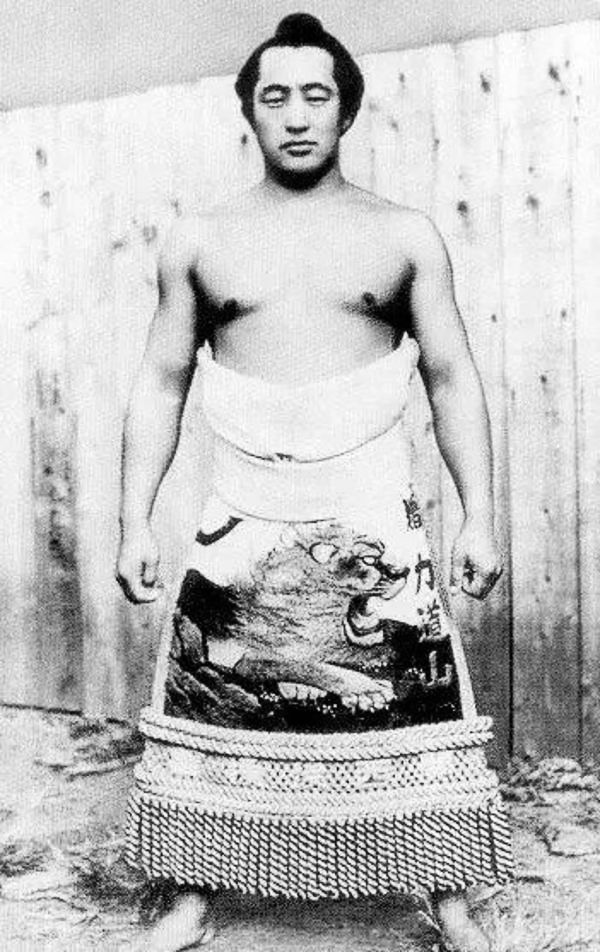
Time was (and to some extent still is) that someone designed attire to make sumo's look good. Sumo's aren't shaped in a way that lends them to be described as 'fashion models', but why can't they be.
In Sumo size is equated with the positive qualities of 'strength' and 'power' ropes, headress etc are all designed to accentuate these positive qualities. I don't hear of Sumo garment makers crossing over into fashion design though. I suppose they are thought of as artisans.
Guys it's easier than girls, because you can interpret any physique into positive attributes, if not presently certainly historically.
When I say fashion is designed by the wrong people, I'm thinking of comic book artists being perhaps a viable alternative...
Wtf? - Take Oh!Great (pen name) author and illustrator of Air Gear. As a writer he borders on one of the worst out there, but his ability as an artist is actually one of the best in the Japanese comic-sphere.
Comic book artists create characters in all different shapes and sizes (if they are good) in order to differentiate their characters and make them distinct. (something a fashion designer I assume is supposed to do).
So they deal with fat characters and still try to dress them so they look cool and intimidating.
For an extreme example. But it isn't just the realm of fiction. What about fashion icons like Biggie Smalls?
Someone at least designs clothes to take what somebody has and emphasise it in its most positive interpretation.
Women unfortunately it's harder. If you are 'plus sized' whatever that is, clothes are designed to in essence apologise for your existence. To utilise diagonal sweeps of fabric or whatever to conceal your stomach and so fourth and so onwards. The positive qualities of different figures seem simply not to exist for women because traditionally women have had a very marginalised function in human history.
If I taught a fashion school I would have my students start out dressing animals, walruses, elephants, cheetahs, antelopes, dogs, cats, horses to teach them to start with the model and dress them. Hopefully they wouldn't interpet this as making clothes from the aforementioned animals.
After a year of that I'd move onto circus freaks, then eventually the average human proportions aka the vitruvians.
Then and only then would I be willing to concede and talk about fashion designers 'creative abilities', again I must employ a lack of charity, but I simply see no achievement in making clothes that look good on a 'good looking' person.
I kind of feel, with the models proportions being so universally agreed upon then all that designing a dress should involve is taking a paper doll model, drawing a tangent to it's nipple then using that line as the basis for your dress. If you want to be avant gaurd, draw two different tangents for each nipple then figure out a way to join them up.
There are a few designers I do understand the methods of and respect. Issey Miyaki comes to mind, for his technological innovation and engineering/architecture approach to clothing.
And that's about it. Otherwise the approach seems to be, make impractical 'concept clothing' that will never be worn on the streets by anyone but can be exhibited by models at a fashion show. Incorporate some small concept into a mass produced line, sell them in department concept stores the world over to convince dull people they can purchase an interesting personality.
But now I'm getting into tomorrow's post...
I guess some kind of conclusion is necessary so I guess I'm falling back on the old systems engineering principle - Garbage In = Garbage Out. If demand is what drives mainstream fashion, and people demand what they 'want', and what they 'want' is based on unrealistic expectations or deflecting their behavioural shortcomings onto the clothing they wear, then that's Garbage In, and as a result Garbage will come out. There are all kinds of desirable qualities, but 'sexy' is to fashion as 'pop' is to music. Sure everyone wants to feel sexy, but there are more flavours out there and each will have their own strengths. Sure I like to feel sexy when looking at somebody I find attractive, but I bet you like to feel powerful when walking through an underpass at night? hmm... there's all kinds of things fashion could do, but doesn't. At least not in the sense that the very word 'fashion' brings to mind.
Thus the process flows: people don't know what they want, so they are the wrong people to make clothes for, there-to-fore the wrong clothes are made for the wrong people perhaps inevitably by the wrong people.
Globalisation is a tricky thing. Because it is impossible to feel the effect of globalisation by standing still. You have to travel (ironically) to feel the full weight of globalisation on this world. That is the feeling that no matter how far afield you travel in the world you are standing still.
To be sure, you can get sushi (nori) hand rolls in Ballarat now, and Thai Green Curries with actual Kafir leaves floating in them and this seems like an increase in consumer choices in sunny Ballarat. Before it was bakeries, and in the budding days of globalisation - McDonald's and KFC. So Ballarat seems to be a more colourful and exciting place thanks to globalisations.
But if some small Australian city in the corner of the world has Thai curries and sushi handrolls, then if you look in the opposite direction say the small Bavarian town of Bamberg and looked at your choices of cuisine you will find: Thai Green Curry and Sushi handrolls!
You see, to the individual standing still the globalisation seems to make the world a more interesting place, but to the individual moving the world has lost its luster in its homogenized state.
Ballarat to Bamberg the world is truly becoming a global village. All we need is for Middle Eastern and African cuisines and soon everywhere will have the cuisine same as everywhere else. (admittedly in Germany you can find the sausage stands which you can't find in Australia...yet).
But what of fashion - you don't see shirts saying 'Paris, London, Tokyo, New York, Bamberg, Ballarat' but that's what globalisation means to fashion. The distribution chanels have changed such that the epicenters are more influential than ever.
When 'A Bathing Ape' founder Nigo started out, he would fly to the US and buy up stock to send home, back in the late 80's early 90's. New York would heavily influence Japanese fashion, but back then it required a 20 hour round trip flight.
Which sounds incredibly fast, but 20 years on the internet has made the process of 'coolhunting' much, much, much faster.
I hate cool hunting, and you know the saying 'by the time you hear about the bandwagon, it's already too late' well if the aim of being cool in its unrefined form is to express yourself as an independant individual, that bandwagon moves at a blistering speed through fibre optic cables to just about any corner of the globe that isn't dfependant on an Australian government to give it bandwidth.
For example, let's stay in Harajuku and look at Fruits magazine.
Why I say 'telling' is that it has 'japanese' and 'english' on it. So the magazine isn't exactly a hard to come by local publication anymore. What started as one guy documenting the handmade fashion of Tokyo youth has ended up as this. And inevitably that lead to Gwen Stefani putting her name on imitations of Japanese kids fashion creations and selling them right back to them. And publications like the sartorialist.
I know there are London spin offs of Fruits, and varying imitations of the Sartorialist, ranging to Copenhagen Chic (which adds bicycles to the voyeurism) and well anyone can find these places interesting.
What is the what? I hate globalisation but anyone (including me) can find these coolhunting, fashion agregators interesting?
What am I saying? If you combined all these pages together, you would have about 200 different styles a year from sartorialist alone, 900 or so from the fruits franchise, and eventually 1200 new choices every year. Only some kind of statistition could filter through all the aggregates and determine the 'style trends' in one monotonous glob right?
Well there's always choices, even when it comes to school uniforms. Long socks or short socks? Socks up vs. Socks down? Shorts in winter? School boy knot or double-windsor? long sleeves vs. short sleeves? top button open or closed? shirt tucked in or not? Traditional buckle or modern? etc.
But as far as I know from marketing about 25% of people in the world think for themselves, another 50% do pretty much what they are told and another 25% don't think about other people at all. (you can pick them by their IT and Engineering attire).
That 50% band is what gets up my nose, and has become increasingly odious as globalisation has spread. Think about it, 10 years ago there would have been 100 coolhunters in New York getting roughly the same amount of business. Now I would guestimate that there would still be 100 (if not 1000) cool hunters in New York, but 1 of them (ie. the sartorialist) would be getting more clientelle (even if they don't pay him anything) than the other 999 combined. His blog proudly proclaimes 'selected as one of Time magazines Top 100 design influencers'.
The way most ladders work particularly in the commercial realm is that no.1 will have 60% of the market share, no.2 will have 30%, no.3 10%, no.4 3% and so on downwards in ever diminishing supplies.
The internet has meant that fashion 'trends' can be preserved and transmitted in greater quantities and higher fidelity than ever before. The result? If you are in Ballarat or Bamberg, it means you are dazzled with the 1200 new choices every year, because back in the day it used to be roughly 4 new choices every year.
But what has been lost is the vast opportunities for mutation.
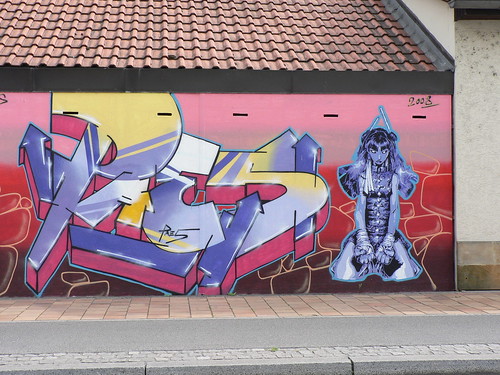
Take for example the following test (no mouseovers):
Q: What city is this in?
Can you honestly answer that question? My guess is - no. You can't.
Only those studying psychology may guess that I was too mentally strained to try and recall another across the world and out of the way city to use as an example so I just googled 'bamberg graffiti' even then I can't say for sure that this picture is in Bamberg. There was no caption.
An architecture major might recognise the roof tiles as germanic...
Anyway, graffiti is one of the most globalised fashions in the world. Whereas in the 80's every city had it's notorious players, the notority of the city stars has shrunk and Banksy's has grown to engulf everyone everywhere.
But it's interesting to pick up the book King's Way documenting Melbourne graffiti between 1983-93. it demonstrates fashions ability to mutate.
Globalisation had started for sure, with the advent of MTV and stuff as our first fashion agregators (or coolhunters) but when you flick through the pages of King's Way, what you won't see is a bunch of Melbourne Graffiti artists dressed in the same exact clothes as the graffiti artists of Brooklyn, but kids that look like they are living in Orbost today. Denim jackets, mullets, freckles etc.
Like a game of chinese whispers the underground culture originating from Brooklyn mutated with every ear and eye it passed through. The expense and sheer effort involved in sourcing clothing and styles from the US made local manufacturers and surf brands preferable and easier to stock.
1200 new styles a year may sound like a lot, but before fashion started globalising, there would have been 1,000,000 new styles a year - you just didn't notice them because you had no portal to see them through.
But I'd take a big bet that back in the 1980's if you took a train (or whatever) from New York to Chicago the teenagers in each city would look different. They would dress different and whatever. The most homogenous items (yet still localised) would probably be sports attire. At any rate, there would have been more distinct styles on just the east coast than there is today where sports attire is probably now the most differentiated attire. I'd be willing to bet I could find a couple of fashion journalists who had done such a thing and would testify to it.
But I'm just taking the principals of 'scalability' from 'The Black Swan' to predict the past (not an easy thing to do) of something I never experienced personally.
But I have experienced culture shock of passing through different country towns of Victoria. The rules for acceptable attire changed more than they do now. Billabong and Quicksilver (and now Roxy) being primarily responsible for the homogenisation of bogan fashion.
Thus in conclusion we are left with a prisoner's dilemma, when you are isolated from world fashion aggregators (coolhunters) you have less choices (say 30) albeit of local mutations of fashion that are actually more unique. When you do use world fashion aggregators you have more choices (say 300 for the average individual) that are in fact carbon copies and not really unique at all.
I see no way to combat globalisation apart from making your own clothes, but then there's nothing to stop the sartorialist or some other coolhunter wandering up and snapping a photo of you and next thing you know you are buying a copy of your clothes off Gwen Stefani. Perhaps the simplest thing to do is just displace yourself linearly in time, and simply read last years Sartorialist post corresponding to todays date... but then again fashion moves in ever tightening cycles (remember the 80's revival in the early 90's).
More tomorrow.
P.S. Incidentally this post was inspired by the ironically stupid 'Secret Melbourne' group on facebook, yet I haven't needed to mention it until the post script which is superfluous to the thesis. I checked it out, although its name pretty much says it all, and its only saving grace is that a constant stream of wall posts make it a very user unfriendly fashion aggregator. Furthermore people's 'secrets' are impossible to evaluate in any objective way. Further to that I assume its going to appeal to a kind of person unlikely to contribute something worth keeping secret, but really with 1,400 fans and counting to scour the CBD for 'cool' spots, they are bound to find everywhere eventually. If you want more mutants and less clones though, dropping this group may be a good place to start.
I thought I'd flesh out this ol' post with some more specific examples.
Now in my lifetime there have been a number of game titles that have dominated the world (like mini-Michael Jordans) every couple of years. But I'd be hard pressed to think of a game bigger than Street Fighter II, for sheer mindshare in the early 90's.
SF2 was everywhere, in every lobby that an arcade machine could be plugged in. Kids would pump $40 in to these machines on a weekday to try and haduken their way through M. Bison, back when $40 could buy you a house AND a family.
I spent my first $1 on 36 seconds of glorious E. Honda hand slapping action. I would stand back and look at the little 'move guide' laquered onto the arcade whilst other kids played, dreaming of my big moment when I would flawlessly pull off the forwards backwards joystick move that would send Honda through the air.
Even now I feel like crying over discovering how dissapointingly bad I was on my first attempt. Mind you I was much younger than the typical smoking, spiritually crushed arcade frequenters of the era.
Arcades have pretty much gone now in Australia, and good fucking riddence really, they were ineffecient, unwelcoming, unfriendly, expensive ways to go blow your whole day.
But before they died, Mortal Combat appeared, and perhaps making a bigger splash - mortal combat 2.
The hypothesis I'm presenting to you is that 'kids' think they want 'realism' because it's somehow more mature, more intelligent and better executed. They will describe something as more 'real' for being graphic, because they don't know what 'real' is and they don't know what they want, aside from looking childish and stupid. This probably isn't a young kids fault, but almost always those superior to them in age, who make them feel stupid for being a kid, which is what they are and don't do their actual intelligence credit.
Another way of putting it is my old chestnut 'crime fiction is what adults read when they are too embarrassed to read fantasy'.
One caveat though - I'm firmly on the Moorcock side of the Moorcock vs. Tolkein debate, beyond the realm of fiction, but to everything. That is to say, I'm not anti-realism, because I think we should watch, read and play things that are pure escapist fantasy rather than about actual ideas, emotions and social situations. I think either medium works for writing stuff that is 'about' something, which Tolkein was vehemently against (although I've heard 'The Lord of The Rings' was an allagory of Tolkeins views on race).
The thing is that MKI and then MKII with it's 'realistic' character designs, fatalities and what not took over, and wiped Street Fighter off the map, except its loyalists. Myself included. I can remember standing for hours jaw open on bourke st, roughly where JB Hifi is now but a huge arcade used to be - watching a guy play as Shang Tsung on what must have been one of the first Mortal Kombat II arcades. (It may have even been MKIII now that I think about it).
The real question is how did something that looks this bad:
overtake something that looks this good:
Now obviously, what looks good and what looks bad is a tad subjective. But SF2 predated MKI by a year. What I mean is the design element of street fighter, the animated sprites look so much better than the posed digitised photos employed by Mortal Kombat.
Street Fighter series stuck with the animated style to this day and it looks beautiful, Mortal Kombat only adopted animated characters when it went 3d (another dud tech trap in video gaming that ruined many a franchise), and even then they were based on the live action precedents set up by MK1, 2 & 3. That is to say the characters where drab and boring.
Going back now, I forgive Street Fighter II's original crappy graphics (they got modified and upgraded several times over the games ultimate lifespan) to the shitty resolutions available at the time, but from concept art right through to finished game you could tell an actual artist had touched each stage of the game design.
Whereas some crappy hack had borrowed some costumes from a shop for Mortal Kombat.
Just to hammer home the argument, this is what MK4 ended up looking like:
The pursuit of the latest technology and realism to win fans (like a 3rd dimension) ruining the game experience.
Whereas Capcom stuck to it's guns and this is what Street Fighter 3 looked like:
It probably didn't even use the best available tech, drain your processor power or anything, they put their effort into design and execution. Great characters, great story, great look...
It equally applies to other fads like adventure games that went from poorly animated VGA sierra adventure games to live action monstrosities like 7th Guest, 11th Hour etc, or 3d world explorers like Myst and Zork. These tech innovations I feel did nothing but expedite the death of adventure games in the face of 3d shooters.
In turn 3d shooters like wolfenstein and Doom rather than taking a more designed base approach to make the games less monotonous, where replaced by the same games with 'better' graphics like Quake, some one about a cult with a zillion weapons including a baseball bat (I think it was Cult of the Wolf or something), and so fourth. I was never a fan of the first person shooter, but could have been if the efforts had gone into level design, game play and making interesting characters, not trying to accurately sculpt the environments and guns to match something you could actually buy in texas.
All in all, it still isn't 'real' in any real sense. Nobody actually solves their problems with guns, or ends a fight by ripping somebodies head off. If Mortal Kombat was 'real' after each fight you would go to court for manslaughter at the least. If Golden Eye was 'real' you would go deaf from operating machineguns without protective gear and get post traumatic stress disorder from shooting living human beings in plentitude.
The feedback continues to come in - this time from a philosopher:
Ok, here's what I got: you sometimes express yourself a little dogmatically. On quite complicated and controversial topics, for instance, you sometimes say stuff like every right-thinking person agrees with you, when in fact the consensus opinion might be quite far off. That isn't to say that you're wrong about these things, just that your way of expressing them doesn't always come with the appropriate level of epistemic humility. That's something I've found annoying in the past.
While we're on epistemic humility: very relatedly, as I recall, you sometimes tell people what their problems are like you are in a special position to know, when there is no obvious reason why that should be. Again, doesn't mean you're wrong, only that you should be a little more cautious coming to such conclusive opinions, and expressing them.
There is definitively a theme emerging I think, and my best course of action short term is to simply shut up, until I can learn how to listen and speak. I think the 'let right be right' is on track but its also great to get feedback because no matter how many times you read it you still learn something every time.
I must remind myself of the words of Mark Twain - "It is better to keep your mouth closed and let people think you are a fool than to open it and remove all doubt." but alas I am a fool, it doesn't seem too productive to be ashamed of it.
I wish I had these feedback people on hand to help me correct the behaviour...
I thought I'd give a progress report of how I'm doing at bettering myself and my self destructive behaviour.
One of the wake-up calls from my feedback was how disenchanting my tendancy to crap on with long winded stories could be. How it gave the impression I was a know all.
In 'What Got You Here Won't Get You There' which I just lent to a friend so I forget the author Marshall's last name, he talks about the counter intuitive observation that if you put two people in a conversation and ask the participants what they thought of the other it typically breaks down as:
1. The participant who said the least, asking questions about the other to keep the conversation going is often thought of as a 'great guy/girl' by the other.
2. The participant who contributed most of the content (dominated) the conversation, is not thought of as nearly so great.
I never thought about this. Nor would I have thought my tendacy to dominate a conversation was offputting, or even a conversation killer.
I had assumed that an 'intelligent' listener would see the sincerity and thoughtfulness in what I believed and appreciate that I was a thoughtful and sincere person.
Besides, there is right and there is wrong. If I have more insight on a topic a provide more value by speaking up right?
I'm not sure if I'm guilty of 'adding too much value' or 'an obsessive need to be "me"' or whatever, but that I just don't impress people by proving how knowledgable I am on everything and everything. Infact more often than not the contrary is true.
Once enlightened my mind cannot become endarkened again. When I think of my 'smart' friends, many of them never talk about their knowledge unless explicitly asked for an opinion yet everybody knows they are smart. I know they are smart, often really really smart. I do get impressed to see their reasoning minds in action and all. But they don't seem to have the compulsive need to weigh in and settle arguments for other people like I do, with a smug 'you're welcome'.
I also mentioned in my excuses post that I have been taught through high-school debating to sound like I know what I'm talking about even when I don't. Which is just plain dangerous.
So following a depressive funk after recieving the feedback, I intellectualised this counter intuitive gem. Basically I asked myself if their were any situations ever where I would need to prove I knew more.
The only context is where I have an organisational responsibility to speak up and stop somebody from making a costly/dangerous/negligent mistake, say trying to pick a clog out of a food shredder. That's the time to risk sounding like a know all - to save somebodies hand and/or business.
Otherwise my new maxim has become - 'let right, be right' I don't need to be right. I don't even know if I am when it comes to forecasting. But something out there is right, and that's how it (anything) is going to play out. Right doesn't need champions to speak up for it in most situations, (following orders from a tyrant may be the exception) it will speak for itself in due course.
Unless you have an explicit responsibility to make your opinion and the information you are basing it on known, you (I) should just shut up. I find it very difficult, especially when people are talking about one of my pet topics like Japanese culture/history, 90's music or comics.
If you will think of it like a movie, a mystery, say you are watching a piece of shit like 'Mystic River' and the director introduces the mute brother of a kid and it seems suspicious and superfluous to your keen intellect and you yell out 'That's it, the mute kid's the murderer!' even if you turn out to be right, is anybody really going to benefit from your keen insight? The movie is going to play out regardless.
Life is like that. If you came out and called the GFC (somewhere between 11-50 economists managed to worldwide) it wouldn't prevent it from happening. It happened precisely because people weren't listening to any rational arguments for the investment products. You may have a responsibility to make that call for your clients who are paying you for the advice, but everyone else isn't asking you for it, and the net result is probably only going to serve yourself.
What you want to do is inform yourself, and that's something I'm still terrible at yet at least conscious of. Seeking information rather than giving it out. Asking questions and trying to see what people know, to give them a chance to impress me. And most do, usually through their kindness and sencerity.
I've also since having this revelation become more sensative to conversation killers. If you needed a conversation killed and turned into a monologue these are the people to hire. My mother's family are the Conversation assassin professionals, which tells me where I got these skills from, and am guilty of myself, but seeing their Xmas lunch in action was an eye opener with my new perspective. Anytime anyone was talking about anything, somebody be it aunt or uncle would interject, often gracelessly with offering some opinion on what was being said, and too often nothing relevant at all.
I've also seen people that just talk incessantly about themselves. I don't think of them as egotistical or self obsessed either, I just think they are probably unaware (like I was) of the effect they have on a conversation. They see somebody listening, they hear somebody talking and no uncomfortable silences. Bingo! A conversation. It doesn't matter that only one participant is talking, incessently, about themselves.
I smile at the thought that the guilty parties (and probably even myself) upon hearing the above example would probably launch into a long one sided monologue beginning with 'I know exactly what your talking about this guy/girl I know...' while I or you nod along mutely, trying to surpress your laughter.
Thus if in doubt, at the moment I'm just shutting up, saying 'yes' 'mhm' and 'I know' I try to ask questions when I'm on my game but listening is a really thought intensive process, and when I do make a statement I can get on a roll and go back to my old habit.
But at least my current job provides plenty of interruptions and escapes for both speaker and listener so that I can kick myself after fucking up and try and think of a question to throw the conversation back onto them and their lives.
It's hard, but I'm working on it. Most days I fuck up. Let's see how i go.
Most people go for financial advice after they have already made the decision that will have the greatest benefit on their wellbeing.
If we adopt a simple principal of investment, that we should concern ourselves with the scarcest resources first - then many fail to look at or evaluate the most precious one.
Many may argue that generally land is the scarcest resource since 'they aren't making any more of it.' But by the same logic, crude oil becomes the scarcest resource because not only are they not making any more of it, people are actively destroying what remains every day. But from a personal standpoint the scarcest resource hasn't yet been touched - time.
Time is unique in that you only have so much of it, and it gets spent whether you make a decision or not. This usually points to things like 'time management' no doubt important, but thats still a bit too advanced a question for this interlude.
The first investment decision is how you are going to spend your time, and most people will get financial advise without touching this question at all. Likely because a 'financial advisor' is not a 'career advisor'.
An argument can be made, for not saving and not investing for later life because we should enjoy our lives while we are fit, healthy and unattached. Not only does this lead to disastrous youth financial management (being up to their eyeballs in debt before their first full time job) but its premis is false.
To assume that the 'old you' will not desire to enjoy life is a big and incorrect assumption. Nobody resigns themselves to 'I'm not at my athletic peak anymore, therefore I will accept the good times are over and lead a life of poverty and misery.'
You will desire International Holidays and beach resorts as much later as you do now. The reverse argument though is also false - the 'defferred happiness' syndrome.
That is where you sacrifice now in order to afford a better tomorrow. Resigning yourself to a miserable 25 year career in order to afford some luxurious orgy of a retirement.
Most people can reject the 'deferred happiness' on an intellectual level because it is uncertain whether through sheer fortune you will survive long enough to enjoy your retirement.
But still many fall into the trap.
Assume 1/3rd of your day is spent sleeping, 1/3 on recreation and 1/3rd at work. 30% of your time portfolio is dedicated to a job.
Do you like that job?
That is the first question of investment. How are you investing your time? While it may seem important to earn money, no amount of money can buy back time. Vast amounts of money may be able to buy some time when you are at your physically least capable but the exchange rate isn't efficient. Still the price of time goes up like anything else when it becomes most scarce.
Nobody would take on a $500,000 mortgage at 20 to buy 13 more days, but you could bet the late Kerry Packer would have.
Furthermore we can assume that 1/3rd recreation time wil be spent with your family. Do you like your family? Is your marriage a happy one? Difficult questions but vital to your day to day quality of life.
Work and family contributes so much to happiness, that its surprising more people don't get career advice before financial. As if 10 years of great retirement are more valuable than 25 years of day to day office life.
Work should contain enough stress to keep you buzzing, enough challange to make it interesting, a social outlet for you, and it should tap your talent reservoir. Getting those things will make such a difference for you now, the cumulative benefit over your career may be more valuable than a vast retirement nest egg.
Furthermore, there's no reason really that you can't have both. Most people just skip right over the first question: 'How are you investing your time?' and go straight to retirement plans. Cutting out a whole stack of obtainable lifestyle goals.
I have a new found respect for parents who live vicariously through their children. Although, this may mean I respect all parents, which certainly isn't how I feel.
You see that parent that says 'little Andre, go on outside and hit 1000 serves before dinner.' or 'Pete, we're going on a drive and you are going to dribble that ball out the window or I'll take your damn arm off!' or 'Michael if you don't hit those high C notes I'm going to punch you in the eye!' are at least trying to break the cycle of banality, if not for the children's sake.
But most parents under the guise of 'wanting it for their childrens sake' vicariously look for a secure life absent of any pitfalls. And I think, certainly the private secondary system has come to reflect the strong market demand for 'all the things we didn't have in life'.
But it's more like an insurance advisor got in the ears of private schools and said 'what we want to do is spread the risk around such that everybody leads average mediocre lives'. Any kid aspiring to a 'dreamer' profession can be resolutely crushed by denying them electives and streamlining them into subjects they would never want to do in a million years like further maths.
In fact vocation type courses is now firmly aligned with kids that are struggling, kids that have nothing else. Except for those kids that do have something else, this something is what I have come to term as 'the fallback fallacy'.
Most true vocations of dreamers are 'scalable' that is if you look at the job market for that vocation the average wage will be somewhere below the poverty line, and those that call themselves 'artists, actresses, actors, musicians, table tennis pros, custom motorcycle builders etc' are more readily identified by society as waiters, call center workers and factory line workers.
But if you look at the top of those professions the best in these professions earn 'obscene' amounts of money.
It's because they are usually globalised professions in limited demand. Thus a few hundred people can fulfill all the studio needs for actors in big budget films for the whole world 1 in 10,000 artists can produce enough art to fill all the offices and museums in 3 cities. You only need 20 AFL players out of all the hopefuls to make up a side. You only need 5 starters for an NBA team. And so on BUT, the value they then generate is immense. These scalable professions are 'winner takes all' professions, and the rest live below the breadline.
This it is high risk, you have say a 90% of never making it, a 9% chance of earning a living and a 1% chance of hitting the jackpot. Thus parents vicariously wanting 'a better life' for their kids will in most cases get anxious at all the 'actor' and 'artist' and 'drummer' talk and try and encourage their kid into becoming a statistician or some shit as 'a fallback'
Now the odds I gave above are meaningless. If say you put 4 years concerted effort into your desired vocation as a teen your odds will be more like 80% chance of never making it, 17% chance of making a living and 3% chance of hitting the jackpot.
If you hadn't guessed it, I'm just making these numbers up. It boils down to 'you have to be in it to win it' or 'you miss 100% of the shots you never take' or other reassuring sporting/lotto cliches. The point being, that sometimes these scalable proffessions are vicious cutthrought dog eat dog, fish eat fish darwinian battle royals... aka actually worth fighting for. But the thing that makes you a minnow in this ocean full of sharks is dedicating time and resources to a 'fallback' career.
The logic is thus - it's hard to be a popstar (allegedly) so just in case you don't make it get a degree in pharmacy, just in case you don't make it you can still enjoy a 'quality of life'.
So young girl slaves away through years 11 & 12 gets into uni studies for 4-5 years blows some money on a gap year or touring round the world and discovers that they are 22 all of a sudden. Most of the chart topping popstars are onto their second album by that stage and they haven't had a singing lesson in 6 years. Good thing you have that fallback career now?
Fallacious, absolutely fallacious. Putting effort into a fallback qualification is in most cases the very act of 'not making it', and what is the fallback career anyway? It isn't something you wanted to do. It's not your first choice in life, it's at best your second, it comes often with huge debts and as is often the case, the only security to be had in this world - the security of failure.
There can be no prize to pursue or claim now that you have fallen back, it isn't your dream to be a pharmacist, engineer, chemist, actuary, lawyer, doctor, whatever... you wanted to act, you wanted to hold a championship trophy aloft, you wanted something that would bring tears to your eyes not through love, not through religion but sheer effort.
Instead you are left with a career, a career that could have waited for your decent and dedicated attempt to make something special of yourself as an artist, singer, writer, acrobat or budding entreprenuer.
And what is a career, Bob C* Cock aka Adam Gates summed up what I call the 'cycle of banality' in a way that spoke to me at the age of 16 so vividly that I remember it today:
Obviously any half-intelligent dimwit would see the folly of pursuing a "quality of life". This very pursuit reduces your life quality to that of a lab monkey. But they wave the golden carrot in your face. When you make this much money THEN life will finally start. THEN you can relax a little, read a book , enjoy a good fuck . When you get that raise, enter that income bracket and swallow without thinking. Perhaps that's all our modern educational system really is, the elimination of the choke reflex.
Now mind you, many of your teachers won't fess up to the intellectual laziness on their parts. That's all part of the game. An obstacle race really. Just get through High School and things will be better. Just get through college and things will improve. Just get that promotion and life will start. Why bother filling kids heads with IDEAS? What good will Camus do a freshman anyway? And that my friends is where the true sickness really lies. They simply cant be bothered to remind themselves (as well as you) of the association of thoughts, ideas, creativity,critical thinking etc. to the "real world". For to do this requires not only hours of hard work, caring and intelligence it demands that they fight the one mind set that most of them have been entrenched in for years and years-
This is what I have struggled through and come to accept, it seems vicious and cruel and whatever to encourage a kid to pursue something that seems almost impossible. ALMOST impossible, but the alternative is really to 'sit this round out' but the round is your life and you only get one shot at it.
Sitting it out, if not as melancholic as Bob Cock describes, involves exactly what most lives amount to - study for the first 21 (to 23) years of your life in the most developed and priveledged nations in the world, then get a job, then get married, (these days buy a house each before you get married) buy as many houses as you can until all your descretionary spending is taken up by mortgage repayments on investment properties. Then have kids. Then flip your properties at (hopefully) a profit so you can afford to send your kids to a private school where they will be faced with the same dilemma. Spend their life pursuing something worthwhile (to them) but ALMOST impossible to obtain, or play it safe and sit this round out?
Propogating the species, your genes and your memes may seem noble. But not if they are just using up resources consuming goods made unsustainably for offspring that within 4 generations will bear almost no genetic or ideaological resemblance to you at all really isn't. If nobody breaks the cycle of banality, what's the point?
Furthermore, in a country like Australia there really is no risk. If you spend your years 18-26 pursuing a stand up comic gig and you never make it and one day you accept that you just don't have the fire in the belly, the eye of the tiger anymore so what? Quit. Go to school, go to uni, it's much easier to get in now than straight out of highschool now you are a mature age student. You will almost certainly be in a better financial position than them. You will be relaxing when your own high school buddies are prematurely ageing from mortgage stress thanks to taking financial advice from the same qualified source that gave them career advice - their parents.
You will outperform the other students I guaruntee it, because you will care about this course. You've had 6 years to think about your decision. They most likely had a matter of weeks to lock in their preferences. Most of them will end up changing career anyway at some point. The most annoying ones drop out. An employer will hire you once you are qualified and then your colleagues will find you more interesting than themselves because you spent 6 YEARS AS A STRUGGLING STAND UP COMIC.
Doing it hard will have taught you something that most people if not born with it, never get - kindness, sympathy and persistence. You will have the precise education a private school fails to deliver - the ability to back yourself, to take risks and live with the consequences. To haul yourself out of deep funks by your own bootstraps. THAT is a fallback career. One where at 35 you don't wake up at night and think 'What could I have been' one that involves no boredom.
Even if your fallback career fails, what of it, back to uni again. Or buy a franchise, make gourmet burgers. Learn woodturning, sell all your assets and set up a business. Whatever. Do anything, just break the cycle.
' Ever tried. Ever failed. No matter. Try again. Fail again. Fail better.' said Samuel Beckett.
Words to live by, any other life is not worth living.
It is why I fear not trying more than failure itself.

 Toyotomi Hideyoshi - first man to unify all Japan's warring states.
 Tokugawa Ieyasu - founder of the Tokugawa Shogunate, one of the most dominant and longest running family dynasties.
 either that or takehiko inoue is a fashion stick in the mud like me.
 image sourced from