Tuesday, May 08, 2012

Thursday, May 03, 2012
Tip of the Icebubble
Wednesday, May 02, 2012
Allow me to slip into something a little more "comfortable"
 image via
 Tuesday, May 01, 2012
Subcultures
A man has an idea, the idea becomes an institution.Subcultures, being cultures involve people are always going to have fuzzy edges and be hard to define. But generally they have this originating idea or rationale and 'epicentres' that can be geographical (The Seattle Grunge scene with Nirvana, Pearl Jam and Soundgarden. The London Punk scene with The Sex Pistols etc.) but beyond the idea you have a swathe of for lack of a better/less/more insulting term 'average' people that subscribe to it, formalise it and make it an institution. The rest is just probability, when you interact with any 'member' of a subculture the odds of them being one of the originators or 'ideas' people is low. The odds of them being some vacuous cliched subscriber is relatively high. And whether inside or outside the subculture talking to a mere subscriber is annoying and will almost certainly result in frustration and resentment. And while the very notion of the 'average' person, or the 'norm' is kind of a fallacy, I may venture to define them so you have a clearer picture of what I'm talking about. The average person is risk averse. This doesn't just apply to gambling, but social situations as well. In any social function drawing attention to yourself carries risk - that you will be judged positively or negatively. By being socially risk averse the average person fears being negatively evaluated far more than they delight in being positively evaluated, so even while people may subscribe to the fantasy of being famous and unique and admired for it, they won't actually risk it. In the same way that almost everyone subscribes to the fantasy of betting their entire net worth on a roulette table and winning, very few people would willingly do this (or even gamble part of their net worth). The average person, as far is as useful to define for this discussion, while feeling a desire for self expression doesn't want to look stupid. Thus on average a person will look for some external reference to copy or imitate when expressing themselves. They will look to somebody they admire and imitate them. People we admire are as undiverse as fashion. They are concentrated, epicentres. A minority. The majority will almost inevitably imitate a minority. The majority of people are opinion seekers, the minority are opinion leaders. I'm not just making this shit up. The research has been done. There are academic, peer reviewed, published papers on this behaviour. With numerous examples. Like acting ability (and by extention talent in general) is often retrospectively applied. In theory an Oscar for Best Actor is the final and ultimate recognition of your acting ability. In practice, once somebody has recieved an Oscar the public will retrospectively apply talent and value to their acting career - ie, taking cues from respected authorities or epicentres. Network Theory I assume would also apply, that very few people/sources generate the opinions held by the majority. Pretty much half if not 75% of marketing research is on where people get their ideas from, it is from my marketing studies that I was first introduced to the 'opinion leaders' and 'opinion seekers' segregation. And I would ask you now to turn your attention to this website/project by dutch photographers/social anthropologists called 'exactitudes'
They call their series Exactitudes: a contraction of exact and attitude. By registering their subjects in an identical framework, with similar poses and a strictly observed dress code, Versluis and Uyttenbroek provide an almost scientific, anthropological record of people’s attempts to distinguish themselves from others by assuming a group identity.I warn you that exactitudes can be confronting, I mean to learn that people dress exactly like you in Rotterdam, Netherlands, it's not even New York, the place you get your cues from. Their rational on the 'about' page tends to suggest that these subcultures sort of spontaneously occur, as a flash mob might appear to. The names applied may not be the generally used ones or even the label identified by their photographic subjects, but if you have photosets of 12 people, I would guesstimate that 12 is probably not enough subjects to contain 1 opinion leader. In summary, any subculture is only genuinely a subculture until it hits the critical mass where the membership is large enough and the identity formal enough that joining the group presents sufficiently low risk of embarrassment. Prior to this critical mass, a subculture looks cool. Post this critical mass, a subculture looks sad and pathetic. Depending on whether you are an opinion leader or an opinion seeker. This sadness may be experienced from inside the subculture and outside. Technology The theory of averageness is one we can all agree on. Subcultures will inevitably get up your nose. The details of which subculture don't matter. Lets get more contentious. Are subcultures getting shitter? If I say 'Hipster' a subculture named after a cut of jeans invented/popularised by Mariah Carey, on average people would probably say 'Yes' to the above question. I am lead to believe they would say this even if they are a hipster. But evolutionarily speaking there's no reason for humans to have gotten somehow 'worse' at expressing themselves. Generations aren't dumber, or less capable of getting dressed. Their drive for self expression and its competing need for group affiliation hasn't changed. We have the same reasons to try and forge our own identity and imitate our peers as any proceeding generation. Why then would I stick my neck out and say: 'Yes, subcultures are getting shitter'? Because of what has evolved. Technology. Specifically the internet and its role in globalisation. The exactitudes site above was forwarded to me by a buddy pal shona after reading my post that I am pretty much going to rehash in this section: Basically though for recent generations the fashion cycle has gotten far more effecient. That is the number of opinion leaders you need to create a critical mass for opinion seekers to form a subculture has shrunk. Basically, the internet has shrunk a lot of things, for one thing, fashions can spread and reproduce with higher fidelity, because a kid in Melbourne can easily look up what a kid in Williamsburg, New York is wearing on line. The local bookstore is now Amazon or Book Depository, the local record store is now Itunes or the Pirate Bay. The process by which Ballarat shoe stores knew to stock Dock Martins when grunge was big remains mysterious to me. But basically it used to take time for the Seattle Grunge scene to make its way out to regional Victoria. No longer. The difference between New York and Melbourne is no longer 3 years, nor even 6 months. It is the 10 day postal time. And if you really care about fashion you can pay for express post. When Cracked.com wrote up Hipsters they mentioned this shrinking time frame between cool and passe:
Hipsters also attempt to stay on the cusp of their perverted version of fashion. Are black framed glasses out? Try 60's horn-rims. Does your friend have his lip pierced? Try cutting yours off. This isn't about beauty or even basic hygiene. This is about looking like you traveled back from the not too distant future. A future populated by douchebags.The not too distant future is probably literally the future the nearer you are to the epicenter of the scene. But if you leave in a country with an inferiority complex like Australia, the future is New York, the 'not too distant Future' - London. My experience of hipsters is probably more stationary than the cracked article. Skinny jeans for example seem to have been in for about 5 years. Ironic facial hair at least 3. But the cycle has sped up, the epicenters of fashion and culture haven't changed, they are still New York, London, Paris, Berlin, Tokyo etc. They have never been, and the chances of are diminishing rapidly, Australian. But it used to take somebody with genuine curiosity about the world and some kind of rare opportunity time and resources to tap into these epicenters, then their attempts to reproduce these exotic cultures would be frustrated by the materials they could obtain to recreate them. Thus a subculture used to take more time to form, and was subject to more mutation. In the 90's the kid with both an internet connection and a credit card was a slim minority. In the 60's you used to have to fly to London to check out the scene. Now any old nobody can tap into any subculture anywhere within approximately a week. The chances that you can buy the exact articles of clothing being worn by somebody on the sartorialist is probably 50/50 at this stage and in 10 years will probably become 1 (that is, certain). Last week or the week before, I caught up with a friend that has done the relatively retro-cool thing of moving to London, in discussing what opportunities London had that Melbourne didn't, whether they were real in practice or just psychically etc. lead to the observation that Melbourne is the kind of town where so little is going on that even if something cool and new does crop up, the time between it being cool and underground and becoming a pretentious 'scene' is perilously short. Conceivably in cities as large as London and New York, there is enough competition in the underground that it isn't really 'the' underground but many, and scenes can remain relatively thin. But regardless, technology enables us to import a scene really quickly and in numbers. The defining (and I guess, negative) trait of hipsters seems to be this hypocritical self consciousness about being cool, for cool's sake. And yet, I can actually relate to this desire to be ahead of the curve and getting frustrated by shit going mainstream. In Ballarat the fashion cycle was both slower and easier to observe. Without knowing the specifics of how it worked, to use a catch all term, the indie kids would go and buy their clothes from op-shops. In 6-12 months, the 'op-shop' finds would have a surf-brand label stitched onto them and be worn by everyone else, whom not only would steal the indie kids identity, but ridicule them for the new identities they had adopted. This I imagine happens to hipsters in the space of about a week, now. And everything has escalated because now instead of buying clothing at 1990's opshop prices ($1~$4) they have to buy them from internet warehouses at $70 plus shipping and handling. And buy them almost constantly. The idea doesn't even get time to enjoy itself before it's an institution. Imitators get frustrated at imitators, because it is hard to get undeserved kudos for imitating somebody when everyone else is imitating the same people at the same time. I was first introduced to Hipsters through Adbusters write up of them in the damningly titled 'Hipster: The Dead End of Western Civilization' They summarise the effect of technology and globalization thusly:
Hipsterdom is the first "counterculture" to be born under the advertising industry's microscope, leaving it open to constant manipulation but also forcing its participants to continually shift their interests and affiliations. Less a subculture, the hipster is a consumer group – using their capital to purchase empty authenticity and rebellion. But the moment a trend, band, sound, style or feeling gains too much exposure, it is suddenly looked upon with disdain. Hipsters cannot afford to maintain any cultural loyalties or affiliations for fear they will lose relevance.In the same way that the transistor radio first brought teenagers into existence, it seems the rise of internet shopping and it's rapid, high fidelity dissemination of culture has frustrated the teenage existance. Talking 'Bout Your Generation My most beguiling theory and least thought about, backed up and documented comes from the depths of my irrational prejudices. Like technology it is an argument that is contentious in saying that subculters are getting somehow shitter. In the 60's you grew your hair long and took drugs to rebell against the social script handed to you by your parents that you find boring and suffocating. But very few individuals were relatively risk seeking enough to do this. 'Get a job you hippy!' presumably suggested that rebelling and growing your hair had significant costs associated with it back in the day. Like you literally couldn't get a job unless you cut your hair. These basic economic pressures probably gave rise to the seeming lifecycle that you rebelled as a teenager and then through university, then it was time to grow up, cut your hair and join the workforce. The risks have gradually reduced, just as the fashion cycle has sped up. Thus if you were a Gen-Xer growing up in the 80's the chances were that your parents hadn't been part of the minority that actually rebelled in the 60's, had probably never tried drugs and thus the tried and tested ways of rebelling were still good for you. The Gen-Xer's grew their hair and took drugs and none of it seemed to passe. But over successive generations, I theorise that the chances of your parents having experienced the forging of their 'self-identity' in the exact same way as people have been doing for 5 decades increased. You saw in the 90's a rise in the number of children whose parents let them smoke weed and try shrooms because they had at their age, and they turned out fine. In short rebelliousness needed to occur in a different way if one was to entertain the fantasy that their life would not somehow resemble their parents. At the same time, the rebellious phase seemed to have become less about not doing what your parents did, as to not doing what the generation directly preceeding you did. You don't care about rebelling against people that were rebels in the 80's, you care about rebelling against people that were rebels in the 00's. Here is where my prejudice comes in. To me the subcultures have gone roughly as follows - Rock, Hippys, Prog, Punk, Geighties, Glam, Grunge, Alternative, Skate Punk, Nu-metal, Emo, Hipster. I know this is very white subcultures and I know it is not exhaustive (for example I don't know where the New Romantics fit in). Generally though you can make an argument for cycles, but that doesn't reveal my prejudices. Let's just look at the end, so after the 80's you saw a rise in bands playing the loosely defined 'alternative rock' that coincided with a recession - in response to 80's rock like Guns & Roses and their ballad singing ways. It was defiant and rebellious in it's responsiveness in ways that I associate with strength (my prejudices) it was harder, louder, less commercially viable, dressed down, less self conscious, masculine, unappologetic etc. It asserted itself. If the generation proceeding you defined itself in a defiant way that I associate with strength, and had it pretty much covered? How do you following it define yourself in a defiant way? In ways I associate with weakness (again my prejudices) narcissism, pretentiousness, quieteness, synthesiser, commercialised, dressed-up, self consciousness, emasculation, irony etc. That's basically my extremely prejudice and unresearched theory. It is far more likely that music and fashion is cyclical. That contrary to rebelling against our parents we probably imitate them. My parents record collection was music largely from the 60's and 70's when nobody played synthesiser. The generation that followed me's parents probably had record collections that consisted of music from the 70's and 80's when everybody was fucking playing synth. Synth's will perhaps dissappear soon as an upcoming generation of children of 90's record collections (where the synth was once again abandoned) gets it's turn. Or perhaps not, since technology and youtube in particular means that the first largest record collection you discover is no longer necessarilly your parents.
Sunday, April 29, 2012
Creative Process
Wednesday, April 25, 2012
It's Over
Tuesday, April 24, 2012
Lest We Offend
A soldier will fight long and hard for a bit of colored ribbon.Which is to say, on remembrence day and Anzac day I get confused as to what the general vibe of what we are remembering and what we are forgetting is supposed to be. Are we glorifying a tragedy? Or are we reflecting on a tragedy in the noble ambition that a population at large won't be fooled again? I am for the latter, but not the former. Furthermore, I have a feeling that wars are by and large rarely decided by soldiers. They are decided by academics in buildings breaking codes, and diplomats in staterooms operating telephones, and other communication exchanges. To say the soldiers, whom are transport for the 'arms' attached to their bodies are the key factor I feel is letting those truly responsible for war, the decision makers off extremely lightly. When Australia entered the Iraq war John Howard asked the public in that unpopular war to direct the flac at him, and lay off the soldiers who were just doing their jobs. And he was right. There are decision makers in war, inevitably somebody is responsible for engaging. Elsewise you simply do not have a state, and that state would have no holiday to celebrate military traditions. The decision makers deserve the lions share of criticism and glory. War can be entered into meaningleslly and voluntarily (such as Iraq and Vietnam) or it can happen to you forcing you into an incredible waste of defending your existence (such as the Pacific War). As Keating said in his remembrence day speech:
Because the Great War was a mad, brutal, awful struggle, distinguished more often than not by military and political incompetence; because the waste of human life was so terrible that some said victory was scarcely discernible from defeat;etc. The speech was ultimately celebratory of how extraordinary an ordinary person can be, and I agree. But I suspect there's a corellation generally speaking between people who inject the most solemnity and respect and importance into a day like ANZAC day and those who would most readily call for another war should even the vaguest opportunity arise (eg a state 'harbouring' terrorists). I find this offensively hypocritical. Another aspect of hypocrisy is in the general way we treat our forebears. I have never intended to be ambiguous about my stance on the direction of indebtedness across generations. Children owe their parents nothing, parents owe their children everything. I shall presumably at some point transfer from being an absolute creditor (to my parents) to an absolute debtor (to my children). This goes on through the generations. I find it thus hard to hold my tongue when a day comes along where I am asked to feel indebted, forget or deliberately overlook all the bad and pay, PAY respect to any person that somehow rises in significance over myself or any other individual. Somewhat serendipitously I've been going through a Josh Freese phase in my music listenings and yesterday worked my way onto listening to the Vandals album entitled 'hitler bad, vandals good'. Hitler was undoubtedly bad, and the most recognisable figure of WW2, a man more celebrated even in his villainy than Winston Churchill, and I suspect to his generation and probably the next three (and possibly counting) to follow a kind of comforting figure. I think to many these military holidays equivocate to a simple world view of 'hitler bad, australia good' and 'hitler bad, england good' and 'hitler bad, USA good' and perhaps even 'hitler bad, modern germany good'. Similar to conspiracy theories, the subconscious desire of the person who purportedly hates the 'big brother' conspirator but in fact seeks the comfort of their existence to reassure them that life is orderly predictable and that somebody is in control, I think there's a subconscious appreciation that Hitler was so bad that all who opposed him are heroes and allows us to look at our past present and future with rose coloured glasses, because in this ultimate acid test we determined once and for all 'hitler bad, we good'. Thus why on this day or any should I pretend that my Grandma and I have a shared meaning of Australia. Today I am supposed to honour the sacrifices made by my forebears in defending this nation to enable us to have the lifestyle we enjoy and tomorrow I can go back to scoffing at her ignorance in opposing Climate Change, Refugee Visas (aka Human fucking Rights) and Same Sex Marriages? On what day do we honour those who marched in the streets to end the Vietnam War and those who marched in the streets to prevent joining the Iraq war? When do we honour those who care about the lives of complete strangers be they soldiers of the same state or civilians of another? On what day do we honour those who hold media to account? Or honour the media that actually holds the decision makers to account? Where in the ANZAC parade do the conscientious objectors march? Those who would rather go to prison than fight an unjust war? When in other words do we start celebrating those who actually do remember and DO learn from the horrors of War? A 'Peace and Goodwill' day that was dedicated to somebody other than Jesus would be a happy holiday that I could fully get behind.
Monday, April 23, 2012
Sunday, April 22, 2012
Better
Saturday, April 21, 2012
Commit
Monday, April 16, 2012
Make Less Decisions
I've been subscribed to the manager-tools newsletter since before I left Honda, which is a pretty long time. It's also been a loooong time since I listened to a manager-tools podcast, but I still read the newsletters from time to time.
A recent one was about how it is good to make less decisions. Here is an excerpt from it, and let me say if you want to be a manager, just don't bother with other shit head to manager-tools.com and actually learn.
One of my themes for this year is 'make less decisions'. Scientists say that every decision you make saps a little bit of energy from your body... The secret, they say, is to make the decisions ahead of time, when you're not in the situation where you have to make the decision. So instead of deciding at 3.55pm whether to have the donut or not, you decide Sunday night 'this week, I'm not eating donuts'. When you get presented with one at 4pm on Thursday, there's no willpower involved, you already made the decision.
In that spirit I'm heading back into an intensive work period where I will need to be really. And I mean REALLY fucken productive. Everything I do I want to be a triumph the likes of which Ceaser would envy, and for the scale of the project I have (semi-unwittingly) taken on, it's going to end up eating my life to get that result.
So here are my decisions I have made for my life for the next two-three months.
1. Short runs only - Speed sessions 800m or 3km, focus on running fast.
2. Practice instead of watching TV or Movies. Practicing is my new 'break'
3. I will produce 10 pictures per day.
4. Only eat when hungry.
Hopefully this can get me into a healthier lifestyle than when I was in late stage exhibit preparation. There I was incredibly productive but alas just stacking on weight and completely absorbed in the task.
This is the plan, allegedly sharing them makes us more likely to stick to them.
Sunday, April 15, 2012
Real People
It is my personal bias to treat people as if they are real people, even when they are trying their hardest to convince me otherwise.
Wednesday, April 11, 2012
Open & Closed
Yesterday I watched this:
I also watched some friends play in their Experimental Jazz band Maka Kahn (in my defence the support act kept referring to them as 'Marcos' band') and it was inspiring and a privelege to see artists operate in the kind of space Cleese was talking about.
And envious, I don't these days have the opportunity, nor the skill to cut-loose with my own art. It was a reminder that I need to resurrect superfluous h.
And with my own self portrait experiments, I have discovered how addicted I am to narrative. It seems I can only mentally handle construction or deconstruction. I am weak at improvisation. I have to confess as great as watching free jazz is, I feel an unease that is almost indescribable in not knowing where a piece of music is heading, when a set will end, what is going on.
Which is of course all part of the art form. In the same way as reading about and deconstructing your own gender conditioning is a dizzying experience.
But overwhelmingingly there is joy. There is joy to be observed. There is joy in improvisation and it was just a stunning example of the 'open' mode Cleese and the research he sights is talking about.
Last week somebuddy called what I do 'a hobby' which is I guess kind of true, and my personal wealth does lie in having so much time to indulge my hobbies. But I also consider them 'work' for the simple reason that I feel work should be challenging and art and to a lesser extent running are one of the few things in life I have ever found to be challenging.
But this talk sheds new light on what is possibly the degrading moniker of 'hobby' for art, music, sport. I guess I don't take much seriously, except play, and I take play very seriously, and thus I probably always come across as in a state of play. I think I'm in open mode almost all the time.
I don't know and can't say if my peers, friends and colleagues would label me as 'most creative' because of my lack of seriousness. I feel to narcissistic to be regarded as not having an inflated sense of self importance. And at the same time I really don't give a shit about myself at all.
But art, music and sport, they are all work. Damn hard work, they just require an intensive amount of time, space and play.
But they are challenging, I'm sure I have skewed perceptions, but in my life I have found what most people regard as 'hard' to be easy, and what other people regard as 'easy' intensely hard.
I possibly need to work harder at my closed mode.
Then again, seeing trained musicians at play, I feel I need to work harder on my open mode too.
Tuesday, April 10, 2012
What Life Should Be Like
Two Parts.
Part One.
Life should be easy to sustain on a labrynthine planet with a population of two, me with my life and somebody else with there's. And we spend our lives playing a game, trying to catch eachother out, trying to destroy eachother, or push eachother to new heights. A game so involving I can't tell if it's destructive or creative because I'm simply having too much fun. Too much fun to notice time going by, or what I'm doing with my life.
Life should be like that.
Part Two.
I enjoy reading my friend Yalei's blog, albeit it is usually much deeper and much wordier than the other 250 art blogs that I subscribe to. This post is in response to her profound post (forgive me Yalei if I am editorialising or misrepresenting) inability to complete the exercise of writing 'What Life Should Be Like'. Which is worth reading, Yalei has a very profound honesty about her creative process and a very generous honesty in posting it on a blog for anybody who is interested to read.
I can’t get over how difficult this question is. It’s really asking you what your ideals are. What your ultimate ideal life is. Why the hell do I find it so hard to answer this question? Once ideals are involved, rationale is 100% obliterated. So why is it hard when I have an open road to idealize away on?
I am fascinated by the differences between Yalei and myself. And for fear of appearing to preside in judgement over her, I am well aware that the only information I have is like you what is in the post. Rather I sit in judgement of myself.
I found the exercise pretty easy to do, in part because it is kind of premeditated, I imagine like most people I have spent a great deal of my cognition trying to imagine what life would be like. I also see an exercise as an exercise, so my response in part one is a 'hyper-efficient' version that I think Yalei really captures how the question captures what your ideals are.
With that aforementioned premeditation, my response reflects ideals that I have been forming over a long time. Thereby with past behaviour the best predictor of future behaviour you could expect my ideals, what I'm searching for unlikely to change.
And yet, I find committing them to paper - or computer pixels or whatever - not much of a committment at all. I just assume I'm free to change my ideals whenever I like. I can reanswer this question, produce as many drafts as I like. I probably wont, because of time constraints.
I mean it's an exercise that allows us to write anything, and ultimately with these exercises I take the view that we only have to produce something. But at the same time, having had the horriffic and debilitating experience of an existential crisis, I know too well first hand the pain of having everyone thinking you can do anything, and how hard it is to figure out the something you should do.
soooooooooooooooooooooooo... I dunno, why Yalei and I are different. But I'm glad we are. It's more enriching out here in blog world.
Monday, April 09, 2012
Three Phase
Easter reminds me of Japan, kind of, I mean it is a stretch.
It's because of chocolate, remember when you were a kid and you went to your friends parties and at the end they gave you a lolly bag to take home that contained lollies? And you played games like the chocolate game and literally had a nervous breakdown as you tried to roll a 6, then scurry into some ridiculous costume, then cut individual blocks of chocolate with a butter knife before the next kid managed to roll a 6? (A game that in hindsight seems needlessly cruel).
These were the days where our parents controlled our chocolate intake, and chocolate had some kind of novelty value. Then remember your uni days when you bought like $16 worth of chocolate, snickers, M&Ms, cadbury blocks and kept them at your desk to prevent you from leaving some godawful assignment? The chocolate lost all flavor made you sick, it became your baseline.
The same is probably true of McDonalds, when I was a kid, mum capitulating and buying us McDonalds was a big deal. A really big fucking deal. (Once my mother diagnosed the onset of appendicitus because I couldn't finish a quarter pounder, needless to say, once my appendix was removed this never happened again).
Yet there have been times in my life where I ate McDonalds so regularly McDonalds became my baseline. It was simply just 'food' to me. No big deal.
This is what Japan is like, I suspect. Most people fetishise the nation, the culture, they are like the kid at the birthday party, or at McDonalds. Unlike growing up where all the easter chocolate feels like a liability rather than a priveledge, our geopolitical sphere is such that there is no obligation to 'grow up' on Japan. With sufficiently limited exposure it can remain the candy store to your inner kid, or it can become 'just another fucken country' with enough exposure.
Or...
yes, I feel Japan has three distinct phases. In my view the most enjoyable phases are 1 and 3, the most painful and hardest to observe is 2. I actually don't have enough experience to know how optional 2 is to get to 3. But here they are.
1. As described, this is the phase where you are an enamoured tourist, with fetishised views of these exotic uber-oriental culture that seems mysterious and magic. You can breeze through Japan marvelling at the retro-futuristic blade-runner-esque efficiency of Japan's technology without understanding how something so dated can still seem so advanced to a western mind (like trains running on time).
You shop in Harajuku blown away by the tribes and the clothing, buy some shit in Akihabara, titter at the titalating pornographic flyers handed out in Roppongi then hop a bullet train down to Kyoto where you marvel and meditate at the stillness of the temples, then try and snap obligatory photos of girl in Kimono's using mobile phones.
Then depending on your age you go to Osaka and get completely fucking hammered and then you fly home. Or if you are too young or too poor to drink, you go home.
Phase one is great, you are just an observer, soaking up the delights Japan's foreigness and uniqueness has to offer, oogling girls legs and skoffing at the Bon Jovi stylings of the effeminate 'cool guys' of Japan. Japan is like candy to you.
You boldly declare 'I could live here!' and...
2. You do, you try it. You try to go deep, to go into the inner workings of Japan. Everyone seems so welcoming, so accomodating, you unpack your bags in your homestay and relish the dinner your hosts take you to on the first night. This is the sun setting on your first phase. Because the dinners don't stop. The tours don't stop. The sightseeing and organised activities don't stop. Months pass by and you are scratching your head as every Japanese person you come into contact with spends an increasing amount of time scratching their heads trying to come up with some planned activity to fill your every waking hour.
You have a few embarrassing incidents where you discover that some friend of your host taking you around for a day takes you to a bunch of stuff you've seen already. You study hard, you start noticing things that you never did before you decided to live there, like entire trees made out of concrete and you ask yourself 'why?' and the young girls in the clothes shop work 11 hour days saying 'irashaimase!' in an annoying tone and folding t-shirts for almost no money.
Very few people your own age can hang out with you. Those you do get to hang out with corner you with poorly spoken english and they refuse to speak in Japanese. Your every attempt to integrate into Japanese daily life, to see Japan through Japanese eyes is rebuffed offhand.
Despite your best efforts and intentions, frustration grows, every time you try to break through to the other side of Japaneseness, and be accepted by this community you love, you just smash your head against a wall.
Even dating a local, you find that you are on the outside, an accessory some how. It is easier for your partner to be rejected as 'really truly japanese' than it is for you to be regarded as one.
Then one day you sit down with those other, sad, loser expats you've been so diligently avoiding and just lay out your frustrations with Japan and the Japanese and thus enter...
3. Which some people seem to get straight away. This may be controversial, but I suspect racism actually helps. Some people I theorise can enjoy Japan but never feel any desire to integrate. But more often, people do.
Here suddenly you accept that you aren't Japanese and simply never will be. The Japan club doesn't want you as a member. As an english teacher sure. As an exotic and handsome/beautiful partner, yes. But as a Japanese. No.
It isn't malicious, just incomprehensible. How can YOU be Japanese? This is a rhetorical question, and despite there being seemingly endless reasonable rebutals (that will only trap you into phase 2) to the Japanese the question has no answer.
Beyond accepting that you are 'gaijin' and it isn't your doing. You hopefully have learned enough if you did/do indeed pass through phase 2, to one day realise, you don't want to be.
Because being Japanese sucks. It isn't the worst thing in the world, and all the charming things that lure us in in the first place are very real. But imagine being judged by your productivity and not your face time at work? Imagine if your boss listened to your ideas and acted on your input? Imagine if you recieved a promotion and were able to manage people older than you? The Japanese more or less cant. The only way you would get promoted ahead of your seniors is if you are the progeny of the company's boss, and it's a family business.
Imagine having two whole days a week off? Imagine eating breakfast with your family on a sunday morning? Imagine taking 2-4 weeks a year holiday and going to a foreign country and seeing things and eating things?
Phase three is where you accept and embrace the secret nation that exists within Japan. The nation of foreigners. The Gaijin, the outsiders. This is where you know enough of japan to not merely be a tourist but to be a highly skilled consumer of Japanese culture. You play the gaijin card when it works to your advantage, yet know how the locals roll when that is in your best interest. And sure there's a few perks of 'being Japanese' that you give up, but they were never obtainable anyway.
I guess phase three is where an adult graduates and learns to self moderate their chocolate and McDonalds intake. Thereby maximising the pleasure and convenience they derive from it.
I have passed from 2 to 3, I spent an embarrassingly long time in phase 2, but I eventually learned. I kind of envy and kind of resent those in phase 1, but Phase 3 is the fucking shit.
Saturday, April 07, 2012
Boredom
The Easter weekend is boring. I know I know I only have myself to blame, but this weekend I've been to an art launch, hosted a dinner party and am going to a Barbarion gig tonight, yet I still find the time to be bored.
It reminds me of the character from Douglas Adam's hitchhikers series, that wound up being immortal. He ended up deciding to insult the universe in Alphabetical order because he had 'too many Sunday afternoons' those painful times where we just have nothing to do.
Good Friday I maintain is the worst public holiday of all the public holidays. While the traditional 4 day weekend of Easter is a chance for working stiffs to get away one last time before winter, I would personally much rather trade it for a day off on Valentines, you know celebrate something other than mourning.
And was the mourning of Christ really necessary? Or just a facade like the encore at a concert. Just as bands I'm sure pretty much expect to do an encore, and the crowds cheering is a mere formality these days, would Jesus have come back if his few fans hadn't been upset but were instead constructively moving on with their lives already?
Tuesday, April 03, 2012
Inference
Probably one of the hardest but most valuable things to come to terms with in life is that 'we are what we do'.
This is obvious from the outside looking in. When your friend has scotch for breakfast and does so alone you are probably going to infer that they have a drinking problem despite what they tell you.
It is easy to call oneself an elite athlete, but if you sit around on your arse eating cheetos all day nobody is going to accept your self diagnosis.
It doesn't seem fair, we have a right to self expression, but not a right to be believed. Others fall back, whether consciously or unconsciously on evaluating our behaviour, because behaviour can be seen.
Think. Who is your manager at work? Seems obvious, but think about their actual authority, who does the team look to, who's ideas go ahead? You may wish to make the distinction between 'manager' and 'leader' one being a formal title and one being a recognition of one's actions (and others responses to it).
Imagine if Mark Zuckerberg rang you up to inform you you were being facebook audited, and had to provide evidence that all 700 of your friends were indeed friends. What evidence do you have?
Just about everybody can't help but see how people behave, behaviour consists of - things we do, words we say and how we say them. Behaviour is seldom random either, this is how in the evolution of our species people have gotten pretty good at evaluating us as people based on our actions.
Everyone's an armchair psychologist, what is surprising is that people are not often wrong. Except when it comes to themselves. I spent most of my life thinking that 'people know you better than you know yourself' but really when it comes to what we are generally in denial about it rings true.
Those who observe us will probably know long before we do that our marriage is loveless or that our indulgence is an addiction. But it is easy for people on the outside to accept the facts because they are spared the emotions and consequences of the revelation.
And as somebody who invited honest direct feedback on my shortcomings, it is fucking hard to take even when you are 'mentally prepared'.
Habit is powerful, that is what makes us so predictable and inference from behaviour so effective for people. But behaviour is a choice.
We always choose how to behave. Mental illness is another matter, because you lose your choice due to chemical imbalances depending on the nature of your problem. But everything else, including addictions we choose to do.
People who actually change are rare, hence the saying 'first impressions last' which always implied that people set their mind about you and also seemed unfair. But the sayings factual basis is probably in us being so reliable and consistent. That we are set in our ways before people even meet us. Thus the first impression is going to in most cases be the same as the last impression.
Thursday, March 29, 2012
Wednesday, March 28, 2012
Fuck Cars
That's basically my stance on infrastructure. If standing for political office, that would be my policy.
Except such a view is democratically unpopular. Thus if I am standing for office at all, it would be on a pile of corpses of anyone who dare oppose me.
Whence my mother, dearest Janice last visited she bought me 'bulky' things that I would struggle to buy for myself since I don't use cars. Please note, there is a 4wd sitting out the front of my house right now, probably with petrol in the tank and paid up registration and insurance that I haven't fucking touched in... I don't even know how long, I can't remember the last time I drove. Probably to drop one of my deserter family members off at some kind of aeroport.
But my mother believes me to be incapable of hauling a bag of dog food home except by combustion engine.
This is one of those misconceptions of physics that plagues city infrastructure planning. Cars are not nearly as necessary or efficient as people believe.
Does anybody remember how big bins used to be? By that I mean the bins your council picks up every week provided you remember to put them out. They used to be much much bigger. But then they got taken away and replaced with smaller bins.
And people were like 'oh my fucking god! How am I going to fit all my garbage in there?' and of course they couldn't so people changed their habits and households started producing less waste. (Or wandering around the block the night before pick up hoping somebody like me, who produces on shopping bag worth of trash a week actually put my bin out so they can fill it up with theirs.)
Well, this is what my 'Fuck Cars' stance on infrastructure is all about. Swanston st in Melbourne is a no drive zone for much of it, and most people would agree that it would both be A) fucking annoying and B) fucking insane for anybody to drive their car down Swanston looking for a park.
All my childhood memories of Melbourne are again, sitting in the back seat of beloved Janice's car looking longingly out the window at the Melbourne Museum, or Bourke St, or perplexingly the Dandenong Market, wondering why it took an hour and a half to drive to Melbourne and another hour and a half of circling a block before we could get out and do anything fun.
And sure, laugh at the hayseeds, but when I do my cycling circuit I get honked or cut off every day by people that perplexingly drive their fucking car into the CBD.
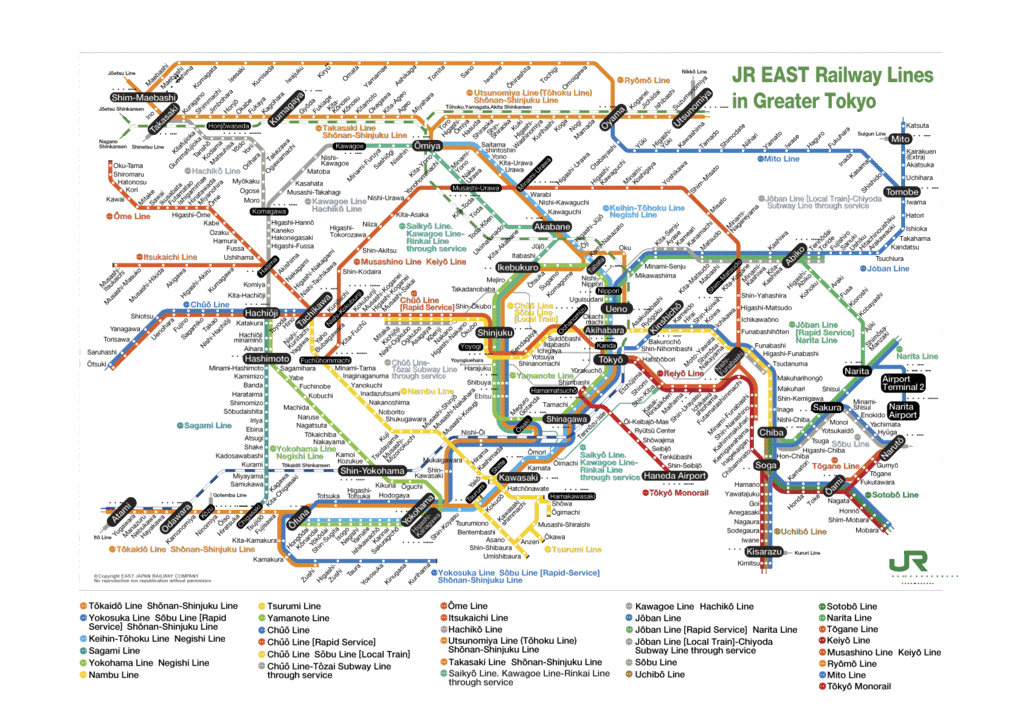
Melbourne's public transport is Shit. The city loop is no Yamamoto Line in Tokyo, but the one thing Melbourne's trains can do is take you in and out of the CBD.
But right now when I ride to town, I like to take the scenic route for the additional calories burned, and the scenery. So I ride along the Yarra River from Kew to Federation square, emerging onto Swanston st, only to find lanes dug up so they can construct 'Copenhagen' style bike paths on the one street where cab ranks aside, cyclists didn't have to compete with cars.
Fuck that shit. If I were mayor, I wouldn't be investing in building fancy bike paths that confuse peds into standing in the middle of them while making phone calls because they can't comprehend a 'road' for 'bikes', I would just close Elizabeth street to cars as well. Then Russell. Then start closing Lonsdale, Latrobe, Collins, King, Flinders etc.
A process known in Europe of 'pedestrianising the CBD' basically, you would take the Melbourne City loop and say 'inside of this loop, you can walk, tram or ride it to where you want to be in the CBD, but you do not drive your car in.
And before you say 'but what about all those shops, how do they get their food deliveries, and merchandise delivered' and the vicious side of me is tempted to say 'well retail is struggling anyway' but I have no problem with trucks and cars delivering goods into the CBD, they do it after hours and have legitimate reasons to be in the city. It's people who drive in during the day I have a problem with, because there is no valid reason to do it.
well there's a few valid reasons - they are as such: if you are a drummer in a band. if you are transporting the rest of the bands gear. if you only have an hour to pick up ramen from a decent CBD ramen shop as per your dying Japanese exchange students last request.
Otherwise, 'convenience' is no excuse to congest, aggravate and polute the CBD. Fuck Cars, people should stop using them all the fucking time.
Doctor vs Psychologist
You go to the doctor, your eyes are caked with mucas, when you manage to part them and look at her, your bloodshot visage dimly reflected in her glasses, she says 'So what is the problem?'
And you respond 'Nothing, I'm fine. This is normal.'
The doctor moves closer 'to me it looks like you have conjunctivitis. Are you sure this is normal?'
'Yeah, yeah, yeah. Really, I'm fine. can we talk about something else?'
The doctor says 'no, I mean conjunctivitis is pretty common, I see it all the time. This is a textbook case. I can write a prescription for you right now?'
'Look, this is pointless. You're not listening to me. I'm fine. Okay, my eyes have a little sleep in them, that's normal. It happens to everybody.'
You leave, a complete waste of your time. Later that day you are squinting at a colleague and they say 'Man I don't feel so good, maybe I should see a doctor.'
You feel like you should help them out. 'Look, I saw a doctor. They're crap, just talked. Complete waste of time and money if you ask me.'
They didn't.
This scenario, I wouldn't be surprised if it hasn't occurred in over 100 years.
Now, you go to a psychologist. She says to you 'what's wrong?'
You feel awkward, anxious and eventually you just start telling her what's been bothering you. You tell them about your lack of energy, lack of sex drive, loss of belief in your work, how you just stay at home watching TV and not eating, and how that just makes you feel worse.
She asks you how long, you tell her you've been feeling this way for 2 months.
She says you are depressed. You ask her what to do about it.
You start an exercise regime and change your diet accordingly. Forcing yourself into social situations. In time your depression gets better, you regularly check up. The psychologist determines that it was a depressive episode, rather than a Major Depressive Disorder.
You stop the sessions, your quality of life improves dramatically.
This scenario too, is rare. I can say with certainty it has happened at least once in the last century though.
But this contrast I feel is the social stigma that drags down the utilisation of psychology and subsequently the quality of life of so many people.
I suspect, for many of those who bitch about psychologists AND they are somebody who has actually employed one, there will be two major reasons 1. It was forced on them (eg. in childhood) and 2. their psychologist WAS a bad one.
On the first point, it's a big help if your sense of 'normal' is actually normal. And this is easier to determine and thus appreciate the services of a psychologist when your anxiety, depression... distress is a deviation from how you feel normally.
You know, a blind person will struggle to imagine the sensation of sight for example if they were blind at birth, but they live in a world where it will be impossible for them not to conclude that their lack of 'sight' whatever that is, is not normal. It is hard for a blind person to deny the reality that most people can see.
But for most ailments people see a doctor for, it is because they have a concept of 'normal' that they describe as 'healthy'. Deviations spur them to treatment. Conversely our psychology, our thought patterns are the single most familiar thing in the world, and to a child, whatever they are is 'normal' so I imagine overcoming denial in a child is a very very hard task.
On the second, for the number of doctors, and bulk billing doctors people get to choose from, the percentage of psychologists are greatly reduced. Largely because fewer people actually use them. If you get a bad doctor, you feel it, and you change it up. People form preferences and judge doctors on their interpersonal skills too, even if they are clinically perfect.
Psychologists are harder to switch between, try out etc. because bulk billing psychologists are rare, and for perplexing reasons, people will spend much more time with a bad psychologist whom depend on building a relationship to actually perform their job, than they would a doctor, based on their interpersonal skills.
IF I could get society to the point where they approach psychologists and psychiatrists like doctors, it would be a much better world for almost everybody to live in.
Monday, March 26, 2012
Newfound Respect for Junkies
For undisclosed reasons, I have been undertaking one of the most unpleasant things I've ever done in my entire life over the past week or so. It is the fucking worst, and yet it falls to me, and only me to do it.
But I only feel like vomiting, heroin withdrawel must be so much worse. For those who have kicked the habit, you are forever my heroes.
Sunday, March 25, 2012
Remarkable
So post Musashi exhibition, I've been in a kind of slump, I finally found a daily drawing project that stuck though and feel I've turned a corner.
So I'm facing a fact though, success has a lot of vaguries. We all know it, except there is little evidence, even anecdotal that what we think of as success exists. That is, the jury is out on the hedonic payload of 'succeeding' and whether the person who desires success, and the person capable of success can retain the same definition of success.
blergh? Put simply, by the time we are in a position to have what we want, typically we seem to want something else.
Which is by no means a fatalistic stance, can't succeed, don't bother. Rather the whole... you know, it's not the destination it's the journey. Certainly my own notch system represents my own degree of success in things I actually value. (by contrast I only blutacced my latest degree to the wall because I wanted to use the cylindrical tube it was posted in for something else.)
I've made no secret of my recent psychology sessions, one of the big things I had to face was that I may possibly be...
...please believe me when I say, my social conditioning makes it incredibly hard and uncomfortable for me to write this, which is by the way one of the major benefits of seeing a psychologist, you can dispense with ettiquette, social conditioning, conventions etc...
remarkable. I still have trouble believing it. I would probably say exceptional. Like, I realise that I am an exception to many rules of 'how a person normally acts.'
I don't like this notion, that I am in someway special. I have spent years refuting it and being offended by it.
Like all through high school, I never considered myself to work hard. I made what to me seem to be a bunch of ordinary observations, namely 1. teachers won't trust self directed learning to deliver the results they need for their own performance review - therefore you will never be assessed on anything they don't cover in class. 2. I referred to 1% of all handouts ever again, so I took to simply throwing them away as soon as a class was done.
These were my secrets to doing well in school, while doing almost no homework and keeping a remarkably tidy locker, folders etc. I simply had nothing to put in them. I just paid attention in class and did the practice exams. I find this strategy both A) highly effective and B) wholly unremarkable.
I have tried to 'sell' my strategy for educational excellence for years, and years and it is always rejected most commonly because people tell me 'but you are different, you are smart.'
Maybe I am, but not in any remarkable way. Not that I feel.
That I think is why I love Musashi Miyamoto's Book of Five Rings so much, why he had to be the subject matter of my first exhibition. If you read his actual 'invincible' sword strategy, it is WHOLLY UNREMARKABLE. He simply and pragmatically employs what works, while stripping back all the pretence.
Thus the outcome of my psychology sessions is that:
YES remarkable people do exist.
HOWEVER, the dividing line between 'remarkable' and 'unremarkable' is in practice amazingly small.
SPECIFICALLY, remarkable people, just actually try to be remarkable. That is it.
It's why I think the best advice on success remains Woody Allen's:
'80% of success is showing up.'
Saturday, March 24, 2012
Met Her For Twix
Let me assure you now, that within almost 100% certainty this post isn't about you, but difficultually is about something I can't write about directly. Unlike Met Her For Ix* which I wrote some time ago and could quite possibly be about you.
Enough with the tauntery! On with the metaphore, which is probably actually a lowely analogy.
Zaman struggles with vowels, so much so that we don't really know if his name is spelt Zaman or Zamin. We both use Zamin, but then the Fitzroy Learning network that introduced us, calls him Zaman. We share a look that we both know as 'we don't know' over the 5 years I have been tutoring him.
He was struggling to spell 'sticky' which seems like an obvious word to use, but to do so just from hearing it - for example Zaman doesn't hear that the 't' comes before the vowel sound, so he will make a mistake spelling like 'sitky'. So in an attempt to teach him the consistent and logical rules of the english language (the trouble with which is that English is a mess, and every single fucking rule throws out exceptions with alarming rapidity) I got him to spell similar words that he is more likely to recognise.
'stop' he spelt 'stap', then 'step' then 'stip' then for good measure tried 'stup' and looked at me bewildered when I told them the vowel was wrong in each case. He had completely forgotten that 'o' is a vowel. Even though it features in the word 'vowel' he just doesn't think of it that way.
Now I could tell him 'you are forgetting o' but why go to the effort of getting him to make the connection between 'stop' and 'stick' (t comes before the vowel in each case and Zamin learns how to spell a common constanant cluster 'st' by hearing it) only to give him the crucial answer to which vowel makes the 'o' sound.
If I don't force him to figure this shit out by himself, he is far less likely to retain the information. He is just more likely to focus on the next opportunity to make a mistake, because he fears mistakes, rather than embracing them as a learning opportunity.
It's hard, it takes time, and I feel bad doing it. But I would do him a disservice otherwise. I think it's why he likes me as a teacher and a friend.
*Some years ago I decided I liked Twix bars so much I developed my own counters that goes 'Ix, Twix, Trix, Quix, Pix, Six - Ixty Ix, Ixty Twix... and so forth. Thus 'Met Her For Ix', is not Met Her For 9 in roman numerals, but in fact Met Her For 1 in my own unpopular, and too obscure to bother using** counting system. But like Superman I or Grease I it is just called 'Met Her For' because I didn't anticipate a sequal.
**unless of course you are me, the patron saint of wasted efforts.
Sunday, March 18, 2012
2 things you could change tomorrow and make education better
1. Homework - get rid of it.
At a vegetarian dinner the other week a girl I argued with most of the evening (true to my vices) had earlier (to arguing) said that schools where supposed to neutralise advantage/disadvantage.
Educational reform is hard, because you are never able to build an education system from scratch, you have to reform what we have already. But if schools are meant to neutralise advantage/disadvantage you would get rid of homework.
I don't so much care about neautralising advantage or disadvantage though, I would say get rid of homework because it encourages the notion that there is always an advantageous tradeoff between resources consumed and performence.
Specifically it sends kids home with the message - the more of your time you give up, the better at school you will do. This implicit contract is made with no real expectation of actual returns on the kids behalf.
We are training kids to be like their moron parents who work 'voluntary overtime' in a hangover from an 80's Japanese fad in the hope that their improved chances of getting improved wages will be such an improvement as to compensate them for the lost family time.
Homework simply says, it's okay to run over budget, to keep drawing from the well, to just do more. More = better. Better is better. More is worse.
2. Get rid of group assessment.
More of a plague of Business degrees and higher education, group assignments are just plain bad.
Firstly because of their gross inefficiency and inequity. They are inefficient because they add a whole bunch of compliance costs to an otherwise regular assignment. Like the time taken to arrange and actually meet.
Secondly they become inequitable naturally. Economics 101 motherfuckers. Say you have 4 students in a group. An A student, two C students and a F student. If we assume that the grading of the assignment works in such a way, and that the students work in such a way, that each's contribution is consistent with the grade obtained. Then everybody get's a C when the labor is devided equitably.
Two in the group are indifferent, and simply pay the compliance costs of having to actually meet for the group assignment. The F student is better off, the A student is worse off.
The A student has no insentive to share the work equitably, thus in order to better their grade (presuming they care about grades for reasons I still don't understand) they need to do as much of the assignment as possible. The only thing they can do is buy off the other students to PREVENT them from contributing. Even if they make a (rookie mistake) token effort to get them to contribute, they end up wasting more time reviewing and compiling the contributions.
Instead what winds up happening is that the highest achieving student takes on the whole assignment (thus I have often said a group assignment is an assignment that is work enough for 5 people, done by 1) and then emails a copy to everyone in the group before the due date to make sure everyone is okay with what is being handed in.
Thus 3 people don't contribute at all, and 1 person contributes everything and EVERYONE is better off. Because they A) all get an A grade and B) save all the compliance costs of weekly meetings, arranging weekly meetings, coordinating tasks, chasing contributions etc.
Group assignments in other words are a complete farce. What does the University gain?
I have speculated and inferred, and my suspicion is that they get to pass a whole bunch of students that would otherwise fail and get disgruntled. Group assignments smooth out the bell curve and lower the failure rate.
Having completed two business degrees at RMIT now, I can tell you I used to cry when a week one lecture revealed that assessment was an individual assignment, and tears of joy when they said it was a test.
Group assignments teach you about the realities of the work place, but they are bad realities, like the pareto distribution of workloads. So fucking get rid of them. There is plenty of time to learn to be a team player when you are in an office, with an actual manager in your team.
Get rid of these two things and you have gone a long way to educational reform.
Wednesday, March 14, 2012
The Future is Futuristic
I have a friend who like me, has a friend. His friend had a thing against advertising, particularly outdoor advertising. He hated ads because he reasonably suspected that if people wanted shit they possess the skills to go out and find it.
Economists too, can't come up with a mathematical justification for advertising. But this was more simple, more basic. He regarded advertising as some kind of offense. Visual pollution if you will, and so would drive his ute up to a billboard get out a roller and simply paint over the ad in flat white paint. If anyone questioned him he would simply tell them he was supposed to be doing it.
The police eventually caught up with him and he did several stints in prison, such was the strength of his conviction.
I don't know how I feel about advertising, I guess some of it is good, mostly passive highly targeted advertising, like the ads in my BMX magazines that relate to BMX. It doesn't necessarily result in me purchasing anything from them, but it raises my awareness of various brands like We The People etc.
I applaud outdoor advertising initiatives like the Chinese governments total ban on it. It's ugly, probably ineffective and more to the point, ugly. Furthermore it is an incursion into the public space.
I read and watched H-Wangs post yesterday and it is interesting you should check it out.
'Thankyou' probably is the future, but this speaker was the first and only thing I've come across since Thomas Friedman's 'the world is flat' that I suspect like the book will catch wildfire amongst business people and amount in the end to nothing.
What I mean by analogy though is that Friedman's book like the keynote speaker seemed to be built up on thorough research and fundamental truths but emphasised the wrong stuff to come to a... I hesitate to use the word's 'wrong conclusion' but I can't think of something else.
For example, Friedman's book talks about the wonders of globalisation, thoroughly like 600-900 pages thoroughly, but he spends only a couple of pages on the shit that must inevitably derail the whole vision of globalisation as a source of good.
This guy, talks about how the key skillsets of success haven't changed in 100 years. (And probably not for most of the history of civilization and commerce) and that I fundamentally agree with. Nothing causes me more chagrin or makes me hate commerce more than it's obsession with modern technology and the constant 'new worlds' we are entering that are yet to produce little if any result.
So I feel compelled to provide a definition of a 'New World' that I feel has specific enough criteria to be validated. Okay being able to buy shit just by thinking about it in the presence of some Wifi device in the future is not a 'new world'.
A new world is when one of the fundamental experiences of being human changes. eg. You don't wake up wondering what it is you are doing with your life and where your life is headed. That is a NEW FUCKING WORLD. And it could be achieved in concievably good or bad ways.
I might write some posts about catching the fake rabbit, but fundamentally wondering how to stay competitive in a changing business environment is nothing new.
In fact even the concept of thanking high value customers isn't new. The keynote speech about 1-1 marketing or customer relations or whatever is I guess new. In that thanks to datamining social media like twitter whereas before thanking high value customers in a personal way required some kind of actual relationship, conversation etc and thus was restricted to Business to Business (B2B), you could employ somebody to find a web customer's twitter account, figure out what athlete they like, go to ebay buy some appropriate sporting memorabilia and send it to the person and they will be blown away.
Today. In three years time when such practice is widespread, they will simply just expect to be thanked. Until eventually big internet shoppers will be treated like IOC or FIFA board members, recieving a constant stream of bribes and gratuities that will not predict whom they will shop with next but most importantly - eat into everybodies bottom line.
And customers follow a Pareto distribution often, which is to say 90% of your sales come from 10% of your customers etc. Certain customers are more profitable than others, so what about the 90% of customers that contribute 10% of your business?
The 60 minute presentation says that Wine-library just gives them a phone call to say thanks. And I agree a business could easily fuck this up by trying to turn a thanks call into a sales pitch. But what if this practice becomes widespread.
I buy some books from Amazon, go over to Dr Jays and buy my attire for the next 6 months, then go to ebay and buy myself a watch. I then get a call from Amazon where a bubbly employee of the 'thankyou' department thanks me for my loyalty and wishes me a nice day. Followed by a bubbly employee from Dr Jay's thankyou department calling me to thank me for placing an order for the spring season, followed by three calls from ebay, the seller and paypal thanking me for bidding successfully, using paypal and shopping with ebay.
Almost everything undergoes inflation, groceries, education and even courtesy.
One of the most mindblowing concepts regarding the internet is that whenever you have an abundance in something (information) it will create a scarcity in whatever that something consumes (attention).
Perhaps I am old school, and again the presenter covered this, but when myspace was seen as a great way to launch your band, it was infact the opposite. Instead of having four people in line to hand a demo tape to the local radio presenter or record exec, suddenly you have a million people in that line. The internet made it harder for your band to break through the noise than it is to win the lottery.
The most successful bands I know at building a following do use the internet. But they also play a fuckload of gigs. Live gigs. At bars, bars that expose them to people.
The notion of 'thankyou' is nothing new, it is infact predicated on the observation that it still costs more to attract a new customer than it does to retain an old one. Look after your customers and your customers will look after you.
The principle would have been taught in business schools from at least the 1960's, maybe even earlier. This speech is about a specific execution, talking about the logistics availed by social media, ebay, secure internet shopping.
Thus I feel a greater service would have been done the audience if it was called 'fuck technology, learn your fundamentals' than 'how to apply tried and tested fundamentals of business in the new world.'
That's what I mean by saying I agree fundamentally, and suspect his predictions and visions of the future will wring true. Many of his observations are totally valid, like the fact that in the past pre-internet and pre-facebook we never would have phoned a friend to say 'mmm mm tacos for dinner om nom' but his notion of 'nobody gives a fuck about privacy' is the underpinning assumption and if you type 'how' into google then within the first 5 autofill search suggestions you'll see 'how do I delete my facebook account' so I think it dubious.
Thankyou departments probably will inevitably come in, the competive advantage value was depreciating the moment the speech was first made. Just like the first company to use telemarketing probably concluded it was the greatest competitive edge they ever had to proactively go after business, until everyone was doing it to the extent that legislature was enacted against it.
And maybe getting sent free shit by companies we buy from will always be welcome, if not paying off for the companies at least we get some free shit. Until ebay customers complain that everything gets bought up by institutional thankyou departments and instead of being able to buy their sporting memoriabilia themselves they had to place a $2000 order for wine and hope the company was reading their twitter feed. Or whether we discover we live in a world where the only way to see Radiohead's concert is to be the customer of some company.
It doesn't even compare to the 'frequent flyer points' competitive advantage, that at least paid off for business. The first company to introduce a frequent flyer points program (United Airlines?) described it as the 'ultimate competitive advantage' when they launched it. Within 24 hours competitors had their own programs up and running. It was instantly immitated.
Which didn't make it folly, by no means. What each program did was errect switching costs for their customers. That is once you had accrued reward points with one airline, you had an incentive to keep accruing with that airline rather than switching to the cheapest one. The switching costs created room for the airlines to raise their prices, and their competitors too.
So really a savy frequent flyer would probably have ended up cash positive by simply buying the cheapest flight available from whichever airline and never accruing frequent flyer points.
Even if it only costs 12c to call a customer and thank them, and abbundance of grattitude will inevitably create a scarcity of good will. I'm not saying it doesn't work and won't happen, just that in the end customers will wind up indifferent. It is why such a practice of thanking people probably dissappeared from practice - it became an unappreciated and insincere formality, so people probably just stopped doing it.
The speakers key advantage and insight I feel is not the specific execution of a thankyou department, or even the humanising of brands (that too isn't new) but his recognition of when people say they wont do something that they inevitably will do. (eg. people who said they would never get a mobile phone that wind up with one. people who said they'd never use facebook but do.) If he truly has a knack for it, then he gets the advantage of being an early mover.
I'm not sure though that this skill can be taught. It equates to 'buy low, sell high' investment advice, that for over a hundred years the bulk of humanity has proved itself, time and time again, to be incapable of doing. His advice may be 'recognise the next big thing while its still small, then get on board before it becomes big.'
There might still be time for me to set up a 'grattitude registry' website, where people cut out twitter and just list things they want companies they do business with to buy them to say thanks for buying shit for them. Then you can avoid double ups and ambiguities and false guesses and people getting freaked out by an audience they didn't intend datamining them and sending them shit.
But I'm too lazy and don't need the money.
Subscribe to:
Posts (Atom)