Tuesday, March 10, 2009

Skeptic to The End

On the Eve of the Apocalypse where warheads are flung around the world at neighbouring states in a spiteful act of stupidity and the world is destroyed 83 times over by the US stockpile alone, imagine two men sitting on a hilltop watching as wave after wave of radiation saturates their bodies as atomic mushrooms spring up into the sky making any prospect of a future life impossible.

"Hey Terry" one of them smirks "The world has been destroyed in a wall of fire, just as revelations predicted. I guess the bible was right after all. Bet you regret being an athiest right now!"

The other saddened by events says "No Dave, you see even with so many deaths we still haven't seen any evidence of the afterlife. This is simply a tragedy, and you are no more sure of your souls existence than you were yesterday, and onwards back through time. You still have to comprehend the horror of 'what if I'm wrong, what if there is no god' where I can look back and contemplate the life I've had."

And the two sit in silence as their retinas burn away and their skin burns off and their insides boil and melt, into the abyss.

Sunday, March 08, 2009

The Core and Fear

I didn't get my final figures for last weak up along with many things I neglected on friday but I did:

ending weight 79.6kg (no difference)
running: 33km (1 x 10km, 1 x 20km, 1 x 3km)
sprints: 0
cycling: 150km

All in all a pretty light on week. The only new thing was I started 'strengthening my core' which is all about injury prevention. My right knee for reasons unkown tends to take all the cornering impact in my running and I must have a muscle imbalance.
It gets sore but not seriously so. Infact it stops getting sore the more I exercise it. At any rate knees are not good things to have on your mind. I don't want to spend the rest of my life hoping around on a gimpy leg.

So I started working out my core stability muscles, glutes, abs, obliques and back. I hate doing crunches and shit, so doing the running exercises like 'superman' and 'bridge' and the dreaded 'metronome', 'plank' and 'side plank' are less painful for me because it isn't strength building exercise just stability building.

That said they aren't pleasant and I've been tardy. But I have done two full sets of the exercises and will endeavor to do at least 3 sets per week. So from here on out I'll record my core sets.

The second aspect is the relationship with fear. This is probably the thing that running has been most instructive in above and beyond any other activity I've engaged in.

Going to state meets like I did back in highschool, you competed with a very different field of athletes to school. In my own school I was the fastest for anything over 3km and generally knew the level of competition and was comfortable with all the expectations.

Lining up at a meet with strangers though made me feel sick, every minute that ticked away before the race started was met with incrementally increasing dread. Much like getting injections, you end up just wanting it to be over.

If it was possible to run a cross country course with your eyes closed, state level meets might have actually been as pleasant as getting an injection.

Intimidated I would hang back rather than engage in shouldering my way into a good starting position. I just wanted to see the rest of the field take off and find a comfortable space to run within.

This strategy allows you to observe the runner getting pushed into the mud on the start line and trampled by two or three sets of spike shoes once the gun goes.

I never wanted to risk that in order to be competitive. Back then I was a poontang.

Reading Vagabond the other day though, I found a particular quote quite profound 'fear and strength are not necessarily contradictory'

From that I know that understanding fear is a key part of strategy. It is how we differentiate winning from losing. Engaging in an activity that contains no fear is rather pointless. Like jogging my way to victory in school competition. It was only when runners like Ben and Tim pushed me that I really pushed myself.

So too fear of injury means you can adjust your training to become stronger, rather than blindly pushing on and ending it all prematurely. So really the 800m is as legitimate a pursuit of knowledge as any other.

I shall extrapolate this lesson out into all aspects of life.

After the Launch

After the launch party, I was walking to the train station and I felt something, something new. And I can only describe it as 'incredibly small' I never would have guessed that that's what I would have felt looking forward from the past.
I will endeavor to feel it someday again.

On the train home I sat in my corner on a small seat and listened to Ugly Duckling, and laughed like some creep to myself.

Wednesday, March 04, 2009

Stylistic Aspirations: Frank Miller (sort of)

I don't know how the bastard did it, but in a career generally characterised by some of the shittiest comic book writing ever.

Frank Miller is 'the beatles' of comics. I remember reading an interview with Les Clapool (apparantly conducted within ear shot of Larry 'Ler' Lalonde) where the interviewer asked Les who his influences were and Ler turned around and said 'dude, just say the beatles' then Les talked about the beatles for 10 minutes and how the were unavoidable as an influence.

So too do I recall listening to an english radio station in Japan and the hosts introduced this new Bri'ish band whose name I can't remember but they listed their influences as 'Pink Floyd, Lead Zeppelin, Black Sabbath, Radio Head etc... but NOT the Beatles' then they played a track and afterwards the hosts said 'sounds like the Beatles' and it was true.

Most of the Beatles tracks are candy pop that seemed hardcore back when you had Chuck Berry and Elvis as just about the only rock and rollers on the planet (Frank Sinatra was considered hard-core and schoolgirls got wet over him back then) but these days it's been done and doesn't need doing again, but was done again by the Monkees and then Oasis.

All that said amongst all the candy-pop theirs offerings like 'Helter Skelter' the first Heavy Metal track or at least the precurser to all Metal, and then theirs subject matter of Maxwell Silver's Hammer, Bungalow Bill and even 'Octopus's Garden' I've heard refers to fingering a girls pussy. Great concepts executed as pop tracks that the Spice Girls could cover.

So too is Frank Miller, 300 is incredibly idealistic and poorly written, Ronin is one of the worst comics ever written, Sin City is a big ball of cliche, The Dark Knight Returns again is poorly written, The Dark Knight Strikes Again is all over the place, and Allstar Batman and Robin is considered some of the most attrocious writing ever to grace the comic book world. There are even competitions where scans have been made of Jim Lee's Allstar Batman & Robin artwork to see if you can write a better dialogue/story than Frank Miller.

But amongst all this Batman: Year One is one of the seminal defining works in comic book history. As Sale says all Batman writers owe the grim-dark-loner image to Miller. He reinterpreted the pipe smoking Billionaire playboy into traumatised kid dressing up as a bat because he can't deal with his grief.

This more than anything else characterises Miller as a writer, he has brilliant, revolutionary ideas that can provide quantum leap developments to staid and tired characters like Batman and yet... he just can't seem to execute them.

Really from the earliest I have cringed at how bad the dialogue is. If you want a demonstration go see Sin City. Every single fucking character talks in a gravelly noir voice that you almost think 'what terrible direction, all these characters are one dimensional, who made that bonehead decision' and then go read the Sin City comics and you realise that 'Frank Miller made that decision' because that's exactly how every character is written.

So too with Batman: Year One, and even more so in Dark Knight Returns and Dark Knight Strikes Again. All the shouting in 300 is exactly how its written, and Alan Moore does a hilarious stab at Frank Miller's Daredevil.

So to me, like the band I heard in Japan I would never set out to create something 'milleresque' but would be almost happy if I did. He does do some things well, even if dialogue isn't his forte and his real quantum leap for any character is just to take an existing one and make them dark and gritty, or in the case of Allstar Batman take a dark and gritty character and make them darker and even grittier.

Here is what one can take from Frank Miller and be proud of:

1. Pacing
2. Composition

1. As Alan Moore says in his 'Writing for Comics'

A fast action scene, maybe a fight scene, would very possibly work better if it moved as fast as possible. Compare some of Frank Miller's silent fight scenes - which move very fast, flowing from image to image with the speed of a real life conflict, unimpeded by the reader having to stop to read a lot of accompanying text- and the fight scenes of lesser writers where any sense of movement in the scene is undercut by the antagonists mouthing huge chunks of dialogue at one another.


Which is true and correct, Frank Miller is often noted for the fact that you can read one of his comic books in ten minutes. He will use four pages to demonstrate someone busting down a door and goes lavishly on the visuals.

None of which is a bad thing, after all the whole advantage of comic books is that it is a visual medium.

I happen to think for action sequences and pacing Takehiko Inoue's work in Vagabond probably makes Miller almost entirely redundant. Except that Miller doesn't have long philosophical flashbacks in the midst of fight sequences, where Vagabond does this all the time.

That said Vagabond is all about the inherant interest of conflict, so it kind of makes sense, but man was Dragonball Z painfully drawn out in this regard. Before any punch was ever thrown you had to spend a week watching whatever spectators of any match give their lengthy contemplations of power levels until the reader dropped dead from starvation and the fight scene never occured.

So yes, Miller is a very good example for pacing and visual storytelling from the western perspective if you want to avoid Japanese cliche.

2. Miller isn't a great drawer, he uses fine lines to draw chunky images and then a lot of play between light and dark. You can see how he is influential on Tim Sale in this regard.
That said it is actually a lot like me thus far, my lack of drawing ability being apparant my style is recognisable whereas someone who has mastered the art of 'How To Draw Manga' for example has no style of their own and their work will be generally unrecognisable. Much like I wouldn't be able to tell Eichiro Ooda's work on One Piece from whatshisface's work on Naruto just by looking at pictures of characters.

Although kids consider manga exciting and probably superior in drawing style to the western comic world, it is objectively speaking, really boring and staid. So Frank Miller's compositions are quite painterly without the style, Sin City probably captures this element more than any other.

Scenes like Marv with his women in the first Sin City novel and all the textures being cut from black and white are incredibly good. And then reversing the image so you just see these lips floating on a matt black face.

By restraining himself and embracing his limitations he pushes further than other artists of the era. Much like the Beatles restrained themselves with Ringo Star.

Overall I'd prefer to draw like Frank Miller than like Jim Lee, Todd McFarlane or any of the really busy artists.

Remember the Internet?

I was searching for references sake for Perry Farel's 'Letters to Xiola' last week and it turns out that google's top result for this poem would be exactly the page I found back in 1998 when searching for a transcript on the antique that is Yahoo!

And I felt nostalgic. Because (I'm aware I'm being hypocritical) but I just think that all the leaps and bounds the internet has made, although I would never refute how good they appear to be on paper are just plain shit.

User generated content is overhyped. Infact Tim Sale in his book black and white summed up my feelings exactly in describing the 'black and white' comic explosion of the 80's (arguably the exact trend that has made it to Melbourne now in the form of zines).

"It was a lot like punk rock, you suddenly had this broadly accepted notion that everyone had a right to say what they wanted. But just because you have the right to say something doesn't mean you have anything worthwhile to say"

And there too I am being hypocritical. While I have never uploaded anything to Youtube, I have drawn my own comic and I do generate blog posts as a 'user'

But my main objection is how carried away we all get with new possibilities. I don't know what it is called, but I can think of numerous examples. Like in the late 90's reign of terror known as 'New Metal' every kid wanted a 7-string Ibanez or a 5-string bass. But the contradiction was that people hadn't actually mustered up any talent on the oh-so-seemingly-pedestrian 6-string guitars, or 4-string basses. Which mind you Korn and Limp Bizkit never managed to actually generate any significant contribution to the guitar, when compared to someone like Tom Morello who blew the 6-string wide open with his new style of play.

Or the desire for a carbon fibre road bike, when you can't currently push your aluminium or steel framed one to 30km (a barely competitive race pace). Or wearing a hugo boss suit to a job interview for KPMG when you have no professional work experience whatsoever.

It's basically the mismatch between desiring the most powerful tools at the most amatuer level.

It's something we all feel. And perhaps the name is impatience. Funnily enough what is left behind is often what we deem 'art' those antiquated methods that get picked up and refined and perfected into something actually new, actually impressive, actually inspirational.

Instead of watching some fat guy in a leotard achieve world wide fame for posting his impersonation of Beyonce's 'All the Single Ladies' which is really quite crap, is there anyone out their compiling a book of what people managed to do with html script?

I had a resume in HTML, or at least that was how it appeared to Bryce when I sent it to him, he commented that you should be suspicious of anyone that uses HTML anymore. I believe it was some finugled version of html that my brother programmed for me while it was cutting edge. It did all the formatting for you no sweat no matter how much you fucked around with the contents.

A few years on and I think that although that resume was probably the very definition of uncool at the time, how much I like the retro aesthetic now of all the geocities pages that first populated the internet. Impossible to navigate, and the quality of information was totally unreliable.

Even though rationally I know there is far more content on the internet now than 10 years ago, it used to feel like a much bigger much less comprehensible world, thanks largely no doubt to lack of common standards, good search engines, and talent on part of the public.

But basically I dub this the retronet! and it was a refreshing deviation from searching for something and having wikipedia come up as the first search result.

Furthermore I was talking to my brother and he said all his old school friends that used to post on a outlook message board on 'The Wheel of Time' series aparantly still all have geocities style personal webpages.

Last thought on the retronet, the general tastelessness of MySpace pages, and the shitty content therein demonstrate that our means on the internet clearly extends beyond the grasp of a population that generally has nothing worthwhile to say.

myself included.

Monday, March 02, 2009

Stylistic Aspirations: M.C. Escher

One cannot love geometry and art without loving MCE, Perhaps it is simply impossible for one to not love Escher.

Whilst I could postulate that the intrinsic mathematical principles in his works resonate with all of us on a universal level, he has this to say on reality:

As far as I know, there is no proof whatever of the existence of an objective reality apart from our senses, and I do not see why we should accept the outside world as such solely by virtue of our senses.


Which is the kind of sentiment that is adopted by players of 'Deal or No Deal' when they spend $43,000 for a 1/5 to actually do better than it.

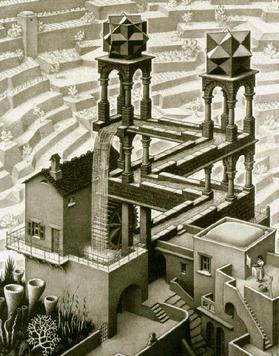
That said Escher often covered theme's like recursion as below:


And other perpetual energy machines that are also under laws of physics impossible:


But rather than explore mathematical principles and impossibilities through architecture, tessellation and metamorphoses, I have to say I am a big fan of his line work and composition.

Much like Alan Moore, Escher is a man who takes the full potential of his medium, being the 2d image and with a little thought exploits it.

What I like most in his architectural work and optical illusions is his use of vanishing points and creating 3d perspectives. Which in turn allow him to build structures that could never be built in a 3d medium. Or at least if they were to be built in a 3d medium would only be viewable from one given perspective (the perspective that escher gives the image).

I have seen a model constructed of Escher's 'ascending and descending' and whilst from the correct perspective looked as though someone had built his impossible staircase, from others it looked like the sydney opera house as the dimensions of each step were required to become ever more distorted.

What really though allows Escher's 2d images to trump the 3d medium is that he can place people on his structures that are not distorted such that your minds eye must construct the building as impossibly as it appears, to have staircase that climb onto their lowest step and waterfalls that feed themselves.

For me that's the ultimate in any medium, to find a message that could not be communicated in another medium.

I also though really like Escher's early wood cut prints, particularly the landscape reflected in puddles ones. Escher I have a particular soft spot for because he did the majority of work in black and white. Much like my studio art folio in year 11, where my visual diaries contained black and white sketch after sketch after sketch until I settled on my triptych design, whence then it was pointed out to me that I intended to paint them in colour and hadn't done any exploration of colour.

To me colour is a given, if I'm going to do them at all. I only really struggle with the flesh tones, and otherwise, it is much much easier to translate colour from mind to page than it is to translate form from mind to page.

And again Escher uses straight lines to great effect, particularly in the woodblock prints. Alas I work with pens and pencils, and have only dabbled with lino=print. Wood block for reasons I don't understand in both eschers work and the Traditional Japanese prints seem to give the most defined lines in visual art. Perhaps because there is only one roll of the brush to the entire piece.

Alas, avast and so on, perhaps Escher is also the hardest to stylistically emulate. He is down officially as a Graphic Designer, suggesting that technique is the word to use more than style, and whilst I love the straight line, I hate using rulers. I work in jagged compositions not measured compositions.

Techniques such as vanishing points and perspective I feel is a matter of practice, that whence 10,000 hours or whatever Malcolm Gladwell thinks the magic number is I would be an accomplished imitator not someone who had developed their own style. I could then go on to illustrate development proposals for strip malls in what used to be neighbourhoods with character and culture like my beloved Brunswick.

Oh well, if I had the mind to concieve of tessalations and perpetual motion machines I would have done so by now.

Sunday, March 01, 2009

Stylistic Aspirations: Skan Srisuwan Fiduciose

Whilst it is easy to say 'the internet has opened up many exciting possibilities for artists' it's hard to point at an actual example. It seems we are all still obsessed with the renaissance masters -> pop art. Whilst living in the 'post art' era.
Advertisers are treated like artists. Along with graphic designers, marketers and architects.
It's also true to say the reverse. Indeed, it seems that art has also been living the capitalist dream. Abstract painting could be described as 'office wall paper' a reflection of the nature of business today, communicate no information that could make you in anyway liable for anything. No opinions, no meaning. Hollow missives and what not.

But alas I rant on, on cgtalk which I check about as often as NBA.com which is to say, more than email, gmail or facebook combined, I stumbled across an artist who's popularity amongst the forums at first confused me, and then proceeded to blow me away.

I don't know his name as such, or more acurately, what his real name is and what is an avatar name on the forums, so I'll simply refer to him as fiduciose, which is the name of his website.

First some examples of his work. Most of which can be found on his website www.fiduciose.net and will only use the ones he has already shared on cgtalk and hope he doesn't mind. If he does, I'll pull them down.

link via cgtalk

I have to say that as a lover of straight lines and geometry in composition, this is truly exciting. The cutaway element too, of solid, inanimate objects falling, flowing away. For me the business in his imagery and preservation of form and more particularly motion makes his compositions something I really want to sink my teeth into moving forward probably more than any other artist.

Even better for me was the WIP thread of the latest cgtalk challange.

The revealing element was the composition drawing:
link via cgtalk.

How someone can build up form from these abstract lines was beyond me. I certainly can't think like that. I always start with a finished image in my head, then block out the geometry first, then draw up the detail. The overall result I'm afraid is often static. Compared to his final image:

link via cgtalk

Which to me is probably his most inspiring work. I particularly like the way that it's a picture I can look at for 45 straight minutes and still not know what I'm looking for. Yet the composition still sends my eyes around I suspect in the way the artist always intended them to study the picture.

They almost put Inoue Takehiko's brilliant work in Vagabond to shame. I still completely feel the sensation of a lance shattering an opponent, even though I can't percieve it in the painting anywhere.

That to me is the holy grail of the static image.

Furthermore, even his 'master and servant' offering seems to use a different approach, it is not lost to me the significance of building curves out of straight lines, streams out of jigsaw puzzle pieces.

I don't think I'd ever try either approach directly, I lack the imagination to arrange so many moving parts into one picture, and the technique to build up so many layers in either photoshop or more intimidatingly, on a page, but I am inspired to perhaps use some 3d software to compose intersecting plane compositions that I can then ink looser forms on top of.

So really it might be cheaters imitation, but I do keep in mind with all inspiration that the world doesn't need more imitation to advance, it needs people to find their own style and offer it up to the world. So any artists I try to take away from, it's more I set out for their end destination but take my own path.

The other half is that in the spirit of supporting new emerging artists, I promise as soon as I have both the money and subject matter, Skan Srisuwan would be an artist I would definitely commission. I just hope he manages to stay in a reachable price range while I get there.

Saturday, February 28, 2009

Thursday, February 26, 2009

Circle Work & Weighting Games 800M

This week I have covered:

Sprinting: 6 x 100 m
Cycling: 275 km (only twix big rides though)
Running: 20 km
End Weight: 79.6 kg.

For some reason I had stuff to do in town everyday this week so although overall I didn't put in the real burn out sessions like last week I still managed to rack up the ks. I doubt most of these would be helpfull.

Cycling is useful mental preparation, I have one tactic - attack. That's it. If I'm on a long straight flat, I attack. If I see someone on the horizon, I attack. If I'm climbing a steep hill, I attack. If I'm riding downhill with a tale wind, this is new, I attack. If I hit a hairpin turn, I attack.

Really that's all I can think of. But running a sprint round a bend (be it 200m, 400m or 800m) It's the same story I can only attack. There is simply nothing else to do. Somewhere in the process though, you slack off, so the key is to constantly look for things to attack, or be going fast enough that the time between launching an attack on a corner and an attack on a straight is minimal.

Now to address the 'Circle Work' aspect of the title, what I mean is I have started to do the hardest part of any training regime. That is to stop being nice to my mind. There are things you can do that are nice to your mind, like easing into a training regime, starting small, perhaps jogging 500m then racing 500m then jogging again and calling it a day.

If I ran a business like I run my training regime, I would employ more cunts than any company alive. I've never pushed myself as far as Ben Cousins say, who runs until he vomits, then keeps running. But I'm trying to come close.

So this week the big jump has been in my running, and I never thought I'd say it, but cycling is simply too effecient. It takes far too long to hit the wall and start burning fat. Running on the other hand is traumatic on almost every human system.

So one of the big runs for me was a circuit around the cemetary, park down the junction then jogging up the hill by Xavier home. It's about 4km, and I called myself a cunt and threatened to kill me, and 'you can do better than this cunt' and 'I don't care if you vomit you fucking pussy-fucked cunt' about 80 times.

It was the big run of the week. I have done nothing but endurance running really for the past 5 years. It's been a long time since I did race pace mid-distance. My aim is to step this circuit up into a 2 x 4km lap ending on the hill each way. I can think of no better prep than a 10:1 ratio of endurance running for the 800m. Furthermore having to sprint home uphill (for approx 400m-500m) should make tactic 2 - race the first lap andf make the second 400 a game of who slows down least, one in the bag for me.

So yesterday I was just trying to get one lap under my belt. Above my belt was dinner, the runner friendly dinner of silverside with potatoes. So vomiting conditions were good. Running after dinner is also an excellent way to trick your body out and have you kick your metabolism up. Running along I had to get my legs lifting, increased stride length and constant reminder to attack (thanks cycling) because for the past 5 years it has been all about easing into my pace for the long hall, not pushing myself.

So it was a traumatic run to say the least. I attacked the home stretch as if I had 50-100 meters to go not 400-500m and as the incline hit, it was more like hitting the wall, which I thought I had done earlier on the less inclined hill on the backside of the cemetary. But I simply forced myself to plod on uphill. Uphill is actualy what I excel at on the bicycle, but as I learned the hard way this didn't translate well into running.

But I got to the top without stopping and even broke into a cantar towards the last set of traffic lights, were I slowed abruptly and this was over.

That was the mentally challanging single circuit. The other challange with endurance races is the bizarre paradox of destination vs circuit running. Running from say the city to home, is easiest even if it's 12km because you have to get there anyway, and the faster you do it, the less time you spend doing it. Consistency pays off, and when you reach the halfway mark you think 'Woohoo, I'm on the home stretch now' or 'It's all downhill from here' (which is literally the opposite of what is true if you live where I do).

If you run a single circuit of say 6km the same thing applies. Back in the rat though you'd look at the lake and think, if only it were efficient enough to just swim across half way, duck out from behind the bushes and hit the finish line, because it is also the start line. That's about the only annoying thing, you head out and head back in. Some literally post the halfway point as a hairpin turn, some flagpole or course marker you have to slow right down to turn around, or face having your arsehole ripped off by centrafugal force.

But worse than a 6km circuit is having to run 2 x 3km circuit. It's just mentally much harder. Just so running 10 laps of an athletics track is much harder than running a 4km circuit. The boring monotony of anything as straightforward as a track makes you want to call it quits early. The pain of 2 laps of an actual cross country cirquit means that when you hit the halfway line you don't think 'Woohoo - halfway' you think 'I have to go through all that shit again! fuck!' even though before the halfway mark all you thought was 'everything I do here, I have to do one more time, this hill that is killing me now, NOW on the FIRST lap, I have to do it again' etc.

So the circle work is going to be a big part. I need to be able to run a hard 400m then do that AGAIN only harder. It is what I call the 'attack, attack, attack, attack, attack!, attack!, attack!!, attack!!!' strategy I am yet to put a patent on.

The other thing is my physical concentration. I need to change the composition of my body to max out my power:weight ratio. Only propelling, driving and stability muscles are welcome, any other non-essential compounds are not welcome in my body. (except my awesome hair).

So in this age of purchasable lifestyles, I went shopping!

Here is the breakdown - I am 176cm tall. I need to look at bodies and figure out the ratio 'playing weight I need to be'

First stop, Usain Bolt 196cm, 86kg


He has 20cm more to pack on a meagre extra 6kg. And none of that I'm guessing is fat either. For me to get in h:w proportion with Usain Bolt I would need to weigh -

(176/196)*86 = 77kg (of muscle and bone)

I believe below 73kg my BMI goes all unhealthy, so this seems good to me. 77kg is technically overweight but with nothing but some protein pistons for my heart to worry about I don't care.
But let us not forget, I'm strictly utilitarian in my body image. I don't want to get thin to look hot, I want the most versatile and dominant body I can get.
For that I need to look at Shawn Kemp,

Shawn Kemp 208cm, 104kg (in his heyday)


Now Kemp was a meat-cake. Phil Jackson described him as 'power forward extraordinair' before his bulls rolled him in the Championships. But this was the guy that posted up to the NBA's all time best season team with 72 wins in the regular season, and along with Gary 'The Glove' Payton pushed them to 6 games.

That's the sort of physique I need, one that doesn't run from Jordan's unstop-a-bulls. But fights it. Usain Bolt is all very well, but the 800m isn't an event I want to run from. It is one I want to attack and kill, and give myself the best chance of beating it, even if it remains favored by the bookies.

Kemp is about as much of an 800m runner as Usain Bolt is. Plus I like to play basketball.

So the maths is...

(176/208)*104 = 88 kg.

yikes, that means not only would I have to dip down to 73kg to shake the fat off my bacon, I would then probably have to do nothing but drink protein and hit the gym until I had gained 15kg of lean muscle. This seems impossible, as much as I would enjoy walls of solid meat to protect me from the 800m apocalyptic fall out.

Are any other NBA players in my league?

Chris Paul 183, 79.4 kg (he already weighs less than me.)

I would have to weigh (176/183)*79.4 = 76.4

I could achieve that next week! Except that Chris Paul is ripped, I am merely a lump of fat on some meaty legs. So again I'd have to go back down to 73kg then build up 3kg of muscles.

Kobe Bryant 198cm, 93 kg

Kobe has the same appeal as Shawn Kemp, but in a different way. He will face down Lebron James, the younger, bigger NBA star and shoot right through his defence. That's humiliating for Lebron, and it is humiliation I seek to exact upon the 800m.
So let's do the maths.

(176/198)*93 = 82.66 kg

Hmm, almost ten kg's of fast muscles I need to gain in the core and arms. Is it doable? not by me. But this perhaps shall be the benchmark. If it's too hard, I'll go Chris Paul/Usain Bolt. If it proves to be easy, I might gun for Kemp! Something tells me though, the absence of Kemp like physique in the NBA before or since he played (and even before he stopped playing, he ended at 127kg) that Kemps don't come around too often.

Stylistic Aspirations: Alan Moore

Even though there are plenty of artists I'd like to talk about, I feel I won't get any further than making constant allusions and comparisons to Alan Moore if I don't cover him extensively today.

Alan Moore is the De Niro of the comic book world, a method man, his dedication to the art form in the first half of his career is unmatched and forced everyone else to lift their game. Often immitated never duplicated Alan Moore is the real deal comic book writer.

I have to say though, that as in yesterday's approach I must agree with Tim Sale and say for my personal viewpoint reading an Alan Moore book is often taxing, sometimes tedious and rewards close attention. His books are unflippable. You would never flick through an Alan Moore book and be captivated by what you see there.

So it's kind of amazing he got discovered.

I think my favorite work of his is probably his short run on Miricleman as writer. You could tell way back then that it was something special. Furthermore it was a comic about comic books, ALan Moore is a deconstructionist, and the best thing you could ever read about that comic book icon 'Superman' can all be found in the pages of Alan Moore's Miracleman.

As such I am a big fan of Alan Moore's approach if not his execution, watchmen for example fits Mark Twain's description of a classic to me 'Something everyone wants to have read but nobody wants to read' I'm glad I read it but I didn't enjoy it the first time, and frankly still can't see why it is elevated so high above his other works. It also has a bit of an emperors new clothes feeling about it, I don't know what it is about even though I've read it and had a couple of years to ponder it. It seems brilliant but I couldn't tell you why.

Perhaps it is the host of unlikeable or dull characters that are clustered around Rourjake and Veidt, they are very human, very real and it is easy to empathise with them, but if I wanted that I'd read 'Beloved' or 'The Memory Keepers Daughter'.
And I just naturally hate ensemble cast stories with 8 or so main characters.

That might qualify what I mean by being a bigger fan of his appraoch than his execution.

There is one quality shared by everyone I like in this world and absent in everyone I dislike or don't have time for, and that is: they think.

Alan Moore thinks about the medium. Perhaps the biggest influence for me is his insistence on not deriving comic book writing from a cinematic mindset. Claiming if you think about comics like you think about movies, they will always suffer from the comparison.

But its what you can do with a comic that you can neither do with a book or a movie that makes it a legitimate format in its own right. For example, in a movie you might drop heaps of complicated clues throughout the course of a film that all coalesce in a climactic convolution of complication but the viewer doesn't have the option to flick back a couple of frames, minutes or hours to see those clues and appreciate what happened. You either have to do a montage of flashbacks to remind the viewer, or hope that they have the concentration of Mach 3 fighter pilots and can piece it together for themselves.

You can also change the size of the image to emphasize certain points, and cram heaps of little panels in tight silent sequences to convey action sequences.

The artist can do perfect juxtapositions and so fourth.

Anyway really step one of the approach is to think about the medium, then you proceed to come up with the idea.

The idea is simply to insert a motive into writing a comic. Alan Moore's greatest critique of the comic book industry by far I feel is that too many storylines are simply obsessed with conflict. Sale when talking about Bob Kane, and whoever created Superman that they literally thought no more than 'Hey how cool would it be to be a billionaire that fights crime at night, and how cool would it be to be bullet proof and fly and shoot lasers out your eyes!' and the early comics were no more thought provoking than this. New mythology without any real moral guidance or message behind it.

As such the idea is what you want to communicate through the metaphore of the story, so he gives examples of 'The Curse' which was a story about a woman who becomes a werewolf every full moon staying in a log cabin in the woods in Swamp Thing. A story inspired by the idea of womens menstrual cycle.

SImilarly his famous Superman book, where Superman is fantasizing about being home safe on Krypton having never come to earth, but in reality is the victim of a mind bending parasite plant sent from Moghul, was more obviously the idea of how the homes we dream of and feel nostalgia for are in reality not the great places we make them out to be. In the end Superman fights with his father and rejects the imposed reality to return to the real one. Poigniant, and actually moves the superman character forward in time, where most comic book writers move comic books backwards.

Part of the idea is also the audience, and probably the biggest thing I took from his essay on writing comics into fowp was thinking about the audience in terms of feelings. Safely pre-release of fowp I feel I can talk about the influence without knowing how it works. But basically he points out that the industry goes to extensive lengths to create an 'average reader' much like the legal system creates a 'reasonable person' neither of which can be found in one place. Then the typical approach sets about not offending, upsetting or turning off the average reader.

A long legacy of this is the resurrection of killed off popular characters and do-overs that populate any long running series like Batman, Superman, Wonder Woman, Green Lantern, Green Arrow, Spiderman, Iron Man, Fantastic Four, Daredevil, Flash and every other western comic book ever. Even Spawn resurrected 'the clown' after boldly killing him off after the first couple of years.

But Alan Moore throws shit to the wall that sticks, and he does it on the assumption that if you (the writer) find something funny then chances are someone else will too, and that's how jokes manage to exist and spread. SO too if you find something emotional then chances are someone else will too. These feelings have a deep sead in evolution that allow society to function, so instead of tiptoeing around peoples sensibilities you have to go after them.

In fowp for example I knew when I wrote the guide to the last four pages that they moved me. The test though is if what preceeds it manages to set people up right for the same feelings and if my artwork is good enough to translate the writing onto the page.

In that Moore leaves nothing to chance, as Sale says he can do half page descriptions for one panel, which is a lot. I do things like 'we see people running away from the beach, guards running towards it.' and leave the rest of the composition up to me as the artist.

Not a fair comparison, to my knowledge Moore has never illustrated one of his own comics, so presumably I as artist am thinking what I'm thinking as a writer. Except you never know when things need juggling around or just don't fit on a page or how to twist the composition because it turns out flatter than you thought.

The next thing I take away from Moore, is the real 'method acting' component of it, which is the research phase, the setting. Once you've thought about the idea and it's audience you can slip any metaphore over the top of it, I inject at this stage a preference for the most disarming metaphore. For example if I wanted to teach kids about the phallacy of materialism I would pick a metaphore that had real appeal to kids, like a Naruto style Ninja School or some shit.

But you go further, and just churn out a detailed pile of notes about the government, culture, fashion, economy, trade relations, history, social issues, sciences, etc. Until you have a makeshift encyclopedia on your world.

I did this for fowp, even though the 48 hour window in which the story takes place allows you really only to see 1% of it. I have it all written down and didn't bother to write in any info-dumps, that is a character that explains the whole world to you early on 'Your father, the king' etc. It is enough for me to know it is there if the story ever demands it to make sense.

In other words, I would have made the movie of dune (a whole lot differently for one thing) without the introduction that explains in some detail an overview of the Dune universes politics and economy. That is really poor writng, and did not appear so blatently and unapologetically in the book.

In business and the military obviously you do the opposite, you put the bottom line up front, cut to the chase etc. You don't waste peoples time.

That's what really impresses me in Moore's run on 'Swamp Thing' and 'Miracle Man' he takes the encyclopedic imposition of the characters continuity as it pre exists, and deconstructs it into a new compelling idea. Swamp things autopsy by the florionic man was mind blowing. As was 'A dream of flying' that kicked of Miracle Man. Miracle Man is still sloppy, he pushes forward too fast in unveiling Kid Miracle as the villain. But that was early days, in later writing he attempted less and pulled off more.

I think that's what I dislike about Nolan in his Batman movies, he cherry picks the profound messages executed masterfully by Miller and Moore and inserts them into the movies in the most obtuse and artless way.

Example, Miller in Batman: Year One, had Batman crashing his car and botching his crime fighting all over the place. He had him running in with the cops and really created for the first time the batman character that wasn't a playboy billionaire but a man trapped as a grieving boy, that put on a mask to become himself.

In Batman Begins, Nolan believed it was a good idea to have the spiderman-esque love interest played by Katy Holmes reach up and touch Christian Bale's face and say 'I thought I'd wait till you take off your mask, but this is your mask Bruce' dumbing down something you really had to feel from Batman Year One, The Dark Knight Returns and so fourth.

SO too in the Dark Knight, the depiction of the Joker, Alan Moore revolutionised the character and the relationship between Joker and Batman in 'The Killing Joke' which retold the Jokers origin and also culminated in Batman and the Joker laughing at eachother over a joke about two madmen escaping from an asylum. This as far as I'm aware was the first introduction of the notion that Batman is as insane as the Joker and two needed eachother to keep playing their games.

It wasn't said but you picked up the subtext. It was really classy. Joker also quite depressingly says 'Sometimes I remember it one way, other times another' revealing the very memories that drive his identity shift on him. This was a get-out-of-jail free card to excuse the multiple origin stories around Joker and the multitude of ways the character is written.

In 'The Dark Knight' Nolan just has Joker deliver quite artless running commentaries lecture style to almost every character he comes across to make the same two points. I'm sorry Heath, but I would have given that Oscar to Fiennes for 'In Bruges'.

But that is what is ultimately so rewarding about Moore's writing, furthermore unlike someone like Jordan, Claypool or Clapton/Hendrix, it's easy to spot how Moore could be better, just use less words.

Oft times Moore doesn't sit back and let the visuals tell the story. His descriptions often more detailed than the pictures themselves. Someone like Loeb let's the setting be the complete domain of the artist, but then uses thought bubbles to tell most of the story.

I thus far have avoided using thought commentary as much as possible and completely let the visuals describe the setting.

AT the same time, I couldn't handle any really complex ideas, like Superman vs Society, or What makes someone human? or Anarchy like Moore does in Miracle Man, Swamp Thing and V for Vendetta respectively. I'm building up to it. But I know ultimately I will have to increase the word count to do it, and the amount of literary devices.

I think once you know the medium, the idea and the setting you have the big 3 down and it's really hard to make writing really hard from there. He goes on through Characters and then Layout and so fourth.

I followed his process pretty methodically, but mixed it up when it came to doing the writing. He does an afterword to his original essay on how to write for comics where he says once you've done it, you need to throw that away and be completely new. A good example of Moore doing this is his 'From Hell' work which is brilliant because its a historical essay converted into a comic book, it seems to be a stand alone story rather than being about anything other than its direct subject matter.

Unfortunately after League of Extraordinary Gentlemen, most of Moore's stuff is like De Niro's later acting career, flawlessly executed roles that offer very little. Tom Strong, Albion etc.

I hope he goes back to his own 'garage days' and picks up his old methodology to write something, because he is ultimately the best at it.

As for me, I was already abandoning the methodology in fowp, there were a lot of times things just worked out and I never made a conscious decision nor planned them that way. The pieces all just fit and I hope all my future writing goes that way. Somehow I doubt it.

As a stylistic aspiration my next major work I'm doing the prep for now, I'm still following Moore's process (but jumping back and fourth making constant adjustments) to me the feeling is still more important than the thinking though.

Writing is in many ways has the best ease of doing/enjoyment ratio. Drawing can be highly enjoyable and rewarding, but it just isn't easy to do. It's slow going and takes a lot out of me mentally. You'd think if you find drawing fun, then you would find all drawing fun. But it isn't across the board. I hate backgrounds and landscapes, and only really lose myself in a drawing if it is creating a dynamic character. Creating a generic character is perhaps the most thought intensive of all. Like having to describe someone you didn't notice down the street.

Whereas I enjoy writing an essay style economic diatribe, screenplay, comic and fantasy novel. It's easy to sit in front of a computer and just type. Comics are probably the hardest of them though because you have to be imaginitive whilst writing in a very contrived and unimaginitive style. Eg. We see the prince approach the begger. We see the prince proferring a diamond necklace above the poor beggar girls head. We see the necklace dangling around her neck, a hint of cleavage and some dirt marks across her chest from her unwashed neck.

That too Alan Moore is also the only person I have come across who has written an essay on writing that is any where near comprehensive, so it's really quite impossible to not have him as an influence. Vs. Frank Miller of whom I have no idea how he writes anything. (nor do I have any real desire to emulate his writing)

Wednesday, February 25, 2009

Stylistic Aspirations: Tim Sale

I'm currently reading the Tim Sale Art Compendium/Working life biography "Black + White" that perhaps with some finugeling I can persuade Harvard to some kind of prisoner swap program, although in my view I am palestine giving up one military trained commando for 30 or so scraggly Palestine kidnappees.

In no way however would I suggest that Tim Sale is superior to yesterday's Inoue Takehiko, infact hands down Takehiko is probably the more versatile, prolific and thoughtful of the two.

But Tim Sale probably has to be the bestest most nutritious comic book artist in the west. And reading his take, I draw a lot of paralal's in my limited experience to the key lessons he has picked up in a lifetime of the industry.

First of all, I like the way he thinks. For a while I walked around saying (to those who knew or cared) "Frank Miller's the master of cliche, Jeph Loeb is the real deal" and Sale's most celebrated work are his parings as storyteller with Loeb. You may recognize that 'The Long Halloween' was one of the major basis for 'The Dark Knight'.

But you see you can do a control test and look at Sale's work without Loeb, and Loeb's work without Sale. 'Hush' is inferior it feels like a bit of a romp through a funpark, 'Batman Superman' is borderline terrible, like Men are from mars, women are from Venus, you just need to read the title to know it is going to be an exercise in contrast.

BM: Superman's so light, I hate it.

SM: Batman's so dark, I feel sorry for him.

Ad nauseum. But Sale's work on Grendel, Amazon, Deathblow etc. remains as good, at the very least in terms of visual storytelling.

Of particular inspiration to me is that his characters are actually different. More so than Takehiko's you see a sale picture you know exactly who drew it. Where most artists are striving to imitate manga characters, big eyed females and androgenous boys, really tight lines and attention to detail etc. Tim Sale uses free flowing lines to create people that you could break into pieces and still recognize.

The hands he draws are meaty, the men barrell chested, the girls like retro pin-ups and WWII noseplane art. They are curvy, sensuous and womanly, not girlish.

His take on Batman is for me as I like it, he views Batman & Bruce as these 8 year old kids that have never grown up, never let go of the past. He also draws Batman as physically menacing.

Perhaps some of the best indicators though are in his critiques of other comic book notables:

'Todd is very fussy with a lot of his lines -- Todd has too much shit going on for my taste. I never had any problem with how big the panels were, except the stories weren't interesting... I never had any interest in Spawn or any of the Image books. For me there's got be a story there, and if the story you're telling is not very good, your technique makes no difference.' - On Todd MacFarlane.

'By the time Miller was writing for Mazzuchelli on Born Again, he had it down. And it was still early enough in his career that he wasn't hermetically sealed yet. He really knew how to manipulate a page, how to manipulate twenty pages. But he didn't really know how to end the series -- the supersoldier storyline was just horrific, I think; Miller's last fifteen minutes of fame.' - On Frank Miller.

'If you pick up V for Vendetta and flip through it, you might just put it right down. I did that with Gibbons on Watchmen. I picked it up and thought, too many words, too many panels, there's nothing here that grabs my attention, and I just put it down. Eventually people said to me, "What are you an idiot? Just READ it!" and I did, and I realized it was a book that rewarded close attention.' - On Alan Moore, Lloyd and Gibbons (sort of).

I find these criticisms revealing. For example if I had to pick one reason I'd take Takehiko Inoue over Alan Moore, it would be the word count. There hasn't been a single Alan Moore comic I ever read that was 'un-put downable' I had to get 2/3 of the way through Watchmen before I even found it interesting.

Likewise Frank Miller is a good artist in terms of composition even if I'm not a big fan of his linework, and I'm most familiar with his Sin City stuff, which I feel excels really in the use of negative space. That's something Sale takes away from Miller but he is right to call Miller's storytelling abilities into question, I find Sin City to just be almost a study of 80's LA and have no other real idea behind it, as Alan Moore would say 'a presumption that conflict is inherently interesting' and that 300 is arguably one of the worst stories ever told. It actually was so poor I read 'Persian Fire' to get the Persian Angle on the whole thing, and that was an academic history book.

Just so with Todd MacFarlane, I don't know about the line work, but he like Frank Miller suffers from an inability to really think about the idea behind a story. They end up being pure plot, no message. There's a few flashes of brilliance in the whole Spawn arc, but it is ultimately a forgetable story, convoluted and craptacular.

But what Sale likes I like, for example his nightmare are all the 'detail' scenes, heaps of machinary, gadgets, leaves blowing, busy streetscapes etc. I can't stand these. In drawing FOWP there are about 4 pages in succession where it's in a hall that is supposed to be full of people and panic ensues... those 4 pages took so much out of me, I did 2 per day, and still had to come back and back again, and back again in the inking phase before I was happy with them. Even then one of them is my 'least happy' page in the entire story.

For me though, Sale is all about two things -

1. The use of light and dark.

2. Anatomy.

The use of light and dark, you really need to see a 2-tone picture of his to appreciate how much he has his pencils and ink down.

link via timsale1.com

He could almost be working in wood-block or lino-print. He can convey such a sense of depth from a binary composition style. He talks about using charcoal and a shammy cloth and an eraser to do his white lines, instead of working in white on black paper. It's a pretty impressive way to get good at the 'cut-out' feel.

He will also use large flat black spaces to give his backgrounds real menace. He talks about Toth as an influence on his style by saying 'Toth would just make it all silhouttes and call it a day' which is precicely what I did any time I had over 5 people in a frame I needed to draw.

I always shift around my perspective to make a scene look as packed as possible whilst minimising the amount of drawing I had to do. My favorite was to do one panel that portrays a bunch of characters huddled round, then break up the rest of the panels into close ups on the mouth, so you knew who was talking without having to show any of the interpersonal interaction.

Anything to save effort.

Let's move onto the 2.

Anatomy, Tim Sale's Catwoman is my favorite depiction of the character bar-none. It's also the most interesting the character has been. His batman I've already stated is a huge meataxe of a guy, but probably most telling is his Superman. As he descirbes it 'fat doofus?' or 'the thumb with hair?'

My strong point I feel is faces, and sadly only when they are front on. I really struggle rotating the head of a character around. Fortunately I made it easy for myself in the most part with fowp, the one character for whom it would be difficult was the only character I did practice for.

But anyway, Tim Sale does the real, face floating on a circle surrounded by a drawing of a head. There isn't the line work that connects them all, that really only comes in with shading and inking. His anatomy is all outlines, which rather than making it easy, I find makes it harder.

Consider, if you took a 3d illustrating program and constructed a praying mantice model, all you would have to do to turn it around is click and drag your mouse, the proportions will be preserved and the outline silhouette will translate perfectly.

If you draw your anatomy from outlines, leaving yourself with a 2d shape, rotating it becomes immensely difficult because you need to keep in your head a picture of the ever changing outline. It is easier when you do a realistic anatomy, and like Inoue put down all the anatomy, then clothes, then facial expressions. These pencil skeleton + muscle geometric sketches are the only way I find to survive.

But this means I can't use exageration much for my anatomy. I found the character of Udonis in fowp, who is meant to be a towering beefcake really hard. His height changed relative to all the other characters in every successive panel. In the end as an amatuer I had to be happy with him conveying that in principle Udonis is 'tall' and 'big' and leave it at that.

Yet Sale uses these creative anatomies so well and so consistently with characters like Batman, Superman and Hulk. Their physics have no basis in reality, the are herculean monsters. But nobody does it better. Nor conveys such emotions.

And then of course, there are the women. He does literally use anatomy like the old school pin ups. The legs are too long in proportion to their bodies, the women are impossibly curvy, their lips are like something out of a 20's film. They pull off glamour and simplicity and all of it. You wouldn't describe them as fanboy like Miller's nor I think like most other artists currently - self conscious.


Catwoman being a perfect example, she's nobody's pet but Sale doesn't have to go to extreme lengths to make her a self conscious 'Independant Woman' like Charlie's Angels or some shit. The simultaneous femme fatal and feminist comes through. A reconciled sexuality & social consciousness.

Not to suggest that Sale isn't some kind of pervert. I just efforts to make Mary Jane more than the trophy bride she is really forced. You can leave it at 'she earns more money than Peter, but her work is no where near as meaningful and rewarding' and do a great thoughtful piece without having to force superflous brains, insight and intellect in a character that chose to model as a profession.

As I said the way forward for me is in working more with lighting and shading. Tim Sale uses the curved line, which is probably the biggest sticking point in imitating his style. Back in highschool I prefferred making these really angry, unstable pictures by drawing curves out of heaps of straight lines piled on top of one another. I definitely see ways I can take from both Sale's Negative Space techniques and silhouettes and incorporate them immediately into my work.

Having gone through a complete drawing and inking process I now feel I can sit back on the pencils and say - that just needs shading, I can fill it in photoshop or do it with the inks.

I also want to adopt more of his style into Anatomy. Having written my own script I wouldn't part with more then three panels to a page, because I think you lose the ability to really pace something out, put in pauses or high contrast. Some of the extremely busy pages Alan Moore uses are some of my favorites with him. But yes 3 panels to a page is the ideal. And I hate certain kinds of detail. Doing heaps of textures is fun, drawing heaps of facial expressions small scale isn't.

I also think most valuably is his rule of 'making something fun to draw' The monster in fowp was always fun to draw. The alien was interesting. Drawing guard after guard after guard was dull. I wanted to incrementally change each one of them, but it was really taxing and most of them shared the exact same hair style. I vow to learn ways to avoid that next time I write anything. All cast, no extras.

The anatomy though is the most curious, I think I will have to start by drawing things that aren't human, like giraffes, lions, hippos, elephants, kangaroos etc. Then work on humanoids and all sorts of experiments, trying to express abstract concepts like 'fast' in a persons physique. (If you want to see someone who does that really well, I suggest you look at Mr. Evolutions cheetah, they are built for one purpose, running things fucking down).

Perhaps more than any other, Tim Sale is the guy who can make an image out of negative space, and that's something I'd like to have up my sleeve.

Tuesday, February 24, 2009

Stylistic Aspirations: Inoue Takehiko

Looking through Artbooks yesterday, I think now that Brett Whiteley's sumi-e self portraits are probably the best contempory zen paintings, because they didn't go for the all so alluring Japanese pop-culture feel.

Not surprisingly I will hop and skip to today's artist, Inoue Takehiko. And to those in the know I will boldly declare that if it was a choice between Inoue and Alan Moore (probably tomorrow) I choose Inoue. Of course Alan Moore doesn't draw or ink his own comics, but in many cases will give a half page description of what he wants in a panel that doesn't leave an artist much room. In moore's case it's a lack of technical ability, not a lack of vision.

But Inoue as a writer is to feeling what Alan Moore is to thinking. Inoue captures the human experience. He also uses straight lines and sharp edges far more in his cross hatching and faces, something I prefer too.

Early on my embarking of fowp, I went round to Harvard's to raid his drawing reference books. He had a copy of Sumi:

available from Amazon.

Which harvard would barely let me touch and would not hear of lending me a copy. He also put on a dvd of 'how did he draw it' which youtube review describes as a 'spectacular' 3 hour dvd. I think the use of Spectacular is kind of an exageration, perhaps an act of taking as much license as possible.


The DVD doesn't have the annoying music, it is mostly silent. But it is good for my blog to have numerous examples of the man at work. Turns out 'How he draws it' is through a technique he has put at least 10,000 hours of development behind.

Perhaps the only useful tip I picked up was to draw the anatomy first then put the clothes on top of it. But alas I barely put 8 hours prep in before I started drawing so I really needed to.

He uses loose pencils, often only putting in the jaw line and facial expression and then details all come in in the inking phase.

I mean amongst the 'myriad' differences that make up the vast ocean between his drawing ability and mine (and not just geographical, 'the pacific ocean' and all that) perhaps the most obvious is the use of brushes for inking.

This I'm not sure how to practice, but I guess I will give zen paintings a go, a little brett whitely style, a little inoue style.

The things I like the most about his stylism though is perhaps how uniquely he portrays both genders. From as early as the slam dunk days he already had his repertoir of faces more or less down, you can pick up vagabond and slam dunk and recognise the same faces.

Musashi is Sakuragi, Otsu is Haruko, Akagi is Denshichiro Yoshioka etc. But without degenerating into the somewhat useless, guess the sexual preferences of an artist game, Inoue captures what Germaine Greer would call 'the beautiful boy' like Michelangelo was so adept at, In my view his ability to combine youth and masculinity into appealing characters is actually much less faggy than the standard manga 'cool character' archetype that usually involves dressing up the 'cool guys' in a bon-jovi meets David Bowie and a bucket of hair product sense.

If there's anything manga artists suffer from in general, it's androgeny in their male characters. Equally on the women's side, Inoue doesn't infantilise the women into 'kawaii' characters. In slam dunk Ayako is a tomboy whilst not being an overt lesbian and Otsu in Vagabond is a girl-become woman. In the text Inoue uses 'beautiful' to describe her, even though he has described her as 'cute' himself. Alas the war against cuteness is an 'egg breaking against a solid wall' and Inoue is falling by the wayside.

Anyway, comparing Takehiko to Michelangelo may seem hyperbolic, but his line work has that effect on me. It is so similar to the rest of manga with obvious nods to the archetypes, just like walking through the Uffizi gallery in Florence will drag you past 'Crucifiction' after 'Crucifiction' and you would honestly struggle to tell most of the lesser artists apart.

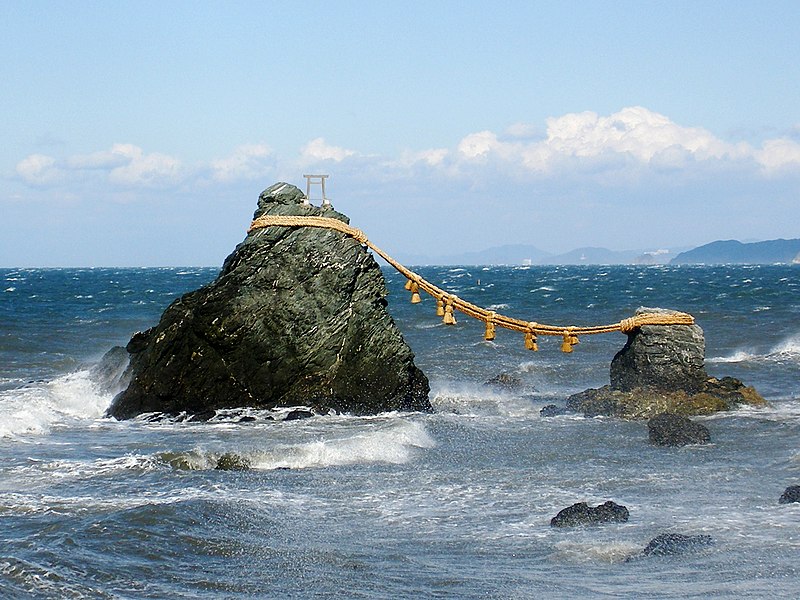
But when you are looking at a Botticelli, Da Vinci or Michelangelo, you know you are looking at a Botticelli, Da Vinci or Michelangelo. Just like I recognised Vagabond as by the same artist that did Slam Dunk even though my first exposures to each were 5 years apart. And considering the steaming, heaping mounds of shite manga one has to wade through to get to something even remotely interesting, Vagabond and Slam Dunk are islands akin to the beautiful husband and wife rocks at Ise Peninsula amongst this sea of shite.


But I could use that metaphor to describe just about any of the artists featured here.

As a storyteller, Inoue is 'the big gun' because he does it all. He uses Zen-scrollwork lines to convey powerful sword strokes in intense full page spread combat scenes that could never be captured in any other medium but the comic book. In a movie it would come across as unspectacular, perhaps only the intense duel at the end of 'Sanjuro' or the three way shootout in 'The Good The Bad and The Ugly' come close, but even then they have nowhere near the power of Denshuru staring up through his severed fingers at the sky as his entrails fall onto the ground or Seijuro Yoshioka realising he has been cut in half after the patent dark downstroke inked line of Musashi and he going head to head.

Nor is there anything more energizing than looking at Sakuragi swat the ball out of an offensive players hands in the national championships. He really uses the comic medium to freeze these moments.

Slam Dunk probably gives the best examples of pacing, in my opinion he is better at this than Frank Miller in his hey day. You really feel like you've played a game of basketball reading it, as he shows the fast break transitions, getting back on defence and so fourth all in a few panels. Action sequences are the hardest thing to do well, broadly speaking you have to cut down the panel size, lose the dialogue, if you are crap, an abundant use of motion lines, if you are good a careful selection of 'snapshots' if you will from a live sequence that allows your mind to fill in the blank and create a smooth image in the head.

This is what Takehiko does. He does it all infact, his landscapes too are breathtaking, like the zen scrolls that depict cliffs and mountains, and streetscapes that seem to really be full of people, instead of drawing in a bunch of silhouettes and calling it a day. (as I do) Harvard tells me this tedious detail work is what apprentices are for, and maybe he does just palm off some loosely inked pages to some stooge and say 'I need you to cross hatch in all the maple leaves' or something soulcrushing like that, but at least he can compose the scene settings really well. This is also no mean feat since Japan has systematically set about destroying or obscuring with telephone wires the vast majority of its traditional architecture.

Then he does metaphores and substances really well too, one of the most poigniant bits of comic book writing and execution I have seen is Musashi confronting the Yagyu master who lies on his sick bed. In an initial moment of dissapointment that this will not result in any fight sequence, you are then swept away by some of the most powerful writing I have personally ever read.

The 'what is invincible? It is just a word' forms a lot of my world view now, not even Alan Moore managed to do this with much deliberate effort in V for Vendetta. And the sequence he uses is something I highly recommend everyone knucle down and read if you are at all interested in comics.

To me, while recognising Takehiko as one of the 'ultimates' of the medium, and I do have a pie in the sky idea of something I could use his stylistic influence on, at the same time I'm acutely aware of my own desire to differ from him.

Most notably I feel more desire to write about social issues and economic metaphores more than the spiritual/philosophical. I also have a strong preference for one-shots. Do a story about an idea then drop it like a rock and move onto the next metaphore, where he does 'journey' type stories, taking an individuals development and plunging into its depths.

My inking is very rudimentary, my characters all flat, it will take a lot of practice to realise them with shading. Infact I have thus far avoided almost all lighting issues entirely. That's something I definitely want to aspire to in Inoue Takehiko's work.

Lastly a final example of the man at work. (on ultra large scale).

Monday, February 23, 2009

Stylistic Aspirations: Brett Whiteley

I believe I vowed to do more posts about artists I like a long time ago and did one on R.S. Connett, who was a big influence in my highschool art days.

In the lead up to actually distributing FOWP and in preparation for my next to drawing exercises I thought I'd start throwing down artists that, even if you eventually look at my work to date you may find no hint of influence evident in the work, nevertheless I aspire to borrow bits and pieces from, or incorporate their work into my drawing exercises and what not.

First up, Brett Whiteley. I hate nationalism, and as an Australian this is why Brett Whiteley is important to me. Because as Bryce put's it (in reference to music) 'We should celebrate music because it is good, not because it is Australian'.

Brett Whiteley is world class. Perhaps in some respects a poor man's Pablo Picasso, but if you looked at any volume of his work you'd never think like that.

As I stated in one of my FOWP updates, what I don't know about composition could fill the whole universe. And that's just one side of the coin.

Take Brett Whiteley's 'in the studio'

Link via art-search.com.au

I'm told Rembrandt practically invented composition and remains the master, perhaps though Whiteley is the master of decomposition. Where a rembrandt causes the viewer to look involuntarily at precisely what rembrandt wants you to look at, Brett Whitely seems to do everything to ensure you don't look at what you are supposed to look at.

Consider that the above painting won the Archibald prize for portraits. Brett's portrait actually appears in the handheld mirror next to the canvas. The hanging scroll directs the eye down yes, but then Whiteley's eyes direct the viewer to the nude. The nude is perhaps the most blatant distraction, but there's also Brett's use of Ultramarine blue and the brown that makes up the floor which always made his negative space - wall, sky, ocean...etc overpowering.

You get assualted by colour and in that way the composition works by simply forcing your eyes to seek refuge from the brightness. Almost the opposite of Rembrandt where as you move away from the pictures focal point the palette retreats into black, the edges get softer the shapes blurred.

For me Whiteley's spaces hold tremendous appeal, because they lack a sense of proportion, and the large areas of flat colours are what has always come through in my backgrounds. Except that where mine just look crap, a flat wall with one small feature, Brett somehow makes the same concept work and work really well.

I'm still not up to the colour phase which may I suspect have a large part in making empty space work, but I plan to do more exercises in decorating rooms, the brett whiteley way. And of course by drawing it, not by going to IKEA.

Going back to the nude though, Brett Whiteley's sketches of nudes are probably amongst my favorites in the world. I am not a fan of the nude, largely because I am not a fan of big hairy bush, and this seems to be the preoccupation of most nudes. I'm also not a fan of pedophelia, so the traditional way of avoiding bush in nudes is while I wouldn't say anything in art should be outlawed, not to my tastes.

I am fervantly waiting for the brazillian to make its way into the art world, curiously Michelangelo's nudes didn't emphasize bush, nor many other renaissance painters, but curiously enough were more often than not, nude little boys.

I will also admit I struggle with the female form in general. To my credit as a non-chauvinist, I must look at faces a lot because I know how to put one together from a few abstract lines, but breasts I just about cannot do.

I have gotten better at representing the female form from more than one angle, but my biggest problem perhaps is my love of the strait line, it never occurs to me drawing anything to rotate my wrist at all, so women with their abundant curves are problematic to say the least.

But Brett said in a video I had to watch in art class that 'the curve is the most spiritual of lines' and this made a lasting impression on my, if not my work.

Take 'Towards Sculpture' as an example not just of his nudes but of his linework:
link via prints and printmaking.gov.au

Firstly he has a very distinct lack of proportion, an eye that emphasises the form rather than finds it. This is something I am terrible at, my work is obsessed with correct proportion and I keep trying to fit everything into a believable world (somewhat unsuccessfully, as Udonis in FOWP will prove).

As such the artists I find truly confusing and incomprehensible are the Whiteley's of the art world, perhaps Picasso is a better example, as someone who is classicly trained and can just throw that eye away for a wholley new one that can both completely skew reality and yet work intrinsically at the same time.

I think it's been demonstrated that the more emphasis placed on stand out features, (such as Prince Charles' ears) the easier a charicature is to recognise, even easier often than a photo. Perhaps in this way there is some mental trickery that allows the brain to get a semi abstract view of the world.

The last thing I like about Brett's line work in particular is his tendancy to work over an image. He builds an image up from throwing down a bunch of lines then I believe emphasises the 'best' or 'correct' ones, but leaves trails of the workings there. This was something I did a lot in FOWP, suspending the fact that I wasn't quite sure how to clean up the images on photoshop and perhaps just plain old fashioned laziness, I also felt dishonest whenever I removed original screwed up line work, and didn't do any real tidy-up between pencils and inking phase.

I felt in a way fowp isn't just a stand alone story, but actually a documentation of my progress as an artist. You can often see just how bad my initial attempts were hiding behind some more solid and confident ink lines.

Nevertheless, the setting and the story also play a role in comics, and I agree that the 'curve' is the most spiritual of lines. In most of my work, as an athiest too, I tend to stear clear of the spiritual and give it a wide birth. This doesn't lend itself to semi abstract. Perhaps only in scenes with a lot of emotion.

All in all, I will do a study particular of Brett's linework to build up the repertoire, somehow his nudes manage to be sexy without to me being vulgar, or overly scientific. They are very emotional, womanly nudes and I somehow doubt that anyone other than Brett would have jacked off to them, and even then Brett was probably thinking of the models too.

Sunday, February 22, 2009

What if... Buddha?

People are willing to clasp their hands in front of themselves, burn noxious incense and pray for answers from the Budda.

People rub the Buddha's stomach for good luck. Throw coins into a box and ring a bell in front of Solemn Japanese Buddha, and release birds from cages in front of Thai Buddha's in all manner of posture and scale.

A guy who sat under a bodhi tree and meditated and thought until he figured out the answers to his problems. He must have been brilliant, exceptional to reach enlightenment.

Would the world be different if Buddha had instead reached enlightenment by digging a 30cm x 1 m x 10 m trench? Even a 1000 m trench? If Buddha had obtained enlightenment by digging would we pray for enlightenment from the exceptional digger?

Or would we get out in a fucking field and dig for ourselves?

Now I'm aware that certain sects of Buddhism do advocate amongst their followers extensive meditation in order to reach enlightenment, and I have a soft spot in my heart for Zen and it's liberal stick beatings. But these practitioners are usually called Buddhist monks, those that figure out their best crack at enlightenment is to try and figure it out for themselves.

furthermore there is some bizarre certificate system were someone can recognise that you have somehow achieved nirvana, but these Bodhisattva's and Buddhist monks are not what you typically call buddhists.

So what if Buddha had been some kind of menial laborer, would it be easier for moronic disciples to stop 'praying for answers' and start 'working for answers' if the process was less confusing, less esoteric?

I guess the amount of Christian Carpenters answers my question.

Sorry this doesn't make a very interesting issue of 'What if?'

My Discovery of the Year Thus Far

My discovery is that Ugly Duckling are actually really good.

They are the first truly good rap act, in my limited opinion since J5 in the post Native Tongues reign of gangsta and club trax rap.

Furthermore having presumed them to be a novelty band, its surprising to find they can put out rock solid albums, much like the Bloodhound Gang.

Thus far I've only heard their Taste the Secret Album which i'm told is not as good as their earlier work. That said I believe 'Opening Act' is one of the most important songs ever written, and if I had a band would insist it be played every time the sound check was being performed.

Likewise, 'Abigail Silk' is probably the best hip-hop song about a femme fatal that Q-tip or Black Sheep hasn't done. 'Daisy' is on par with De-La-Soul's 'Jennifer taught me' but as funny as 'Strobelite Honey'.

Then there's the more De La Soul-esque songs like 'Rio De Janeiro' and 'Goodnight Now' (As well as 'Opening Act') that remind me of Prince Paul style production.

The audio fortunes you follow of Meat Shake - the fast food franchise, and their rivals Vegie Hut are a slightly removed riff on 'De La Soul is Dead's' jeff and the Demo Tape narrative, but De La Soul ripped off 'Midnight Marauders' in Mosaic Thump so really it's all relative.

Anyway, I expected 'At the drive thru' to be at best what the album would offer, but bizarrely UD opted to make a film clip for one of the weaker novelty songs and left the much more substantial content (like 'Dumb it down') away from the market.

So as my title suggests, this is something I discovered for myself, I'm aware the album has been around for 4 years or so, but this is exceptionally recent considering I'm still trying to work through all the albums released in '96-'97. If nobody else cares about those years it falls on my shoulders of posterity to do so.

Saturday, February 21, 2009

It's a Fine Line between Annihilation and Ascension

The more I allow my life to revolve around the 800 meters, the more I think there's enough of an amazing true but untold story to make an Oscar winning documentary on the event.

Wikipedia has this to say:

In modern 800 m races, runners start from staggered positions on the track and must remain in their respective lanes until the end of the first curve (about 115m). After the first curve, competitors may break for the inside, as long as they do not deliberately obstruct or push another competitor. Running at full speed for the entire distance is impossible, and a runner's strategy and tactics are a factor in reaching the finish line first. Running in the lead is often considered a disadvantage, as trailing runners can choose when to accelerate past the leader, and wind resistance has a greater effect on those in the front of the pack. Runners in lane one but not leading the race must also be careful to avoid becoming boxed in by other runners, as this eliminates the crucial ability to completely control one's own pace. Running in last place is also not recommended, as there may be too much ground to make up when the final sprint for the finish starts.

However, it can be sensible for an athlete to remain at the back of the field if the pace at the front is far too fast, provided that the athlete in question does not leave too much ground to make up. This was illustrated by Kelly Holmes at the 2004 Summer Olympics, where Holmes stayed at the rear of the field until the last 300 m before making a decisive move. A more unorthodox tactical move came from John Woodruff who, in the 1936 Summer Olympics, was boxed in by runners early in the race. He slowed almost to a complete stop, let the runners pass, and then took the third lane to come from behind and take the victory. In the 1972 Summer Olympics, Dave Wottle, demonstrated yet another unusual tactic by crossing the 400m mark in last place, unfazed by the overly fast pace, and passing nearly every racer in the last 150 meters, taking the gold.

In top class races, the lane start usually ensures a brisk pace for the first 200 m. Occasionally, no one will be happy to lead, and the field will bunch for the remainder of the first lap. This will lead to a slow first 400 m, leaving the runners extra energy for a hard sprint on the second lap, favouring the sprint type 800m runner. Alternatively, one runner will ensure a fast first lap and the winner will be the athlete who slows least on the second lap. This tactic favours the endurance or distance type 800m runner. Some 800m runners are able to run world-class times with even laps, or even negative splits (which means the second lap is quicker than the first).


Note in particular the "running at full speed for the entire distance is impossible" and the last paragraph which states that the first lap could be deliberately slow, favoring a 400 m sprint style, or it could be deliberately fast favoring an endurance style run.

In other words, unlike the 100m sprinter, where you turn up each day knowing exactly what your competitors and you are all going to try and do, you go to the 800m having literally no FUCKING IDEA how you are going to run it.

Surely the easiest thing to do is sprint out into an insurmountable lead in the first lap, where your competitors hit the wall and you jog it into the finish. Except what if you hit the wall?

Question two, the second simplest thing is to comfortably tail the pack and then make your move and sprint off at the right time. Except what if they sprint off on you?

The answer to both these questions, defies game theory, probabilities and prisoner dilemma's. (Although if you decided to rock, paper, scissors for all places then simply jog the two laps in that order, everyone would be better off).

You simply don't know. It leads me to believe then that here, in ultimate uncertainty, God dwells. Yes God is the 800M.

If you make one slight miscalculation, one nervous little mistake, if your knee tweaks just slightly, or your heal slips out a mm, or you break a nanosecond to early, or you hesitate between a hummingbird's wing flap the 800 meters ends like this for you:


That's if you are minutely off game. If you get everything absolutely perfect, this is what it feels like (I have experienced it once):


Poor Kubrick, had he just run the 800 m as a child, he wouldn't have had to make that confusing movie. And poor everyone who was relieved to lose their virginity, to know that you still have not experienced winning an 800m foot race, and that popping your cherry is roughly, honestly 1/1000 the experience beating the 800m is.

Nate vs. Marbury

If there are two non-contenders for MVP, it is Nate Robinson and Steven (Stefon? Stephan?) Marbury. So hopefully this won't be too controversial.

If this post is going to be of any interest at all you already know who they are. Rather than dredge up the past here is the argument:

Nate wants to play. Marbury doesn't.

Thursday, February 19, 2009

800M - The Jump Start

This week I have covered:

Sprinting: 9 x 100 m
Cycling: 255 km
Running: 4 km
Basketball: 2 hours (Shooting Practice only)
End Weight: 80.5 kg.

Obviously most of my time was spent on cycling. Starting Saturday I got on my bike and did 75km for the first time since the first week of January, before which I'd been doing a lot of exercise. At the start of the year I was just knocking on 80kg's by the middle of February I was pushing 82kg's. Which is close to a record weight for me (I think, I didn't weigh myself at all in Morrah St).

Furthermore my metabolism slowed down. When I first started drawing I could not sit still for more than 5 minutes. Now I can sit still for 3 hours at a pinch.

So this week was all about throwing caution to the wind, and sending my body the message I expected it to act like the elite piece of machinary it always has been.
And the week was full of surprises.

Surprise one was my first sprint session where I managed to do 6 x 100 meters. This actually means I managed to do 4 x 100 meter sprints, probably losing around a second each time. The last third of any sprint session is merely you pushing your body through the motions.

My experience with long distance running is that after you have run enough, stretches more or less become irrelevant. You are far better off spending the same amount of time putting your socks on properly to avoid blisters than stretching extensively to avoid injury in long distance high impact running. I find conditioning has far more to do with injury avoidance than stretches.

That said, I do believe in stretches when it comes to sprints, because you are ask your muscles to do things you don't ask them to do for weeks...months...years at a time. As such you want them to get as much advanced notice that something is up as possible. Plus I've always had shitty flexibility. I have tight hamstrings when give me a -20 in the sit and reach test.

Today I did my second sprint session of the week which took the form of 4 x 100m except the last 100 was a non event, I petered out and left clutching my hamstring after 50 m. It was just knotted.

Surprise number 2. My gung ho attitude has failed to result in injury thus far.

I know as a cross country runner you can't get faster unless you do the fast running, that is - sprints. lacking a team to do continuous relay's with, I instead am just doing lots of near approimations of distance on a football field.

I will get down to Melb Uni ath track at some point to do proper controlled sprinting, but right now it is about getting the muscle development of my propulsion sets.

Here is the break down of my regeme so far good to have on paper because in my head it is a mess.

Cycling - Build Cardio and resperatory, aswell as developing injury prevention muscles in my knees, quads and butt. Endurance riding at 20 kph + speeds, minimum 75 km as set this week. Bit of fat burning too. Low impact sport.

Sprinting - Aneroebic fitness, develop strength and speed. Engage arms, core and back muscles. Looking to increase stamina through sets of high intensity running.

Running - Fat Burning, Aerobic endurance. I have only done 3km this week of running. It was hilly and felt surprisingly good. My heart holds up because of the cycling I guess, and my legs aren't as super tight as when I first started training for the half marathon a year ago. This year I intend to do the marathon, so I will begin now building up to half marathon distances. From my place this means to fed square and back.

I will be happy though if in the interim I do mostly 8-10km runs. I have an oviod gut at the moment that is probably 5kg's my legs don't need to carry 800m so the aim is to get rid of this.

Basketball - Anerobic, Aerobic endurance, fat buring, upper body and core strength building. Jordan had to rebuild his body on his return from baseball, he did it in the gym. Not being so dramatic I plan to just do it by playing basketball. I'm thinking of trying to target full court games. 40 minutes of running 30 m in either direction more or less continuously is the stamina I need. Even just running about a half court though gives plenty to worry about. It also gets me lifting arms and heaving a small weight repititiously and the act of boxing out and jumping for rebounds is also pretty intense. I remember when I first played again 3 years ago being amazed at how hard on the body it was, often pulling up sore for 3-4 days afterwards. If I play basketball once a week I'm happy. I can always do that old chestnut game - suicide to improve agility too.

At any rate I picked up from last weeks exercise profile:

Cycling 10km

To the regime above. Which I count as a jump start, I might drop back a bit next week, down the cycling and up the running, but long term I want to be pulling twice all those numbers above. Switching to sets of 8 x 100 to 4 x 200 to 2 x 400 to 1 x 800 and so on.

My theory is if I can get my 100m decent and my fitness up to marathon level it is then the relatively simple process of slamming the two events together to create critical mass.

Please don't point out how erroneous this assumption is.