A Naive Series Part 2: Totalitarianism
"Naive" is French for gullible or childlike, or near enough. I am not a lexicologist. What I am is consumed by the question "what are people?" to which my best answer is "no one thing" but this is kind of an unsatisfying answer in the same way that J.P. Morgan's market forecast "it will fluctuate" is more accurate than it is useful.
Naive as a prefix
Being part 2, naive can be treated as a synonym for default, or factory settings for the organic factory for minds that is the amniotic sac. I probably shouldn't myself be authoritarian when it comes to nature v nurture, so we might also treat it simply as "most prevalent" or "modal" if the naive-isms might better be explained by status quo parenting.
This series is about the kind of intuitive sense-making schema people operate unless a considerable force (education, in the broader sense) is acted upon it.
In part 1, I looked at naive chauvinism, which is in summary that most people unless educated out of it, unreasonably believe their own preferences are superior to others - eg. that their Grandma makes the best chocolate cake in the world, through to the way they drive is reasonable and everyone else drives stupid.
From here it is a short hop to 'Naive totalitarianism' in fact if my assertion/speculation that we tend to naive chauvinism, with chauvinism being an unreasonable belief in the superiority of your in-groups whatever, it would be surprising if we were not then logically prone to naive totalitarianism.
Perhaps the best and most famous expression of what I assert is naïve totalitarianism comes from Alexander Solzhenitsyn:
If only there were evil people somewhere insidiously committing evil deeds, and it were necessary only to separate them from the rest of us and destroy them.
Alexander laments via the words "if only" as life in the Gulags has taught him that no such simple operation exists, alas if we subtract "if only" then we go from lamentation to assertion:
there were evil people somewhere insidiously committing evil deeds, and it were necessary only to separate them from the rest of us and destroy them.
That's naive totalitarianism.
Totalitarianism
Totalitarianism will have a wikipedia page I'm here to give you a naive version. I am probably using it as a synonym for authoritarianism rather than its extreme version. I may also increase the accuracy of my assertion by suggesting that we are naive frustrated totalitarians.
So totalitarianism is basically a really high confidence level. Like you are as confident that you know how society works as you are confident that 2 apples plus 2 more apples equals 4 apples. Totalitarianism is a belief in a simple world in which there's good people and bad people.
It's a concept I would probably best summarize in a list of behaviours:
- Believes in an orthodoxy, speaks in absolutes "Dances With Wolves is a great movie."
- Polices speech - both words and topics of discussion. "Mum you can't say 'six-seven' you're so uncool."
- Subscription to the orthodoxy is more important than actions and behaviours. "Well I just can't believe that. John is a Christian."
- Practices double standards. "Don't turn your nose up at spirituality." - [turns nose up at natural sciences.]
- Dehumanises the outgroup. "Girl, If I were you I'd take that Temu-Versace belt and hang yourself with it."
- Believes the orthodoxy can only fail through lack of commitment. "We just haven't tried Communism properly."
What makes someone good, is that they "get it" and so are "one of us" where "it" is the roadmap to utopia.
What makes someone bad, is that they "don't get it" or worse are projected to "get it, but are too selfish/uncommitted" and so are one of "them."
When you presume the answers are known to a problem that is understood, then everything reduces to commitment. To not conform then allows only two possibilities - you are stupid and require re-education, or you are bad and require active resistance.
Generally bad people are subhuman by virtue of being bad, and everyone (or maybe just the good people) are suffering because of insufficient commitment to being good.
For me, the big tells of naive totalitarianism are pretty simple: do they speak in absolutes? do they get indignant when challenged? does the person have double standards? Explained visually here by the brilliant Tom Gauld:
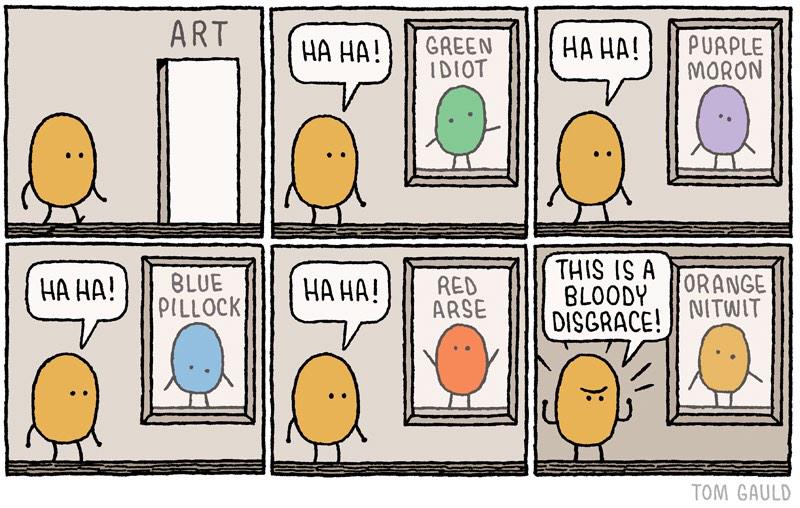 |
| Sourced here |
I feel that this is sufficiently broad to cover all extremes of authoritarianism that we have actually seen, like Ye Olde Theocracies (through to contemporary religious totalitarianism) where heretics, heathens, apostates and adulterers are targeted by violence.
Thru to Fascism, generally characterised by a belief that a nation exists within the blood of some ethnic group (rather than a social convention, legally constructed on paper), and so long as you really are into that, you can be as radical socialist as you like so long as benefits only accrue to the pure blooded people.
And Leninist-Marxism where the workers are too stupefied by class consciousness to "get it" and so Communism has to be imposed by the intellectual elites and the people are liberated from dissenting opinions until such a time as they awaken into the utopia of communism via Lenin's fist.
Naive + Totalitarianism
I would like to step back from any specific ideology, or formal context for totalitarianism for a moment to emphasize the naivete.
Naive totalitarianism if I had to bet, is going to have its foundation in the emotion of anxiety. Anxiety is a response to uncertainty, and for many people anxiety is unpleasant to the point that it prompts them to try and take control. A really banal example is an examination for a subject you aren't confident in. Some people can live with the anxiety of not knowing what grade they will get from A-F on the exam, others cannot and take control by studying excessively.
The naive totalitarianism comes out in these situations when a friend asks them "hey do you want to play brickball this lunch?" and notice this is an open question, allowing for the uncertainty of yes or no or even counterproposals of activities. The response is "No, I have to study." a definitive statement that is untrue, the speaker could not study and maybe get a B or a C instead of a B+ that will result from the extra hours of study, instead of becoming a doctor they might pick up a trade and work in construction. Such hyperbolic speech we, on some level understand as escalating a mere want into some kind of need.
If that last sentence feels like an alien way of thinking to you, you may be living the naive totalitarian life.
"The customer is always right" "Bridezilla" "Kitchen Nightmares" all give us banal concepts of naive totalitarianism we can see everyday without needing bold graphic swastikas and goosestepping soldiers parading in order to experience it.
"The customer is always right" suggests that all service roles are beholden to, and measured against, the ideals of the customer, customers can treat their expectations of service as an orthodoxy that is not determined by reasoned debate or even market forces but simply the emotions of how the customer is used to being treated (eg. by US waiters working for tips vs Australian waiters who are employed by the business owner) or expect to be treated, (someone who has booked a holiday to Paris based on watching Ratatouille)
"Bridezilla" I've been fortunate to never encounter in person, though we could generalize it out to any event where the ostensible host takes as orthodoxy, their egocentricity. I also... while open to the possibility that "Bridezilla" refers to some extreme...I would also apply it to a sentiment as simple as a bride or groom getting frustrated because "nobody is dancing" where we can begin to see the totalizing nature of mandatory fun. The hosts and event planners may think they are throwing a great wedding reception for their guests but the moment they start stipulating how classy (scripting the best-mans speech and feeding it to him through an earpiece) or unclassy (making everyone get out of their seats to dance the "Chicken dance") We are just objectifying people in a totalitarian way.
And as for Kitchen Nightmares, well this sums up the totalitarian nature of Friedmanesque, Chicago-school Neoliberalism. Not all the time, but so often the Kitchen Nightmare is born of the business owner (who can simply be some dipshit with a string of failures that has taken out a loan in his stepdaughters name because his own credit rating is through the floor) gets his or her or their way, even if they haven't been to culinary school and are employing someone who has.
Usefully, kitchen nightmares exposes an exact counterexample to the totalitarian attitude of "the customer is always right" with the more transparent totalitarian attitude of "the owner is always right." Where customers refuse to eat the food and pay for it. Yet the workers who need the shitty job taking frozen food out of supermarket boxes and deep frying it in oil that is overdue for a change, are subjected to a naive totalitarian regime by virtue of having to come to work and follow directions (or lack thereof) in order to collect a pay check.
Though not a perfect segue, it is segue enough for me to then suggest that you probably live in, and under some kind of totalitarian regime. I assert this because I think most employers and most family units are going to be characterised by naive totalitarianism, because of our shared propensity toward naive totalitarianism.
Most employers, and many families have an authoritarian structure, even if the authoritarians lack real power - like parents of adult children whose offspring go no contact - a large subject on its own, but the gist of which is that people become more set in their ways as they age, we tend to rethink less and parents get cut off because they treat their preferences as non-negotiable.
The All Important Monopoly Boardgame
My table-top and role-playing gaming friends appear to actively hate "Monopoly" and the place it occupies as the pre-eminent family boardgame.
And Monopoly does suck and has a surprising propensity to associate itself with nefarity. You may consider just this section but a mere first draft for a project I plan to use to venture into the overcrowded marketplace of economics explainers. Here an excerpt from Monopoly's wikipedia page:
The winner is the player remaining after all others have gone bankrupt.
In many ways humanity at present faces two major existential threats everyone is largely tired of hearing about - nuclear annihilation and climate catastrophe. The former involves us collectively resisting the urge to wipe ourselves out through nuclear warfare, and most people are under-anxious about this prospect given a recent return of 'dickheads' as heads of state of nuclear powers like the US, Russia, China and Israel that give off a "fuck y'all I've got mine" vibe.
The latter, climate catastrophe we are also likely under-anxious about but not for lack of trying, the anxiety just manifests as a 'freeze' response rather than fight or flight because unfortunately, unlike nuclear annihilation for which freezing prevents the threat, climate catastrophe involves en-masse lifestyle changes.
But I am increasingly of the opinion that we cannot take collective action on climate change at global or local levels because there are other problems in the way, and the "monopoly mindset" is a big one.
In a "lucky country" like Australia that is prosperous and safe, there's a reputation that everything here is trying to kill you. That you walk under a tree and a bear will drop onto you, you walk along a beach and pick up a pretty shell that is in fact a cone fish which stabs you causing you to stumble and fall into a rock pool where a blue ring octopus poisons you disorienting you so you walk out into the water through the tendrils of a box-jellyfish before a shark takes a bite out of your leg making you easy prey for the saltwater crocodile that passes on the shark since you already are bleeding out and munches on you as the rip-current drags you out to sea beyond rescue and you console yourself that you would have died from skin-cancer early anyway but you'll sure miss your home among the constantly on fire gumtrees.
That's all just Australian's pulling your leg, drop bears are a myth and the deadly sun, fire season, snakes, spiders, kangaroos, emus, jellyfish, shellfish, octopuses, platypuses, crocodiles, stingrays, birds et all are perfectly safe so long as you get nowhere near them.
What most Australians have to contend with is living in a society where everyone approaches life like a monopoly game they are trying to win.
Now the conventional wisdom in Australia more takes the form of "bankrupt or be bankrupted" hence people are urged to get a flimsy pretext of a job in order to mortgage themselves up to the eyeballs as quickly as possible, a strategy we are so good at that the age at which people purchase their first home is getting older and older under the auspices of this common sense.
The Australian public sector ie. the taxpayer invented Wifi at the CSIRO, and of course the achievements of the Australian private sector are even more impressive...
...
...
...Crocodile Dundee and Mad Max?
So the naive totalitarianism comes in because Australia is a country where unfortunately everyone is trying to "win" a zero-sum game. Which is why monopoly the boardgame is important, because after you win by bankrupting everyone else, not only is the game over but everyone hates you.
Monopoly is a false analogy for an economy but its enduring appeal to the frustration of actual boardgame enthusiasts, I suspect is its appeal to our naive totalitarianism, our psychology that evolved over at least a hundred and fifty thousand years of being homeless people, where if we asked our ancestors "what did you accomplish today?" and they answered "well I woke up, had a snack, lay around for a bit, fixed myself lunch, felt tired, had a nap, got up but felt groggy so masturbated to wake myself up, ate some berries, lit a fire and went to sleep." their peers would regard this as an incredibly productive day and we would think it had all the hallmarks of depression.
We used to be so economically unproductive that being totalitarian, trying to "win" at life was pretty harmless, just like in 2025 there are still groups of people who live hunter gatherer lifestyles, and we can see some life-supporting plant that belongs to a nomadic tribe who are all like "fuck off this is ours and if you pick a fruit we'll kill you." and this totalitarian desire to control this resource and dictate who may and who cannot benefit from it does not become a geopolitical issue unless that plant sits on the proposed path of an oil or gas pipeline.
But a majority of humans now belong to nation-states, and people treat them not as an infinite game where we co-operate to keep the game going, a game whose gains are all based on cooperation to build open and tolerant societies, but a zero-sum game where the in-group needs to take control and force the outgroup out.
For the last decade I've been experiencing painfully the colonial irony of what right-wing commentators have come to call "wokeness" and left-wing people have continually disowned any labels in order to shirk accountability. A political disposition that is overwhelmingly white and colonial in vibes. An obvious example being "Latinx" a New England exonym non-violently imposed upon everyone from the long and diverse histories of Latin American colonies-come-independent nations by institutions like PBS and the Democratic Party for the benefit of their benefactors.
Obligatory acknowledgement that an increasingly Christian-nationalist right, and global totalitarian counterparts (eg. Han supremacy in China and Taiwan, Aryan supremacists in India, Japanese supremacy in Japan et al.) practice their own cancel culture and identity politics and muster no-more-if-not-less dignity about it.
But its all monopoly, its trying to seize territory whether it is literal "Autonomous Zones" or linguistic territory regarding pronouns for exclusive use by an in-group that is trying to drive the out-group bankrupt.
I am not a libertarian, but I aspire to be non-totalitarian by saying nothing can be imposed without public consultation. A more general way of saying this is everything has to be up for discussion to be the constructive and productive least-worst ideal of government by the people, of the people, for the people.
Alas, instead of trying to keep the game going by making it fun for as many people as possible, we naively are too often, trying to win.
Where do they go
What then, is the null-hypothesis, on an individual basis for totalitarianism? The null hypothesis is one that if true, means you cannot accept your thesis. So like if your hypothesis is "all quadrupeds are cats" there's nothing to stop me from conducting experiment after experiment where I count cat or kitten legs to confirm my hypothesis. But a null hypothesis would be "some quadrupeds are not cats." for which a single observation of a dog or cow or goat or sheep or mouse etc. is sufficient to force me to accept the null-hypothesis and throw out my thesis.
For naive totalitarianism, and I'm grabbing at air here, but picture your 'enemy' the bad people, the worst people.
For me, it's a psychological archetype, hard to express but my most succinct attempt would be "wanton mediocrity" that's my enemy, basically the kind of society Joe from Netflix series "YOU" is trying to romantically infiltrate every season: vacuous, pretentious and assuming.
That's the demographic I am most tempted to round up and eliminate to make the whole world better, except being a psychological profile, may refer to 90% of the global population.
If you are a socialist/communist it may be billionaires.
If you are a conservative it might be liberals or immigrants.
If you are a liberal it might be conservatives or bigots.
If you are a feminist it might be mediocre white men.
If you are a "manosphere" guy it might be blue haired lesbian feminists.
And when I say 'world' it need not be global, you may be advocating for 'greater diversity'* in a microcosm, like your organisation. I feel the test that falsifies naive totalitarianism is if you have some provision for your ostensible outgroup.
*(Australian journalist Antoinette Lattouf was foisted on my attention when our national broadcaster ABC fired her for criticising Isreal and she successfully sued them for unfair dismissal. Her TEDxSydney talk provides a great example of how a strategy of 'advocating greater diversity' can be totalitarian. In her talk she refers to research findings from Deloitte indicating the benefits of diversity for productivity and performance, but her presentation omits the detail that these benefits of diversity are contingent on 'diversity of thought' aka heterodoxy - as such, you may achieve better performance by assembling teams containing a right-wing straight white male and a left-wing straight white male than assembling a team of South Asian, East Asian, West African, North African, Sub-Saharan African, Southern European, Northern European, Middle Eastern, South American, Central American and North American graduates from Columbia University liberal arts degrees.)
At first blush, I myself have no provisions for the "wanton mediocre" I just at some level idealise them being "out of the way" like if they weren't to enter Marathons because they overvalue them and underprepare for them, I'd be living in a better world where I don't have to submit to a ballot to see if I get a place or lose it to someone who does park run occasionally and maxes their training out at 10km for a 42.2km "prestige" event. But then multiply that out by the entire market.
I don't really know what the mediocre do and where they go once their wantonness has been thwarted. Its beyond my computational power.
At the same time, for my prejudice the provision is pretty simple - this demographic goes from overconsuming scarce resources, to consuming an appropriate amount of resources. They go from having 3 real properties to 1, they use their annual leave to rent a beach house a few hours drive away instead of flying halfway around the planet to visit the latest instagramable fetishised hotspot, they walk to the shops instead of driving, when they are driving they take the next exit instead of it being socially acceptable to do a 3-point turn anywhere, anytime etc.
To tie it in to my previous post about naive chauvinism - I am a cyclist. As a cyclist in Melbourne I find 'shared pathways' annoying, where a path typically with a line painted down the middle of it is available for both pedestrians and cyclists. I would like to see an apartheid where both groups are catered for, parallel paths - one for walkers and joggers and one for cyclists, skaters, roller-bladers as exists along the beaches of Port Phillip Bay.
I would accept the null-hypothesis regarding my own totalitarianism because I make provision for pedestrians, and my moral character may deserve no credit because recognizing that peds need infrastructure is just a practical reality. Every cyclist is also a pedestrian, you just subtract the bike, but you need a bike to be a cyclist. Peds will only stop crowding out and obstructing cyclists if they are given their own infrastructure.
But drivers, especially if car-brained are often totalitarian regarding cycling infrastructure. I am often surprised by the antipathy plebs feel for cyclists, like they are the greatest menace since St Patrick drove the snakes out of Ireland. I come across totalitarian drivers that simply want cycling infrastructure destroyed so cyclists will stop cycling and get a car like a contributor to society.
That's naive totalitarianism - cars for all and fuck bike lanes. Now lets wade into less intuitive domains -
If for example, you are advocating for greater representation at an existing organisation, that is owned and operated by demographic majority of your locale and has historically hired people that look like the ownership, it is very counterintuitive that an egalitarian organisation would hire "Scot from Scotts College in Scotiaville" and you are instead like 'hiring needs to stop hiring Scot from Scotts College in Scotiaville, and start hiring Fatima from Happy Valley Technical Institute with Fatima's Syndrome' and the recruiting staff are like 'so should we interview Scot from Scotts College?" and you are like "sure, but the obstacle to equity is that we keep ignoring candidates immutable characteristics and focusing on systemic advantages like a) whether the person is already known to the organization through affiliation, and b) qualifications, experience and credentials from reputable institutions. He need not apply because we need greater representation so he isn't going to get the job, or if he does that'll be the exception because we need more Fatimas and Americas and Sun Moons and Carmens and Faiths, and we need more on the board and in the C-suite so Scot's career paths will be narrow..." and then I am asking "but where does Scot from Scotts College work? What does he pursue in life?" and if you're like "not my problem." I'm sorry, but that's naive totalitarianism, not social justice.
Then in that individual case, I'd have to reject the null hypothesis. You have succumbed to naive totalitarianism.
Now importantly, I pick the above example, because I suspect that it is a caricature of the left that people will recognize. I am not suggesting that campaigns to inject diversity in the workplace have been that effective in real world practice. If there's any basis for it, it may be slightly harder for young members of ethnic majorities to get work than maybe 20 years ago when nobody was even making overtures toward diversity and representation and you could just full blown run an old-boys club. And it is more likely that getting a job, even for graduates is simply harder for everyone because technology has made the art of recruitment harder and worse, not better and more efficient.
(It is an aside, but in my opinion the adverse impact of email has been a greater dampner on white male employability than social justice because a) it lowered the cost of applying to any given job. and more crucially b) it got rid of the mail room, effectively sawing off the entry level rungs of organisational ladders, meaning in the past you could get a job out of highschool and if you were bright and not a dickhead the company would notice you and give you some real responsibilities, now you need to get into a University course that simulates work experience and has a work integrated learning program where they place you into organisations the institution partners with, to do free labour in the hopes of getting hired.)
The point of the example is the "not my problem" part, which say, right-wing Christian nationalists may be doing in regards to refugees, shaking their fist and saying "you can't come here we're full!" and someone says "well they can't really stay where they were and live, so where do they go?"
"Not my problem" means we reject the null hypothesis, you're a naive totalitarian because you are operating the software that came with your computer that seems to tend toward "there's good people and bad people and we just need to identify and exclude the bad people."
The Job(s) of a Functioning Democracy
Democracy is non-totalitarian, when it functions.
I have recently been thinking of it this way:
I think back to my highschool cohort. I was in a graduating class of roughly 100 students. As an individual citizen, I was mostly focused on my own performance, my own results and my own future. The job of a head of state though, is to be concerned with the performance, results and future of everyone (at least short-term futures).
Where it was my job to complete my exams that allowed me to become a billionaire astronaut cowboy, I didn't have to think about what would happen to the students that did not do well, there is nothing stopping the individual student from putting blinkers on and charging through any peer pressure to enjoy some portion of their youth being a teenager with an unhealthy worldview that their options are: medical school or commit suicide.
But, and it's a little complicated because the timelines aren't in sync, the whole graduating (and non-graduating) class cohort becomes the workload of democratic leaders at some point.
First by timeline, its 2025 some percentage of students are finishing up high-school by quitting school, this in my jurisdiction includes people who are 16 and up, so not just those completing final year. There are also tertiary students that are finishing degrees that are oversupplied for the employment opportunities, the classic being Marine Biology but has at times been teachers (in 2025 they are in a shortage again). A large part of our education system, can be regarded as an analogue for 'Buy Now Pay Later' (BNPL) whereby the qualification/certification has little to no relevance to what that person will wind up doing.
Indeed, plenty who complete a degree in their early twenties, will retrain for a career transition in their late twenties proving 90s animation icon Daria prescient with her "my dream for the future is to not wake up at 40 in a cold sweat because I was forced to decide what to do with my life when I was a teenager." or something.
But basically the government is going to be faced at any given time with a bunch of people entering the workforce and a democracy is distinctly not totalitarian when functioning, if there's a bunch of young people in a regional urban center who finish highschool but do not go onto further study, the government generally scrambles to offer a tax incentive to a mining company or manufacturer to set up shop in that region so they can employ these people who are like "Bachelor degree...nah."
At the same time, in maybe a metropolitan urban center, you get a bunch of kids who do not want to be the kind of kid that doesn't at least go to University for a bachelors degree, not before you have a chance to lose touch with your peer group and so will do an arts degree at a third tier institution and maybe go into a depression that it isn't even one of the "big three" or whatever, but nevertheless complete it and it is the job of the government in a functional democracy to have call centres and hospitality and service industry jobs for these people until they can find themselves and retrain or whatever.
The government might also scramble to expand the legal liabilities of employers so they need to take on more employees to work "bullshit jobs" in administrative capacities, box-checking and duct taping and maybe even being goons to each other. Furthermore they may operate a tax-incentive program where a company effectively ends up with "consulting and training" coupons they can spend on third party service contracts that have almost nothing to do with the production of social goods by a firm but the firms have a choice between giving $200k to a consulting group that runs a fun off-site strategy session with no meaningful outcomes beyond a 'vibe' rather than a) fund healthcare, education, law & order, infrastructure etc through paying taxes as a % of profits nor b) distribute some of those profits to workers via significant wage increases which shareholders hate because it is an ongoing liability.
Strictly speaking a democratic government can also not function, they can put pressure on people to find their own jobs by making welfare or social security harder to obtain, they can cut public expenditure so the private sector doesn't have to compete with the public sector, they can neglect whole constituencies they just don't feel they can win over not at any price they are willing to pay via polarization and particularly by trying to create single issue voters and moving towards extremes that increase switching costs for voters.
So a democratic government may cease to function democratically and migrate toward totalitarianism by abolishing a law that creates a modest incentive not to discriminate in employment against people based on immutable qualities. Such that suddenly you have a bunch of recent migrants maybe who cannot find legal employment in industries that have low skill thresholds due to them receiving their education offshore. And these people also have their welfare cut off because the government isn't looking after this constituency to appease another. And some create jobs through entrepreneurial efforts but not everyone can start an Ethiopian restaurant near where the community can afford to live so many create income through crime which can then be pointed to and asserted "look, this crime can't be caused by too-high barriers to legal economic opportunities in this country, it must be the pigment of their skin or some other character flaw that leads to failure to assimilate."
But similarly and far more exceptionally, we can see maybe in industries like the arts a reversal of historic trends that sadly does nothing to repair an already determined past, but you have like a theatre company that just will not commission work from a historically dominant constellation of immutable qualities like (among playwrights) being a heterosexual or homosexual white man with merely ADHD. And you might go to the companies board of directors and find photos of that exact group expressing their commitment to Diversity and Equity and it doesn't mean the established parties are going to give up their careers in the name of diversity, but what can be done is putting a freeze on hiring/promoting anybody that looks like the board.
This is presented as what I believe to be a false dilemma between "equality of opportunity" and "equality of outcome" for functional "equality of opportunity" applied to the whole pipeline should in time lead to equality of outcome at the population level, the tricky thing (as the past decade has proved to be the tricky thing) is if you have a product to sell at the market, getting equal opportunity out of consumer preferences. Furthermore, we operate under a "Kitchen Nightmares" economy where the people who own the restaurant set the menu, and the people who mostly inherit wealth get to decide what risks are taken through 'entrepreneurship.'
To be clear, "equality of outcome" is not totalitarian, but "equality of outcome NOW" is totalitarianism, where you just force the outputs regardless of inputs. Furthermore, I have not heard people really tackle the full sentence of "equality of outcome for sexists and racists." or whether such character flaws mean you are simply excluded from provision, which is totalitarian.
A functional democracy will give sexists and racists a vote, but this participation cannot lead to a "tyranny of the majority" so long as the democracy functions by having institutions that limit the powers of an elected government. This point is one I don't have any confidence an unedited vox populi segment on a satirical news show would establish as common sense.
Which is to say, that I think what is common sense is a notion that sexists and racists should be denied a vote to protect vulnerable people from racist and sexist laws being passed. What common sense is not I assert, is that sexists and racists can vote but passing racist and sexist laws is likely to be struck down by separate branches of government (as happened when Trump's "muslim ban" executive order was deemed unconstitutional) now, yes, non-naive totalitarians, ie. totalitarians will attempt to dismantle the institutions that limit totalizing, but a functional democracy has these institutions. It isn't a matter of one totalizing force of good overcoming another totalizing force of evil.
Poppers Paradoxical Remedy
20th century philosopher of science I feel clearly articulated the central challenge of running a democracy, or rather, an open and tolerant society.
A tolerant society cannot tolerate, intolerance. That's the paradox. The one totalizing exception for which there is historically insufficient will - which is to say you will probably see advocacy groups for more tolerant societies calling on young people to "call out their racist uncle" at thanksgiving/christmas a call that needs to be made because most of us would rather avoid conflict than stamp out totalitarian views, just like youtubers have to ask you to "smash that like button, hit subscribe and turn on notifications" like you don't know how to do it by now, but they keep saying it because people don't.
The big data set that relates the paradox of tolerance to naive totalitarianism is of course religion.
If you don't know me by now, I'm an atheist, and also, an igtheist (or ignostic) which is to say, if you tell me you believe in god, I will tell you that I don't know what you are talking about. My ignosticism likely even goes further, in that I don't believe generally that you know what you are talking about.
Where we will have common ground, is that I believe neither of us believes in "freedom of religion." For example, odds are neither of us preference or privelege the laws set down by the creator of the universe over the laws of the land. We don't really have freedom of religion, if you think god talks to you and told you to commit murder and then you murdered a bunch of people, most legal systems don't rule "well we think revelation is a perfectly legitimate epistemology, and we recognise that the opinions of a supernatural entity overrule the opinions of the state."
And you have numerous examples in day to day life, like migrants who come from religious communities where bigamy and polygamy are legal don't have (all of) their marriages recognised in destinations where such practices are illegal, nor child brides, and sometimes marriages to first cousins. Just as conversely one may potentially move to, or transit through a territory where the law doesn't recognize same-sex marriages.
But the latter example being evidence that some states don't have "freedom of religion" is not evidence that other states do. We can reframe this as only theocratic states are states where people are free to practice at least one religion, and nowhere else can anyone actually practice a religion. (Theocratic states like Iran also don't, I suspect, function very well, so a woman having her hair on display might result in morality police beating her to death, but a prominent politician may be known to do lines of cocaine off the buttocks of prostitutes and face no investigation nor legal repercussions.)
I'm most familiar with the Abrahamic religions, that have numerous sects that cannot be freely practiced by taking scripture seriously because any lucid reading of the scripture is one of intolerance, or perhaps some would be more comfortable with me putting it as a prescriptive holistic approach to life.
People get in a tizzy when people use "literal" to mean "figurative" and that prestigious dictionaries started documenting this popular usage. Yet, "freedom of religion" is in my opinion, similarly egregious because we actually mean "freedom from religion" at least in regards to monotheism.
It becomes hard now to not talk in pure truisms, for example what makes cultures multicultural is their intolerance of monocultures...duh! Democracy functions as a "utopia-thwarting institution" and its success derives from how frustrating it is in imposing compromise on people.
Institutions like "free speech" are explicitly utopia-thwarting. Southpark's Kyle Brovlovski is Jewish because his parents are Jewish, Stan Marsh is not Jewish because his parents aren't Jewish (though they gave Mormonism a one episode try) and they are best friends. When Eric Cartmen sings "Kyle's mom's a bitch" this is remarkably similar in emotional impact to reasonable criticism of any and all religion given that it remains among the strongest predictors of adult religiosity are things like geography, and the religion + religiosity of your parents.
As such, for many religious people, I quickly came to recognize that questioning core beliefs, or questioning at all elicited the same emotional responses in believers as telling them their mum's lasagne sucks, that classical music is boring etc. 2010's "Judeo-Christian" apologists Jordan Peterson and Tom Holland who make ambiguous "Wagner is better than it sounds" arguments for Christianity also leave me with an overwhelming sense that they defend Christianity more so for emotional reasons than the compulsion of reason, for them I suspect it is some profound familial connection that leads them to making the investment of time and energy into mental gymnastics to defend crusader impulses.
Freedom of religion + Abrahamic religions looks like the fucking crusades. Crusaders are people free to act out their religiosity fighting to the death over possession of the "holy land" in a conflict that continues right up to the present day - progress largely being that "we" have gotten the costs somewhat under control largely by not having the Church but the state collect taxes and while some of this may provide astronomical levels of funding to military conflicts in the middle east, some at least now gets spent on shit like education and healthcare, law enforcement, infrastructure, bailing out our boneheaded economic bubbles etc.
A father-son crusade however about three days before I write this sentence appear to have decided to take their religion seriously and went and shot dead 16 innocent people at Bondi Beach including children and I am not going to do justice to the human suffering inflicted. This is where someone like Sam Harris would be at pains to point out that lucid readings of scripture heavily favour that acts of terrorism like this are what it means to seriously believe a religion, I believe he expressed it in the truism "the problem with Islamic fundamentalism, are the fundamentals of Islam." Though I haven't been paying attention, but do not believe that he articulates this out equally to a character like Benjamin Netanyahu, who at the very least appears to entertain Jewish fundamentalism.
But not to single out any one of the Abrahamic faiths, youtuber Prophet of Zod has a pretty accessible and comprehensive description about how most people pretend to be a believer albeit he is singling out American Christianity. There is also journalist A.J. Jacobs account of trying to live in accordance with the bible for a year "the year of living biblically" from which he offers an observation that:
A critique of fundamentalism. I became the ultra-fundamentalist. I found that fundamentalists may claim to take the Bible literally, but they actually just pick and choose certain rules to follow. By taking fundamentalism extreme, I found that literalism is not the best way to interpret the Bible.
So A.J would likely even lump 'fundamentalists' in as essentially doing what Zod's archetypal 'Mike' does.
Civilization's great achievement where and when it is achieved, is having the prevailing religious belief be one in a soupy-kind-of-god, that they do not so much believe in, but rather believes in them, taking the form of the society the believers grew up in, condoning its shared beliefs, shared rituals and shared practices voicelessly like the puddle takes the shape of the depression it sits in.
In this way, modern secular societies like Australia, Canada, EU and UK, Japan, Korea and according to CCTV4 China also, people are free to practice a narrower bandwidth of available religiosity that excludes totalising religiosity. But we are not free (nor should we be) to take seriously the idea that the ultimate authority revealed to some guy the ultimate truth as to how to live one's life in any way where a literal interpretation of what it fucking says is any defence in a court of law.
All that is permitted is 'exegesis' which is a critical interpretation of the text, elstwise in the 21st century we have to open up debate again in deference to freedom of religion as to whether all forms of slavery, genocide and sexism are permissible and furthermore given that we have multiple ultimate truths to choose from, we'd be obliged to duke it out.
Bringing this back to Popper's paradox of tolerance, we used to have religious totalitarianism. Catholic Spain exiled the Jews from the Iberian peninsula and the Ottoman's took them in. Prior to that the Kingdom of England in 1209 issued "the Edict of Expulsion" the first European territory to expel Jews from its lands and resettlement didn't occur until the 1650s. (Shakespeare managed to write 'The Merchant of Venice' when Jews couldn't openly practice in his entire lifetime, and possibly himself and probably his entire audiences at the Globe had never met a Jew.)
In the meantime, Catholics and Protestants duked it out brutally and we also had dark episodes of taking religion as a serious totality like Imperial Japan treating Hirohito as a living god, the Irish troubles having colonialism divide along religious lines, Jonestown massacre, the Heaven's Gate cult suicide etc. through to Bin Laden's attack on the World Trade Center twin towers ending the end of history and wetting appetites around the world for the naive totalitarianism that fuels the crusades.
Civilization, if it is anything, is the process of building institutions that assume the answers are unknown and that carry out with some modicum of efficiency and finger-crossing a systemic thwarting of all attempts by everyone to fix everything with their myopic conception of what needs doing.
Good guys and Bad guys at Sports
Sports is a domain where we can agree, that sports are not as consequential as say, military conflict. Sports seldom rack up a death-toll, disrupt global supply chains, destroy wealth, drive rapid technological innovation and bankrupt nation-states.
When I started writing this section, I thought I was going to make a pretty straightforward comparison between the totalitarian attitudes of "indoor kids" vs "outdoor kids" how either can fall into a totalizing trap of seeing the other as defective somehow in a way that perhaps grows up to map onto the extremes of the right and left political spectrums.
Inadvertantly though, I found an example too perfect of "indoor kids" being totalitarian. I chose a video from "Books and Cats" purely from the name of the channel and largely for aesthetic reasons to suggest a reductive stereotype about someone in high school that maybe resented the celebration of athletes without having any appreciation of the merits of competitive sports.
This stereotype straw-man I was then going to counter with Kobe Bean Bryant:

The point being, at the elite level sports are made great by exclusion.
Let me put it this way, a little kid starts out on a balance bike or training wheels. Eventually though, the most of us that can ride a bike, put our faith in inertia and start riding a bike.
Now let's posit another level - which is somewhere between the age of 12~15 kids who ride bikes, need to basically get the fuck off the footpath and start riding on the road, which these days have more bike lanes and cycling infrastructure.
In adulthood proper, you have to face at some point cycling at night with lights, and cycling in the rain if you want to use cycling for commuting.
While there is something to be said for building cycling specific infrastructure to make cycling safer and more convenient and encourage more people to do it, there will always be a hardcore elite of cycling that wants to ride their bikes on intercity roads, in national parks, off of cliffs.
And at the elitemost of sports, we are going to find our most elite athletes who want literally the opposite of a safe and inclusive environment. They are there to try and perform under the most adverse conditions of physical and psychological punishment, in order to get more joy.
Hence Kobe describes being bullied by big kids Michael Jordan and Dennis Rodman as "This was fun".
This is the kind of Gen-X feminism counterargument to naive totalitarianism, that we have people who want to play not just the game, but the meta-game which includes cheating, includes double-standards (in the NBA it is pretty much an established fact that star players get favourable calls) but to what end? What social good is produced from these oddities who want to be free to be bullied?
It is hard for me to convey, I can only make a subjective argument. We know Kobe wound up having one of the most storied careers, with only Tim Duncan rivalling him and Michael Jordan clearly eclipsing him. But I'd submit just this short highlight reel as evidence that Kobe's game expanded the frontiers of human possibility.
Fancy footwork to spin around defenders and bank in shots will probably be lost on someone who compares it to splitting the atom or unifying physics. Just consider that homo sapiens have been "anatomically modern" for 125,000 years. Approximately one of them has moved as Kobe did, but it is unlikely he will be the last. His innovation isn't quantum either, it didn't come out of nowhere, we have beyond Kobe's own book, literal hours of testimony as to Kobe's "mamba mentality" his competitive obsession with basketball, initially imitating Jordan, then changing his shot based on Tiger Woods changing his golf stroke, changing his shoes after watching soccer-players low-top shoes not result in greater ankle injuries, learning low-post moves from Hakeem Olajuwan etc. etc.
Fundamentally though, in opposition to totalitarian pedagogy that wants to create safe, fun and inclusive environments, what allowance is there for a kid who wants to go straight from high school into the NBA when he isn't the tallest, isn't the fastest, isn't the strongest etc. his entire career, he just wants to go up against the toughest competition and take it extremely seriously.
Here we are presented with a paradox of inclusivity, we cannot include a diverse range of human personality, if we do not have exclusive spaces for those whose self-actualization, for whom living their truth, means they need to go up against only the .001% of the athletically elite.
By definition, competitive sports need institutions that say to most people 'sorry kid, you can't come in here' and the alternative, the work-around is uncompetitive sports.
But alas, this is totalitarian, you are making no provision for the people who love competition, who love competitive sports. Essentially insisting that in Utopia they must function with a hand break on.
Books and Fig-leafing
Inertia and not nostalgia is why I generally go back to high school politics, because pretty much all of my life experience suggests that while it isn't ironclad, the way to bet is that most people's politics don't get more sophisticated than what they survived off in high-school. This is also a series on naive psychology, so of course if people are still thinking this way at 40 and thought this way at 5 then we can trawl through high school for examples.
High school for most of the 20th century, and at least the early 21st century forced kids to do sports. A few kids are really good at it, most are mediocre and a few kids are bad at it, possessing little cardio-vascular fitness or hand-eye coordination or reflexes.
20th Century Cinema, dominated in the Anglo-sphere by hollywood popularised the concept of "the jock" typically a local football hero, who was celebrated by the community typically for being the biggest fish in a small pond where even on the silver screen, jocks are rarely depicted as having any real prospect of going pro. Where the "nerds" in such movies often have very bright prospects for their future earning potential, but are not celebrated, not desired, but marginalised.
Giving us a dichotomy of "outdoor" kids, the jocks and cheerleaders, and "indoor kids" the drama kids, the band kids and the bookworms.
Because of the aforementioned marginalisation of nerds, or indoor kids that prevailed in popular culture. Now drawing on my own superficial bigotry, to find an example of totalitarianism coming from the "indoor kids" I just judged a youtube channel by, not so much its cover, but it's name "books and cats" the odds that this channel would spend any time discussing Kobe Bryant's sporting legacy seemed small. It also suggested someone proudly leaning in to a bookish stereotype.
I had just picked like the most recently published video to watch, but this then got Books and Cats into Youtube's proprietary and super sophisticated algorithm that uses advanced technology to show me more of what I had just watched. So I came across a video titled "The Roald Dahl Edits are fine, actually" from which I will now excerpt the transcript and I will embolden the totalising language within.
But this form of aggression, this reaction that we see from GB news et al, is not ok; and I’d bet it has very little to do with protecting free speech, or protecting history.
It’s censorship in brute form: it’s a bid for control from those who shout loudest, who mock, who bully, who punch down, and who do so to silence the rest.
You might be left thinking: but how do we know when censorship has gone too far? I think it’s easy to be like ‘surely everything offends somebody, how can we possibly police this?’ And yes, think of a thing and there’s probably someone out there who is offended by it. But to rest on that argument, to do nothing when people say or do hateful and hurtful things, to make no changes, to refuse to evolve, is a form of passivity that means no progress is ever made.
There are some nursery rhymes that were changed so long ago that we- so many of us don't remember what their original words were.
"Eeny, meeny, miny, moe, Catch a tiger by the toe." It wasn't originally tiger it was [the] n-word. And there are a number of these classic Rhymes that in their original iterations would be very offensive to the Contemporary ear. Now, she raises this point, and he brushes it off and it’s never revisited. But it’s an important concern to raise. Look back at the kinds of things children said, did, played with fifty years ago, and there are things that, I would bet, most people would agree are not appropriate today.
Ultimately, I’m in two minds about how much the Dahl edits matter. How effective they will be at making children feel more included, I don’t know. But language is important, and making moves towards a more inclusive and diverse literary canon in small ways is important work, even though it might not seem as urgent as tackling other, louder, more obvious issues of inequality.
Puffin seems to have closed the case, and the rage seems to be dying down. But I hope that whether you agree or disagree about the value of the edits, and whatever you believe about editing literature in general, you can avoid this kind of nonsense, and engage in a respectful conversation. But what about your relationship to Roald Dahl? I think it’s likely that, for some of us, part of the anger over the edits comes from a passionate love of the books. What do we do if something we love, have loved since childhood, is deemed outdated or bigoted?
Now, I don't include this to take a stance on the Roald Dahl edits in the specific, it is included to bolster my claim that totalitarian attitudes are fairly innate, to the point of naive.
Generally, I'd say I'm unconvinced by fig-leafing/bowdlerization of texts. This is largely because I am tentatively persuaded that media effects are weak. Certainly relatively weak. And Books and Cats in my example, incidently provides an example - Eenie Meenie was bowdlerized before I ever heard it. I learned much later what "Tiger" was a substitute for at a point where I was no longer a child and no longer used the rhyme to determine who would start off as "it" at recess.
Other problematized cultural artefacts had also been figleafed, such that at the turn of the century, when I first came across the dubbed cartoon of Japanese serialized comic "One Piece" I was surprised to learn from wikipedia that the US company that dubbed the first few seasons for English speaking audiences, not only changed the character Sanji's cigarette to a lollypop for all his scenes, but recoloured black characters that Japanese artists like One Piece creator Eichiro Oda and Dragonball creator Akira Toriyama to pick just two of the bestselling creators, but by no means the worst offenders.
But just because ethno-nationalist state Japan was 50 years behind US, UK, Canada and Australia in retiring the gollywog aesthetic, I'm going to guess that despite this "important work" being begun "so long ago many of us don't remember" the idea that it is "important work" can somehow sit with concerns that racism and bigotry are on the rise.
Jeepers that took too long, the stuff I've bolded in the transcript excerpt, are broadly just assertions, totalizing language. As is the video title itself "...are fine, actually" the video essayist, is simply asserting that the edits are fine.
The essayist, takes a strong principled stance, but they don't argue for it, they don't justify it. I have linked to the source video-essay if you feel so inclined to check it out, but the essay proceeds like a later subject in an educational course, where it is presumed you've already done the classes where we learned why that principled stance is justified.
The oldest videos on the channel begin about 3 years ago, and start with a video titled "Who was John Keats?" Keats was a Romantic Poet who died age 25 and shot to fame posthumously. I don't think Keats originated any ideas about literary criticism, media effects, post modernism, post structuralism and techniques or methodologies like 'close reading.'
Mercifully, Books and Cats, which I am at pains to remind, I am picking on merely as an example of "indoor kid" totalitarianism; turns out to not have many videos, so with a shallow reading of the 47 video titles at writing, I strongly suspect that an actual survey of the channel content would never establish the legitimacy of the project asserted in the Roald Dahl video.
In other words, the video essay is an essay intended for "us" an internal communication. It makes no effort to avoid Hitchen's Razor - "that which can be asserted without evidence, can be dismissed without evidence" it is for me, particularly totalitarian in that its assertions to me, simply appeal to what "everybody knows" and I myself have little more than "vibes" as to what Books and Cats assumes everybody knows.
In the fact that the essayist feels no obligation to establish the case for all the assertions in bold, but holds them to be self-evident, presupposes the counterpart to assertions - dismissal. I can make a prediction that anyone who might post as a comment an argument that bigots should be free to express their opposition to fig-leafing Roald Dahl can simply be dismissed as some kind of subhuman. My perusal of the first 20 or so top comments indicated that the channel is likely simply a silo or echo chamber. This in turn is likely to be due to Youtube channels being capitalist artefacts.
Rebecca Watson is a youtuber that has had some profile (particularly in "New Atheist" circles) for some time and strikes me as a fairly "indoor" type, she also strikes me as reasonably totalitarian in her views, as in there's us and them, we the reasonable good people and them the bigoted idiots. I learn stuff from Rebecca and find her unpleasant, but often worth listening to. Not as an authority, but as a distinct commentator who can help me approach understanding things better.
Anyway, here's an excerpt from a video she made that I feel also hits my vibes of totalitarianism:
I don't often talk about trans women in sports because I just don't think there's much to say besides this is a stupid wedge issue involving a handful of trans people playing a game and literally no one should care about it. But people do keep caring about it against my will, likely because transphobes know it's a stupid wedge issue that they can constantly bring up and trick people into thinking they should care about it.
For me, again though the video is about the IOCs ruling on whether transwomen can compete in women's Olympic competitions, I just pick it out actually because while the subject of the video is a criticism of the IOCs bigoted position against trans women, and argues that by permitting trans men to compete against women the IOC is endangering cis women (I haven't watched the whole video) I pull the quote as an example of a totalitarian diminishing of the importance of sport. Again, this is merely the vibe I get from Rebecca, that she is someone who perhaps just thinks sports are stupid, a past time of them, the "outdoor kids" who perhaps, pray to God for success in football.
As a sports fan, it is trivial for me to recognise that Rebecca's strong assertion that "literally no one should care about it" is a parochial totalitarian statement of wilful ignorance. Now someone like Rebecca may feel forced by her own wording, to condescend to comment on the sporting world only insofar as it overlaps with a form of bigotry, but to me her statement is the equivalent of asserting that the "gather-step" rule in basketball is a stupid issue and literally no one should care about it.
Sports I would argue, are often an exercise in "simulated-realism" as in, what they mostly tap into is a simulation of war, be it chess, football, polo, basketball. Clearly, many sports across the world emerged as means by which to practice martial skills. Wrestling, discuss, shot put, caber tossing, chariot racing, horse racing, archery, foot races, rowing etc.
However, it's a continuum, a continuum sport and war are both on. If you didn't know, war has rules. Mustard Gas is banned, you can't attack the red cross, there are knives that are band because the wounds they inflict can't be stitched up. As at writing, news stories are being generated daily by the tweets of an ignoramus who doesn't realise he is threatening Iran with war crimes like blowing up water infrastructure.
We've already established, that Kobe operated outside the rules of basketball, and he loved going up against world champions Rodman and Jordan who also were not above operating outside the rules of basketball. All three are pre the "gather step" era, fans of the prior era are often dismissed as "old heads" for complaining about the "gather step" rule change resulting in NBA highlight videos where we are supposed to celebrate a play where Lebron or Ant or Harden take 7 steps as they drive to the rim. But most of what I see are people posing an argument that taking 7 steps is unimpressive on the same basis as someone breaking the 100m sprint record by riding a drag motorcycle is unimpressive, and pointing out that Michael Jordan and Dominique Wilkins didn't even travel in the NBA Slam Dunk contests, only taking two steps, no "gather" step.
Sports are not easy to understand, Chess has some of the least "fuzzy" rules, but you know there was the whole thing about anal beads being used to cheat, it is really, really hard to define the boundaries of any game as often spectators, media coverage etc. can have an impact on the outcome of games. Basketball's rules are quite "fuzzy" in that its well documented that a player's fame impacts a referees reluctance to enforce the rules, referees have been caught up in betting scandals, then just the fact that the referees have to first run up and down the court while staying out of the way and putting themselves in a position to see things.
All the debate serves the purpose of bounding that fuzziness so as the sport of basketball doesn't simply become war, where all is supposedly fair.
So I would argue, that the gather step is an issue that not-literally no one but in fact, some people, should care about. Now I assert, that my argument and Rebecca's totalitarian statement cannot both be true at the same time.
A friend of mine said that the trans women in sports issue came down to a debate as to why female competitions exist. That same friend caused me to realise that because of this issue, functionally a wedge or not, that I understood the nature of gender dysphoria less than I had assumed I had.
"Indoor" totalitarianism, manifests in being unjustifiably dismissive and often even resentful of sports. Even if you regard sports as an insignificant waste of time however, the trans women in sports issue doesn't permit a neutral stance on the issue - at least from the position that sports don't matter. Because if sports don't matter and nobody should care, that also works as an argument to maintain the status quo and exclude trans women from women's competition, as dates back to when medical gender affirming procedures were basically not available, nor was socially transitioning a locally accepted social convention.
Full disclosure, I haven't watched the entirety of Rebecca Watson's editorial on the IOC decision news story, I am just betting it is "indoor" totalitarian based on the opening statements, I could be wrong though, Watson's video on Dunning-Kruger really got in depth into the science and argued persuasively that I was indeed among the many that did not understand the Dunning-Kruger effect.
I'm betting Watson will simply argue that the IOC should have made a different decision based on asserting her values, there may be arguments, but they will be unfounded and possibly incoherent because it is proceeding from that indoor totalitarian view that sports are games that literally nobody should care about, unless I guess they are "tricked" into caring about them.
And I would bet, that Rebecca will conclude her video, without a coherent statement that she does not care about the issue, but in fact cares enough to favour one outcome over the other.
And to put it in context, as at writing Watson's video has almost 31k views. Former NBA Point Guard Jeff Teague's reaction video to the Charlotte Hornets vs. Miami Heat play-in elimination game published three days ago has 56k views. Sports ARE HUGE and as significant as literature and music at least.
So at least to my mind, of course people are being naively totalitarian when they just assert their preference and make no allowance that it might be perfectly valid to not share that preference, whether it be someone who believes that sports are good for kids and books corrupting influences, or the opposite.
Conclusion
Years ago, at the start of what I'd argue was just a disastrous decade for the left, I got curious as to a disparity between woke and anti-woke memes. It was fairly easy to identify where anti-woke people got their arguments for, the public "intellectuals" they leaned on, and often reproduced uncritically and verbatim were subjects of media-obsessions - most notably Jordan Peterson, but also Sam Harris, the Weinstein brothers, Douglas Murray, Bill Burr, Dave Chappelle, John Cleese, Johnathan Haidt etc.
Particularly in the early days however, woke just seemed to be memes that were proliferating, and could come from anywhere. There was just jargon that cropped up, an abundance of it: mansplaining, manspreading, trigger warning, safe spaces, privilege, emotional labour, decolonization, identity, non-binary, gender-non-conforming, platforming, deplatforming, #metoo, cancel culture etc etc.
Etiquette cropped up, was observed, but almost nobody could argue. In fact questioning many of these memes was pretty much taboo. They were adopted as a fait accompli.
As someone who pretty much never bothers to even try to get my finger on the pulse, I asked friends who enthusiastically adopted the etiquette if they could tell me who these ideas were coming from. I wanted to hear the best arguements for them, as while some I understood others I could not differentiate in practice from simply being ad-hominem, and often, functionally racist.
One of my friends told me to check out "The David Packman Show" which I did, and like, this would have been back in 2017 at the latest. It wasn't what I was looking for. Transparently, David Packman was 'some guy' not a public intellectual, running a DIY news channel that just had a fairly woke editorial position. What I saw was a guy explaining complex news stories with no particular qualifications, sitting behind a mocked up news desk with no real oversight.
So I told the friend that recommended David Packman to me, that it reminded me of Alex Jones. I don't think I'm exaggerating that this description BLEW HIS FUCKING MIND, and not in a glass shattering way where he noticed what I noticed. More that he couldn't see any parallels at all between alt-right Alex Jones and far-left David Packman.
To be sure, and to be fair, there are certainly meaningful differences between Packman and Jones. I do not anticipate ever learning that Packman will have to pay damages and go bankrupt as a result of spreading baseless conspiracy theories.
Pakman is likely better educated than Alex Jones, with a BS in economics and communication and an MBA. These however, do not confer upon him any real expertise on any particular topic. (By this I mean, I have a BBu in economics and finance, I am not an expert in economics and finance) My friend that could not believe I would ever compare Jones and Packman, I feel is exhibiting that naive totalitarianism - specifically, an appeal to what everybody knows.
That was around a decade ago, this year, a decade later I was at a friends place. I was sitting in front of a rainbow flag painted on a wall in their back yard. Hanging from the trees in their yard were pennants coloured rainbow and others that were chequered strung all about. That friend and I are both very educated adults, and it struck me that like my friend who couldn't see any parallels between Alex Jones and David Pakman, this friend likely couldn't see any parallels between living where they lived and displaying proudly LGBTQIA+ flags, and where others choose to live and proudly displaying Australian flags, or the US stars and stripes flags.
Then in something that gives me hope, Youtube upchucked a clip from comedian Joe DeRosa titled "Be Tolerant and Shut Up":
"It's real easy to be tolerant when everybody around you thinks exactly the same way you do." and it speaks to my adult experience.
It's very very very hard to not be totalitarian. The instinct that life is about being good, and not being bad is strong. But it's when you are smashing the face in with a cinder-block of somebody you recognized was bad, because I don't know they don't wash behind their ears or they didn't bow to a hat on a pole in a public square, and you run out of breath causing a brief moment of lucidity, that you might fathom the cognitive dissonance that whatever they did that was 'bad' bashing their face in with a cinder block as an exercise in paralegal justice is 'badder' and that's the peril of just sticking with our naive totalitarianism.

No comments:
Post a Comment