You Could Not Come To My House
This post is not about how my house is too good for you. It is about navigating the space between manners and flattery.
It is about how the home I grew up with could not be visited by guests, which admittedly is exaggerated, you could visit it by 'popping in' unannounced, or I may have been able to smuggle you in if you could pass as a child my own age.
Furthermore, psychologically protective instincts evolved over hundreds of millenia may already be kicking in that I might reveal some dark "people under the stairs" shit involving gimp suits, buckets of fish heads, bars on windows. No I'm talking about clutter.
Because, I feel justified in generalizing, we live in a world where it is no secret what constitutes criminal behaviour, and any person enrolled in a school or subjected to a workplace health and safety training video in an induction program is almost certainly going to connect the dots that if it's not okay to harass a co-worker in the photocopy room, it wasn't okay for your Uncle harass you in your tree house.
No, this post is about some Seinfeld/Curb level shit. When I was 17 I went on a summer exchange to Japan, a culture known for it's neatness and manners. My fellow travellers and I were billeted out to host families to stay with over our 3 months. I clicked with my first host family, a couple of teachers that lived in a house with their two sons.
I have kept in touch and been back to Japan maybe half a dozen times. Always staying, likely overstaying, with my first host family. I remember fondly, but with some melancholy when my Japanese mother introduced me to another way of being, when she invited me to come look at her eldest son's bedroom, a spectacular mess, impressively so and he was by no means a Hikikimori. He was in fact much like me, a teenage boy. Now Japan is an oppressive patriarchal society, so I am not asserting any black-and-white here, simply that I benefited greatly from feeling my Japanese mother's affection for her messy son radiating off of her in a profound way. To me, this was another way of being I was not aware existed, a form of radical acceptance that I was not a recipient of.
Manners it is my impression, are poorly understood. Their crucial function in society regard how we treat strangers, because of stranger danger. I saw somewhere that in Germany good manners involve having your hands on, not below, a table, a tradition that allegedly goes back to people using the cover of a table to pull out a dagger and kill someone to get out of a long, boring meeting. Road rules can also be considered a form of manners that has in many cases been codified in law - like 'right of way' but there's law, and then there's law enforcement. Furthermore, not being a traffic law expert, I can't recall anything in my licensing exam that addressed who had the rights to a car park space - the car reversing in or the car going in frontways. Generally though, I'm going to assert that manners say poaching a parking space by going in forwards on the pretext that the reverser is 'taking too long' is wrong.
It's wrong because it's a dick move. Dick moves are bad because they can escalate into violence. Someone bad mannered in respect to road manners can cause a fatal incident. We don't realise that in a society where citizens of the wealthy nations can go pretty much anywhere and be greeted by a "Good morning, how can I help you?" that we came from societies where a stranger was routinely greeted with "Who are you? I don't fucking know you. What are you doing in our village? Did you put the evil eye on Bessy and cause her womb to fall out? I'm going to fucking kill you!"
Flattery is also intuitively, but often intellectually not understood. Flattery is manipulation, Socrates debates whether what he calls "rhetoric" is an art or a 'knack' in the Gorgias dialogue and then gives us a pretty good description of what I feel the lay process of a flatterer these days: "guesses at what's pleasant with no consideration for what's best." and the post that follows is going to be difficult because of this guessing game. Specifically, there's a piece of my brain missing I am acutely going to struggle with that doesn't understand what and who is being flattered when a distant cousin comes to visit a house and a child is commanded to clean up their room to look like an Ikea display suite in case a guest gets lost looking for a bathroom and stumbles into it.
'Kings and philosophers shit, and so do ladies. Even on the highest throne in the world, we are seated still upon our arses.' ~ Michel de Montaigne
When I visit friends of my own age in the places they live, and friends I have made myself as an adult in the places they live, the experience can be like visiting a foreign country for me. Not universally but frequent enough to be normal; I encounter clutter, mess, dishes piled in a sink, I'll be given house tours past unmade beds, and permitted in bathrooms with cluttered countertops, mirrors spattered in toothpaste, hair clogged drains and verdant toilets.
Now I may be an oddball, but generally I approve of this social norm. I must admit, I am not behind the environmental consideration of "if it's yellow let it mellow" and as a bad guest, I will flush both before and after I use such toilets, even if I am just doing no.1 from a standing position. There is no myth-busters episode where Adam eats nothing but a whole can of beets a day for a week before pissing into a toilet that Jamie has pissed into in white overalls so they can see weather the splashback is rebounding Adam piss or displaced Jamie piss, but if it is wrong for another person to piss on me, and wrong for a person to leave a bucket of piss propped above an ajar doorway so when I go through it I get their piss on me then it is wrong to leave diluted piss in a toilet so it can splash up and/or out and get on me. So I plead ignorance, and flush that stagnant piss away.
Furthermore, there is an element of informed solidarity I feel with the greater socio-economic context. The post-war period of actual social mobility is well and truly over. The numbers all say social mobility goes downward now, as a natural consequence of growing inequality. When I grew up, most adults I knew lived in a more comfortable, more spacious and more beautiful property than their parents (i.e. grandparents) I hardly know anyone of my generation in that situation, admittedly though, I am a deadbeat artist.
When I am permitted to move through my friends spaces, the message I am receiving is not "I don't respect you" but is in fact "yeah, so this is how we live in our home and I respect you enough to be honest about it."
And it isn't just the houses, as scarcity usually intensifies value, it is the time-poverty, the cost of living, the remoteness from grandparents who for previous generations provided less financial support and more services like babysitting. Grandparents were also generally younger, as were parents. Furthermore a significant number of school leavers were leaving education around 16 and more curricula were dedicated to vocational skills that can be used to maintain a property, and spendthrifts used to repair their own whitegoods rather than take them to the viable businesses that used to repair whitegoods, whereas now cheapskates simply don't leave their refrigerators out for hard rubbish when interior design influencers declare "matte gunmetal finish fridges so 2000s."
So yeah, whether conscious or unconscious, the ability to tidy a home and scrub the toilet before (or during) a visit by a guest is a necessary sacrifice of expectations for our modern times. We have a loneliness epidemic which isn't helped if people feel obliged to handmake a gluten-free vegan croquembouche with enough time left over to clean and renovate their kitchen before they will have me over to discuss how stupid everyone is.
But also, and crucially for me, I'm with Montaigne. Who are we kidding, people shit. People live. People have better things to do than constantly maintain the place where they live, (where they have agency, where they relax and self-medicate) up to open-house standards.
This is not to say I have no standards, but a line must be drawn, and that shall be the meat of this post. I have been to some friends places that crossed my disgust threshold. Where at times I felt like gagging and needed to tamp it down and gut it out, because when things get bad enough for me to be sensitive, I'm not going to say anything because I'm not qualified nor equipped to deal with mental health issues.
Where they've handed me a cup to drink from and my impulse has been to refuse it, I don't, I just purse my lips real tight.
And I am one of the dirtiest hobos I know.
What I am going to argue, is that there is a fuzzy edged goldilocks zone that constitutes good manners. The lower limit sits above safety including hygiene, and also matters of guest consent and agency. The upper limit sits beneath actively engaging in deception, fraud, grift.
And sorry, due to the misstep of letting me be in a highschool debate team, I have a lifelong habit of anticipating and heading off objections. I am very familiar with the "preference" defence, the "I like living in a home that looks like an Ikea Catalogue" people also prefer to fly business class, I dare say, more people have this preference than hold the financial means to realize this preference, and it is wrong for someone to demand someone else, like their partners or children make financial sacrifices to fulfil a preference.
Two people with a shared mental health issue that anything that can't be photographed for a coffee table book is "messy" and "doesn't feel good" to live in, can partner up and mutually consent to make whatever sacrifices are necessary to avoid tackling their deeper anxieties until they have children. But maybe not, because this isn't one of those big klaxon sounding ways in which parents fuck up their children. It is a very ordinary way in which parents fuck up their children.
In what the US is known as "The South" child beauty pageants are "a thing" often defended as a practice as "a southern thang" a mere impeachable preference. The entirety of not just the US but the Anglosphere gets the heebie-jeebies over this preference, and confidently voices their opinion that it is "fucked up" as in "this is obviously going to fuck kids up" but in the same way, you might co-opt your kids into a cleaning spree on a Saturday morning that takes 6 hours when the Prime Minister has launched a social media ban by telling the kids to get outside and enjoy their summer, and your friend will flatter you by remarking on what a "beautiful house you have."
Child beauty pageants are condemned from the outside because there's an intuition that makeup and false eyelashes are not age-appropriate pursuits or diversions for a pre-pubescent human child. But what of the pursuit of home beautiful? Are throw pillows and polishing display-only trashcans and degreasing overhead fan filters the age appropriate pursuits of a child?
By fuzzy edges, take for example being naked. I feel there's a lot to be said for Scandinavian cultures where nudism is far more normal creates healthier attitudes to the human body, and not narrowing an association with nudity to sex. But I'm pretty sure in nudist scenes, you generally carry a towel to sit on, and people retire to a restroom to piss and shit, and while obviously you can have your cock out, you aren't supposed to get erect.
And in a share house situation, or even where there's a guest over. It's okay if you are having noisy sex, but generally so long as there is at least one wall between you and your guest, and also at some point it may become rude if you keep your guest up beyond a reasonable hour, at which point they may bash on the wall and yell "enough already" and that's not rude of the guest. But having sex in front of your guest is not cool, unless all parties have consented to it.
When it comes to how clean your house should be, I mean humans shit. We're also omnivores so our shit is not consistent. If you are expecting a guest, I feel its reasonable for a guest to expect you to have cleaned your toilet recently, but between that recent and the guests arrival, if people need to shit, I don't expect them to clean the toilet every time they shit. Specks of shit are fine, streaks of shit, or spray coverage like 30% need the toilet brush, because its implausible you didn't notice that so its a reasonable inference that you saw what you did and thought "that's fine" which it isn't and not particularly for a guest, but for anyone but you, it's not fine for the same reason it has never been a human custom to great others by bending open and gaping our arsehole with out fingers so others can inspect the inside of our rectum.
Curiously this means that leaving a loaded toilet, does not incur as much judgement as a flushed toilet with big nasty streaks left behind, because I'm going to assume you got distracted by your phone and forgot to flush, possibly to wipe. I will likely flush, and not mention it to anyone. These lapses happen, plus we've all, but those with specific mental health issues, used a public toilet or needed to use a public toilet, we'll certainly be able to handle a private one.
There is also the fuzziness of things everyone knows and everyone knows not to speak about - like every hand you have ever shaken has had a dick in it. The complicated aspects of manners where knowledge is shared under conditions of plausible deniability. But not mentioning the floater is not an argument for the non-existence of the upper fuzzy edge, where everyone knows that people don't live in an interior staged for a photo shoot, because staging your interiors for a photo shoot is an act of commission not omission. It's a lie, you are lying to people's fucking faces, and plausible deniability doubles the offense not diminishes it. This is the difference between "well maybe all she was offering was a coffee" and "maybe he thought I was offering him a coffee at 1am" and "maybe that is reflective of their home life" and "maybe they thought we can afford a maid."
"In fact, he no longer respects the other as a human person. From that moment on, to be precise, all conversation ceases; all dialogue and all communication come to an end. But what, then, is taking place? This very question is answered by Socrates with an old-fashioned term: flattery" ~ Josef Pieper
Pieper resonates with me because 'flattery' seems so trivial that it can fly under the radar. I am acutely aware of how banal it is, how mundane, how everyday it is for parents to ask children to perform for strange adults. How vulnerable I am right now to someone simply asking "what's wrong with making your bed?"
There's that, I don't know like US Naval College commencement speech where the guy who does have a proper title and an accomplished career said something like "if you wanna change the world, start by making your bed" and I think Jordan Peterson picked this up and ran with it somewhere in his 12 rules. But do you think any robust research has ever been done into whether it matters one fuck if beds are made? I ask this genuinely as someone who lived through the revolution in rolling vs stuffing sleeping bags into their case, and it turned out there was no fucking point to the tedium of rolling up a sleeping bag into a swiss roll, however, this may have been a result of the advent of synthetics and it used to matter when sleeping bags were stuffed with pigeon feathers and rat fur.
Anyway, parenting is controversial, I do not believe children are short adults and generally I think it is bad that so many children are growing up not with the historical standard experience of having unqualified parents (a quirk of our biology predating bureaucracy) but with unqualified parents who have no fucking handle on their own anxiety, and worse: dogs, our domesticated pack-animal best buddies being held hostage by people with no fucking handle on their anxiety. Yes, there are households out there where the dog is in charge and they can't operate the door handles.
I need to get this back to flattery, so here's the road I am taking - I think it is progress that parents now don't force their children to "Go give great aunt moustache a kiss. Go on. Go on! Kiss Aunt Moustache or I'll fucking beat you to death tonight! That's blood family is everything. Everything you hear me child! If we didn't have family, I would have to be accountable in some way for my cluster B personality disorders. There is no fucking escape, pucker up and kiss this distant stranger because she needs to feel looooooooooved, and if we don't uphold this convention maybe one day I will be accountable for my personality!"
...and it may have taken lesbian feminist marxist scholars to finally say what we all feel - which is that when we were children we hated being forced to kiss some musty old hag who made us sad to see, hear, smell, touch and kiss. It is surprising that intellectual heavy lifting had to be done to reform the institution of extended family, by pointing out that it is a violation of human rights to force a child to 'love' someone without their consent.
For some people, even though I really got into that example, (I'm picturing Greeks and Italians), it may be hard to see what is wrong with the institutionalised lie of unconditional love for distant relations. (and even immediate relations) What is wrong is that it is a lie, what Pieper said, even worse, because nobody is respected as a human person in this scenario. The worse thing than lying to someone, is coercing someone to lie for you.
 |
| Still from stop motion Christmas feature "The Little Drummer Boy" where his refusal to smile is solved by painting one on. |
One day my residential college's catering company invited some prospective clients to our dining hall to demonstrate what they were capable of. There was no briefing of the student residents that this was going on, we just came in one lunchtime and noticed that the food we were being served looked like actual food, with recognizable ingredients, like one might expect at a restaurant, with things like garnish.
My speculation, was that the catering company were pitching their services to clients represented by men in business suits sitting at a table. That it was likely a contract worth much more than the student residency contract. That they weren't invited to experience how they normally fed us, but how they potentially could feed them.
A friend of mine, an Arts-Science double major, speculated that the catering company were in fact trying to win a contract by overpromising, and felt himself to have an ethical obligation to approach the table of suits and say "just so you know, today's food is not representative of what we normally get." and he reported back to our table that a few of the suits had said smiling "oh is that so?"
Josef Pieper is a guy that wrote a little text you can find for free on the Internet Archive in pdf format called "Abuse of Language Abuse of Power" and I find it interesting that he touches upon flattery in particular.
Though in my pull quote he references Socrates, from memory his argument against flattery is more grounded in the Kantian moral imperative to always treat people as an end not a means. Pieper argues, and I am inclined to agree, that flattery is by its very nature inescapably manipulative. We flatter because we want to use someone in some way.
Which brings me to the upper ceiling of the goldilocks zone of manners. There's a heuristic regarding manners, that goes "it is the duty of the host to make the guest feel at home, it is the duty of the guest to assure the host they are not." I really like this, because of its two way nature - the host extends hospitality and the guest declines to take advantage.
I grew up in a household where the rule was more like "it is the duty of the host to assure the guest we are not at home, it is the duty of the guest to assure the host they feel at home." Now the tricky thing is, most of this story is not my story, I can't tell it, I was just a witness dragged in a couple of times a year to a pantomime where our family presented to guests as though we were a hotel, not a home where a family lived.
Furthermore, my parents who held this view, and still do to a greater extent, I'm not confident were aware there was any other way to be and are not conscious of why when we had friends from out of town dropping in for some coffee and cake, it was necessary to mobilize the family to clean the house all Saturday.
My intuitions told me it was an undertaking worthy of ridicule, and on one distinct visit I joked before the guests arrival that I would take them on a tour and explain everything we had cleaned and tidied just for them, and then repeated this joke to the guests when I arrived.
Decades later, comedian and eating disorder survivor Nikki Glasser appeared on Conan O'Brian's podcast and shared an anecdote of being complemented by a coworker's daughters for being so beautiful, and she preceded to "break down" the illusion of her beauty by going through everything from her fake eyelashes to her spray on tan and maybe washed ass, to impress upon these girls that it wasn't how she really looked, and her co-worker thanked her.
The evidence that these standards remain ridiculous to me, takes the form of (for me) bizarre conversations with my parents where they have come to me seeking validation that they've done some good intervention by forcing their grandchildren to brush their hair.
As near as I can guess, my parents think that the modal member of society sees a kid with unkempt hair and thinks "that kid's parents must be crack addicts." that the children's grooming is a reflection on the parents. They simply haven't had time to catch up on the fact, that society no longer tends to view crack addicts with antipathy, but sees them as victims of complex bio-psycho-social factors.
Now, I am not disputing the laws that require parents to take care of children's basic needs, like nourishment and hygiene. But brushed hair so the members of the parish don't start their tongues a wagging as to who is a good and proper Christian is not a child's basic need, and my parents and I are at a communication impasse.
It's an impasse where, like most impasses, I don't get what they don't get about the 21st century. I would guess that of all the things parents force their children to do, they are generally undertaken with a rationale of "they'll thank us for this one day" like getting vaccinated and educated, having limits imposed on their screen time. But then there's the all the things parents force their kids to do, that they re-evaluate as adults and don't thank their parents for, like elocution lessons, kissing decomposing relatives, concertina camp etc. and it scares me because I too will be displaced by time at some point, with kids telling me "tohm brah don't be such a woozle wozzle ya gravy nerfer, you sound a million years old when you worry about thermonuclear missile exchanges, nobody needs to live to reproductive age, get on the astral plane Xenial." or some shit.
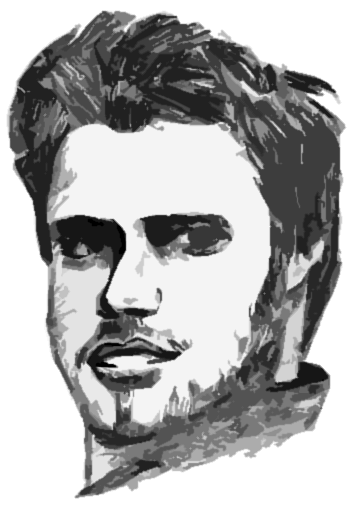
But my parents (and this is not a photograph of me) used to pay people money to give white boys like me this haircut:

This is a haircut you give a child, when you do not give a fuck what people think of your kid, when you want him to get the shit beat out of him and he only survives because so many parents also harbour resentments of their children that he disappears in a sea of mushroom cuts. The haircut you give your kid when you are oblivious to what people of culture and taste think of you, or your ability to parent. The haircut you give your kid, when you slept through the classes about Hitler's visions of a perfect Aryan race and what was bad about them.
This haircut was incredibly in the literal sense of what 'incredibly' means, popular with parents of my parents generation. Like we'd been bad or something, or they hated us. That hair is clean, that hair is brushed and it looks terrible (sorry kid, but you know it's true, I can see that that smile is 'brave' and that you are in fact, about to cry and I still can't tamp down my bullying instincts to put my fist through your face because by rendering you unrecognisable it would improve your quality of life under that fringe) fucking cave children roll off elk hides with natty, parasite infested hair and look better than 80s white children with their low infant-mortality and long life-expectancy rates. Except as it transpires, that when the leading cause of death in males under 50 is no longer parasites, diarrhea, syphilis, rabies, appendicitis et al. men choose to kill themselves as their leading cause of premature death. Coincidence? It's Movember that fights for mens' mental health, not Bowlvember.
My parents in turn would have been of the Levi-501 generation, having had their own battles with their horn-rimmed spectacle parents to "chill out" about the fact that kids these days don't wear trousers, don't go to Church, drive without a hat on, don't wear gloves, and don't know who "that bitch on all the money" is.
On one of my first dates with Claire, she pointed out how it was our grandparent's generation that lived through the depression, but an abhorrence of food waste had been transmitted through three generations, from their children to their children's children ie. us. I can only imagine that there is a similar sensibility regarding children's hair that goes back to the bubonic plague. But Milhouse was the voice of our generation when he declared "it's not cooties it's lice and my mom says it's nothing to be ashamed of."
But what about having to get a special duster on a pole to remove cobwebs in a high-ceilinged house on a Saturday, because the nobodies from nowhere were dropping in?
I know to this day, I am sensitive to what I experience as the erasure of my being. Often the hardest part of a break up for me is the effect my former partner has in packing away anything and everything that reminds them of me, even though I understand this often indicates how much, rather than how little they care about me.
There is just some deep intuition in me, that saw it as reasonable in a home to see invisible lines where it's like "here is tohmicito's room, he is a child and he manages this space like a child" or a few years later "this is the door to tohm's room, he is an adolescent, he shuts himself in his room and listens to angry music because he is going through a prolonged period of disillusionment and is seeking out voices that do not lie to him, if I stop talking you will hear the muffled bass lines of Mike Bordin or Justin Chancellor bass players of Faith No More and Tool respectively which are on high rotation. We don't know if he is masturbating in there and it would be wrong for us to investigate" whereas kitchens, communal living areas, bathrooms are spaces adults are responsible for.
The alternative message which makes no sense when you say the quiet part out loud, is "these are our children they have no agency and are mistaken about who and what they are."
I am sure there is something about this performative cleaning that functions as flattery. There is plainly a deception, because of how uncooth my joke-cum-threat to point out to our guests that a coffee table was normally cluttered with books and VHS cases and CDs that we read, watched and listened to rather than dust, and so normally there was also a patina of dust on that coffee table too, but they were all stashed away to pay you the respect that we in fact sit in a sterile environment staring at the wall, or worse, watched Channel 9 on free to air TV.
I don't know, I don't understand it, I don't know what it was all in the service of, but it was fundamentally performative, deceptive. The best and most benign I can guess, is that it was a form of costly signalling, that lets the guests know we expended all this effort to erect a facade that nobody could possibly believe was reflective of our day to day reality.
But I'm sad that you could not come to my house. See how messy my room actually was, the cds all over the floor, those CDs were important to me. The millimeters thick layer of dust on my desk I pretty much never used, that desk was unimportant to me, hence neglected, even reviled. How I piled my casual clothes in a heap and dressed mostly from the floor. And the doghair, on my clothes, on the rug, and the cardboard boxes our dogs had to sit and sleep in because their was a Quixotic quest being undertaken to keep the house tidy.
I'm sure there is a lot going on, and opinions will differ. I suspect a Robert Sapolsky style analysis would fully explain performative house cleaning as needing to understand 5 minutes ago, 5 days ago, 30 years ago...150,000 years ago as to whether your ancestors lived in a fishing archipelago or whether they were nomadic pastoralists on the steppe.
I would drive at this fundamental thing which is painting a smile on your face and come back to that quote from Pieper that "[they] no longer respects the other as a human person" as a fundamental truth.
I will freely acknowledge, that there is much wrong with me, as a person. Even as a child, for which I likely was not equipped to take responsibility for, but this was not handled by painting a smile on my face, nor on our house.
And then there is the degree to which things were fine, but presented as perfect. Like cobwebs are fine. Dust on bookshelves are fine. Dog's being inside is fine. Lawns not being edged is fine.
It was getting into these diminishing returns that I would guess the old culprit shame needs to be suspected, and I hope I do not take too much license from Pieper, to say it is an abuse, a lack of respect for our fellow human beings, to hide our shame.
"Who needs the approval of one family member when you can have it from millions of acquaintances?" ~ Mayor Shelbourne, Cloudy With A Chance of Meatballs
The reason you could not come to my house is that you weren't allowed to. I would eventually learn, that this was not a universal practice. As a kid and teenager, even as an adult, I have tended toward having a best friend whose house I spent a lot of time at, where I was made to feel at home, and aside from a willingness to help out with chores I probably failed to "assure the host I was not" at home. What I didn't do was go to a bunch of friend*s* houses, and likely for bio-psycho-social reasons, I didn't tend to befriend kids who lived in houses that felt like hotels rather than homes with shit lying around and mess and clutter and all the tangible evidence that people live in a home.
But because flattery is a deception, all I can testify to, as an insider, is that the house you visited was not the home I lived in. Either we were lying to you, or we needed you to lie to us. Or possibly both, like when Dave Chappell did that bit on fake people who make you fake, I believe anthropologists call them Californians.
Maybe though, other people live in neat and tidy homes. I mean absolutely some people do. Let me hit up pinterest real quick.
 |
| Neat with a dog. |
 |
| Messy w/o a dog |
An influencer's bread and butter is literally the pursuit of the adoration of millions of strangers. But in the first image, because of those very pressures, I just can't have confidence I know what I am seeing. It seems likely though that the image is heavily curated. Not just the fit, but perhaps the placement of the dog. My attempts to read the mind of the dog and compare it to my experience suggest that the dog was recently told to "up, up" on that cushion and "stay" or "sit" or possibly "down" which the dog will understand as "lay down" not "get down" and it appears to be interested in when master is going to okay it to come and loiter around her and be like "what are we doing where are we going?"
It is plausible though, that this influencer is rich, they have a cleaning service, possibly an interior designer, they may also, as seems very likely, have been born rich. Rare is the Lillie Allen who while having a famous parent, pulls themselves up by their bootstraps. I'm sure influencers have a huge advantage if they have the starting capital of a dentist's offspring, vs a teenager that caught a bus up to Oaxaca from Chiapas and works a 10 hour day to earn $4USD to save up for her first smartphone.
The second image though, contains text that suggests a different kind of curation. The thing is, I believe this photo, I feel confident in what I'm looking at, though it may be to some extent performative, this is much closer I feel, to the median experience of an adolescent to undergrad woman. She owns a bunch of shit and storage solutions don't work. She doesn't have to essentially complete an obstacle course to get into her bed each night, but I believe she has a wardrobe that has overflowed onto a cheap roller rack, and flat surfaces are immediately co-opted to house her abundance of shoes and cases for jewellery and makeup and electronics and she is time poor, cash poor and space poor.
The same confidence-disparities apply when it comes to visiting people's houses. Alas, just as I don't understand the full story of my own experience, like I've been in some spick-and-span houses in my life, but I have no fucking idea how curated my impression was. I simply lack the experience of someone going all out when I visited to make their place feel like a hotel suite, and then watched them break after three days and confess that "I can't keep this up. I need to use the stove top and fats gonna fly. I can't keep running down the street to the public park toilet block to shit. I live in this house, and my existence leaves a trace."
Perniciously leaving me with a lack of understanding if I have been in households that were what my household occasionally pretended to be, or whether I have been in households that were also pretending to be what we pretended to be.
I feel it is more likely to be the latter, under Occam's razor rules. The best evidence I have is that common experience people in Australia who live in apartments with balconies have, where they are technically not allowed to put a clothes horse on their balcony because in a paradox of modernity - apartments are less valuable to potential investors if they give the impression that they are used as housing by tenants.
And just as apartment dwellers struggle to air their clothes in deference to hypothetical buyers passing by, enter the Schrodinger person whom may or may not exist that was alleged by my school administrators to call up the school to report uniform policy violations they had seen by students off campus, down the street. I have friends that say "of course these people really exist" I'm more inclined to think these were just "good guesses" by administrators playing the odds that almost certainly, students left campus and untucked their shirts, rolled up their sleeves, took their blazers off, and defecated in gutters because school uniforms are anachronisms from another fucking country.
The kind of person, I assert, that has the motivation, should they exist, to call up a school and say "I saw three ungentlemanly students of your supposed house of learning entering a KFC at 2pm with their blazers tucked under their arms!" is by definition someone whose esteem is worth fucking nothing. As Bart said to Mr. Stanky "let's just say I'm a concerned prude with a lot of time on his hands."
I'm not saying I've never been to Epstein Island, I'm not saying I'm not in the Epstein files, redacted or unredacted. But the curation of private school students, really the upper class, the attempts to mould young boys and girls into the kind of person who wouldn't be seen dead in a KFC without a formal jacket, is likely foundational to the kinds of abuses perpetrated by and for the Epstein class.
What matters is not the etiquette, but the manners. Objectively the kid whose school does not require him to wear a necktie that holds the KFC door open for a tradie coming in to grab lunch and use the bathroom is a better person than the private school boy in blazer and tie that leaves their trays on the table for staff to clean up and date rapes your daughter.
Now, I'm not stereotyping all private school boys as monsters and all public school boys as angels. I am a private school boy. I am saying "manners maketh the man" and the point of blazers with embroided crests, leather hard soled shoes, neckties, boater hats is and always has been pageantry to confuse exclusionary etiquette with inclusive manners.
You don't hold a door open for another person so they can esteem you, you do it because you esteem them.
It was my second year in a residential college that was likely my first real experience of dysmorphia. At my college, back then, people applied on printed applications, you attached a passportish size photo of yourself, an image that would be reproduced in the student extension directory in black and white photocopy and the tradition was that the photos from the application would be stuck to these big boards for all the "freshers" and displayed on the junior common room window with names to help facilitate orientation week, where the intake students got to know each other.
I was an "o-weeker" a returning resident that would facilitate o-week, an elected official so I was present that year when two young women cut their photos out of the display board. In contrast to making kids kiss distant decomposing relatives without their consent, yes there are in hindsight likely a bunch of consent issues to be explored with this tradition and the use of residents application photos.
At the time though, I found it odd behaviour. Irrational. I expect it to be a basic incompetence in perceiving how we look. A lot of people think ascertaining how we look is a matter of perceiving oneself in the mirror, and may be thrown when seeing in a photo of themselves, that their hair is parted the other way, that other people don't see their reflection, they see them. But actually, how we look is best ascertained by how other people treat us. This is the reconciliation we need to do with a photo we find unflattering, and there is that flattery again.
When I see a photo of myself looking particularly weary, haggard or burnt out, when strong downlighting turns my hair translucent and reveals my scalp or experience dysphoria in myself usually because I'm doughier than my self conception of who people are interacting with, I feel something, maybe bad, but take a conscious moment to think "well that's how I looked and people treated me fine."
Now I don't disagree if you are already thinking "that's because you're a man, that's because you are white" certainly it is easier for me, but the tricky thing for me regards flattery. People tend to treat me as though I am intelligent and authoritative and worthy of respect no matter how I appear outwardly, I can count on one hand the number of times I have been disrespected to any extent that obstructed me from getting what I want. You in an Armani woollen suit and glasses by Oliver's peoples and Gucci loafers is not your ticket to being treated like I have been treated almost my entire life.
Maybe I'm being flattered. Almost certainly I have been a victim of flattery, having interactions where people assure me I'm fine through word or deed and then never hear from them again because they were lying to me. The contents of other people's minds and hearts is also not entirely a mystery to me, though mind-reading is, I acknowledge, a cognitive distortion.
But there's also times when I'm overconfident, I'm being mean, I can tell people don't like it but won't do anything and I avoid my shame by feeling contempt for them, and their inability to stand up for themselves and this is like when I say to someone "nice hair" and they are like "ha ha." When I write out the social exchange it sounds more sinister than it is.
And by that I mean:
| From "The Far Side" by Gary Larson. |
I'm sure it doesn't help that I make fun of your hair, but this is because I am a lay pleb. and not a dentist merely touching your gums gently with a probe and using your sensitivity to diagnose a larger problem in your emotional health.
One of the things certainly wrong with me, is that I don't esteem most people enough to esteem me in return. I've told the story a number of times from my early flirtatious exchanges with Yoli, and it resonated with one friend enough that they've shared it back with me as an example of me-ness. I walked into the break room one time and she was there so it was just the two of us. We made small talk, and she asked me what I'd been up to and it happened to be after the weekend I ran a marathon which I mentioned and she said "what? I don't believe you." and I replied "I don't need you to believe me."
I possess in other words the obverse attitude to "photos or it didn't happen" which isn't in an internet context, insensible as a policy. (There's a lot of people claiming drinking milk from a cow's anus cured their cancer and such.) Crucially, the marathon isn't something I have run in the past to seek esteem from my peers. It is for me, an autotelic exercise that I generally employ to get away from people and feel emotions like isolation and despair. And Yoli is someone I liked and wanted to like me.
Based on my observations, other people seem to really care about the impressions they make on people they in turn, don't particularly care about.
Back when commercials weren't 100% gambling and scams, Harpic ran a campaign with the slogan "What does your loo say about you?" for which, I cannot find the ad that ran on Australian televisual milk crates, but I found a British one that is no doubt, the original:
I wish I could find the ad campaign I remember, because for my cultural context the casting sensitivities were perfect. The host was clearly a perfectly nice woman just trying her best, the kind Mitchell and Webb portrayed in the "women sort yourselves out" sketch, and the guest was some horrible snob, a real Karen, someone with both resting bitch-face and animated bitch-face, the kind of woman the Australian patriarchy can't successfully keep out of offices where they can make an impression on foreign visitors so they can't appreciate how chill we can be at our best.
My RMIT Marketing lecturer Con Stavros, now a faculty dean, made no bones to my class that he found such campaigns unethical, not specifically this one, but any that operated by trying to sell you some personal deficit in order to sell you a product to bring you back up to the blissful ignorance you experienced before they told you.
This is particularly different from say, making someone aware they have cilantro stuck in their teeth, causing them momentary embarassment before they remedy the situation with a fingernail, and know going forward everything is going to be alright.
I can't read British archetypes, in the Australian ad though, you need to be able to parse that the problem isn't that your toilet doesn't have the right plastic attachment that releases chemical streaks with every flush, gets covered in shit itself, colours the water some colour that people associate with strong chemical agents, think of a port-a-potty and also infer that your shit must be especially potent because most toilets don't have visible urinal cakes in them, except for the grossest toilets used by the grossest people; but the problem is that you have a snob in your house, and the ad actually tries to sell you an anti-solution to the problem - a product that will encourage a snob to stay in your house.
I have said before, and I'll say again, I know there is something wrong with me. I too heavily discount millions of acquaintances. There is something unhealthy in the romantacism of ATCQ's "Against the World" I am the grasshopper that needs that speech about "if the ants rise up" from Pixar's A Bug's Life although granted the grasshoppers lose despite the speech and in my case there is no "us" of grasshoppers, and grasshoppers have a more successful historical record of killing hundreds of thousands of humans that underestimate them than possibly any other animal on earth except the mosquito. But I digress.
I'm going to "yes, and" my own defects as a human being. Psychologist Esther Perell, it's been years but I listened to the first maybe two seasons of her podcast where she shared de-identified recordings of couples therapy sessions. I recall one where a couple were struggling with impotency issues. The husband couldn't get it up, Esther dug into his background and inquired as to whether anyone had ever asked him "what would you like" on the hunch that he was from a cultural background where families valued 'face' or something.
I'm not some orientalist that delineates a hard and fast line between the Orient and the Occident and that they are necessarily opposite. In this case The Onion article "Teen Unaware He Locked in Heated Ongoing Competition With Parents' Friends' Son" is good investigative journalism into the human condition.
White people also get overly concerned with face without Maoism, Confucianism, Taoism, Buddhism, Hinduism or living through the Qin, Ming, Tang and Han dynasties, The Great Leap Forward and The Cultural Revolution.
People everywhere fall for comparison traps, let the imagined attitudes of millions of acquaintances get into their own heads, and wind up resentful of their own children, something they imagine would also be judged unfavourably by millions of acquaintances and so need to add to the list of things they need to "fake until they make"
There's a calibration issue, and like I probably am not calibrated into the Goldilocks zone, I wear clothes until they fall apart, this has been a life long habit, and the recent change I made to my lifestyle was to learn to sew so I can better repair my clothes and get even a few more weeks out of my rags.
Alas, it's a calibration issue, not a "just don't do that" but you have to make careful adjustments to stay in the zone.
The triggering incident for this post was being in my parents house and needing to throw something out. I walked up to the bin and had to ask "where is the bin?" in a world weary voice, for me the equivalent of "Dad have you stopped taking your meds?". The bin had been removed, hidden, in anticipation of a guest. Making me instantly recall the scene from Curb where Larry's cousin Andy and wife tell Larry off for using their kitchen trash can, and Andy's wife explains the purpose of the bin is that "it indicates that we know how to throw things out" to guests.
I am certain that this was based on actual events.
Fortunately, that was not the house I grew up in either, the house I grew up in had a bin. Our first dog Lil when she was dying but before we knew it, would knock the bin over to eat the contents because she couldn't swallow food because she had developed megaesophagus and so was starving constantly. Lil was a big and best part of the house I grew up. Sadly, you couldn't come.

No comments:
Post a Comment