Tuesday, August 31, 2010

Success is like a Cafe

So I talk about failure a lot, peeps know I'm obsessed with it. It is my mistress I court at every corner. But what of it's twin sister - Success?

I was sitting in a very nice cafe today, the name of which I don't know and it was so nice I kind of thought it would be a nice life, running a cafe. I don't know shite about coffee it's true, nor could I make good muffins or sandwiches and whatever. But seriously, having your business as a nice relaxing place for people to unwind would provide one with a nice relaxing place to work.

Anyway, I thought 'Success is like a cafe.' And maybe it isn't. I don't know what I'm saying...


Now I remember, success could be like a cafe, but really what I'm talking about is the vague and abstract concept of 'making it' that is the breakthrough. I've been told in any creative pursuit you are a pro when you don't actually have to do anything else to support yourself. That is you are a writer when you tap out a story or article from time to time and don't serve coffee at Starbucks to pay the rent. (it just occured to me that I know a writer literally doing this, fortunately he's probably too busy with starbucks to read my blog). You are a musician when you earn money from blowing on the end of a tuba and not when you give lessons to some fat kid from private school. You are an artist when you go to your studio and paint a rotting fish still life and sell it for your years wages, not when you go to a call center and conduct computer assisted telephone interviews for the collation of statistical data.

Thus the concept of 'making it' through this frontier has tremendous appeal. Anyway I'm going to stop explainanating and just talk about cafe's now.

If you are some kind of creative, you want to be the cool cafe. The hidden secret place to chill out. You just want to be a good cafe, that makes good coffee.

BUT you want people to find out about you and flock to you every lunchtime and pay your mother fucken rent by loading up on lattes. You want to be successful.

You could once successful, buy out your neighbours and put on more staff and service more customers. You could get an electronic cashier, you could have a seperate staff member for ordering and paying and pay somebody else to be your barista and send them to official barista competitions.

Or you could just keep being that cool cafe you always wanted to be. You can't service your demand, but you are doing what you love. You won't get all the customers you can, but you will keep all the customers you can handle. That is, no matter how many people hear about this cool cafe, this great atmosphere, you just keep being what you wanted to be. You get some money, not perhaps as much money as you can wring out of the short term, but you get it and you get to keep the atmosphere, the vibe you wanted to create.

That's mother fucken success. Success is like a cafe.

Tuesday, August 24, 2010

Open For Business*

*I'm not actually open for business. yet.

Before I know it I will have graduated and will be legally able to dispense financial advice. I think as a mature student sitting in the front row because my eyesight has already gone I also think about my future clients a lot more than the green uni students that surround me with no real practical experience in the workforce. I think about my future clients often and I have become increasingly aware that in the future I may have none, none that I can help anyway. Here (hopefully) briefly is why:

#1 I don't think like the majority of clients out there.

In Business Finance (Finance101) the lecturer asked rhetorically why we buy a share, the answer being 'for the entitlement to future dividends' which is fair enough, but in a departure from this (and my usual emphasis on practical outcomes rather than semantics) I am considering one day putting in large lettering on my wall a different answer 'we buy shares because we wish to assume the risks of ownership.'
I don't believe in partitioning the mind, my last post looked at how believers could have minds such that they could design a scientific experiment that earned them an A+ in year 12 physics then go and listen to a priest give very specific explanations of the origin of the universe with no scientific evidence whatsoever.
Thus I don't see why I might go and support a sporting team may or may not win, or see a band that may never get signed or buy a zine of a friend that may never get a publishing deal then buy shares in a company I don't want to succeed.

Put simply, for me the question of ownership begins with whether you want the company to succeed or not. Not what its riskyness and expected returns are. Sure you want the business to be good, but first don't you want it's core value to be something you support. Thus I don't give a shit if a bamboo bicycle manufacturer offers more risk and lower returns than a brown coal exporter. I want brown coal to fail and I want bamboo bicycles to succeed.
From there I'd try and pick the best bamboo bicycle company, the most viable, the one likely to beat out its competition in the long run and so fourth, but that is where I begin my thinking not where I end it.

In this regard I'm much like Ben Graham and Warren Buffett - I think of buying a share in a company the same as owning the whole thing, and treat the investment decision as such.

Most clients though, shares are just numbers, and my lecturers teach me thus to reflect the industry practice. We spend hours talking about Beta's, covariances, variances, standard deviations, CAPM, CLM, RFR, Modern Portfolio Theory and almost exactly 0 time talking about companies. We assume that a clients criteria for investing consists of two variables Risk and Return and they don't give a shit how the optimum is achieved.

I give a shit, I don't care how strong BHP is, I don't want to own a penny of it.

#2 I can only help the rich.

I have friends that have the rich gene, they may not actually be rich but they are candidates to be rich. Why? they are willing to back themselves. They are willing to sink money into an uncertain venture and put up with the consequences if everything goes pear shaped. These are a slim minority of my friends that I try to spend the majority of my time with.

These friends one day I hope will be my clients, and I can help them. Most people I can't help.

Thus when I open my doors for business I imagine many of the people who walk through my doors will hear these sweet words from me 'get the fuck out of my office.'

I sort of don't want to touch superannuation money, even if there's a lot of it out there, and it is tax effective. I don't want it because it's money that has been saved for people, not by people. It's passive money in the possession of passive people.

People who think about their destination and not the road they want to take. People that will come to me with their own answers and just want me to tell them they are right.

People who want to buy property.

See I think my lecturers and the industry have got it all wrong. They invest tremendous amounts of energy into calculating risks and devising 'optimal portfolios' that in practice often underperform the market index (or no effort fund.) It costs people money to underperform the market and it is immensely popular.

But my chief concern is that uncertainty is uncertainty, and certainty is certainty and after the event you can be certain that whatever happened happened. That is the odds that something that did occur occured are 1.

Thus pointing out that something has an expected return of 14% with a standard deviation of 6% is a waste of everybodies time. Whether you get 8% or 20% are the consequences to concern yourself with not the odds of either occuring. Can the client deal with getting 8%?

Rich people can, they will give me money to play with they can afford to lose. They will say things like 'did I beat the market? who cares, I earned enough to buy this big house!' where the morons I will throw out of my office will say things like 'You charge 1% and you only achieved returns of 8% but MLC achieved returns of 12% this financial year so what are we paying you for?' and I will say 'I don't know, take your money and get the fuck out of my office. Keep chasing the annual winner because it won't be MLC next year.'

Actually that would be more than I can hope for, most people lacking the rich gene just listen to whatever moron at their dinner group is proud enough in the good times to advertise how well his investments are doing where he will shut his mouth all the times he has done poorly. Most people are concerned with keeping up with the Jones, independant of what the Jones' can buy or how they got there.

That's all I can think of right now, apart from the thought that is dominating my mind which is: it's lunch time.

Friday, August 20, 2010

What is an Athiest?

Athiest is a label thrust upon you for being consistent. Hear me out! There is no real belief system in atheism apart from this: you don't accept an assumption that explains phenomena when the only (unreal) evidence to support the assumption is the existence of the phenomena it attempts to explain.

Confused? You see a puddle of water on a table, basically an athiest can't say 'I assume there was an icecube there but hours ago' because there are other concievable and perhaps more likely explanations for how that puddle came to be. A leak in the ceiling, a spill from a glass of water.
Sure you could run a bunch of tests to shorten the odds, but an athiest can't/won't say 'there must have been an icecube there' because they can't prove it.

An athiest doesn't stress too much about where puddles come from in the same way that generally they won't stress about how gravity works. An athiest doesn't need to understand gravity to live in a world characterised by gravity. Gravity reinforces itself day in and day out and aside from taking up a profession as a physicist, an athiest doesn't feel any particular desire to inject energy into understanding and revearing the mysteries of gravity.

By contrast a deist can look at a puddle and say 'god put it there' and without knowing the slightest thing about gravity can attribute it's mysterious functioning to a design by the 'cosmic architect' or whatever.

That's all an athiest is and isn't they have a consistent mind set where they approach the mysteries of life all the same and assume no knowledge. They can question everything as a result of this non partitioning of their rational process. What's really most amazing is deists that are perfectly capable of studying physics and biology yet have partitioned off a corner of their brains dedicated to religion where they apply the exact opposite rational process of assuming knowledge and rejecting evidence that contradicts it.

But this is important, one of the key differences between athiests and deists is that athiests don't really exist, as I said it's just a label foisted upon you for being consistent, thus there's no real unity or bond of belief that holds together an athiest community and this is just how I like it. Two people that hate eachother may be thrust together by their shared spiritual belief but not so with athiests. To each their own.

Brakeless

No I haven't bought a fixed gear, I'm just thinking that for a while now I've been coasting through life without any brakes. What are the brakes? well remember 'catch me if you can' where Leo Di Caprio meets with his father in a restaurant and begs him to ask him to stop (a life of cheque fraud and running from the law) and his dad just wants him to keep sticking it to the man?

Well I'm doing nothing so dangerous or irresponsible but it occured to me that in the long monotonous process of getting over my ex Misaki has resulted in their being nobody in my life that could ask me to stop what I'm doing.

I mean, I didn't like working at Honda, I did like it, but deep deep down I knew a big part of me was unfulfilled I wasn't charging headlong at the wall of my limitations, I could succeed at Honda and thus had to leave.

But I knew that if Misaki asked (at that time) I would have stopped, settled and accepted a life less ordinary just to be with her. I got enough happiness at the time simply from her that I would trade the rest to keep her.

Fortunately/unfortunately she needed to leave to work in the family business. So my brake system was being dismantled anyway. But the thing about getting over somebody is that you don't really notice when it happens, because part of it is that you don't think about them much anymore, so I was kind of caught offguard when I last spoke to Miki that almost a year had gone by, and that she was engaged and thus, there was no (I sincerely really hope there isn't) chance she'll call me up one day and ask me to stop. And if she did, nowadays I'd probably ignore her.

It's a bit daunting, but I feel like I'm becoming myself, for better or worse and nobody can ask me to stop.

Monday, August 16, 2010

The First thing To Do When You Panic

...is nothing. Today I was reminded of what it felt like to have my wallet suddenly dissappear in a foreign country and find yourself with no means of supporting yourself whatsoever.

I went through shock and denial very quickly, they get out of the way with a few searches of every possible place I could have misplaced my wallet or whatever. Travelling if it teaches you anything, teaches you that you simply don't exist except for the fact that you have money in your pocket to exchange for goods and services.

So I imagine losing your wallet when travelling alone in a foreign country is much like how Ariel Felt when Ursula took her voice in exchange for legs.
Except I don't have great legs that can nab me a handsome patriarch to look after me. Nor singing crab companions for that matter.

But in Abe Lincolns tradition of 'If I only had 5 minutes to cut down a tree I'd spend 4 of them sharpening my axe' or whatever, when you panic I highly recommend sitting down and letting time pass. 5-10 minutes is plenty. It isn't so much about planning or getting your shit together or whatever - it's about running an empirical experiment where you can prove to your own mind that the world isn't going to fall apart instantly.

Once you realise you have space to move it's much easier to come up with rational solutions. For me it was cancelling my card and stopping pending transactions from going through. Ordering emergency cash, and a replacement card. Then I just had to go to the police and arrange a 'pay on checkout' deal with my hostel.

The second time, I just had to devise some collatoral to offer to the hostel (because I dimwittedly arrived in town with no money having stuffed up a transfer of funds) which was refused on account of my trustworthy face and then digging up some old Japanese currency so I had enough money to eat a meal.

The thing was that in hindsight these situations were pretty easy to survive, and I could have survived a lot worse by sleeping on the streets or something.

Panic flares up to drive us furiously away from something unpleasant, but often it doesn't inspire the easiest, most graceful or even most immediate solutions to passing through our current state of affairs. Often the easiest and simplest thing to do is to endure the unpleasant and take it from there.

Having said all this if you can see the thief making off with your wallet, chase him down, don't do nothing.

Sunday, August 15, 2010

Getting Used to Being a Loser/Don't Be In a Rush to Succeed

James was skeptical of my triple encore theory but then like Kanye ruining an acceptance speech Ali Shaheed Mohammed had retaken the decks and cranked out 'Award tour' and the crowd that was in the process of departing hit the roof.
Except they didn't which was why Tribe stopped and rewound like 6 times until they were sure we were hitting the roof.
And it's not like they fucked up, after 20+ years of performing their shit was tight, we were apparantly fucking up our role as the crowd and it was really hard to determine what I was doing wrong as a member of it and further more I began to wonder who was paying who.

But I totally respect the will to do it over until its done right. And they did it over and over, and they did it multiple times through the show and it was totally the opposite of unprofessional.

24 hours later I'm standing in the reopened Tote's bandroom as men with ratstails and women with mullets pushed passed with plastic cups of bear reminding me never to stand between the stage and the bar again. One girl even even spilt her beer running into the back of me but I was wearing my terrance towel hoodie so I wouldn't have noticed if she hadn't been so apologetic.
Barbarion took the stage and started playing and more or less didn't stop. My ears are still ringing 4 days on. They had their original bassplayer Yuri back and boy were they tight. Tight yet loose and there a band I was lucky enough to get on the wagon of on their 3rd or 4th gig, they have a couple of new songs where they've clearly taken what they've learned but what really impresses me is what they've done with the tracks they've been playing for year(s) now.
They've pretty much amped them up, they've evolved, improved and basically injected more energy wherever they can.
They move about the stage better, command the space better and they aren't afraid to yell out instructions to their sound mixer to correct the balance throughout the show.
They've come along way in a short space of time and I can hear (and feel) the difference. The highlight though was when during 'Running From the Law' one of my favorites, the lead singer Myles a mighty man made a lacklustre attempt to crowdsurf which resulted in him singing from the floor.

The irreverant gracelessness is a big part of what makes this band successful and allows them to shape themselves and grow.

I'm sitting with 150 in a food court as usual (but unusually since we hadn't met for 6 months or so) waiting for the other members of the real gayle king to arrive. He's jotting down something I said which is kind of the point of this post, it's not something I said originally and sadly I can't remember who actually said it because I trawell through that much shit searching for references but whoever said it I resaid it and it was this: 'good is the enemy of done'

And 150 was writing it down, he seems to like my business management cliches that I like to recite to creative peeps. But this one was actually said I'm like 90% certain by a creative peep and that's what makes it so poigniant.

When the Real Gayle King first formed we wasted like 6 weeks of meetings (truly wasted because nobody documented the hilarious arguments) having infuriating arguments between 150 and me about online campaigning. I couldn't believe that 4 creative peeps had come together and the first thing 150 wanted to do wasn't to create but to online campaign and use trolling and forums to max out our web hits.

To be fair, this blog is my forum and 150 can't really defend himself, so in an attempt to do so, 150 was sort of the most successful of us at the time having quite a following of his zines through Sticky and was thus the least excited about creating tangible pieces and most excited about having a blog which the rest of us already had and not much more.

But while 150 is excused the rest of you ain't. Everybody coming into the creative scene is too impatient. How do I know this? Because I'm impatient, and yet whilst I know I've wasted years and it will take me years still (and years longer than I can ever anticipate) simply to get on track very few people think like this. They need to succeed and succeed now.

And I think that's what makes the old school acts, be they bands from the 90's or bands that should have formed in the 90's or earlier special.

H-wang when he eventually arrived at our meeting concurred about the photography world, saying that many of the old hands at photography had taken 20 years to establish themselves and nowadays the newbies worked 2 years before they were teaching classes on how to be a pro-photographer.

The mentality is everywhere despite the success of Malcolm Gladwell's outliers, and mayhaps that's just the facebook/myspace generation mentality. What the fuck is wrong with it though? There's a time to 'go professional' but not till after you cut your teeth. I remember in Year 11, Jacob yelling at Chris for missing his queue that it was 'un-fucking believable' this was a crappy house music competition of no consequence that's not the time to go pro but that's what so many creative peeps feel like to me these days.

I'm guilty as well, I once ripped shit through a friends manuscript (it was like fan fiction of some of my friend and my's fiction that in hindsight was too complicated to produce and never going anywhere anyway) because I was too attached to my own baby to see that everyone else just found it annoying.

Well the Beatles played in Hamburg for like 3 years just earning their stripes. I've seen Sutcliffe's or Lennon's sketches of Paul McCartney attempting to take a bath in a mensroom sink.

"We used to dress how we liked, on and off stage. He'd tell us that jeans were not particularly smart and could we possibly manage to wear proper trousers, but he didn't want us suddenly looking square. He'd let us have our own sense of individuality ... it was a choice of making it or still eating chicken on stage." - John Lennon - after 3 years playing strip clubs in Hamburg is the time to consider turning more professional.

Bobby Chiu one of the lead concept artists for Tim Burton's Alice In Wonderland talked about when he first set up Imaginism studios and how hard it was lugging books around to comic cons with no money and reflecting 'these we will look back on as good times'.

I'm not sure if anybody in the Real Gayle King is doing the work necessary to make it, but regardless I certainly will look back on our listless sporadic and disorganised meetings in QV food courts as good times. Sitting in front of the state library checking out girls necks at Butcher's insistence were good times. Having my phone go off with one word text messages that simply read 'late' were good times.

Rather than turn to Malcolm Gladwell I'll turn to an author I actually have read being Nicholas Nassim Taleb's Black Swan that talks about how to choose the right brother in law.

Basically there's two kinds of people in the world, the vast majority stake their dollars on a daily basis and win a long succession of pennies, encountering a major loss once a decade or so. It's a metaphore so you can basically substitute dollars with 'important things' pennies with 'small pleasures' and major loss as 'any kind of hardship'

Then you have the creatives, the risk takers, the 'losers'. But a very special kind of loser, they are a minority they bet pennies on a daily basis and typically lose them setting up a long string of successive losses all in the hope to win dollars, once ever decade or so (or perhaps never) they win big, real big.
Again the metaphore, should be easy to translate, it's the struggling artist, the research scientist whatever. They are convinced that grand prize is out there to be won and they've inherited this conviction from that common risk taking ancestor.

Whilst most of us would prefer a long succession of small pleasures, others can never be satisfied unless they win big. Many or most never succeed, but its hard to tell because we never hear of them the ones that do win big misrepresent the odds of winning big because we hear about them all the time convincing other losers that their dreams are possible.

And this is good because this is how progress is made. If nobody attempts to hit the jackpot then it just keeps sitting on the shelf of possibility and never crosses over into our reality and enriches our lives.

But maybe the balance is shifting, I just meet too many people that are less patient than me to succeed. Most creative peeps have done more work than me so power to them, but in the spirit of 'good is the enemy of done' I think the biggest leap I made towards actually getting somewhere with my drawing was to give up on the idea that I could ever actually get anything done right.

Looking back on my sketches for the early Real Gayle King Stuff I cringe, but I also see a lot of progress now. Looking at how terrible my drawings were then makes me feel a lot better about how terrible my drawings look now.

FYI I'm publishing on facebook mostly because I'm too ashamed to put any of my stuff up on deviantart yet, I'll get there though with a lot more work and it will be good to kick the facebook habit.

But maybe I'm lucky I never went to art school, and I don't expect much of myself, (the little I do expect is more than I can deliver) I think some of the professionally trained peeps expect more of themselves and expect to get their creative produce right the first time. They don't fuck around and experiment and screw up and evolve anymore because they just want to be pro's right now, they've been trained to be pro's and they aren't ready. 'the perfect is the enemy of the good, the good is the enemy of done'

I'm lucky I tried being one of the majority of peeps, and have a regular steady paycheck in a secure job earning steady small incremental accolades and whilst I wouldn't consider it a total waste of time I met some great peeps and learned a bunch of stuff and what not, I know it's not for me. I'm for living in a garage to minimise my living costs whilst I make ill concieved attempts to create things of meaning hoping one day I'll make something that will resonate with somebody whilst not being sure if that/those resonating somebodies exist.

I feel though if you're not a loser like me you should be putting down your pencils, your plectrums, your stylus, your tough new Lumix and buying a milkbar. If you want to succeed and you're in a hurry go to a real estate seminar and be a real loser. If not take the time to fuck around, fuck up, feel fucking terrible, get back on the fucking horse, fuck shit up old school, and fucking enjoy it.

To end with a cliche, it's the fucking journey after all, not the destination.

Monday, August 02, 2010

Profiling Risk

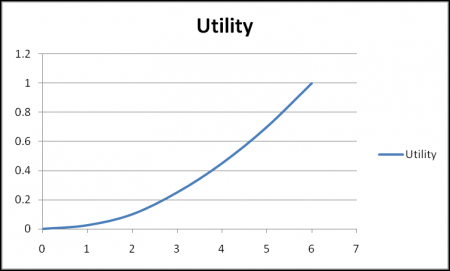
My risk profile is something I think about, it causes me great uncertainty. So when my Pricing Theory class addressed it it was probably the first time I've been glad to see human behaviour depicted by a graph.

You see, I'm trying to be a risk taker, but I don't think I'm a natural gambler. For example, I wouldn't gamble. But my obsession with failure has lead me to an unnatural risk profile.

So first let's just look at the most broad risk profiles:


This person is risk averse, the curve of the graph indicates that their 'utility' or 'consumption satisfaction' decrease faster than it increases. So for each dollar of income or whatever they gain the feel nice, but for each dollar they lose they feel terrible. They are more scared of losing out than they are of winning.

Now here's the risk enthusiastic:


This person due to the shape of the curve, gets more utility for an increase in income than they do from a decrease. They are all like 'woohoo' when they win a dollar and all like 'whatever' when they lose one.

So which one am I? Well it depends...

My attitude is this - 'I'm not important enough to worry about failure' if I went bankrupt tomorrow nobody and I mean nobody would lose out on it (except me). There would be no front page story on the Age, Herald Sun, Financial Review or Wall St journal.

Furthermore if somebody was like 'tohm you have to go live in a park now' I'd be able to deal with it (until I died of pnuemonia) but whatever... I have a high pain/discomfort threshold with a few caveats I'll come to later.

But I get these natural highs when I succeed. Like if I draw good and people like it I'm buzzing. I'm willing to sacrifice the income I could potentially be earning to give myself an opportunity to draw. Success at something I want to do (even the smell of it) is much more rewarding than 'successfully failing' as I've come to dub it.

So this is what I mean by being 'unnaturally' risk averse. I don't care about the consequences because I don't really care about me.

Now the caveats, I think our risk preferences have something to do with our broader behavioural prefences aka Jungian psychological profiles. I'm INTP or something I haven't done the test in a while, but on the simpler one I'm an 'Amicable' or an 'Amicable/Expressive' person.

So let's start with the key differentiator - Introvert/Extrovert. This is one of those counter-intuitive things where people assume an extrovert cares more about other people because they are more social. But when you dig deeper its infact the opposite. Extroverts socialise so more people can care about them, introverts are the opposite they care little about themselves relative to other people, hence they hang back, they observe they whatever.

I'm an introvert, I've trained myself to act extroverted over the years but I know that meeting people socialising etc drains my energy. I get rewards out of it but it costs me. Others get energised by meeting people and talking to people and what not.

So here's the boundaries of my risk profile. I'm happy to take risks for myself, where the brunt of the consequences effect me and me alone. I balk at the idea of taking risks on others behalfs. The thought of hurting somebody else kills me. So I am risk enthusiastic with myself because hey whatever shit happens I'll deal with it, I can crawl out of the abyss anytime. But as an Amiable person the thought of causing hurt or embarassment to somebody else in any capacity I am very averse. I'll do almost anything to avoid it.

BUT then I need a second wave of caveats.

I kind of feel contempt for people in my quasi professional capacity as financial advisor (I'm not qualified yet, but people keep asking me). Talking investments is unflattering to most people, it's not a good look and it breeds contempt in me.

Because most people are risk averse, they fear losses more than they relish gains. But they aren't idiots, most peoples biggest fear is a loss of income (except that very few take out income insurance) and that is because they are focussed on retirement. They aren't (particularly) stupid and understand that inflation may erode the purchasing power of their savings and thus a paradox is created.

Peeps want as much profit and money as possible with no chance of losing. They see not making big profits or returns as risky (because of inflation) but they see the risks associated with high return securities as risky. Thus people are naturally attracted to 'sure things'

In investment Law we are looking at the case study of Westpoint mezzanine finance group scandel where many retirees were dooped out of their savings by what in essence was a ponzi scheme. That's a world of hurt, but I do feel a kind of contempt for the victims - they invested in property development for high interest payments of 12%, they were reassured by the fact that for every $100m borrowed there was $110m in presales. Thus a risk free 12%. Nobody stopped to ask 'If they honestly have $110m presales, then why wouldn't a bank lend them money at 10%, 8%, etc. why take the additional burden of mum and dad investors money and pay them exorbitant interest when a big capable institution can assess risks for themselves?

So more paradoxes, there's this cliche of 'the greatest risk is taking no risk at all' or in a sporting analogy 'you miss a hundred percent of the shots you don't take' but people who keep their cash under the bed because they are scared of bank insolvency will have all their savings wiped out by inflation if not burglery.

My plan if I become a fund manager, hedge fund, financial planner is to drive these mum and dad investors away with extremem prejudice. I don't want to do business with people who don't want to be accountable for their own decisions. I could take risks with other peoples money if they have a similar attitude to me. I imagine I will only end up with the small change of people I can only make richer, but I'd rather play with $10k of pocket change from a millionaire than $10k of savings for your average joe.

Then again, as I actually achieve stuff through risk taking, my profile will probably change, I will feel vulnerable on account of my achievements and start to fear losses rather than gains. My plain is to live a fairly spartan lifestyle, like Buffett only draws a $100k salary even though he's worth 60+ billion or something now.

Anyway confusing, it's hard to take risks when you don't know how you feel about them.

Monday, July 26, 2010

The Utility of Prices

Okay so I'm back at Uni, and after what feels like months and months of not thinking about economics and finance at all, my brain is reengaging. Anyway this semester is actually looking pretty good subject wise. I only have one economics subject 'Pricing Theory' and it looks like it is taught 'well' by my definition unlike my Macro subject last semester which oversold its difficulty and employed too much coercion.

So Utility one of the central concepts of economics, it pretty much underpins all the decisions we make and all economic policies. Most often utility is taught as basically meaning 'happiness' which whilst I'm all for avoiding big technical language Orwell style I make an exception when lecturers simplify utility to 'satisfaction' or more painfully 'happiness'.

I'm fairly certain that they (John Stuart Mill and the classicists) employed utility because to suggest their models could explain or satisfy 'happiness' would be an outright lie. But similar to the behavioural management school - which manages behaviour because behaviour can be seen as opposed to 'attitude' which we can only infer.

Thus similarly I kind of assume that we use 'utility' because we can see people using shit, but can only infer whether it makes them happy.

So anyway, the past two weeks have been spent (not) drawing indifference curves. (I don't take notes in classes unless I absolutely can't avoid it) which are basically a two axis graph of X and Y (which can be anything) and a bunch of non intersecting curves that bow towards the origin. If you can't imagine it click this link.

And they kind of work well. Particularly when you add budget constraints, you get a nice neat world where people try to maximise their utility by maximising their consumption as far as their budget allows. Thusly thuserson you can even suggest that good X represents savings while good Y represents consumption and so forth.

People aspire to the 'highest' indifference curve. Are you following?

Now they've introduced three types of goods. A 'normal' good is a good that as your income increases or its price decreases you increase your consumption of it. Then you have 'inferior' goods which as your income increases you consume less of it (in favor of some substitute - eg. public transport, the richer you get the less you use it) then there are 'giffen' goods, these are goods that get cheaper but people consume less of them. They are treated as strictly hypothetical...

And this is where I always get interested in a lecture. The oddities, or when people see fit to introduce something that is only hypothetical - because this is perhaps my favorite half-baked theory of why economics is fucked yet.

See budget constraints, indifference curves and utility are all well and good if you keep utility and price away from eachother. But you get a quasi goedellien self-reference when you suggest that people derive utility from a price itself rather than the good it is affixed to. Hmmmmmmmmmmmmmmmmmmmahuhuh?

Imagine you got a pen right? right. You can use it to write right? right. So typically you would say the utility of a pen is its ability to write. But suppose you had a magic kind of pen that you could use or not use and it went up in price. All you had to do was hang onto it and it would go up in price. Now I guess we could call the appreciation of its price an indirect kind of utility, you can sell it and then use the proceeds to buy goods that have their own utility. This is kind of an opportunity cost or something, indeed money itself is worth only all the various things it can purchase if you want an on hand example.

But magic pens that go up in price regardless of how used don't exist right? wrong. This pretty much describes any speculative behaviour and it's corresponding wealth effect. Whether it is tulips, tech stocks or 'houses' speculation describes people deriving utility from price itself, rather than 'real' utility of the underlying asset. And these behave like giffen goods.

If people are consuming for price reasons, that is they buy a house anticipating further price rises and don't bother to live in it or rent it out (and worse, renovate it) then they are buying for the utility of the price and not the utility of the actual accomodation/location/infrastructure.

Now, this is another paradox I intend to deal with the 'risk averse' designation of consumers that inevitably drives them to risky speculative behaviour, but basically when people derive their utility, their pleasure through the 'wealth effect' which is the feeling one gets when sitting on an asset that is going up in price and then it drops in price - people consume less of it.

Which is all well and good, but whats exciting to me is the self-referential nature of goods that can impart utility from their price, or prices driving utility which makes it hard to ever fully explain consumer behaviour, rational prices etc.

Will ponder more... I need to get back onto Naive investor too.

Wednesday, July 21, 2010

Small Australia

As I write this Julia Gillard is telling me 'not a big Australia, but a sustainable Australia' new approach to population all that shit.

As somebody who has attended multiple Sustainable Living Festivals, I always thought sustainable population Australia were a bit of a joke. I still do, but unlike Prosper Australia which got a nod from the Henry Review and the fiasco that became the Resources Super Profits Tax, 'Sustainable Population' seems to have gained traction not just with the conservative side of government but the supposedly liberal side too.

I hate these population capping advocates, why? well they range from bigotted to vacuous. People who talk about keeping the human population down always, always lack any real vision - their arguments always hinge around some silent status quo ideal. Few ever articulate it.

All I'd ask is some guiding principal eg. 'Our objective should be to maintain the largest biodiversity the planet can sustain.' I like that, I don't think population controls are the solution, but it would certainly help somebody build a case.

Instead nothing is mentioned thus 'Little Australia' or 'Small Australia' arguments come across as bigotted and fail to acknowledge the myriad issue of 'who' who gets culled. I thought I'd look at some of the woeful oversights of population arguments because its starting to piss me off and get personal.

Resources

Basically the 'non-racist' stance comes from the simple observation that resources are finite. The planet earth simply cant yeild the resources necessary to satiate everyones material desires, therefore you can presumably cut back the population and needs will be sated.

We already have a methodology for dealing with allocating resources, it isn't perfect but its called the market.

When I say it isn't perfect, that's reflected by the fact that some 10% of the worlds population control upwards of 80% of the worlds resources. Infact I suspect 1% of the population controls 80% of that 80%.

Then there's water, land etc. all of these have markets in which immigrants have to compete. They have to compete against people who own 3-5 'investment' properties, they have to compete against coca-cola, aluminium manufacturers etc. for water.

Amartya Sen points out in 'Development As Freedom' that almost no famine in history has been the result of inadequate food supply. It is typically characterised by inadequate food access. What's the difference? Well one is where there is no food. The other is where people are priced out of the food market.

Even in Ireland, during the great potatoe famine, Ireland was exporting food to England. Famines are generally a failure of government to intervene in market prices in an economy where most of the population can only trade on its low skilled labour.

The point being that most resources problems are a question of how they are distributed amongst a population, and these issues are rarely related to the size of the population itself. Fact is you could try to 'stop the boats' by I don't know spreading peace and prosperity throughout the world, or you could say tax rent seeking mining companies on their super profits and redistribute that income to the community and achieve a better resource distribution outcome much more easily, effectively and morally than offshore processing.

Economic Arguements

Generally fall down, lets break it into two groups though - skilled and unskilled migration. The easy one is skilled. Australia's academic institutions are not world class, we can't compete with Ivy League Universities in the US or their equivalents in Europe. What we can offer is a lifestyle that many wealthy nations can't compete with.

US we have healthcare, UK and Europe - space. Same goes for Japan, China etc. Take Japan, last time I was in Japan I thought that it would cost close to $20 to recreate a typical Australian home lifestyle in Japan. Why? First you have to buy all the property, then all the adjacent property, then pay to have the powerlines buried, trees planted, roads widened even then you don't have access to the acid free rain or any way to stop right wing propoganda trucks cruising round your hood playing 'yuki ya kon kon' over and over again.

Skilled migration is cheap, people who have paid all their education et to come to Australia, help business and pay taxes for the community. So cutting back on skilled migration is not much of an argument at all.

As for unskilled immigration, that's trickier. Generally though, business like high levels of immigration because they feel it undermines workers salary bargaining position. But having a larger population does provide more labor for new industries when times are good, stimulates construction, etc. Plus they send their kids to schools and those kids can be anything. Their kids can be anything...

Allthough unskilled migration is tricky, it brings me to my next point -

Morality

Countries don't exist, not in the way water exists, dark matter (doesn't) exist, stars exist, continents exist etc. They are artificial constructs acknowledged only by humans that are trained to see them there. Fancy sounding?

Well yeah, but what I mean is that nationalism is ultimately transitory and illusory. Those ANZAC diggers we (supposedly) go out and support for example were fighting for Queen and Country, a COuntry where an Aboriginal Woman couldn't own her own home, where employers could discriminate against homosexuals and any number of pre-reform characteristics of our society. My Grandfather presuming he didn't diddle Japanese girls himself when stationed in Hiroshima would probably have had a hard time predicting that his grandson would date a Japanese girl one day.

'Nations' characters evolve and shift between generations and are essentially indefensible, you can't stop the children of tomorrow from valuing different things not without severely hampering their education by excluding what is constantly being discovered about life the universe and everything.

One thing remains relatively constant though, a nation is a social agreement to command exclusively some resources, most notably land.

Any resource on earth imparts some usefulness, some utility. Many called 'natural' resources are not created through human endeavor, they are a natural bounty.

The decision as to who has access to these resources (and community created ones like health, education and infrastructure) is relatively arbitrary. It is decided principally through the 'Ovarian lottery' that is, where you are born.

You have a 1/4 chance of being born CHinese for example, which means a quarter of the worlds children are born without any basic freedoms, you have a less than 1% chance of being born in Australia and if you want to enjoy the 7.2 hectares of resources in an Australian's average carbon footprint (sustainable consumption is 1.2) free health care, civil liberties, public education, wide open planes, fresh air etc. you have to move here.

People don't choose to be born, and they don't choose where to be born. But what fucks me off is that people who talk about immigration and sustainable population never have there hands up to leave these shores.

There's a suggestion of 'we were here first' of which I'm all like 'who's we?' well this quote from an excellent crikey article explains:

"‎Nearly all Australians are the children or descendants of immigrants. To demand a slashing of immigration is a staggering example of inter-generational opportunism on our part, in effect denying to future immigrants and their children the advantages that we ourselves have accrued as the result of the generosity of generations past."

Then there's NEVER any question of emmigration. These people want to suggest that living in Australia is a privelege not a right yet they don't then go on to say that we should pack low skilled Australians on a boat to make room for greater immigration from high skilled migrants. That we shouldn't Cuba style send all our convicts to the shores of Florida. Nor that we should send our poorest to countries where their meagre savings make them incredibly rich and take on some of the worlds poorest to provide them with the opportunity to become relatively rich.

Now, I know these arguments are untennable as forced emmigration obviously creates some obligation on the destinations. In the question of refugees we do have a moral obligation, as one decent human being to another we should offer shelter. Refugees don't 'want' to be here, they aren't like 'oh great war has broken out, I can leave my community, my ancestral home, my livelihood have fun in an offshore processing centre, and finally move to Australia!' that's not how shit goes down. People are never glad that war gives them a 'queue jumping' excuse to emmigrate somewhere. The loss of a homeland is devastating, so devastating we should as gracious hosts try to make them feel as at home as possible.

But more broadly, people should be able to move around the world, unharrassed and unmolested as the world is our common heritage and our ward. All this cordoning off into fences and divides is nothing but in-group/out-group gang mentality. If somebody is dangerous it is up to their immediate community to reject them, somebody on a permanent protection visa really has the same opporunity to do harm to the community as a backbacker on a 30 day visa does.

Why punish somebody just because they weren't born on the same patch of land as you? Why reward somebody because they were? This nationalism masquerading as environmental/economic concern is so sickening I turn to Bill Hicks:

I was over in Australia and everyone's like "Are you proud to be an American?" And I was like, "Um, I don't know, I didn't have a lot to do with it. You know, my parents fucked there, that's about all. You know, I was in the spirit realm at that time, going 'FUCK IN PARIS! FUCK IN PARIS!' but they couldn't hear me, because I didn't have a mouth. I was a spirit without lungs or a mouth, or vocal cords. They fucked here. Okay, I'm proud.'"


You can't pick your parents, your family, in many places you can't pick your government, or who your government works for, but people can and should be able to pick their country and be unharrassed by people who don't even bother to check whether the arguments they raise have any factual basis.

Tuesday, July 13, 2010

My Heart

I remember on warm September nights riding to Napier St in Fitzroy and thinking I'd entered some kind of fairy land. It's an old suburb with quaint little houses and oldschool hotels on the corners. It was different from Brunswick, this is probably no real news at all to people who lived in Melbourne all their lives, but when you move here from Ballarat to go to Uni you don't really take time to explore all the hoods.

Plus my normal cocktail of brain chemicals was ascue because I'd just really got a handle on my grieving process. At that time I felt like a worthless bug just waiting to be crushed. I remember listening to 'Smaller and Smaller' by Faith No More over and over again. On top of that when you spent 9-5 in a drab office under flourescent lighting McDonalds upholstery is going to seem like Disneyland.

I spent every Thursday night with a group of cool people learning how to tutor refugees with the Fitzroy Learning Networks 'Community Networker' program. I think it was like 6 weeks of 3 hour training, police checks etc.

We learned how people deal with the trauma of being tortured, about how men are often too old to get work in Australia when they bring their families here and the problems of having the wife become the major bread winner while the man just stayed at home becoming chronically depressed.

We had a Sudanese lady from the community come and speak to us, and I was blown away when she talked about the jobs her and her friends got 'cleaning, driving taxis...' pretty much every bottom rung ladder job you could name - I realised unlike my parents 'sacrifices' to give me a good education, these refugees were working to give their kids a chance at a shitty education so they could get better jobs so that their grandchildren may have a chance at a decent education. These people were looking forward to their grandkids, it blew me away.

Also the vegetarian pizza they ordered was amazingly delicious.

So training was great and eye opening. And then I got assigned to Zaman, I had assumed my student would be somebody close to my age. I was informed by Sara the coordinator an amazing person that as far as anyone could guess Zaman was between 50 and 60, he had no idea of his age but his papers said he was 40. At any rate I was immediately terrified of having to teach somebody twice my age.

Zaman was somewhat of a local celebrity at the network so they showed me his picture before I met him in the flesh. I remember at our first meeting he cleared space on the seat by flicking this cat really hard in the ear that was sitting there. I had instantly forgotten every single lesson plan I'd prepared in case he wanted to know something and he pulled out a Fork Lift Drivers instruction manual as part of his scheme to get a better job and hopefully get off the cursed Temporary Protection Visa.

I met Zaman when most of the hard work had been done, he had been detained on Nauru as part of Howards' Pacific solution, where the only way to call his anxious family was via Telstra phone cards that cost about $7 per minute. It was brutal and inhumane, and fortunately there are wonderful people in the world that care enough to help out complete strangers like Zaman by writing them letters and sending them phone cards.

Apparantly he'd been suicidal when he first came to Fitzroy and found out he was on a temporary protection visa which meant he was stuck in Limbo for 5 years before he could be reunited with his family who were moved constantly between Jordanian and Pakistani refugee camps. When he got work and could send money to his family he improved dramatically.

So Zaman ironically put me at ease really quickly, he turned out to be quite hilarious and describes everything as 'beautiful' even when I write a word out for him like 'accelerator'. From the get go he pretty much runs all our lessons. I just turn up, listen and try to explain how english works, often discovering that I don't really know.

Saying bye to Zaman when I went travelling was the only farewell that moved me to tears. I'd just discovered he'd never actually met his youngest daughter, and had attempted to cook me dinner, we ended up drinking tea and eating mandarins.

Yet beautiful as Zaman is, he is but one of thousands upon thousands of refugees created each year by discrimination and neglect the world over. The whole of Fitzroy plays host to a community that has become my heart.

Nowadays Zaman and I meet up in the library and walk home to his place in the Atherton Gardens housing complex. We often run into his kids, and thats the amazing thing about this corner of Melbourne. Kids are everywhere, outdoors in winter playing in the parks. Indoors at Fitzroy Learning Network playing on the computers until the teacher turns the lights out and pushes them out the door.

The community is vibrant, not without problems which happens when you've been raised to believe the police are only there to beat and brutalise you and that nobody looks out for you but yourself. But to be honest, I never see these. I feel safe wandering those streets at night and I feel welcome in refugees homes.

I admire these people like no others, because they are nobodies and they are everybody. They have nothing I don't possess in my basic humanity, a will to survive, infinite capacity to love. They are put in positions so horrible I can't concieve of them and survive. So many have walked away from their family homes, the towns their ancestors lived in for generations to escape persecution and deprevation. They have done it not for themselves but for their children and their childrens children.

They have given everything they own to people smugglers for a dangerous and inhumane journey by boat to the shores of Australia. Australia's 'Boatpeople' policy under Howard was condemned by the UN. Temporary protection visa's are a nightmare, holding people in limbo in one of the worst situations of their life and prevent them from becoming settled and constructive members of the community. Mandatory detention is frowned upon, and mandatory detention of children was a direct breach of UN conventions. It is a sad indictment of the Australian community that these policies lasted so long.

Yet these people stood it all, in pursuit of a dream. They made the kind of sacrifices the world requires right now, above and beyond what needs doing in fact. Reducing our carbon footprint is a breeze compared to the depravity with which a safe and civilized country treats 'boat people'.

They take it, stand firm and do what they can. Study english, work shitty jobs and cope with hours and hours of loneliness and depression. Beautiful people like those at FLN help them, and I guess frauds like me and you can see the result walking through the towers of the Atherton Gardens, my heart, you see kids being just kids running and playing and getting in fight and backchatting old clowns like Zaman and me. I saw a kid pick a fight with a chicken, a literal chicken.

And sure they can be annoying and demanding in the library, but these kids man, its like they are oblivious to what their parents have been through. And they are, I remember fondly Zaman complaining that his kids 'have been to Zoo, have been to Aquarium, have been to Farm... nobody takes me anywhere.' Which is true, I never managed to get him to the Parliament house tour for his citizenship test preparation, not that that is as fun as the zoo.

And then there's stories that break my heart too. Like his friend who was sent to Perth whose kid dived off a bridge into a river and broke his neck becoming a quadraplegic right when he'd just gotten safe to Australia. Or his old housemate that gambled away his earnings and never spoke to his wife or bothered to apply for citizenship.

But there's nothing really dangerous about refugees, I don't even understand how its a fucking issue. The only problems to me stem from the lack of resources available to help new Australians feel welcome and integrate into our evolving community. Its when a refugee is isolated, socially, financially and by language barriers that they are going to do what any person would do, try and survive by whatever means necessary.

By contrast, the temporary protection Visas meant Zaman's eldest daughter had to recieve chemotherapy in Pakistan in the poor quality healthcare available to refugees, she has suffered complications as a result and been in and out of hospital almost constantly. The delay in bringing her to Australia was unneccessary and inhumane, and I sincerely hope it doesn't cost her her life.

But seeing fucking twerps and cunts like Abbott and Gillard working ignorant and irrelevant members of the general public into a frenzy to 'stop the boats' and subsequently make these human beings suffer more. I mean what are they fucking talking about? less than one percent of refugees arrive by boats with the vast majority flying in. Those that do arrive by boats are overwhelmingly found to have legitimate claims to seeking refuge. The 'queue' they are supposedly jumping doesn't really exist, furthermore the queues that do exist, like Australia's interview process and the UN refugee charter process less than 10% of the demand. The vast majority of Refugees are offered refuge by the worlds poorest countries. Why is this an issue? Why do people fucking care? Why do we have to be so distrustful and uncharitable to some of the neediest people in the world?

These people are capable of building a beautiful community. I see it every week, its my fucking heart and its one I really don't want broken.

Sunday, July 11, 2010

Give and Take

Okay I'm a little late to the party but Lebron and Bosh are now members of the Miami Heat along with Dwayne Wade. That's a motherfucken powerhouse and promises several of the most worthless and meaningless chamionship rings the game has ever produced.

Pretty much the sole exception to that scenario is that for anybody who beats the Miami Heat in the next 5 years will hold some of the most hard earned championship rings the game has ever produced, similar I guess to the Detroit Pistons 2004 rings against Shaq-Kobe lead lakers.

But where the Lakers had Shaq and Kobe the were padded out with fading champions like Karl Malone and Gary Payton, Miami is a whole other story.

Wade, Lebron and Bosh are all more or less in their prime, they are all franchise players, that is to say any one of them can hold together a franchise on their own.

Whilst admittedly Shaq and Jordan couldn't win their championships alone, nor could Kobe, this is another kettle of fish. This is a cartel, this is a decision not to compete and simply share the rings.

I've never really liked Lebron, he can play basketball, he has an impressive physique, but his mental game is not there. I just see an infant, and I guess like Wayne Carey in AFL one of his least attractive qualities is that he's been given everything since he was 16 (possibly earlier).

For me Lebron's move to Miami ends the Kobe-Lebron argument. Kobe wins, hands down. Lebron thinks he is making the right move for his legacy but infact has killed it in the womb. He'll never be a champion. Even if he scores 100 points a game.

As Jordan himself said 'when they put the triple-team on you night after night, that's when you've reached that level' which will never happen on a team with Wade and Bosh on it. Wade and Bosh are each worthy of a double team, It's going to be numerically impossible to triple team Lebron and have any outcome on the outcome of the game.

I've always felt Wade had more 'Jordanness' in him, and I guess the one upside for Lebron in moving to Miami is that he won't be wearing another man's number anymore. That's about it. This move isn't about getting help, this isn't about getting a Pippen & Rodman, this isn't getting a Pau Gasol, this isn't in Shaq's case getting a Kobe or Wade. This is getting some ruby red slippers and a Yellow Brick road paved all the way to the finals.

I don't blame Lebron for leaving Cleveland, I'd probably think he was a bigger moron for staying. The fact that they have to play crowd chants over a PA system would be enough to make any super star leave it's a big achievement that the Cavs had such a good home game record in such a horrific stadium.

But I do blame Lebron for copping out. Words like 'undeniable' won't apply to anything Lebron does while playing with Dwade and Bosh unless Dwade takes over and he is described as 'undeniably better than Lebron'. Lebrons legacy is now very deniable, that he is great as a player is undeniable but he simply wont be comparable to Kobe or MJ because he isn't playing in the same league. He's playing in the under 12s now.

If I wanted to be 'like Mike' like Kobe did (before he started to just be Kobe) and Lebron so clearly does I would look for the strongest competitors to play AGAINST and jump over them, that's being like Mike, not trading yourself to their team.

Lebron is Give, or perhaps 'gimme, gimme, gimme.' which isn't to say he comes across as a spoilt brat or immature. He's been treated like royalty by pretty much everyone for pretty much his whole adult life, courted and pampered and what not. He probably can't concieve of a world where you have to take something for yourself.

By contrast you have Kobe, who played in Italy then skipped from highschool to the NBA refused to play for the Charlotte Hornets (or whoever) got himself traded to the Lakers and sat on a bench for a year.

Kobe has had to take everything for himself, that's the difference. As Jack Nicholson said in the Departed 'nobody gives it to you, you have to take it.' Kobe has taken all his rings, his 5 delicious Champion-chip cookies. Because he was truly hungry. To my knowledge Lebron has only ever shown the hunger once, and that was in the Eastern Conference finals against Detroit where he scored the last 35 consecutive points to win the game and go to the finals against the spurs where the Cavs were swept in one of the least watched and least entertaining series in history.

What I'm waiting for is Kobe's take on the Wade-Bosh-James triumvirate trade, I hope he's feeling hungry, I hope he sees the opportunity to cement himself once and for all as the greatest player of his era. I hope its like a rag to a bull, he can smell Lebron's weakness/immaturity and know he owns him now.

I hope Phil Jackson recognises that winning a championship against this heat team will be one of the few opportunities to actually top one of the greatest finals series ever.

I hope every team in the league can see the anti-competitive behaviour and go out hard to crush the Heat. NBA doesn't need a Real Madrid, it doesn't need a Manchester United. It needs a champion, and Lebron probably won't ever be one, and it'll be his own damn fault.

Wednesday, July 07, 2010

People I would swap lives with

I think my self esteem is pretty solid, if not remarkably high, and whilst I am annoying even to myself like the 2nd season of true blood I can't bring myself to stop watching how things will turn out.

I'd never trade youth for experience (particularly since I'm now in the best shape I've been since I was 18) I never send food back at a restaurant and there are very, very, very few people I would actually trade lives with. Here's both of them:

1: Les Claypool.

Sure he's got a big nose, but so do I. Why swap with Les? It's a no brainer. He lives on a property called 'Rancho Relaxo' has put out like 10 albums of some of the most awesome and out there (and admittedly an aquired taste) music of all time. Happily married, owns a boat and oh yeah! He's the greatest bass player ever. He has to be seen to be believed, but the way he moves conveys a real joy in music. Over the years he's got real tight at performance too but I can tell* he still loves it.

Here's some awesomeness from Les:


Plus he is able to get away with wearing whatever the fuck he wants. I love people that have reached that plane of existence. I spend too much time explaining my clothing choices lately.

2: Cheeks Galloway.

Fucken log onto his blog and see if you don't agree with me instantaneously. http://gotcheeks.blogspot.com/ He can draw, colour and design. He works like a workhorse or something, his style of speek is endearing and funny and he has a smoking hot wife.
I'd be surprised if cheeks had any haters really (though mathematically given all the douchebags in the world who think anything different from Jack Kirby's style is not good drawing, I assume they must).

Now sure, Micheal Jordan, Mike Patton etc. are tempting to say 'I'd swap lives if...' (I'd probably swap my entire life just to be able to dunk once from the free throw line (don't hold me to that!)) there are plenty of awesome people out there, but something about the above two. There's a kindness and generosity of spirit, a kindness, a 'I'm happy being me and fuck the rest' That ironically is what makes me happy to be them.

Hopefully that reflects that the key quality I'm trading for is one I already possess, therefore this was all pretty pointless. Including this pointless post.

Enjoy baby.

*percieve that...

Tuesday, July 06, 2010

Orientalism

I'm currently reading the Puffin 'modern classic' "Orientalism" by Edward W. Said. It sounded really interesting, like how it might contain answers to questions I have about why Asia (and in times past the 'Orient' now generally seperated into Asia and the Middle-East) is so fucking fetishised.

I read ti though and am wholeheartedly confused. The book seems academical managing to say very simple things in thousands of words with heaps of supporting references. Arguably my preferred manner of simply proferring conjecture to be weighed up by a reasoning mind based on it's intrinsic likelihood or 'well-formedness' is how the Orient came to be and all the modern day headaches with it.

So currently the book stands at having declared 'by giving name to such a vast region as the Orient (encompassing the Levant to China) Europeans (westerners) created an us & them mentality.

Which took 72 pages. Sure there are supporting examples, but to an anarchist its like 'big woop - nations don't really exist except in the minds of folks. Tell me something new.'

But you see, I still have questions. See I don't think I'm a racist, but now I'm not so sure.

Here basically encompasses my view:

If in 100 years there are only 250 people left alive, I will be glad because that means the human race has survived.

I don't give a shit if those 250 people are all black, or asian, or jewish. I don't care if the european-caucasion is extinct in 50 years, I will simply be glad in this interconnected world that somebody survived.

That's honestly how I feel.

End - my encompassing view of race.

Now - I find generalisations about races useful. There are observable, cummulative effects of race... or are there?

That in essence is what I'm hoping to find out from Orientalism. See I have been to Japan 3 times, I speak Japanese and have travelled fairly extensively up and down Japan setting foot on 2 of it's 4 main islands, which is more than I can say for Australia (I have spent less time in Australia but outside of Victoria than I have in Japan).

So the idea is this (has anyone else noticed how inarticulate I've become lately? I must have reached a critical mass of anti-knowledge) Say I go to Japan, do I experience Japan? OR do I experience my idea of Japan?

For example, if you accept some generalised premise of Japaneseness eg. 'The Japanese people have a deep love of nature.' it's pretty easy to go find corroborating evidence in Japan. Just visit one of the Edo period Gardens, or Meiji Jingu or any of the Shinto temples, or look in the museums and galleries and read haiku for their nature based themes.

But alternatively you could accept another generalisation 'The Japanese love of concrete' and again if you are looking for it you will see all the evidence (and there's a lot), like people remarking that autumn leaves are 'kitanai' whereas parks constructed of concrete are 'kireii' (dirty and pretty respectively) the bamboo railings that on closer inspection are infact fabricated out of concrete and painted bamboo colour...

So I've always scratched my head at people's ability to go to Japan and wander through it like it's a utopian fantasy land. And in many ways it is, it's hard to beat for comfort, cuisine, convenience and security. But people seem to overlook the glaringly horrible shit - like the retail staff that work 14 hour days 7 days a week. That's brutal. All the homeless dudes in the park, the omnipresence of pornography and the fact that everybody is tired all the time.

Same same with China, people rave about 50c beers and $4 banquets and all the DVDs you can eat. Most people can completely overlook the complete absence of basic human freedoms and basic human dignity.

I thought it was maybe a function of time, people who haven't spent enough time in Japan haven't had all the small suspicious things irk them, and maybe that's true. People who haven't spent enough time abroad don't stop to think about the impact of government on people's lives. They don't think 'rich' and 'poor' just 'expensive' and 'cheap'.

Maybe, or maybe we experience the narrative that we've been sold. I've lived in international house, which was a great opportunity. It never really worked, no rainbow gang as such... I also travelled and my experience is that the more time you spend with people the more conclusive it is that they are just people.

Like my ex Misaki, just a person, a person from Japan. Same emotional spectrum, same emotional triggers. Her nationality formed a part of her identity, but as a functioning human being it had little to do with it.

For example, she spoke Japanese - that's a product of being raised in Japanese society. She had other memetic imprints from being Japanese (eg. she was offended by sharing food via chopsticks, it is however okay to feed somebody else directly with your chopsticks, but you cant accept the morsel with your own).

Anyway, these aspects of race are not say genetic so much as they are cultural. I believe that the beliefs shared by people that can be deliniated by national boundaries are generally what I dub 'reinforced' beliefs. What do I mean by that?

Well take gravity, okay so if you have a new born child, that child doesn't need any real reinforcement of the idea of gravity. Gravity reinforces itself, every moment of everyday. That kid NEVER needs a concept of gravity or its specific explanations to understand why the fuck it shouldn't jump off a cliff.

Now take a kid and give him to a Morrocan family to raise and observe whether that kid spontaneously turns into a Japanese person just as it spontaneously understands gravity. Provided the Morrocan family aren't migrants from Japan, that kid won't even be able to speak Japanese, let alone all the subtle and complex cultural nuances of what it is to be 'japanese'. Why? Because these (I surmise) are reinforced beliefs that require considerable energy expenditure to put in a kids head that they stick there. You basically need everything in their community to reinforce the memes through conscious effort. Teachers, postmen, talkback radio DJs etc.

Thus its clear to me that race is an idea invented like religion and countries in general. People have tree-mendous investments in these ideas but it doesn't make them any less invented.

But! Why do some/(most) people fetishise other cultures and a few are just like 'Oh they are people just the same, except they wear different hats?' and can other exogenous cultures invent 'what you are' in the same manner adults thrust Catcher in the Rye on unsuspecting teenagers and say 'here, understand yourself'???

Guess I'll just have to keep reading.

Thursday, July 01, 2010

'I'm a Poet and I don't even know that I am one'

[As an aside I'd like to apologize on my tardiness lately, even though I've been on facebook for years now it seems recently I've become addicted to blasting status updates instead of writing blog posts and my attention span has shrunk considerably. I'm trying to get back to more substantial posting.]

Last night I went to the launch of the 'New Poets 2010' it may have even been a society, though it didn't strike me as such. The event was free, it was packed, there was standing room only. An old acquaintance from my TNS call center days was one of the New Poets and in fact the closing act.

I had a chance to read through her poems this morning. The evening wasn't all great for example some of the more natural-world inspired poems were hard to concentrate on and visualise what was being talked about because my vocabularity wasn't up to it.

Plus at random times I kept thinking of Mr. Show's 'Monsters of Megaphone' skit which I had watched earlier that day. But those are my personal failings not the poets themselves.

The poems generally smacked of work, but in a good way. Sure the creative process is mysterious, but at some point work must be done to push anything even the humble poem to elite new heights.

See I was expecting some kind of cringe-fest like Def-poetry,with pretentious people nodding to pretentious orations by otherwise cool rappers.

Alas, (thankfully) it was not. It was a beautiful event aside from what i feel was unnecessary Masterchef Judge George bashing.

Anyway I don't really know what to say about poetry. It's poetry, and probably best captures the indefinable nature of art. I can say it was high quality poetry, but I wouldn't know how to convey the quality to you.

I bought a book of poems of one of the performers, got it signed and all. But I don't think it would be cool to reproduce her material here.

ONe thing I can talk about though is the heirarchy of crowds.

It is my intention to one day do standup comedy...again. My first experience was pretty brutal and mercifully failure is met with forgetfulness. Comedy crowds are tough, particularly when they are made up of other aspiring comedians and or people who are there just to drink or have some kind of corporate function.

You need to entertain or shut the fuck up.

Contrast this with public speaking crowds, whenever you are making a formal address the crowd is there through some sense of duty or simply a desire to kill time. They don't expect to be entertained they expect to be bored. Thus any jokes you crack have ten times the currency than they would if you were presented as a stand up comic. People shouldn't fear public speaking, its like shooting fish in a barrel.

The 'home crowd' is the friends in the school yard, work colleagues in your cubicle, thats your safe secure environment where you can experiment and fail to little consequence. You can go volume not quality and so forth. It is still probably not the ideal place to test material but it is the most forgiving crowd you'll ever have.

Then there's the poetry crowd, aside from doing strange things to people's haircuts, it's like the public speaking crowd times 10. Because if the rest of the audience is like me their mental energy is totally preoccupied trying to visualise the subject matter of the prose as it works its way into our brain through its artful coding.
Thus thusly, jokes here have ten times the currency they do in public speaking. It's like completely deleveraged from the gold standard (stand-up) or even some kind of reserve ratio (public speaking) this is SOuth America people!

So whilst I've been once bitten and twice shy of standup, I may long term ease into it via the poetry scene, I may even wind up doing poetry rap.

Also to reiterate, supporting people is really easy, If I can rearrange my roster to go see a poetry reading, you 9-5ers can just turn up and support. Do it!

Monday, June 28, 2010

Reconciling Marketing and Economics

Okay let's be clear we are talking about competition, and to some extent recently I've been caught up in the fancy that perhaps even economics needs reconciling with itself.

Namely, economics says people are 'rational utility maximisers' which I don't believe, not entirely it all depends I guess on your definition of utility. I generally accept the 'our world has evolved much faster than our brains' thesis and lean towards 'people are irrational utility maximisers' or as Robert Schiller and other-guy said in 'Animal Spirits': If people want snake oil, the market is remarkably efficient at producing it.

But for todays sermon, I'm going to have to drop the irrational utility maximisers and instead look at utility.

The General-Story: We can't measure utility, so we assume it to be a function of consumption and consumption to be a function of wealth. This assumption is what makes GDP the be-all-and-end-all of economic management comparisons, and a large reason as to why so much in this world is so fucked up.

I'm going to 'cheat' as I have accused others and reconcile into this definition/assumption of utility marketing know-how, that is intangibles that people also consume. Namely 'Goodwill' and 'Brand Equity' things rational people shouldn't pay for but do.

Okay, I think I've got enough pieces now to start putting this puzzle together.

Let's start on the Economists' side of the fence (assuming Finance is a subset of economics) over here people are rational utility maximisers, thus consumers should LOVE competition. Competition of perfectly substitutable goods drives down marginal revenue (the prices paid) to the point the marginal revenue = marginal cost = price. That's the ideal Economists call perfect competition. It basically means there's no excess gain on the part of producers that redistributes wealth.

Economists as such encourage competition (well at least they say they do) because the cheaper goods are they more consumers can consume and thus thusly increase their utility, the broad aim of economics. You also achieve efficient allocation of resources.

This is all very slapdash, but there's an Economist and his accompanying school that deserves mentioning - Keynes and the Keynesians. They observed that prices were not perfectly flexible but rigid downwards, as were wages. The implications of which I don't wish to go into, but this was based on the observation that most industry is not characterised by perfect competition or even competition but monopolies.

This means most firms don't look at supply and demand factors to set their prices, but take a 'cost + markup' approach. They can only do this if there is a lack of competition to force their prices to market equilibrium.

Here finally we have a hole in the fence to the marketers side.

Al Ries and Jack Trout in their seminal work 'positioning: the battle for your mind' make numerous allusions to the 'first, second or exit' theory of industries. This thoery/maxim/folk-wisdom isn't marketing per se, but it is an observed reality.

Generally the market leader for a given market category get's about 60% of the revenue. The number two get's 30% of the revenue. The number three 3% and so on in ever diminishing slices of the revenue pie.

This bears out across all industries where generally the race for number 1 is a two-brand race, and not a particularly fair one at that. Nike and Adidas, Coke and Pepsi, Fuji and Kodak, Hertz and Avis, Qantas and Virgin, Lakers and Celtics, Ford and Holden (Australia only) etc.

Which tells us people like some competition, but not heaps. And sure take an example like footware you can ad in Puma, Reebok, Aasics, New Balance blah blah blah.

The fact is the marketers, who perplexingly study markets, believe that people increase their utility by consuming more brand equity or good will.

That is, whilst we can characterise the market as monopolistic and thus prices don't really behave in lockstep with supply and demand equilibriums, we can't really explain it. Sure we like to imagine that Mr Coke walks into Pheonix Cola's bottling factory one day and has some goomba's rough up the management and send them packing out of town, but generally market leaders aren't elected through anti-competitive behaviour per se, but acclamation.

Is this your experience: You go to a restaurant in town, and you order something, and you like it. After a suitable interval you decide to eat out in town again, you go to the same restaurant and order the same dish. You do so without really shopping around for alternatives. Been there, done that?

Fuck, do you usually get Hawaiin pizza? Meat lovers? BBQ chicken? Chances are there are products and brands you just buy, you don't constantly test empirically whether they are the best option or not.

Generally people enjoy choice up until they have picked a winner. After that choice becomes annoying.

That is the marketers experience and if I take license, philosophy. Build brand equity, build goodwill. If it's a product or service you want people consuming it as often as possible with little deviation.

This seems to contradict the Economists, and Finance peeps over the fence. How to reconcile?

Well, Economists believe peeps to be risk-averse. Risk generally involves fluctuation, deviation etc. this is how we measure risk. Thus it is understandable to hypothesise that people don't like the idea of their wages being renegotiated every day. Why? Well because rent is typically fixed, and other expenses. Uncertainty creates stress, will we be able to pay rent? etc. It should be mother fucking obvious! Why am I explaining this to you!

Okay, now here I get controversial, would you eat at a restaurant that changed its prices every day? Probably not, you'd never know whether your plate of spaghetti al ragu was going to clean out your wallet or be a steal. You'd rather eat somewhere where you know you are going to pay 9 clams.

So prices are typically stable in the short run, and consumers love it. Why because consumers are peeps and they are risk averse. Producers, firms also comprise of peeps and are risk averse. So in some ways having prices change everyday for the people that produce those goods is like having your wages renegotiated every day.

Now let's go to Thailand, this was my experience in Thailand. I hated the barter system, I would much prefer having a clear and unambiguous price that I may simply pay it than to waste 15 minutes trying to negotiate 30 baht off the price of a pair of thongs (flip flops). I fucken hated bartering, particularly when I had to do it for almost everything all day. Now the thing is that the advertised price would be $25 for a shitty t-shirt. You knew you could barter them down, and you ostensibly 'wanted' to, because you wouldn't pay $25 for the same shitty shirt in Australia. But how far down could you go and get them for $11, $10, $8... what is a reasonable price? When do you give up on the investment time wise of bartering to go start the whole process again with somebody else down the road?

It's fucking annoying, competition is annoying and the costs of finding the best deal are routinely underplayed by economists.

Here then I change the narrative, the market generally weeds out competition itself. This would be supported by the research Psychologists like Dan Gilbert go into, which show that people who are given opportunities to change their mind, switch products etc experience less satisfaction/less utility than those who don't.

People actually dislike competition, because as economists have pointed out - they are risk averse.

The cost of competition is opportunity cost, and you only experience opportunity cost when you have an opportunity. Now this sounds terribly like a 'Chinese people aren't ready for democracy' a falsifiable claim that ironically could be tested with a vote.

But marketers know that people don't just consume a computer, they consume the Mac brand as well. They don't just use footwear, they use the streetcred of nike. They don't just read the time off a clockface, they let everybody else know they have a Rolex. People get currency out of the lack of competition, and they enjoy it surprisingly much.

It may be a departure from the traditional concept of utility - people buy watches to read the time. But if we are capable of learning from experience, we realise that people don't just want to buy things to make their lives easier, they want to be recognised for it too.

This isn't a blanket statement either. Generally people want choice to begin with, and thus competition for any solution that is new to them. So in the 80's 90's they may have wanted multiple OS software packages. But eventually people settled on Microsoft not because it was the best, or whatever, but because it was the lingua franca, and then rightly they rejected competition because it would have been a pain in the arse to try and conduct business via the internet with people who were constantly switching their OS.

Likewise a runner doesn't want to train in different brands and fits of running shoes every day. Fans of athletes don't want their favorite NBA player switching shoe company sponsorship 3 times a season. All because people are risk averse, and whilst on the surface competition should make things cheaper for risk averse consumers, it introduces opportunity costs, and they don't like it. It increases the costs of the goods they consume.

And of course you have people like my mother Janice, who's risk aversion takes another form, in some regards competition is her worst enemy, she won't buy anything until she is certain she has it at the best price. This makes shopping with her stressful, and I try to avoid being roped into it but will concede once per decade.

So even for her, her life would be less stressful and more time abundant if she wasn't kept awake at night by the prospect of MYER having a sale on a particular item in 2 weeks time. Thank god she doesn't really understand inflation or the time value of money.

What's the point of all this?

Well there's a school of economists that tout lassez-faire economics, that is Governments and regulatory bodies do as little as possible to intervene in the market. They believe the market is powerfully efficient.

To me this school of thought is directly comparable to politicians who think civilians should have no individual rights in a democracy though. It sort of suggests that people's natural and popular inclinations are infallable.

As Schiller said, the market is powerfully effecient, and if people want snake oil, it will produce snake oil. But it is the rare individual who is risk-aggressive and thus can actually appreciate and exploit the benefits of competition. These people should be the regulators on account of their rarity that can make up for the short comings of the risk averse masses.

If left to its own devices the market would probably eradicate competition all together, as risk averse consumers seek to increase their utility by eliminating all sources of uncertainty.

I hold that the role of economics is not to assume people are 'rational utility maximisers' and build a system on that assumption. I believe it should assume people to be 'irrational risk-averse utility maximisers' BUT build an economic system where 'rational risk-taking utility maximisers win'.

We have to accept that the human mind is messy (but surprisingly consistent) and that it is our job to overcome it, by encouraging the behaviours that will profit society in every possible way.

Sunday, June 27, 2010

The Apocalypse in Retrospect

So I ran the 800 against John on Saturday evening. I won the race, but I'm not sure if I imparted to anyone just how unique the 800m is through the whole ordeal. I remain convinced it is a very special distance worthy of study by psychologists, physiotherapists and moral philosophers.

Furthermore, now that it is all over I can appreciate how truly strange this whole process has been. I thought I'd elaborate a final time.

Uncertainty Squared

In hindsight I can't help but compare our race to Musashi vs. Ganryu, because I'm a massive loser. John is tall like Ganryu and he had to wait for me to turn up like Ganryu, and he had all the spectators like Ganryu and it was in hindsight all over before it began, just like Musashi vs. Ganryu.

But I didn't feel any of the certainty Musashi was said to have had when he declared himself the victor before the duel began. So I am Dan Quayle to Musashi's John F Kennedy. I was late because I stupidly bashed my knee and the toilet roll covers in QV bathrooms changing and didn't want to cycle up and risk aggrevating the injury. So it wasn't exactly planned (nor was I going to let on I'd bashed my knee putting pants on to John before the race).

Saturday was one of the least pleasant experiences I had all year, I spent the day anticipating the race, trying to make a concerted effort not to anticipate the race. it's been a long time since I cared about winning anything, It's been a long time since I've actively cared about myself. So it was a strange place for me to be in.

When you care about something, and that something is uncertain then you get anticipatory stress. Win or lose, you can move on with your life, but until then you hang in limbo.

As it turned out, John's brave stance that he was fit enough to beat me in the 800 without training was stupid. Brave, but stupid. But let me say this, if John and I had both put in say 3 months of dedicated training and he was running 2.18 and I was running 2.20 regularly the uncertainty of the outcome would not decay.

Because this is what makes the 800m unique. On top of the uncertainty that accompanies any win-lose situation you DO NOT KNOW HOW THE FUCKING 800M will go DOWN. If John was running 2.18 regularly, and I was running 2.20 you couldn't say who would win when we raced eachother.

If I run 2.20 by going out hard and running a fairly consistent but slower second lap, this could totally fuck up John's cruisy 1.15 first lap and 1.03 second lap. Similarly if I were to relax my hard pace and just tail John, who's to say I couldn't stick with him the entire second lap? Or burn out and only run 2.40, or John burns out on the first and DNF's?

That is, you can train but as Napolean or Eisenhower or somebody said 'Plans are nothing but planning is everything.' You can have a gameplan, but then you need a gameplan for when that gameplan falls apart. John and my race was somewhat luxurious because it was a field of 2. Even so, the sheer uniqueness of the distance doubles the stress (for me at least).

I thus spent the day combating two things, the first of which was the temptation to formulate a strategy or game plan. I had to exert the mental discipline to go in and 'see' what happened. Make my decisions from there. The key thing was to listen to my body. Any effort I exerted as to whether I should run fast first or fast last was wasted effort, because to me John was a complete unknown. The 800m is a complete unknown. It is unknowable.

Why did I talk about Samurai's? Well in retrospect I can kind of see how addictive the 'life or death' uncertainty of conflict is. It is an all together different mental space... which brings me to the second thing I had to exert mental discipline over.

Loser Talk

In the past month and a bit I have shrugged off 7kgs, I'm the fittest I've been since highschool (excluding when I cycled Europe where I was fit, and malnourished) and the preparation of the mental and physical game has taught me self-discipline and humility.

Win or lose the 800m training has been a good experience for me.

Sound familiar - it's loser-talk. 'I'll just go out and do my best, if I do that I can hold my head high!' etc. The great temptation of loser-talk is to downplay the risk of losing, and furthermore all loser-talk is usually true and valid. There is more to be learned from istakes than successes, there are benefits to just showing up and competing etc.

I believe everything in the first paragraph of this section and would stand by it. The 800m is a naturally humiliating event, with or without spectators. One can easily feel ashamed of yourself in a field alone. Even I discovered in the non-judgemental presence of a Golden Labrador. Such humble pie is invaluable to me.

But we are talking about winning and losing here. I was surprised at how mentally taxing it is to accept the possibility of defeat, and show a respectful fear for it, without succumbing to internal (or external) loser-talk. When you diminish the risks you diminish your sheer survivalist drive for losing not to occur.

but projecting is hard, and it's a razor fine line in the 800m because there are so many opportunities to lose. Run like a mother-fucker and your legs simply give out. Run to slow and find you can't reel the leader back in. Mistime your break and get overtaken in the last 20m. Anybody, nomatter how the fitness cards are stacked in their favor can fuck up an 800m.

Thus it makes sense to do a little-pre consoling, to be forgiving to yourself and look for the silver lining.

I had to crush and strangle these thoughts and just focus, focus on getting to the starting line and then having the presence of mind to see what happens.

Don't Jump off a tall building

When I was I don't know, 14 a recieved some sage advice from one of my 14 year old peers that you don't commit suicide by jumping off the empire state building. The reason: the decision has been made and it's final, but you have time to contemplate your fate.

In the post match dinner, with John and his housemates we briefly talked about other athletic distances, 100m, 200m, 400m etc. In all those races there are no decisions to be made. There's no time, you just run as hard as you fucking can. Thus the uncertainty is uncertainty squared.

When I actually ran this 800m, I was struck by having the time to think. It was creepy to say the least. For the first bend I was unconscious, coming out onto the first straight I only thought 'I'm in front' (not typically an advantageous place to be), on the 3rd straight (the second last) it occured to me I was in a race and I had to make a bunch of decisions.

My only info on John was sound, I could hear his footfalls and his breathing. I remember judging him to be about 4 meters behind me by the footfalls and then listening to his breathing for hints that he was uncomfortable.

At that time (500m mark) I knew if John stuck with me till the 600m I was in trouble, I listened to my own breathing and decided it was regular and decided to break. John simply dissappeared from my auditory register but that strange space was something akin I feel (resembling, not copying) the sensation of plummeting to your death. It is very rare for me to have a window of consciousness in a footrace. A subjective experience of it.

In shorter events as I have stated, you simply run as fast as your body will carry you and you don't think at all. In longer races I find I generally get distracted with either a song in my head or thoughts of sexual frustration. (did I just write that?).

But in the 800m, you get to contemplate your own race like you contemplate your life (I imagine) plunging to your death*. You can reflect briefly whether you've had a good race or a poor race. You can be tortured by self doubt, or you can just accept the run for what it is and carry on through to the inevitable conclusion. But short of your calf muscle tearing in half or hamstring tearing off your thighbone, when you start an 800m you are going to finish it. Unlike a 3km run where if you realise you have lost you may just quit the field.

*I have one friend who is in the fairly fortuitous and unique position of having jumped off the West-gate bridge and lived spinal-damage-free to tell the tale. The way he tells it I got the impression he just watched the whole way down and didn't contemplate his fate at all.

There is no soundtrack to the 800m

It remains a strange mental space, running the 800m, and I don't think my obsession with this evetn will diminish based on my recent experience. I posted a facebook status in the week leading up to the race to the effect of 'I cannot find music that is explosive enough to go with my new found explosiveness. NIN Broken... no good. Sepultura Chaos AD... no dice. Somebody help me please.'

What many fail to realise is that this was serious. I attribute it to the 800m and the strange space-time distortion of the event.

I have come to the conclusion that the 800m cannot be explained, it must be experienced, which would invalidate this post and all labelled 800m on the blog.

There are explosive songs, like 'Refuse-resist' by Sepultura, 'Wish' by Nine Inch Nails, 'Around the Fur' by Deftones. Some of the bands recommended by friends in response to my post like Testament, American Nightmare, Parkway Drive and McClusky were indeed explosive. But they are not explosive enough.

I ended up thinking that if you combined Deftones and Sepultura you might get to the explosiveness required by the 800m and then remembered Headup on Around the Fur featured Max Cavalera then of Soulfly formally of Sepultura. This song was explosive enough to work as a stop-gap, but honestly in any other period of my life these songs are too much for me to listen to for prolonged periods.

I often think of them as overdone to the point of being quite dull. I prefer the subtle nuances of Prince Paul producing or Faith No More for sheer style. They certainly have their place, but such explosive music is OTT. But whilst I was in prep mode for the 800m, they were way, way under.

I offer this as a wayward explanation of how special/unnatural the 800m is. Even in Thrash Metal or Hardcore punk, you can have a pretty hard hitting song running 2.40 which is fairly short song wise, but within the song you will have on and off moments. The thrash riff is 'on' for up to 12 seconds at a time. Chino only screams for max 40% of the song length. The 800m demands a track that screams for 100% of 2 minutes 40. Such songs do not exist, yet I craved them and contemplated trying to mix my own out of Tool, Nine Inch Nails, Deftones, White Zombie and Sepultura.

It also felt like a genuine affliction/addiction. Today thankfully I am calm enough to listen to Stevie Wonders greatest hits and enjoy them because it's a Stevie Wonder kind of day, but last week I couldn't scratch my itch and it was driving me insane. 'Headup' was a woefully inadequate drop of methodone when I needed the hardcore junk. Like an entirely sprinted 800m though, I don't think a soundtrack to the 800m is even physically possible.

Weight Off My Mind/We Define the Context of Our Own Existence

Had I been certain I could simply outlast John by controlling the pace on the first lap, I probably wouldn't have had my breakdown in the last fortnight. But such certainty is not the province of a race. Just like there would be no vindication if I beat a morbidly obese 40 year old in the 800m when they previously could not walk 300m without going into cardiac arrest. I don't wish to compare John unfavorably to an obese 40 year old, (even though he compared me unfavorably to Morley), but rather a race is not a race without uncertainty.

John remarked how 'basketball fitness' for lack of a better word, even 'soccer fitness' or 'ultimate frisbee' fitness doesn't translate to an 800m run. In soccer for example (John's example) a 60m run would be considered huge and out of the ordinary. Basketballers and Soccer Players, AFL players and Ultimate Frisbee Players may cover 10km or more in a typical game, but it's stop start.

What's this got to do with anything? Not much but I thought I'd share it anyway, anyway, basketball players. You watch them on tv and they make it look so easy. So easy you don't appreciate how easy it is.

You have people sprinting down the lane and doing a two-handed overhead dunk and you are like 'woah' that guy must be fit. Which is a stupid thing to say, we are so used to people running up and down court though that it isn't until you try a full court game of basketball yourself that you get truly impressed.

Fact is, it takes an abnormal level of fitness to be even able to raise your arms after 20 minutes of running up and down a basketball court. A basketball is pretty light, it has to be for people to lob in three pointers. But after enough time it becomes incredibly heavy. It is superhuman to be able to keep lifting that lightweight ball and send it gracefully arcing towards the rim.

Similarly the mental burden of uncertainty-squared that is the knowledge you have to run an 800m is seemingly light weight but infact mentally taxing. The day after the race I was struck by how empty and lightweight my head was, sure I'm a fucking clown and what not, but I am capable of injecting meaning into almost anything and taking it seriously. Otherwise I wouldn't have lost the 7kgs that has been hanging around for most of the last preceding years.

But this small inconsequential thing became quite heavy to me. I suspect my experience again is akin (if not actually the same) as to what brought tears to Michael Jordans eyes when he embraced the cold lump of metal that is a championship NBA trophy for the first time.

Perhaps (in fact definitely) I will never be a world class 800m runner, and this isn't my calling. But I cared because I chose to care and I can do that for anything I wish to apply myself to. I draw hope from this, so I'm raising myself up a notch, because I've run through some barrier and taken myself to a higher plane. I don't think it can be taken away either. This weight I've shed recently wasn't a dead weight, but some mental resistence training weight. I carried it around and now I'm stronger for it.