Wednesday, May 29, 2024

The Tribes of Furiosa

 Last weekend I went to see Furiosa: A Mad Max Saga.

If you are willing to pay money to see a film, I would be hard pressed to think of why you wouldn't spend money on Furiosa. It appears to be the case though, that people are not willing to go see Furiosa.

The movie is good, I would go further and say it is probably the best made prequal I have ever seen. Maybe even a perfect prequal, because it has that disadvantage that prequals inherently have which is - we know Furiosa is going to live and several other characters. That sort of shit.

This should not defeat a film at the box office though, especially given how many people I know have watched Mad Max: Fury Road, multiple times. People are capable of being engrossed by stories they have read or seen before, in fact I believe the neuroscience is in and we are most engaged when we know what is going to happen.

Nor should the long delay between the release of Fury Road and Furiosa defeat it at the box office, because this would have to apply to Fury Road which came out 37 years or something after Thunderdome, and also apply to Star Wars: The Phantom Menace, Star Wars: The Force Awakens, Prometheus etc. those are all incredibly flawed films whose financial success is hard to explain apart from a naive fandom gullibly spending money and not waiting for word of mouth.

Furiosa is admittedly a little on the long side, it is a more complicated story than Fury Road which takes place over I don't know, maybe 72 hours if that, it depends mostly on how long Max was out of it when he's captured at the start. Furiosa covers some 15 years.

What annoys me, is that I've seen some reviewers suggest that its because Mad Max isn't in this film (he makes an unnecessary and somewhat incoherent cameo) this is where I find there's an interesting divide between me and many critics I often incidentally agree with.

By this I mean, we agree that Doctor Who isn't worth watching anymore, Disney have bought and tanked most of the world's most valuable IPs, most notably Lucasfilm and Marvel, and there's often a common throughline which is "Woke" and "Entertainment" do not pair well together.

Where I can identify a clear schism however, is on the point of Furiosa somehow making a fatal error in not including Max. 

Max is a protagonist in the tradition of Rincewind from Terry Pratchett's discworld, and perhaps more clearly Luke Skywalker from Star Wars. His main function is to explore a world populated by more interesting characters than himself. 

Where I'd disagree with Terry Pratchett (RIP) is that Rincewind is pretty interesting. I am yet to read a Discworld novel with a more interesting or likeable protagonist. Max too is interesting, you can see it in Tom Hardy's most recent performance, where he is tortured by visions of his murdered family.

But this film doesn't need Max to introduce us to the Wasteland locale where Imortan Joe rules the three outposts of The Citadel, Gastown and the Bullet Farm (or whatever). 

So I want to propose more likely hypothesis, that really Furiosa given it's lack of terminal flaws, should have much of the community second guessing previously accepted hypothesis like "go woke go broke".

The first demands we turn back the clock to Barbenheimer. Oppenheimer did not do as well commercially as Barbie, and conversely Barbie did not do as well critically as Oppenheimer (which cleaned up the Academy awards, and as per forever, moron fans appeared to discover again for the first time that awards aren't distributed based on box office as per Joker, Avengers: Infinity War/Endgame, The Dark Knight etc.) 

I haven't seen Barbie, and while my impression is it's partially divisive in terms of right-wing people hating it, and Oppenheimer which I did see, isn't so much divisive as it is most people couldn't be bothered seeing it I suspect the box-office success was an anomaly. I think these movies succeeded because of "Barbenheimer" which is to say - people needed to see them to be relevant. Barbenheimer was a social media success story, in the tradition of poetry book "Milk and Honey

Social media built up buzz for these films with a catchy piece of internet-slang and a trending hashtag. Forget Barbie's box-office returns, consider how much additional revenue just came from merchandise. What we can also expect, is that while the more demanding (in terms of run time, mature subject matter etc.) Oppenheimer benefitted from the Barbenheimer phenomena, clearly most people did not bother to do the double feature, because Barbie made 50% more in box office revenue. 

Furiosa then is more akin to the box-office disappointments of Fast X and Mission Impossible: Dead Reckoning Part I, where having seen them I would struggle to explain what an audience wouldn't like about them, that they did like in previous franchise installments. These underperformances can't be explained by on-the-nose woke messaging and so fourth.

When regarding these box-office phenomena I'm more inclined to think the problem doesn't lie with the products, but the industry.

I just don't buy that anyone would boycott the follow up to Fury Road because it doesn't have either Mel Gibson or Tom Hardy in it. I must however confess, that when I heard way back in 2014, 2015 whatever that George Miller's big plan was to make a prequal of Furiosa's backstory I was disappointed, just because I wasn't that interested in Furiosa, I did not find her character that interesting.

Now, this year also saw Larry David end Curb Your Enthusiasm, in which in the finale he was accused of repeatedly rehashing ideas. Something that I feel is true, with many Curb plots being old Seinfeld plots and even later season episodes being almost remixes of earlier Curb episodes.

But this got me thinking:

screenshot from "The Road Warrior aka Mad Max 2"

The War Rig from "Fury Road"

The War Rig from "Furiosa: A Mad Max Saga"

Three of the five franchise installments, may well be George Miller simply remaking the same action set piece, again and again, each time with further refinements. The films might be in a meta sense, vehicles for the scene he continues to dream of filming - road piracy where enemies attempt to board a truck.

The thing is though, these scenes all work. I'm not tired of them, I mean if I can watch video after video on youtube of objectively less exciting GoPro footage of mountain descents on bicycles, or long boarding down alpine roads, or base jumping, why not pay money to see something this well crafted at the cinema?

Fury Road is in some respects, just a remake of Road Warrior, with the budget and technology he had always wanted to fully realize his vision. I think George like many of his fans, love Road Warrior and fear Beyond Thunderdome.

Furiosa I put it to you, in a similar manner is just Mad Max. Much like Sarah Conner in Terminator 2 is Ellen Ripley from Aliens - the director just transplanted a cool character. George Miller knows how to write Max, and he likely wrote what he knew to create Furiosa.

So another alternate theory, is that Furiosa has not aged well.

Way back when, I actually wrote about Furiosa because of how excited some of my friends got about Furiosa. In brief, after watching Fury Road, I didn't get it, her character felt like nothing new but I had mental block trying to think of precedents. This was ironic because the trailer that played before the feature was for Terminator Genysis (or whatever) a film you had probably forgotten ever existed. 

When the block gave way, it was a flood. Furiosa's precedents are of course Sarah Conner (James Cameron) from Terminator 2*, Ellen Ripley (James Cameron) from Aliens, Beatrice/The Bride from Kill Bill (Quentin Tarantino), Trinity from The Matrix (The Watchowskis) and maybe we can go back and find one of the more action oriented Bond Girls, I'm sure my list is not exhaustive though I'd say clearly Ripley and Sarah Conner are the true icons of action heroines.

So I feel justified in anyone who said "finally" when Furiosa hit the screens was simply ignoring a quite established trope of female action heroines.

I don't really know, but I wonder if the character of Furiosa fell out of favour with the feminist fan base, I recall reading on the mary sue a scathing review of the prequal comic https://www.themarysue.com/furiosa-comic-review/ and like the comics aren't great, they aren't in the movies for a reason and the review isn't necessarily unfair though its criticisms might be amplified by whatever the reviewers expectations were.

What I found surprising though, was the surprise and disappointment. As in, the Mad Max franchise is set in a post apocalyptic wasteland that is in a macro sense, anarchic. Yes, Tina Turner was a warlord that recruited Max in her power struggle against Master Blaster, but to me I still kind of cringe that anyone might imagine how women would fare in a post apocalyptic wasteland. Like if I came across a woman who remarked "things were so much better for women under feudalism." I would think them delusional. 

It would seem, that much of the Furiosa character's fanbase engaged with the film as pure escapist fantasy, assumed that Furiosa had ascended to her station in the Imortan Joe army how? And had decided to break ranks and steal away Joe's "wives" because what?

The backstory was clearly always going to be very bleak, Furiosa's plan in Fury Road is evidently desperate, almost suicidal, it suggests that something snapped not that something was built. The reviewer for the Mary Sue doesn't suggest any specific alternative expectation, and does concede that clearly rape was built into the premise of Fury Road. All the reviewer proffered was a non-specific list about what the backstory could be:

This could have been a story about them using their knowledge and taking their freedom, rather than being passively given their knowledge and ushered, silenced and unquestioning, to freedom. This could have been a story about agency, respect, curiosity, friendship, love, rebellion, and vibrant humanity.

And I have to admit, the comic is congruent and compatible with the prequal. It might be that word is out however that the character of Furiosa is not who many fans projected her to be. 

Okay yeah, in the new movie I found the economist in me surfacing whenever there is a sweeping shot of a massive biker horde of hundreds driving across the wasteland. I'm like "where's the supply train, this biker army just could not survive out in the wasteland, they don't have the fuel, food or water." Particularly since The Citadel appears to be the only place in the setting where food can be grown and fresh water is plentiful. But I remind myself to suspend my disbelief and get back into the movie.

I think it's a slightly different suspension of disbelief however, to accept that once you remove civilization women's liberation becomes an individual's choice?

So if anything, I don't think Furiosa's underperformance is a result of an absence of Max, it seems far more likely that many women have gone off of Furiosa because they've had ten years to digest and process that Furiosa didn't collaborate with the wives as equals to escape to the Green Place together, but rather hit her limit and hatched a desperate plan to escape that Max stumbled upon and wouldn't have succeeded/salvaged without him.  

Now, where I do agree is that Mad Max Fury Road is not really about Max as protagonist. He might be our guide and he has his own little character arc, but clearly Furiosa is the protagonist or at least the focal character of the film. Even so, it's messy because I'd say the central relationship is Max and Furiosa learning to trust eachother, at the end of the story Max leaves and Furiosa remains, suggesting Furiosa's story has concluded, Max's story continues.

In a similar way, in Furiosa I would say Furiosa functions like Max did, she is kind of our eyes and ears that bear witness to the tragedy of Dementus. Dementus is unambiguously a villain, but in many ways Furiosa is the story of the rise and fall of Dementus. Just as Furiosa was a mirror of Max, Dementus is kind of the negative of Furiosa and Max. He's someone who has leaned in to the whole post-apocalyptic wasteland, he clearly has a deep backstory.

He is however a confusing character, and part of me wonders if the poster created a negative association with Thor: Love and Thunder:
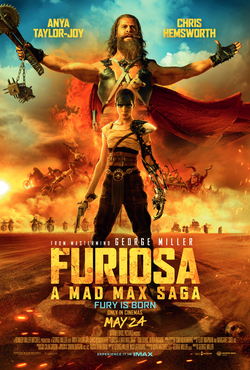

Dementos look changes, possibly making it much easier for the editors to maintain chronology when cutting the film together. The poster shows Chris Hemsworth in his most Thor-like getup, with the blond hair, the red cape and well you can see for yourself. It strikes me as the kind of stupid decision a studio makes, insecure that people might decide they forget they liked Chris Hemsworth in three of the four Thor movies. 

When his character is introduced, I thought he'd been inspired by Reg Mombassa's Australian Jesus where despite the name, and that he was obviously the main antagonist he seems initially to comport himself as the kindest and most merciful among his horde. By the end of the film, I never really got a handle on him, except that he had his own tragic backstory and was just plain unstable. The performance is good, his dialogue is great. 

So here is where I part ways with reviewers that I just don't think can explain the underperformance opening weekend at the box-office:

This review in particular set me off, largely because the youtuber, I think, had this piece written before the facts came in. Like I think he just hates women, I must admit he got to the point where he was making the argument that spin-offs seldom pan out and just lost interest. Furiosa underperformed, in that it didn't make its budget back in its four-day opening weekend. 

But it isn't a critical flop, as at writing both critics and fans rate the film at 90% fresh on Rotten Tomatoes. It's not one of these films where critics give it 100% certified fresh and fans give it 7% or 23% or whatever and you have this massive incongruity.

I particularly object to the youtuber's assertion that Furiosa "flopping" was obvious from the get go I find insulting, because it wasn't obvious to me. I discovered my thumb wasn't on the pulse last weekend where I would have felt Furiosa was one of the first films to come out in months (probably since Dune Part II) worth actually seeing. 

That's the schism, I think for which Furiosa may be a lightning rod. 

I already new that many youtuber movie critics I often agree with, did so incidently because of our differing attitudes toward the MCU - for my part, I agree that the last billion MCU movies and tv shows were not worth watching, but there are many who unlike me want the MCU to go back, where I just want them to stop.

And it's not surprising, I've never been in denial about misogyny existing, it's just when you have a movie and character as bad as Captain Marvel (2019) you can't conclude if someone hates the film because the protagonist is a woman, or if they hate the movie because it is a shitty movie.

Furiosa is not a shitty movie, so I can with more confidence attribute hatred of this film to nothing more than a hatred of women.  

To which, I might conclude by alluding to two wrongs not making a right. Identity politics is doomed to remain what it always has been which is: hot garbage. Given my confidence that I can defend an assertion that Furiosa is Max and Max is Furiosa, they are the same character just as Derek Zoolander's Blue Steel, Ferrari Letigra are the same thing. Stoic badasses with shoulderpads that can drive, fight and shoot against the odds to protect the underdogs from the bad guys.

Loving Furiosa because she is a woman, and hating Mad Max because he is a man is the moral equivalent of loving Mad Max because he is a man and hating Furiosa because she is a woman, particularly once you conduct a survey of your male film buff friends and ask whether they rate higher male action movies First Blood, Roadhouse, Kickboxer, Escape From New York, Predator and Robocop, or Alien, Aliens and Terminator 2. (rewatch T2 if you haven't recently, Linda Hamilton is clearly the actual star of that movie, not Arnie.)

Sunday, May 12, 2024

Gift of Doubt: Israel-Palestine Edition

Why weigh in? I've got spooked voicing opinions about Israel-Palestine before and the clear diagnosis of how I walked into that conflict was probably an impressive level of ignorance.

Probably until recently, it was actually quite safe to discuss Israel-Palestine in polite society, if one bothered to discuss it at all, because my context has largely been Australia (Israel-Palestine never came up in my half-decade in Mexico, though like Australia I have friends certainly discussing it now.) and Australia is a wealthy secular nation of regional influence but is certainly very much a lackey on the Global Stage, a nation that is like an illiterate child at a restaurant restricted to asking for "same" or "yes/no" to whatever is done by/offered to us by either the US, the UK, China or EU. 

Probably most metropolitan residents know both Jewish and Muslim people, very likely have both as friends, but overwhelmingly most people we know and interact with are vague-culturally protestant people of European descent that care overwhelmingly about property prices and interest rates above all else.

This demographic basically flipped the switch last October or whatever, and many became somewhat passionate about the latest conflict. At which point, I should be very clear I don't pretend I know more about what's really going on than most of my friends who share my own demographics, and frequently, psychographics. I almost certainly know less about the present conflict. What I feel though, is that they are way more confident than I. 

So I'm going to try something that might be death as a reading experience - to try and translate spectrum street epistemology into a fucking blog post.

Here's how it works, and I'm going to bias the process to reflect my own bias: that it is more impressive to express doubt than certainty. So the "spectrum" is a 5-point confidence interval:

-2 strongly agree, -1 agree, 0 neither nor, 1 disagree, 2 strongly disagree. 

And I will endeavour to word all my claims such that to "strongly disagree" with the claim, expresses the highest level of doubt.

So I make no bones, my aim for the reading experience is to generate higher scores, which is to say, to bump people's confidence down.

I endeavour to do this, because after one dinner party argument about Israel-Palestine I found myself embattled by people who were way more confident in their assessment of the situation. As in: this topic is simultaneously intractable and straightforward. It hasn't repeated but nor has the conflict resolved, but if I had my time again, I'd probably propose street epistemology of some kind.

"I can explain the history of Israel-Palestine in such a way that no substantive/material evidence would contradict my explanation."

-2 SA, -1 A, 0 NN, 1 D, 2 SD.

"I can name the paramount leader (Prime Minister, Governor, President, Sheik, Sultan, Caliph, Imam etc.) of Palestine immediately prior to the establishment of Israel."

-2 SA, -1 A, 0 NN, 1 D, 2 SD.

"It's impossible to be racist and not know it."

-2 SA, -1 A, 0 NN, 1 D, 2 SD.

"It's impossible for me to be anti-Semitic (specifically bigoted toward Jews) and not know it."

-2 SA, -1 A, 0 NN, 1 D, 2 SD.

"I understand the history of the Crusades and could explain it to a stranger."

-2 SA, -1 A, 0 NN, 1 D, 2 SD.

"If I lived in the times of the Crusades, I could say I would definitely not be a Crusader (putting sex based discrimination etc. aside)"

-2 SA, -1 A, 0 NN, 1 D, 2 SD.

"The educated middle class are not targeted by, nor subject to, propaganda."

-2 SA, -1 A, 0 NN, 1 D, 2 SD.

"Intelligent educated people are never fooled by propaganda."

-2 SA, -1 A, 0 NN, 1 D, 2 SD.

"I would not be fooled by propaganda."

-2 SA, -1 A, 0 NN, 1 D, 2 SD.

"University students have never been on the wrong side of history."

-2 SA, -1 A, 0 NN, 1 D, 2 SD.

"All religions are basically, fundamentally the same, and the *contents* of scripture are of no real import."

-2 SA, -1 A, 0 NN, 1 D, 2 SD.

"I know Hamas would exchange a hostage for a Palestinian prisoner who was critical of Hamas."

-2 SA, -1 A, 0 NN, 1 D, 2 SD.

"I know what a state like Israel, can and should do about Hamas/Islamic militants to ensure the safety of its citizens, immigrant workers and tourists."

-2 SA, -1 A, 0 NN, 1 D, 2 SD.

"I know what 'Free Palestine' means, what it looks like and how it could be achieved."

-2 SA, -1 A, 0 NN, 1 D, 2 SD.

"Based on my history of defending unpopular positions in controversial issues when I see merit, or merely merit in heterodox debate, I'm confident I am not merely jumping on a band wagon regarding this issue."

-2 SA, -1 A, 0 NN, 1 D, 2 SD.

"My positions on Russia-Ukraine, Israel-Palestine I'm confident are consistent."

-2 SA, -1 A, 0 NN, 1 D, 2 SD.

"If Australia attacked a Chinese civilian population in retaliation to Chinese encroachment (eg. tariffs or trade bans causing economic damages, or visa requirements preventing ease of travel to China, or restrictions on ownership for ventures in China, or punitive actions taken against Australian officials being critical of or demanding answers from Chinese counterparts.) It would be unreasonable/unethical for Australia to hold our own militants primarily responsible for a predictable retaliation."

-2 SA, -1 A, 0 NN, 1 D, 2 SD.

"I'm confident that if Hamas leadership were to say 'we are a nation of martyrs' it is meant in the same sense, and has the same moral value as Winston Churchill's 'we shall fight them on beaches...'"

-2 SA, -1 A, 0 NN, 1 D, 2 SD.

"I know how the inhabitants of the West Bank feel about Hamas, I know Hamas policies, I know what ceasefire agreements were in place prior to the attacks in October last year etc."

-2 SA, -1 A, 0 NN, 1 D, 2 SD.

"Hamas could not have predicted the IDF and Netanyahu response to their attack and could reasonably have anticipated that the attack would result in freedom for Palestine."

-2 SA, -1 A, 0 NN, 1 D, 2 SD.

"The Netanyahu government and IDF could not have predicted the international public response to their retaliation."

-2 SA, -1 A, 0 NN, 1 D, 2 SD.

"I'm confident that without a ground invasion, the Israeli hostages could have been returned safe and alive."

-2 SA, -1 A, 0 NN, 1 D, 2 SD.

"The Netanyahu government and IDF are right to act with impunity to global public sentiment."

-2 SA, -1 A, 0 NN, 1 D, 2 SD.

"Based on my history of defending principle even at the risk of being unpopular or disliked, I am confident I would not have been a Crusader during the Crusades, a Nazi in Nazi Germany, a Montagnard in the French Revolution, a Red Guard in Mao's Cultural Revolution etc."

-2 SA, -1 A, 0 NN, 1 D, 2 SD.

"The market is never wrong."

-2 SA, -1 A, 0 NN, 1 D, 2 SD.

"The best policy for a secure future of Israel, is to rigorously defend against public debate, public criticism, UN resolutions and US censure for Israeli settlements in the West Bank and Gaza Strip etc. OR manufacture the Overton Window to exclude criticism of Israel, from both sober rational people and bigoted conspiracy theorists alike."

-2 SA, -1 A, 0 NN, 1 D, 2 SD.

"I'm confident that Palestine has not had access to peaceful forms of resistance for at least 5...10...20...30...years etc."

-2 SA, -1 A, 0 NN, 1 D, 2 SD.

"I know what Israel should have done about the second intifada (including suicide bombings on buses etc.)"

-2 SA, -1 A, 0 NN, 1 D, 2 SD.

"I understand the details of the two state proposal famously rejected in the 2000 Camp David summit."

-2 SA, -1 A, 0 NN, 1 D, 2 SD.

"I understand what Mao's Red Guard are, and their role in China's Cultural Revolution."

-2 SA, -1 A, 0 NN, 1 D, 2 SD.

"I've never been wrong about something."

-2 SA, -1 A, 0 NN, 1 D, 2 SD.

"Intuitions are never wrong."

-2 SA, -1 A, 0 NN, 1 D, 2 SD.

"I've never explored an intractable problem that wasn't simple for society to solve."

-2 SA, -1 A, 0 NN, 1 D, 2 SD.

"I could explain Fascism as a political theory/movement to a 12 year old without making reference to Hitler, Nazis or Swastikas (which is to say, I could define fascism as a set of ideas without merely providing an example of it.)"

-2 SA, -1 A, 0 NN, 1 D, 2 SD.

"The market is never wrong."

-2 SA, -1 A, 0 NN, 1 D, 2 SD.

"Public sentiment has never been on the wrong side of history."

-2 SA, -1 A, 0 NN, 1 D, 2 SD.

I scored 47, pretty high, but not the maximum in terms of epistemic humility. I could go on and on, but hopefully some of those gave you some pause, shrivelled your big swinging dick a little.

Now as to what I think about the conflict, one could guess that I mostly don't know. 

I certainly don't have the confidence to go out and protest, specifically to protest my own diplomatic core's responses. It's a case where I would reasonably expect DEFAT to have better intel than I do, via regular-arse-media reports, I'm not very interested in.

Most importantly, I don't know what one does about Hamas, and I would expect an answer, or a clear declaration that their attack on October 7th or whenever, was wrong. To me, even discounting the most salacious details, it seems pretty clear cut that such an attack is intolerable. 

I have no idea what one does about that. This isn't a crazed shooter situation, but like a quasi-municipal government. For example, I do not think the civilians of the Palestinian West Bank are capable of giving up Hamas to the IDF nor safely delivering the hostages. 

Now, I can have more confident positions on say Benjamin Netenyahu, I would prefer him, had he taken responsibility and resigned, even if any other Isreali replacement leader prosecuted the response and rescue operations in the exact same matter. It is also my opinion that at some level, Isreal suffers from a unique antipathy that doesn't apply to other nations that have been attacked, most prominantly Ukraine. 

Furthermore, I have no real interest in "who started it" timelines because one can probably guess, it goes back to at least the crusades if it is strictly about who among Abrahamic religions started it. Near as I can guesstimate, had I been around when the formation of Israel was debated, I probably would have opposed the establishment of a Jewish state, I guess I would have thought of it as fraught from the get-go. Alas, Israel was established as a state decades before I was born, it exists, that is what has to be considered. I am not one for saying "oh gee, this was a mistake, let's close the project and rediasporise the citizens of Isreal!" 

The modern state of North Korea can be considered a hostage situation. There was a point in history, where the US possibly at great expense could have safely ended North Korea, leaving the entire peninsula as what today economically, culturally and politically is some version of South Korea. Removing North Korea now would be very costly, by magnitudes greater than removing it would have cost in the 1960s, for one thing, now powers like the US have to take powers like China seriously.

It's possible that on the scale of Isreal-Palestine, as expensive as it might seem to definitively remove Hamas the militant entity, it would be way more costly in the future. Furthermore, based on the global response to Hamas' attack in October last year, it is understandable that Israel could have no confidence that the next attack might actually solicit sympathy for Israel and some notion that Hamas had finally gone too far.

Yes, Palestinians are dying. So too are Ukrainians, Belizians, Columbians, Sudanese, Uyghurs, Mexicans, El Salvadorans, Guatemalans etc. etc. I need some reason to compel me to treat this news story differently, and that reason can't be because you hate Jews.

Were Taiwan to launch a hairbrained invasion of the Chinese mainland tomorrow, including tactics of raping and pillaging, and China responded by saying "that's it." I would expect pacific powers like the US, Japan and Australia to back Taiwan for entirely pragmatic reasons, rather than moral ones. That's the level I expect hypocrisy at. For Joe Bloggs on the street however, I would expect people to clue in that such an attack would be reckless and suicidal, and that Taiwan's leadership should surrender themselves to protect civilian lives from a very predictable retaliation.

On that front, I can throw down a non-arbitrary line on who started this conflict - unambiguously Hamas. It can backdate to the last ceasefire to be in effect prior to the October 7th attack, though I'm not entirely sure what would have been in effect given my impression that rockets are launched from the West Bank into Israel, sporadically.

Which probably sums it up nicely, in terms of my position - my position is I need a proposal as to what to do about Hamas, because the solution can't be "leave Hamas be." at the moment I'm left with the impression that Hamas are the kind of actor that are happy for other's to die in their place. They do not appear to have, "skin in the game."

Tuesday, April 30, 2024

Is Unconscious Collective? The Ramayana and The Trojan War

There must be some principle of economics for, I don't know the contemporary euphemism, "offboarding" services. These are companies where, whence you are made redundant part of your termination package might be setting you up with a service that will help you find a new job. 

At some point, some threshold of pricing must be crossed where you are paying someone so much to help you find a new job, that you would be better off just paying the money to yourself and giving yourself a job title. Like "let me get this straight, I'm paying you to teach me how to convince someone to pay me?"

Now, from such services, there is genuine value to be assertained, if not realized. What I think most people do with such generous offers, is go in and apply for jobs just like their last job on their phones because they don't want to think about the trajectory of their lives/careers and what could be, they just want to restore normalcy.

Where that financial threshold clearly applies, is the fake-guru. Like someone you pay $2,500 to for a one day seminar on real estate investing. Where you look around the room and think "there's at least 50 people here...man, this guru could make more money off selling seminar tickets than off real estate investing!" Like fucking exactly! They get rich quick, not you. It's not so much a pyramid scheme as a shake down.

And then I suspect, there's another kind of business, where you pay someone to teach you how to write a novel or a screenplay. Not Margaret Atwood on Masterclass (has that gone bankrupt/defunct btw? I haven't seen an ad for it in ages.) but like, some guy. Some guy maybe with writing credits for Episodes 8 + 13 of Growing Pains season 4, and more recently...nothing. 

Depending on the price, these courses could be helpful or not. It also depends on how delusional the student. It's a calling I suspect that calls completely deluded people often. On the continuum of dubious to grift, screenwriting courses are probably above dubious. 

Youtuber "Film Courage" interviews a lot of people I've never heard of about screenwriting and film making in general. Many subjects have interesting things to say, but there's an archetype of screenwriting instructor that annoys the shit out of me: Adherents to "The Hero's Journey"

This post is about how, one should not adhere to the Hero's Journey, because it probably doesn't exist.

The Ramayana *Translated* Is Not Very Good

Which isn't to say it isn't important, that it isn't worthy of respect, that it isn't significant, influential, artistic, aesthetic etc.

I remember when I was a kid, hearing stories about Archimedes and his Eureka moments, and being blown away that once upon a time, someone who could do maths could be like the most important person in town. It seemed we primary school children, were being taught harder maths than Archimedes did, admittedly we didn't have to come up with measuring displacement. We just had to subtract one number from a total to figure out how much water had come out of a measuring cup.

But once you strip the Ramayana of the poetry of it's original intended language, storywise it is a story most contemporary writers could eclipse. That's okay, unless you elevate it to the status of religious scripture, which people might, I don't know. I'm vaguely aware, mainly through channels that debunk pseudoarcheology that India has it's extremes of Hindu-nationalism that can tout an almost certainly ahistorical "Out of India" hypothesis. Maybe they think the Ramayana is history or something.

Here's my quick and dirty summary of the Ramayana on a pure impressionistic level, as an outsider to the culture it shaped, with all due respect:

I listened to the Ramayana on Audiobook, while at the gym working out. Sometimes at the gym people would get on some noisy piece of equipment near me and drown out the audio playing through my headphones. This was not annoying with the Ramayana, because I never felt like I was missing anything, because the Ramayana feels like it is 80% people asking "Where's Rama?" or more precisely, incessantly proclaiming just how great Rama is.

As such, the Ramayana's main reason for not being great, is that it is almost entirely a contravention of "Show, Don't Tell" and "Informed Attribute".

The premise of the Ramayana, is philosophically interesting, and if it was in a genre of reductio ad absurdum it could probably prove the point that "perfection is unintelligible." Instead, I understand the Ramayana to be in not just the heroic epic genre, but a genre of moral instruction, in which case it's premise utterly fails, though it can impart some moral value claims.

The premise is: "Was there ever a perfect human being?" and the Ramayana is an attempt to say "Yes, Rama"

Is Rama a hero's journey? Well it depends, Campbell's original assertion of the hero's journey was a hero receives a call to action, leaves the ordinary world and journeys into the supernatural world, receives a gift or gifts from deities and then returns home and grants boons." or something sufficiently vague like that, in which case okay. The Ramayana fits the mold, because, you know, it's fiction in which stuff happens and it has a main character.

More formal templates of the Hero's Journey? No, probably not. Rama is born perfect, never does anything wrong (it's all womens' fault) is never in any peril, completes a task irrelevant to his banishment, goes home. 

The kind of neckbeards on Youtube that whine about the CW's Batwoman series not adhering to the Hero's journey would be inconsistent if they didn't also reject the Ramayana, one of the bases for Campbell's monomyth, for not adhering to the hero's journey.

With the premise aside, really two things happen in the Ramayana 1) Rama gets banished to the forest for an inexplicable/arbitrary 14 years, though there may be cultural significance to the number 14 that I do not have the context for. 2) Rama's wife Sita gets abducted, and Rama has to rescue her, in a process that almost arbitrarily takes up the 14 years of his banishment.

For the story about this perfect dude to take place three women and one dude need to cause all the drama - a maidservent, a stepmother, Sita - Rama's faithful and devoted wife and Ravana a demon king. 

The wikipedia page on the Ramayana gives more or less, an accurate synopsis of the 13 hour audiobook I listened to. 

It begins with stuff, but most importanly Rama is born the eldest of 4 brothers, and everyone loves him, especially his father the king. Again cultural context is lost on me, so to a western sensibility the father-son relationship just strikes me as unhealthy and inappropriate. To be clear, the Ramayana is very chaste, this isn't Greek mythology we are talking. 

It's more that Rama's father can't bear to not have Rama by his side, he can't handle not seeing Rama for a month and worries he will die, when a holy man asks to borrow Rama to slay some demons for him. He later does die when he is forced to banish Rama for 14 years to a forrest. Why does he die? Because Rama is just so awesomely great, he dies from a broken heart at having to wait so long for Rama to return taking no consolation from his three wives and two remaining sons. That's how perfect Rama is.

Why is Rama perfect? Largely because he is so devoted to his father, and...honestly he's like strong too, but there isn't much else to Rama's character. 

He meets his wife by stringing a bow that breaks, and he marries Sita and then they go home to be with Rama's father.

Rama's father thinks Rama is so awesome that he wants to have him crowned as his successor before he dies. He's worried that the people don't think Rama is awesome, so he asks his subjects and they all say that Rama is great and good and humble and pious and devoted and great and honest and good and sweet and humble and great...

This goes on for some time, but it's decided, Rama his eldest and best son, will be king. 

Then from nowhere a maidservant, no doubt lowborn and of the working class, persuades the King's second or third wife that if Rama is crowned they'll all be out on their arses. The highborn queen at first is like "No way" because Rama is great and good and humble and pious and devoted and great...

...that goes on for admittedly less time when everyone in the kingdom got a turn to say "where's Rama?" but she changes her mind and the maidservent reminds this queen that the king owes her two boons because she rescued him once and to use those to ask that Rama be banished for 14 years, and that her direct son be crowned in Rama's stead.

Then she goes like full crazy, and cannot be talked out of this by anyone.

The closest we get to Rama having any personality or character in my translated Ramayana is that he says his catchphrase "So be it" when he is informed of the banishing, and once he sees how devoted his wife Sita is to him that she would rather die than stay behind, he agrees to have her come with him to live in the forest. Then he goes back to, for the rest of the Ramayana, someone that everyone keeps informing us is great.

Then it takes seemingly forever for Rama to pack his stuff and leave, with it mostly being various people saying "Rama don't go!" and Rama saying "I have to, my daddy gave his word."

Eventually in the forest with Sita and his brother, a demoness takes a liking to Rama and Rama spurns her saying he is married. She tells her brother the demon king Ravana who likes the look of Sita and decides to abduct her. He persuades his sister to transform herself into a gaudy tasteless golden bedazzled deer, which Sita tells Rama to catch for her. Rama because nothing is ever his fault and he is perfect says "I think it's a demoness playing a trick." but Sita insists he go catch it, and Rama says "So be it."

When he kills the tacky golden deer, the demoness cries out in Rama's name "Sita, I'm dying!" Sita is being safeguarded by Rama's devoted brother, who also being a man is no idiot and reassures Sita "It's probably a demoness playing tricks." but Sita insists he go check on Rama, leaving her unguarded because Sita can't walk or whatever, she's a princess.

Once she is unguarded, Ravana who doesn't give a shit about his dead sister, comes and abducts Sita.

The rest of the epic, for me is almost pure tedium with little interpretive or symbolic value. Some shapeshifting monkeys are involved, I don't know if in the original this provides some comic relief or something, but basically they find Sita who refuses to sleep with her captor, then Sita refuses to be rescued by a monkey who is "pretty much as awesome and great and good and noble and kind..." as Rama, so the monkey attacks the demon city and then goes back to report to Rama.

Meanwhile, just as everyone previously in the story has done little more than talk about how awesome Rama is, everyone but Ravana in Ravana's kingdom pretty much tells Ravana that they are all going to die because Rama is so awesome. Ravana won't listen, so people either betray him for Rama's army or reluctantly go to their deaths vs Rama his brother and the monkey kingdom.

Eventually, and I mean eventually everyone dies, Rama rescues Sita but then demands proof that she staid true to him, she proves it somehow, I forget. They all go back to the kingdom, then honestly I wasn't paying attention, Rama has to banish Sita again, but she is pregnant with twins. They reunite once the twins have been taught to recite the Ramayana, and Rama is so pleased to hear how awesome he is, that Sita reveals herself and then proves her devotion by calling on the God's to kill her if she has been absolutely devoted to Rama. The earth opens up and Sita is taken away into death, and Rama knows for the second time that Sita has remained true. Some celestial beings appear and tell Rama not to be sad because he is an incarnation of Vishnu and Sita is an incarnation of Vishnu's wife so they will be reunited when he dies. 

The end of the Ramayana.

It's not great.

The Trojan War - Morally Ambiguous

Homer's Illiad (which translates to "Troy") begins in the 9th year of the Trojan war, Apollo fires plague arrows into the Greek camp. Someone figures out that if the Greek commander in chief Agamemnon releases one of his Trojan captives the plague will end. Achilles goes to tell him to release the prisoner, but Agamemnon turns all anti-vax, and demands one of Achilles slaves as compensation for having to give up a prisoner presumably because he has rights.

Achilles decides he's done with the stupid war and refuses to fight. The reason for the war gets revealed that Paris a son of Troy seduced and/or abducted Helen the most beautiful woman in the world, enacting a clause among Greek Royalty that said everyone had to avenge anyone who stole Helen for themselves. A pact devised by Odysseus to resolve the stalemate over who would get to marry Helen and how would they be safe from all the spurned suitors.

Shenanigans ensue and eventually Agamemnon eats crow and sends Odysseus and Achilles best friend to plead with Achilles to fight again. Achilles refuses, as he is not bound by the original pact, he was too young to contend for Helen when the pact was made. Achilles' best friend Patrocles persuades Achilles to let him wear Achilles armour and fight the Trojans in his stead. 

The ruse works and the Greeks make gains on the Trojan army, until Hector kills Patrocles. This pisses Achilles off bigtime and he fucking loses his shit. Hephaestus (Vulcan) makes Achilles new armour overnight, then Achilles goes out kills fucking everyone including Hector, he's in such a rage that instead of honoring Hector and releasing Hector's body to the Trojans for proper burial rights, he instead drags Hector's body behind his chariot for two days.

Patrocles comes to Achilles as a ghost and asks for his own proper burial so his shade can be released into the afterlife, and to have his bones and Achilles put in the same urn so they can meet again in the afterlife. 

Some Trojans sneak out with treasure to try and recover Hector's body, they meet Achilles who feels ashamed and gives the Hectors body, the Illiad ends with Hector's funeral. 

The Trojan war ends after Paris kills Achilles with an arrow in the heel, some guy uses Hercules arrows to kill Paris, Helen loses all loyalty to Troy, Odysseus fetches Achilles suspiciously identical son Neoplotnus ("New Warrior") to fight in Achilles place. Odysseus comes up with the Trojan horse idea, the plot works even though Cassandra is like "No don't bring it in the city the Greeks will kill us all!" but nobody listens to Cassandra. 

They bring the horse into the city, Helen almost foils the plot but doesn't, the Greeks take the walls, open the gates, signal the Greek ships to reland and attack and Neoplotinus goes full blood frenzy Genghis Kahn Anglo-Saxon rape and pillage mode.

Nobody comes out looking good.

End of the Trojan War.

Now, Homer's Illiad opens in the 9th year of the war, and my summary probably excludes some moral ambiguity that is worth considering - for example where Rama stoically accepts his exile because his father's honour trumps the interests of Rama, Rama's brothers, his wife and the subjects of the kingdom, both Odysseus who suggested the pact to defend Helen's marriage, and Achilles who was not part of the pact attempt to dodge the draft so to speak, Odysseus by pretending to be insane and Achilles is disguised as a woman (which leads to the unplanned birth of Neoptolemus) and Odysseus uses his cunning to expose the ruse and enlist Achilles. 

Furthermore, the dude who exposed Odysseus' draft dodging madness, Odysseus frames as a traitor and is stoned to death in an act of petty revenge.

Collective Unconscious or Common Ancestry?

"But Mr. Greene of course there will be similarities of words and punctuation...we both write in English." ~ Sir Francis Bacon to Robert Greene, Upstart Crow.

First up I should disclose, I am unaware of any formal theory that the Ramayana and the Illiad are in any way related. Similarities are superficial, differences quite meaningful. Furthermore, I'm limited by my availability heuristic to think of examples beyond the purview of a proto-Indo-European oral tradition - for example a Mexica or Maya legend about an abducted princess resulting in a war, even a Japanese one.

The idea of a "collective unconscious" is this idea based on the works of Chung and refined by well...people...most notably Myers-Briggs and Joseph Campbell, that there's just kind of imagery in our subconscious. To be honest, I couldn't begin to pretend to know what metaphysics is actually promoted by the idea of a collective unconscious. 

What I would guess, is the idea that there is certain resonant imagery within our phenotype, our DNA or something. What this would suggest, is that if I put a bunch of human embryos on a space ship and sent them to Titan a possibly habitable moon of Jupiter, where they were birthed into some kind of biome, raised by robots and fed synthetic food that met their nutritional needs and given art supplies, the collective unconscious would predict this isolated, artificial culture in an entirely different environment would produce imagery like "The world tree" or "tree of life" they would tell stories about serpents, despite never seeing them, and tell tales about finding their father in the belly of a whale or something. But I'm not sure, because of the extended phenotype. For example, hermit crabs have something in their genes that have them adopt shells as they outgrow shells.

Obviously there's some collective unconscious insofar as we use unconscious heuristics to make sense of the world - we unconsciously register the smell of smoke, feces and carrion as bad. We unconsciously associate horizontal symmetry with living animals. If people take a dose of DMT and hallucinate crazy shit that has the appearance of matter, as opposed to echolocation or heatsignitures, I assume that our visual cortex is bugging out to create images divorced from our retinas but not our experience. I had one trip down the k-hole, and it was suffice to say fucking nonsense and it took so long to come down the short trip was not worth the 2 hours of boredom before the hospital would discharge me. But even kaleidoscopic visions of tropical beaches must be unconscious imagery brought forth, but then, I'd expect more ancient egyption art involving hammocks and cocktails with little umbrellas in them if it were to substantiate a collective unconscious.

It's this idea that there is this deeper meaning intrinsic to us as humans, something we all share.

There's two alternative explanations to the similarities between Yggdrasil the Norse World Tree and other mythological trees - is because trees are pretty much everywhere humans have been. Same with similarities between snakes in mythology - Leviathan, Jormangandr and Quetzalcotl for example, can be explained by the presence of snakes where these myths come up, just as a collective unconscious fails to explain why European dragons are apex predators and Asian dragons benevolent deities, or why Sub-Saharan Africa, Polynesia and India largely have no prominent dragon traditions.

Who Do You Think You Are? Language Edition: By Background: Map created from DEMIS Mapserver, which are public domain. Koba-chanDrawings: पाटलिपुत्र (talk) - This file has been extracted from another file, CC BY-SA 3.0, https://commons.wikimedia.org/w/index.php?curid=97177975

Then there is, when it comes down to the particulars - common ancestry, which is to say, at one point these "monomyths" were actually just a mono-myth. The big one being the "Chaoskampf" a proto-indo-european myth about skyfather, a storm god, battling a giant snake. From which we get Zeus slaying Typhon, Heracles son of Zeus slaying Hydra, Thor taking down Jormangandr, Sigard and Fafnir, Beowulf and dragon, Susanoo and Orochi etc. 

Which is to say, the serpent slaying myth is not one that is conceived of or created independently.

Consider in 1,000 years time some post ice-age where some future archaeologist doesn't understand the phrase "based on the DC comics characters created by Bob Kane" and proposes a theory that Batman (1989), Batman Forever by Joel Schumacher, Batman Begins by Christopher Nolan and The Batman by some guy all suppose that deep inside all human beings is the image of a man in a bat costume that fights crime.

No. The simpler explanation is that all these different realizations of Batman, with different actors, different villains, different effects and different costumes and vehicles, are just remakes of the same source material. (For another example, consider all the Bond rip-offs that have been churned out by US directors and Actors chafing at the fact that they can't direct Bond movies because they aren't British - Indiana Jones (ToD), Mission Impossible, Jason Bourne, XXX, Fast and Furious (Eventually), True Lies, John Wick...which leads into derivatives of a derivation - Nobody and Beekeeper and then parodies of Bond - Get Smart, Kingsman etc.)

The Ramayana is not a story about a hero or storm god slaying a serpent, nor is the Illiad, but the stories are similar to eachother - they are both attributed to a poet, both feature a hero representing an ideal (Rama, Achilles) and a loyal companion (Lakmaya, Patrocles) and another hero that relies more on trickery (the monkey king, Odysseus). Both feature an obligation to be far from home, and both are driven by the abduction of a woman. 

Apart from these broad strokes though, they are oil and water. But they are possibly the same story. Their authorship is contemporaneous, but both describe events in the past, the Trojan war in particular appears to be somewhat of an oral tradition in which the attested Iron Age poet manages to describe accurately Bronze age lifestyle 500 years after events. Furthermore, some batshit crazy amateur eccentric millionaire archeologist actually found Troy in modern day Turkey.

Aboriginal culture in Australia is at least 35,000 years old and as such, likely has the oldest myths in the world. None of these myths appear like Pangaea-pre-continental drift old. As far as I'm aware, though there's serpents in Northern Australia mythology like the Rainbow serpent, there's nothing resembling the Chaoskampf, there's no Chthonic heroes that venture into the underworld and come across a dog that guards the entrance (this is a myth found in Native American populations and is presumably pre-columbian and European traditions like Cerberus "Spot" though similarities could be due to the presence of dogs, and perhaps because dogs aggressively defended corpses they were eating.) 

But I would bet that the Ramayana and Illiad have common features because they were the same story that migrated outwards - The Greeks situated that story on Troy, the Indians situated it somewhere in India, though it does involve some ocean crossing too. Again the Aboriginal example indicates that Oral traditions can preserve phenomena like a Volcano eruption for periods greater than 10,000. But they tend not to preserve info like migrating to continents like Australia and the Americas. My guess is what gets preserved is a matter of relevance.

(The other most famous Indian epic, the Mahabharatam (which contains the Bhagavad Gita, the only part I've read) was mostly composed after Alexander the Great invaded in 300BCE, and though it is 10 times the length of the Iliad and Odyssey combined, the simplest explanation for similarities is just cultural transmission. Particularly if those similarities involve a war or conquest, and there was a story told by a group that came to war and conquer. )

The Greeks focused on concepts like fate and glory, and told a story where it is quite hard to tell who the good guys are, even the pantheon of gods are divided with Athena and Poseidon helping out the Greeks, Apollo and Aphrodite helping out the Trojans.

The Ramayana is a straight up morality play. It's chaste, pushes if anything filial piety, and after consuming both, pretty much any of the characters from the Illiad I would be fascinated to sit next to at a dinner party, be it Helen, Cassandra, Hector, Paris, Agamemnon, Achilles, Neoptolumus, Odysseus etc. like even the bit players who sat on an island with a bad ankle for 9 years, or objected once to the whole project come across as genuinely fascinating.

Were I to find myself seated next to Rama, I would be tempted to look at my phone after he told me "I love my father." and of course, I anticipate his brother and wife saying things like "Where's Rama?"

I would see myself incredulously asking "So you were born perfect, then got heavenly weapons, then you didn't know where your wife was, then you found her, then you used your heavenly weapons to destroy the captors, then you and your wife and your brother went home?"

Admittedly, there could be some not-on-the-nose moralistic genuine drama in the Ramayana somewhere and I just tuned out. Maybe when Rama has to kill someone to end the monkey king's exile, and the monkey king gets drunk instead of immediately helping Rama find his wife.

If you accept the premise, that Rama was the perfect human being, what can we squeeze out of the Ramayana? I think much of it, while nowhere near as graphically heinous as what the Greeks and Trojans did, is actually quite bad in an ethical sense because the Trojan war doesn't claim Achilles is perfect, but that he is great and glorious. The Illiad features numerous disputes, many characters do not like Achilles, resent him, argue with him, including many of the gods. 

Not so with Rama, even Rama's enemies tend to prefer him in character to their own boss Ravana. The Ramayana says in terms of what I got out of its message - respect the elites and don't mess with the natural order. Obey your father. Women mind their own business, and exist either in some kind of cloistered situation or accompanied at all times by a husband or male relative, and honour/reputation trumps welfare.

While I can easily imagine Greek patriots taking a tribal attitude to the Illiad and thinking Greeks good, Trojans bad, the Romans apparantly identified more with Troy than the Greeks and had the opposite attitude reflected in Virgil's Aenid. Obviously Greco-Roman culture is the biggest definer of what we now call "The West" even though both Alexander's empire and the Roman empire at times included Asia and North Africa. But the moral ambiguity is built in.

Furthermore, for example, Cassandra who can prophecy accurately but is cursed by Apollo to never be believed, is a timeless idea that reflects contemporary attitudes toward elites, particularly climate scientists and medical experts, but even corporate whistleblowers. There's an analogue in the Ramayana which is Ravana relative to literally fucking everybody, and to me, it is less useful to depict a villain who doesn't listen to anybody, than to preserve and spread the idea that people don't listen to what has become in the west "Cassandras" people who accurately forecast the doom of some venture.

If Odysseus is an analogue to the Monkey King, again I prefer the teachings of the character of Odysseus, who is questionable in morality, but not tactically - the Monkey King's trickery involves largely changing size, Odysseus actually schemes and plots and while claiming divine lineage is very much a mortal man.

All of which is to say, if there's a collective unconscious, pertaining to the Ramayana and the Iliad, so what? The similarities are not where the profundity lies. It's in the differences. Reconsidering, perhaps for the Greeks, Achilles was also an answer to the question "Was there ever a perfect human being?" alas, what makes the Iliad superior for moral instruction, is that Achilles is not presented ever as morally perfect, nor for having any positive personal traits besides valour/courage, though particularly after Patrocles death he is really driven by blind rage, and is even criticised for his desecration of Hector's body. 

This is exactly what I mean. The moral of the Iliad, if you presented it to a group of kids can't even be said to be "Beware Greeks bearing gifts" because that is a post Iliad event. Maybe it's "Beware Greeks" or maybe it is like most Greek mythology "avoid the gods wherever possible" but really it is a very human, very complicated mess of a story. By contrast, with the Ramayana it's moral instruction is very clear because it is in the genre of an epic morality tale, it is easy to imagine what teacher would say in summation to a group of rapt children: "Know your fucking place, especially women."

Conclusion

Surprise surprise: "Westerner prefers Western cultural artefact." yeah, but that isn't the conclusion, nor the point of this article. The point is if you are a Campbellite-Jungian advocate of the collective unconscious, know that that is a tedious thing to be. 

For one thing, it posits some metaphysical super-structure that isn't necessary to explain the phenomena of cultures telling similar stories. There are two simpler explanations - 1) the stories are similar responses to similar environments. or 2) the stories are derivations from the same source.

The collective unconscious does not predict Aboriginal mythology, folk lore and oral traditions. It especially doesn't predict how different Aboriginal stories are from each other. 

It is one of those tedious beliefs that require active ignorance of the contradictory evidence to maintain, it is almost as annoying as pseudoarcheology, if not another form of it.

More to the point, the value of stories does not lie in their shared symbolism or even plot points. The value lies in what stories can tell us about ourselves. The technology of storytelling is that it is flexible.

I would never advocate to read one and not the other, unless it was a genuine dilemma - like you could only buy one paperback to take on the next train trip, or you only had one audible credit for the month. But if you have time to read both, read both. That's what I did, and though the translation of the Ramayana produced a bad, tedious and boring story that I listened to before Troy; I didn't waste my life listening to it. It remained informative, second-order interesting, in it's inability to functionally describe an example of a human being, I think it stands as a lesson that perfection is subjective, it is a very old example of a story preserved at failing it's very premise. Rama is perfect but one can never find out why he is perfect.

Similarly, without the context of living in the Bronze or Iron age, it's hard to actually see how the Iliad glorifies war at all, beyond the fact that if you were in the Trojan war, you got into a popular epic. But it sounds by all accounts like it was a truly awful ordeal, a good time had by none. Prior to revisiting Troy, I was kind of left with the impression that The Great War aka World War I, and particularly the book "All Quiet on the Western Front" ended the romanticisation of war. 

At the same gym where I listened to the Ramayana and Stephen Fry's Troy, I spent Anzac day, where on the monitor set to the ABC they were playing Peter Jackson's documentary that collected testimony of Anzacs and archival footage of WWI. What I learned was the post war reality of the soldiers - I had thought romanticizing war had remained intact such that veterans didn't come home to jeering and spitting and booing until Vietnam in the 60s and 70s, but the accounts of the WWI veterans painted a very similar picture - nobody wanted to know them, talk to them and especially not give them jobs when they got home. 

The Ramayana and the Trojan War are not the same story.


Monday, April 22, 2024

Career vs Vocation

 I'm going to assert there's an idea out there, floating about society, and I leave it to you to decide how plausible my assertion is. The idea is some version of this:

"In the future, anything you don't want to do will be done by robots, leaving everyone free to only do what they want to do."

There is certainly, some history that supports a future hit by this trajectory - for example the washing machine largely automated what was previously a gruelling, time consuming task greatly diminishing the domestic workload such that it is possible to have two adults in a household both work 40 hours a week somewhere else, and get the laundry done without paying wages to someone to do it for the household.

In my lifetime, I can vaguely recall at one time garbage trucks doing weekly garbage collection used to employ crews of three, with two men running behind a stinky truck tipping the contents of bins into the compactor. Two of these jobs have been replaced by a robot arm, though I've lived in countries where it is still a manual exercise.

I open with this, because the idea that we are approaching some future where people do not do things they don't want to do, only things they want to do while explicitly promising an end to dirty jobs, shit jobs or whatever, implicitly promises an end to careerists.

At which point I have to define my terms. A vocation is a calling, you want to do the work. A career is more like a game, you do what you must to get what you actually want.

For example, being a volunteer worker at a mental health crisis line - someone who speaks to people who call in distress, is more likely to be a vocational calling - someone wants to do the work because it means a lot to them to do the work itself. There are examples of people who work such a job to some other end, than the job itself, Chris Voss, founder of Black Swan Consulting Group and a former hostage negotiator for example volunteered at a lifeline call centre in order to get a job as a hostage negotiator, youtuber Theramin Trees tells the story of a client who worked at a call centre for unhealthy self-serving reasons.

Similarly consider a sales team that sells pharmaceuticals, as has been portrayed in recent movies about the US opioid crisis. Here is a career that probably selects for careerists. People who don't particularly care about the work they do in and of itself, just what the work can obtain for them - high commissions incentivising "gaming" the regulations. For them, a highly addictive expensive drug is great as compared to a cheap non-addictive drug that resolves the same problem for the patient.

I would point out, that people have real needs for which, often, working is a reality. David Graeber distinguished between "bullshit jobs" and "shit jobs" where the former are jobs that are often well compensated but leave the people who have them with a strong suspicion that the job does not even need to exist. Shit jobs are jobs that need doing, but are not a great experience to have. 

To be clear, I have no problem with somebody working a shit job as a careerist. It might be hard to think of say, getting up at 3am every day to turn on all the deep fryers and ovens and grills so they are ready for a 6am breakfast service at a fast food restaurant. Or sitting in a booth policing a road boarder between the US and Canada for the night shift, checking passports, asking stock questions and pressing a button to make a boom gate go up and down. Or being a baggage handler at an airport. These are jobs people may feel no passion for, but they do them because they have rent to pay and children to feed clothe and send to school.

Further to the point, it's not like people with a true inner calling to be a veterinarian or field surgeon or civil engineer, don't also need to obtain food clothing and shelter. People who are more vocationally inclined may still desperately need the coincidence of being compensated for what they produce.

Then there's vocations, like in the arts. I am convinced that people actually need art. Whether it is observing that hunter gatherers used their downtime to paint on cave walls figurative representations of themselves and the animals around them, maybe deities and supernatural beings since 30,000 years ago or something, thru to people who get cranky when you interrupt the netflix show they've been streaming on demand and can pause and resume at anytime.

But, while society needs art, they don't need as many artists as society has, resulting in to some degree a style of toxic vocationism where people persist in roles that most people are indifferent to them doing. The problem is, how does an unpopular artist determine whether they are Joe Nobody or Vincent Van Gogh? There are multiple candidates to explain any artists lack of success, though probably it will be a lack of talent.

Alas, investment plays a role. Consider the following list: The Cruel Sea, Machine Gun Fellatio, Something For KateSpiderbait, Regurgitator, Silverchair, Grinspoon, Jebediah, The Living End, Powderfinger, Custard.

Compared to: Saskwatch, Eagle And Worm, Hiatus Coyote, Blackchords, The Bombay Royale... 

Those two lists comprise largely of Australian Indie Rock Bands. The first list are bands that toured and recorded largely from the mid 90s through to 00s. At the time, Nirvana had happened and the 90s saw a brief implosion of manufactured pop acts between like 93~94 to 97 when the Spice Girls dropped. I was too young, but the impression I have is that record labels literally walked into bars amid Nirvana induced confusion and gave record deals to gigging artists of the time. 

Triple J and Recovery were state funded institutions that were developing artists in the 90s and early 2000s with programs like "Unearthed" that discovered acts like Silverchair most notably, but many other acts that managed to top charts, sell out venues, tour profitably and like, buy houses and have a living as a musician. 

The later lists are like some of the biggest acts I was aware of by 2010. By that stage, if you signed with a record label, it meant they put your cds in some shops. Before you signed, you had to gig enough to get good, build a big social media following, pay to record and mix your own album, launch your album and sell enough copies to impress a label, crowdfund enough money from your fanbase to go tour a festival like SXSW or Glastonbury, then the label turned up and gave your seventeen piece multi-instrumentalist arcade fire inspired band a deal that meant they'd pay the cost of producing more copies of physical cds and you'd get royalties from sales. 

I don't think that early to mid 90s Melbourne was producing more talent that 2010s Melbourne. Music had changed, synths were back on stage, vocalists pounded on floor toms, men wore skinny jeans, but it's not like the population stopped producing talented artists who want to pursue a career in Music. Nor did live venues disappear despite a brief issue with retirees moving into the city and making noise complaints. I know Regurgitator are from Brisbane, Silverchair are from Newcastle or something and so on... my point would be in any given year of the 90s when I lived in Ballarat and went to exactly 0 live concerts or performances, I could name ten Australian indy bands, and my friends be they erudite culture vultures or meatheads with frosted tips and globe skateshoes would know who I was talking about.

I struggle to name 10 Melbourne bands from the 2010s when I lived in Melbourne and for three years or so was going to 3 gigs a week that I could expect anyone but a gigging muso from the period to recognize. Hiatus Kaiyote are probably the biggest act, and I would never expect anyone to recognize the name. They supported Erykah Badu when she finally toured Australia, they are multiple Grammy Nominees and have had their songs sampled by some pretty big names in hip-hop. 

Similarly if we consider the names: Leonarda Da Vinci, Donnatello, Botticelli, Michaelangelo, Fra Angelico etc. I don't think anything mysterious happened to make the High Renaissance take place in Florence conveniently where most of all the greatest artists of the time originated (with the notable exception of Raphael from Urbino) in Florence? 

I think the simplest/parsimonious answer to the mystery of why all the greatest artists in the world were born in the same place at the same time was because they weren't. Rather, that's where the money was to invest in art, so artists became excellent. 

It is probably the same with the 90s, we got so many great indy bands because there was money in being an indy band. I'd make a slight concession that there might have been a lot of money for indy alt-rock acts because the beginning of "The End of History" was more disorienting and more interesting than 30 years into "The End of History". 

So all that said, whether careerists or vocationalists are preferable is somewhat going to rely on context.

What's the meat though? What's the beef? 

I think the difference between careerists and vocationalists is likely the actual division that is tearing our world apart. Vocationalists can destroy themselves, and if grossly incompetent technically someone could be so passionate about performing a role that they could destroy an institution. But generally, I predict that if you investigate the slow decline and failure of once pride-worthy institutions, we will find a careerist fucking it up.

Someone who had to be King, but had no interest in ruling. 

Careerists are I suspect, the far more numerous of the two broad populations. Being a vocationalist may even be seen as being somewhat defective in most working contexts. Think of the detective or soldier in a movie that refuses to take a desk job, preferring to be out in the field, or volunteers for more tours because the theatre of war is their home. These characters are often viewed by the others as abnormal, some kind of freak, though useful. Movies are not generally made about a detective who refuses a promotion in order to continue to fuck up cases and let criminals go free, but I'm sure it happens.

Many people, are likely a subtype of careerist I might dub passive-careerist. These are people who may end up in middle management, because they took a promotion because it was a promotion, not thinking that if they became assistant manager of a two person department (say a logistics department that mostly just calls up warehouses and asks where packages are) they have stepped off the path to much higher positions had they remained in the sales department with a lesser title and lower wage.

I would also hedge against any "Great Careerist" theory of history. I don't think the damage is just done by individual careerists getting into critical positions of power, with former British PM Liz Truss being a notable example, trashing the UK economy in a matter of weeks and serving the shortest tenure of any British PM. 

Careerists being numerous can quickly create a careerist culture, for example - gamefying the work. For example, a chef at a fastfood restaurant is told that his performance is measured by minutes-from-order-time. This metric is meant to encourage him to respond to orders quickly and efficiently, instead he grills up and prepares a bunch of burgers before orders start coming in, so that when they do, they are ready to go. His manager gives him his monthly numbers and says something like "way to go you're getting orders up in under a minute! That's phenomenal!" The chef gets promoted to a management position supervising other chefs that work the grill because his numbers are so good. He wants to look like a good manager, so he actually encourages the chefs that work under him to start pre-cooking food before orders come in.

Meanwhile, though never investigated, because the fast food restaurant went out of business, around the time this careerist started gaming his job, Yelp reviews started to drop in average score, and comments about their food being overcooked, or having got their order fast but it seemed soggy or had gone cold etc. start appearing. Also, the administrator responsible for stocking the pantry and fridges notices that they were ordering more from their suppliers, and that they also had to start paying for additional garbage hauling because the kitchen's waste output suddenly increased. Due to a lack of communication between management, the business didn't realize that these were the product of a line cook gaming his stats. So costs went up as customer satisfaction went down. The only positive comment left in reviews was how quickly customers got their food, and tragically this meant the chef-cum-manager was actually encouraged to keep making the problems worse, while the dilligent quartermaster trying to keep costs under control, was blamed for the increased expenses.

I've always liked the heuristic "What gets measured gets done." because it's more instructive than first glance. The first glance leads one to intuit it is advice - if you want something done, start measuring it. The second glance might reveal that it is also a caution - if you are measuring something, people will do it. Mindlessly.

My beloved NBA is heading toward disaster, and I suspect it is largely due to careerists. Perhaps it is no more poignant than to look at recent All-Star games. For those out of the know, and from different countries (as I am) to the US, in US sports-codes there's an almost bizarre tradition of an All-Star weekend, this is where fans, players and journalists get to vote on who the best players in the sporting code are, and teams are made up of the highest vote getters, then those teams play eachother in an exhibition match.

Perhaps most bizarrely, professional athletes used to take these games really seriously. You can see videos on youtube of the All-Stars sprinting up and down the court and trying their hardest to win the match. There have been few serious injuries, but Dwayne Wade did break Kobe Bryant's nose one all star match, and he had to wear a protective mask in regular season games while the bones healed. Kobe Bryant once called the All-Star Game "The Greatest Pick Up Game In The World" and the award given to the best player in the All-Star Game is now called "The Kobe Bryant Trophy".

In recent years though, the game is a poorly rated farce. Nobody plays defense, the scores are absurd, you can literally watch players standing around as they just watch someone run up for an uncontested dunk or to shoot a wide open three-pointer. Even coaches, bestowed the owner of coaching the Eastern or Western conference teams, have called recent All-Star Games "the worst" games of basketball ever played, and absolutely disgraceful, in their victory press conferences. I believe current plans, are to simply scrap the All-star game.

The other mainstay of the All-Star Weekend, was the Slam Dunk contest. previous winners include Michael Jordan, Kobe Bryant, Vince Carter, Domonique Wilkins, Spudd Webb, Nate Robinson, Dwight Howard, Blake Griffin...big names. 

Admittedly, it is hard to keep a slam dunk contest interesting for half a century. At some point the creativity got ridiculous, with choirs and cars driven onto the court to be jumped over. But the last two slam dunk contests were won by Mac McClung, who doesn't even play in the NBA, he is on the development team roster. He is a great athlete with creative dunks that deserved to win, but the big issue is that star players no longer compete.

This is careerism 101 - you want to get paid, but you don't want to do the job. Except it isn't. The All-Star Weekend is not the job, its a bizarre thing that interrupts the regular season and competition and though it distributes a recognition of sorts, it if anything jeopardizes the ability of pro athletes to do their job, as they could injure themselves in a contest that doesn't count towards what gets them paid the big bucks.

There probably is some cash consideration paid to the athletes that make the All-Star teams, in order to fly out and play. They are unionized. (I looked it up, players on the winning team get $100k in prize money, losers get $25k, you wouldn't know that losing the all star game just cost you $75k before tax though to look at recent games, an amount substantially higher than any fine the league levies against players for criticizing refereeing etc.) 

Admittedly, only relatively recently did NBA players start earning Michael Jordan mid-90s Chicago Bulls money for playing. Rules were put in place so no one team could pay one player so much money again. Inflation basically allowed Steph Curry to be the first player since Jordan to earn such money. But overall, most NBA players earn way more than 90s counterparts. 

Sadly, it seems, that is why they are there. This current season, the NBA had to implement a rule stating that a player was not eligible to win awards like "MVP" if they played less than 65(?) regular season games. Playing all 82 games of the season used to be considered a badge of pride, athletes played through injuries, no doubt sometimes foolishly. Now, a practice emerged called "load management" and the results have been dubious. 

I mean, there's actually so many factors contributing to the NBAs current relevancy crisis, that I could get bogged down in it. Suffice to say, I believe it to be a highly visible example of an institution destroyed by careerist tendencies. Almost everyone involved wants the results of a pro-athlete organisation - Accolades, Esteem, Sponsorship, Money etc. but there has been a sharp decline in playing competitive basketball. 

This divide has come to inform my brief history of humanity - someone does something of value and gets recognized, then the next generation comes along and tries to recreate the recognition without recreating the value.

Most people don't create, they surpass. They see what someone else has already done, and try to do more than that. So they try to beat a sales record, they don't generally create new products and services. 

Vocationalists tend to think about why the job exists, and with deep enough introspection can lead to innovative solutions. Careerists don't, their creative act is often gaming the proxies by which we try to determine that value is created, that jobs have been done.

Alas, we live in a careerist world. Careerists aren't going anywhere and I'm not advocating a careerist genocide. I'm advocating that this divide should be discussed, because it creates real problems.

I might conclude this post, this thought, this sketch, by circling back to David Graeber's "Bullshit Jobs", that article created an immediate impact because Graeber an anthropologist described something all around us that wasn't really discussed. It still is inadequately discussed, the discussion has in my opinion barely evolved.

This is likely because bullshit jobs are a product of the inherit inefficiency of trying to organize society. We wind up with these situations where nurses earn hourly wages close to the minimum required by law, yet a few blocks from the hospital is an office building, where someone spends their day browsing real estate websites not because they are a realtor, but because they don't really have any real work to do but are paid enough that they can borrow funds to buy superfluous housing to their needs. 

I defy anyone who has worked in a workplace with more than 8 people, to have never wondered if one of their coworkers would create more value if they didn't turn up to work at all. An easy target is middle-managers of course, but in my experience this can be true of kitchen hands, waiters, technicians etc. 

Perhaps distinct from bullshit jobs and shit jobs, are people who are simply shit at their jobs. For example, for all the supposed efficiency of the market, in economic downturns when firms are forced to downsize their payroll, it is incredibly rare for an efficient firm to go out of business because they can simply no longer afford to pay their 100% efficient and necessary staff. No company, I have ever heard of, runs that lean.

There is always fat to be trimmed, and careerists can be the biggest victim of this, as often their career path has involved becoming quite expensive while producing dubious value. 

I once worked for a company, where I often got into quite chaste arguments about the jobs priority with a supervisor. We both had the same goal - protecting people's jobs. However, he felt that the way to look out for everyone's jobs was to, for lack of a better expression, play the game. Try to be as productive as possible in accordance with what was measured. I did not, I argued that we should question the game in order to ensure we were doing what we were actually paid to do, so maybe do the work instead of play the game.

At one point, I was delegated to head upstairs to the suits who had questions about why certain jobs weren't being done. I somewhat incredulously explained that the reason was that those jobs took a long time, which meant our jobs per hour rate dropped and people got punished based on that, so that nobody wanted to do that job because we were, simply put, punished for doing it.

This was my first inkling, that the company I worked for was dysfunctional, predicting a trend of decline, long term collapse.

At another point, the guy I used to argue with received a promotion to the next tier, literally a few weeks later he was made redundant, along with everyone else on that tier of management. I felt no schadenfreude, to see someone's philosophy so spectacularly refuted. It was a tragedy of myopia, a fundamental lack of understanding that corporations don't exist in a vacuum, but in an environment. That "what gets measured gets done" is also cautionary. 

What was worse, was that level of management, was the level of management that actually managed the department. Making them redundant resulted in sudden and collosal brain-drain regarding how things were done. Near as I can piece together, the manager the company thought ran the department had some years ago persuaded them to let him hire an assistant because he was swamped or something. That assistant was supposed to do his job, meaning he could now take home his pay check without doing any work. I literally cannot imagine what he did all day for years upon years.

The thing was, his new assistant followed his lead - delegating almost the entirety of their job to the next level of managers down. They were very hands off. I infer this because on the few occassions I witnessed them stepping in to "run things properly" it quickly became clear they had no idea what they were doing or how things worked. And I mean no idea

Fucking careerists. These two had hit the jackpot finding a way to generate minimal value for maximum return. Then unfortunately, some higher ups fired the entire level of management that actually managed the business. After this, it was too late to win those managers back, they quickly discovered the assistant manager was useless and fired them, leading to the discovery a short time later that the manager of the department was also utterly useless.

I feel somewhat comfortable about writing this, because after a long dysfunctional decline, that company no longer exists. 

The question that remains is, does all of human society operate more or less like that company?

Thursday, April 04, 2024

Is Homophobia Eternal?

Which is to say, I am not quite persuaded by the notion that homophobia is something we can predict will always be around. For today, I am merely entertaining it. The notion that there will always be homophobia was put forward by Andrew Doyle - "Homophobia finds a way". 

I should say, I am also not a big fan of faux-"phobias" that I shall specify I mean that etymologically phobia probably just means "fear" regardless of whether it is rational or irrational, by convention specifically a 19th-20th century psychology convention "phobias" tended to describe irrational fears - hydrophobia, agoraphobia, arachnaphobia etc. to which there probably are fair analogues in homophobia, islamaphobia etc. but the distinction can be lost, for example, in describing someone who is irrationally afraid of spiders in the same way as someone who is irrationally afraid of homosexuals; continuing the example, people who are irrationally afraid of spiders may refuse to conduct a conversation in the same room as a house spider until someone else has removed it and people who are irrationally afraid of homosexuality might beat up a male with earrings regardless of his sexual orientation.

I think there was historic utility in the faux-phobia (in the sense of analogies) of homophobia, but because the analogy was false, the term is now, given the legal status of same-sex couples in most of the G7 nations, particularly the Anglo-sphere and Europe, causing as many breakdowns of useful discourse as it used to construct useful discourse. (I also suspect that "homophobic" was perhaps specifically targeted at people with "macho" concepts to specifically needle them with the contradiction between perceiving themselves as masculine and tough, but afraid of effeminate men.)

Lastly in my pre-ramble, I'd say that as I'm entertaining the idea that homophobia is a phenomena that can fluctuate but not progress toward resolution, I am certainly rationalizing toward that conclusion. Because of that, I'm not necessarily going to accept the conclusion.

Premise: Reproduction is Important

I'm not sure what is technically possible these days. Whatever the case, I feel it is at the quarter-mark of the 21st century, still the case that most people alive, and certainly most of the people that ever existed are the product of human reproduction.

As such I would expect this situation to be riding on some quite profound psychological reflection that reproduction is important. People tend to get preoccupied with it, give attention to it, ruminate and fantasize about it, and furthermore do so for things that could lead to reproduction without reproduction itself being the end they are conscious of.

To put it crudely, I'm saying a teenage boy abusing himself over an image of a woman's tits, does so because of reproduction, but are not necessarily having the conscious experience of thinking "I want to have a baby, a little baby that would breastfeed!" 

Similarly, this premise suggests that there is a reason when a distressed person walks through the door of a clinical psychologist that they will likely be questioned at length and upfront about their mother and father, at least until this recent blip of history. 

I suggest that happens as a result of the import of reproduction, even though across the tree of life we can see it take many forms - fish laying eggs to be fertilized outside the body, insects laying fertilized eggs inside another insects corpse, sharks birthing live young that have already fed on their slow to hatch siblings, birds that push their young out of their nests, birds that lay their eggs in another species nest to have them raised in their place, jellyfish that age forwards and backwards, microbes that reproduce asexually etc. we primates reproduce in a general primate way, as a social species.

I'm dimly aware that there are some scant cultures that might hold beliefs in multiple paternity and what not, beliefs I suspect that do not hold up to the scrutiny of genome sequencing.

Premise: Existential Angst

It takes a triumph of reason over instinct, emotion, to think how few days you spend morning the fact that you cannot name all 16 (in most cases) of your great great grandparents, nor all 32 of your great great great grandparents. Not even the least detail of their names. 

You might have an affinity for a particular indirect relation, some great uncle you share a name with if not named for, yet you probably know Isaac Newton, who had no children at all. I would guess the vast majority of some 5~6 billion conscious adults on the planet know Isaac Newton and have no idea who their ancestor was or what they did that walked the earth at the same time. If Newton doesn't do it for you, there's Da Vinci and Michaelangelo, Joan of Arc, Jesus of Nazereth whom we are not sure even existed. You of course know Adult Hitler's name, but in a few generations, most people descended from the Allies won't know their relations' names that went off to impede the Third Reich and Hirohito's ambitions in the pacific. 

Not everyone wants kids, but some people do, perhaps most at some point think about having kids in a desirous way. Even when they experience enough, perhaps the majority, of children around that they do not particularly like. 

People that have kids worry about their kids. Feel sick to their stomachs if they lose track of them, if they deviate from the routines they are accustomed to. I have even heard it described as an analogy, motherhood to having phantom limb syndrome. People use the term "a part of oneself" to describe all kinds of relationships, and kids are not excluded from the subjects of this expression.

Such that, a way to cope with the dread of leading a trivial, meaningless and forgetable life as a brief flash of illumination between two infinite darknesses in an indifferent universe, is to have kids. Children to survive you as a way to cope with your own mortality.

Even same-sex attracted couples, who despite all the historic messaging and environments that suggested that they did not and could not exist, but awaken in some proximity of puberty to realize that they like the sex which reflects them rather than contrasts them, still desire children as evidenced by the battles hard fought for the right to adopt, to employ surrogates and ongoing research to enable multiple paternity and maternity.

Argument

If it is the case that heterosexual people, among others, but are the subject here, feel anxious about reproducing, having kids. If they lay awake sometimes at night, wondering how old they will be at their child's graduation, or what they would do with the long rest of their lives if they do not spend them rearing children, then it makes sense to me, that parents would also get anxious about their kids reproducing.

And if for example, a parent has some reason to fear a doctor's office where they are informed their child will die of some incurable condition, and to a lesser extent finding their children will suffer from some condition that will diminish their chances of finding a mate, or some condition that renders them incapable of having children and perhaps even adopting children given the care they themselves will require, and if in those ultra-rare incidents where a father discovers he is not the father of the children he has been raising for years where upon the discovery of the facts about his mate and his children he spends any time at all feeling any negative affect at all before concluding "this changes nothing" then

It logically extends that parents in some number will experience a dread that their child is same sex attracted. It is just one generation removed from their concerns that they would not have children. I am easily persuaded that there is some undercurrent in all our lives, perhaps only salient for brief moments as bereavement is processed when people utter things like "it really puts it all in perspective" that people to some extent view having a child who doesn't then have their child is in some ways a waste.

I am inclined to think, simply, that them's be the breaks. I think, there is always going to be, a case at least to be made, that their will be some homophobia emanating as an existential dread from the vicinity of parents. The logical conclusion of Steve 38, and Tracy 34 deciding to marry simply because they both feel they are running out of time, having one child who doesn't conform to a gender stereotype long before they have the barest sexual thoughts but even so when their child is 6 Steve is 44 bald and fat, Tracy 40 and though they will have a full and enriching experience of parenthood, now they are preoccupied with the fear that they will never experience grandparenthood.

And so, just as I can't exclude my "bros" who upon becoming fathers of daughters impressed upon me their own discomfort with daughters and femininity perhaps because they had not realized how chauvinistic or misogynistic their own attitudes had always been, and it is of sudden import that sex not define interests, preferences, abilities and aptitudes, I can't exclude the possibility of parents who suspecting their investment in immortality might mature into homosexuality, start opening their mind to the possibility that sexual orientation might be in a parent's control.

Would that I could make the point that even though technological and legal progress may have made the getting of children by same-sex couples a non-obstacle, there is a fairly straightforward meaningful difference between the ease with which a heterosexual mating between teenagers might result in a child, versus a long and expensive process results in a child for same-sex couples and couples that struggle to conceive.

As such, much as your dog, has no fucking idea how society works, and they will find a toy poodle a more immediate threat that needs barking at than a drug addict with a screwdriver trying to break into cars in the same street. People possess reason, but are not that often possessed by it. As such, even if having a gay or lesbian child might actually, statistically predict they are more likely to produce a child than maybe having a straight child, this may not be understood and parents seek for something they understand, something more akin to their own experience.

So, having said all that - and I do not think it an exhaustive case, I'm not for example particularly interested in all the homophobic people who for example - hate themselves or have inflexible ideas of gender roles etc. That might produce the effect of homophobia being present in society without any connection to existential angst over genetic reproduction.

I conclude that if there is demand for solutions to same-sex attraction, just as if there is demand for snake oil, the market will find efficient and sophisticated ways to provide snake oil, subsequently if there is a predictable eternal demand for conversion therapy there will be a predictable eternal supply of conversion therapies.

The last thing that I would add, is emphasis on sophisticated ways to provide conversion therapies, because it is too easy to imagine a future where in Alabama or Mississippi or somewhere in the minds of a western anglo audience, there are church camps for praying the gay away. Given that same-sex attraction and orientation seems to crop up mostly unpredictably* the world over (I do not believe that Iran is free from the phenomena of homosexuality) the market will find conversion therapies that are palatable to someone whose self-conceit is that they are secular, progressive and liberal, but cannot overcome their fear that their offspring will go through life debilitated by same-sex attraction and simply wish, life was more straight forward for them.

Doyle's Argument Afterthought

Andrew Doyle, argues a position, that I doubt is in totality, that medically transitioning children (puberty blockers etc) is a new form of conversion therapy and a new form of homophobia. 

I simply do not have any access to any parents participating in such a process to form a non-speculative opinion. I'm not even sure if it's legal in my jurisdiction.

My impression is he also allows that other things are going on too, like social contagion among teenage girls perhaps.

So the idea that in some cases, transitioning minors is being employed as a conversion therapy seems plausible to me, and compatible with my prediction that there will always be some degree of homophobia inextricably linked to the same emotional centre that makes many people anxious about having children before it is "too late."

It comes to that dog-like lack of understanding as to what the fuck is going on. That one could feel the anxiety that their child might grow up to be same-sex attracted and irrationally hope for a diagnosis of gender disphoria initiating transition processes that can result in sterilisation.

Much as, say black parents of a black child don't have to worry about putting their foot in their mouth racially (if not culturally) when their child brings home a black partner, vs bringing home an asian partner, I can imagine parents that are more comfortable with the idea that they were mistaken in thinking their boy a girl, or their girl a boy, than navigating a dinner conversation with their boy's boy or their girl's girl. (and irrationally not accounting for the prospect that after transitioning their child, they may still bring home a same-gender partner). 

That's really just speculation, and having spoken to thousands of members of the Australian general public, as similar as they are to each other, I must testify there is not much of the general public I actually understand. 

The conclusion is plausible to me, that there always has been and always will be some form of homophobia fluctuating in localized contexts between peaks and troughs. We are certainly in a bizarre climate where Douglas Murray and Dave Rubin can make up half the panel at a US conservative convention, but the same two gay men could inspire picketing and protests from LGBTQIA+ activists.

To me it is plausible simply because if straight people feel anxious about having children, it stands to reason they will feel anxious, provided the opportunity about having grandchildren. For me, while not all parents need react to their child coming out badly or destructively, wishing nobody they knew or cared about had to deal with it, is likely to lead to behaviours and attitudes we could meaningfully label homophobic.

I don't condone homophobia, I predict though, it will keep happening.