Friday, February 16, 2024

Quick Sketch: Conspiracy Tolerance

 I am still resolute in not following news stories because it is mostly an experience of addictive self aggravation. Just a well spring of dazzling editorial incompetence that succeeds, virtually ever time in activating me. That said, Taylor Swift is so overexposed that I passively managed to hear about the Kansas City mass shooting at the Superbowl parade but my apologies because I'm not going to go to news sources for more details.

I subsequent to my decision not to follow this or any other news story, I can't know if more than one person died, I know suspects were arrested, and I don't know the suspects motives.

Just, I was aware that there was a "they are coming for your football" conspiracy theory propagated because Taylor Swift doesn't like Donald Trump, she dates a guy on the Kansas City Chiefs, therefore if the Chiefs won the Super Bowl it was rigged. Then coincidently, the first ever mass shooting to take place at a Super Bowl victory parade happens at the Victory Parade for a team that was at the center of a conspiracy theory.

Tennis has this statistical category called "unforced errors" which measures how often a tennis player needlessly screws up on service or a return shot. Like so obviously double faulting because you are trying to serve an ace would be an unforced error, but also if you tried to chip the ball lightly just over the net because your opponent is on the baseline but the ball hits the top of the net without sufficient momentum to carry over and you cost yourself the point.

Conspiratorial thinking, I don't think is really costly in absolute terms, compared to the social costs of bad welfare design or bad tax policy. There are plenty of boring problems built into the ordinary operation of society that do much more damage and are harder to solve.

But conspiracy theories have gone from mostly harmless indulgence like the moon landing one, the net total of damages being that time Buzz Aldrin punched a conspiracy theorist in the face, to a problem that is probably creeping up on drink driving as a category of dangerously impaired judgement.

Conspiracy theorist death tolls are almost certainly going to be at their highest estimation regarding the recent global pandemic. It is going to be much more tolerable than drink driving though, because there's a degree of self selection to conspiracy theories surrounding a pandemic. The people who won't take the vaccine are at an increased risk of dying to those who do. An "own goal" conspiracy.

So, I think the social acceptability of being a conspiracy theory has become a massive problem. Not just a massive problem, but a massive symptom of broader social dysfunction facilitated by the internet and its sub-innovations like the attention economy and social media.

It makes me think about school. 

I think the problem and the solution starts in how we schooled people from the industrial revolution onwards. Schools functioned in some capacity as an information quality control filter. This meant that you could send a kid to school and rest assured that they would not learn how to not calculate the correct change for a 1 pound note from school. The curriculum in theory, was supposed to be vetted. 

The same things with books in Library's, all the information you could get from books in the library was designated as fiction or non-fiction, categorized by subject, the authors were known, the publishers were known, they had tables of contents, glossaries, bibliographies and end notes.

Our schooling was designed so a student with no critical thinking capacity could attend and passively absorb curated knowledge. 

It admittedly would be hard to set up an educational experience where students were protected from the fallacious argument from authority "because teacher said so". The basic structure of a class is that a teacher tells you what they are going to test you on, then they test you on it and you either pass or fail.

It was historically, a good enough system because teacher's rarely wrote the textbooks with the exercises from which they based their class plans, and the curriculum was set by a central body that probably had the dual goals of believing a society that contains a large number of educated people is intrinsically good and that a society that produces skilled workers can gain economic advantage.

For much of the 20th century, students in Australia learned useful social goods like how to read and write, that are pretty easy to just teach to passive students with no critical thinking skills because if they can't count their money they will go broke and if they were taught nonsense literacy they wouldn't be able to make sense of any signage or restaurant menus and their orders wouldn't make sense at a restaurant.

Furthermore, the hard sciences that deal with the physical world tend to be non-controversial. There are very few contentious issues surrounding whether things fall toward the earth or not or whether you put enough water molecules together wetness emerges as a property. Sure there's arguments in biology regarding monkeys and souls and shit but it's hard to sustain that traction when one side of the controversy just doesn't describe reality very well.

I would be remiss if I didn't point out the traditional function of school to teach controversial beliefs as though they were knowledge to passive uncritical students who needed to absorb those beliefs to pass tests. Beliefs about history and the Queen and special books written in part or wholly by the creator of the universe and who started a boarder dispute.

The fact that our schools operate as belief injectors for largely passive young minds mean that there is almost always some political contest happening over what beliefs get injected into passive young minds.

I contend that our extant education system does a number of disservices to society that are admittedly difficult trade offs for the amount of good primary and secondary education does.

The first is that school structures most people's lives for them for a very long time. The basic 13 years of grade school it has been pointed out is longer than many people serve in prison for killing someone. My own experience of education was that it took a farcical amount of time before I was given as a student any real electives. This was true even of my tertiary education. 

Structuring my life deprives me of the necessity to think about what I want to learn and why. To what end my learning is in service of. 

The second and more relevant one is that curation of the beliefs that are taught. Meaning even in a well functioning educational program where the powers that set the curriculum know to teach astronomy and not astrology, we are fed a diet of information that we don't have to think about that is going to make many people prone to absorbing beliefs assuming they are absorbing knowledge.

I would not bet on a friend being able to distinguish an argument from an assertion. Having recently watched Anatomy of a Fall, that is structured around a court case, I have to concede that the presence of lawyers in a court to point out to a jury that someone just presented speculation not proof is a necessary and value added occupation in our society, because I wouldn't trust a jury to notice for themselves.

That case can be fairly summerized as prosecution and defence continually claiming they knew what happened, and the adversaries having to then point out to judge and jury that nobody actually knows what happened.

Now, in times past, we could rely on the market to keep education somewhat honest. If you got a bunch of 12 year old's in your matchstick factory that couldn't count, they got fired because the market eventually figured out that Old Scrooge's Quality Fire Sticks couldn't be relied on to have 40 matches in a box. 

With the proliferation of bullshit jobs that don't need to exist, fake jobs that facilitate large portions of the public having an income with which they can consume and borrow against - the market can no longer be expected to weed out schools that teach their students garbage.

It can literally apparently take Liz Truss becoming the Prime Minister of a G7 economy to discover that the economic theory she believed to constitute knowledge of how an economy works, was garbage. Absolute burning dumpster fire of shit garbage.

Renteirs have proliferated into the 21st century, I defy anyone to work a job in a modern economy and not witness people who have and keep jobs they shouldn't have and shouldn't keep and possibly never needed to exist.

One of my old employers went through an amusing house cleaning project where upper management finally after 26 years discovered they had a useless middle manager and canned her, which caused them to finally discover after 28 years that she had been brought in by her manager who was also completely fucking useless and canned him. That is a mere two people, whose salaries generated no value for the operation of a business for a combined half century that could have sustained approximately 30 people on welfare for half a century. Instead, two people absorbed a half century of 30 welfare cheques between them.

In such an economy, one can easily survive without having to adapt critical thinking skills. The education system, combined with an inefficient market is ripe for the festering of conspiracy theorists.

If property investors, cannot literally explain to me why I should purchase their valuable services as a landlord. And I mean, I haven't come across a single property investor that doesn't literally call me an idiot for renting, which is purchasing the very service they provide. Right, they think of me with contempt for considering being their customer. Then of course people are going to overestimate their ability to believe true things and disbelieve false things.

However big people imagine imposter syndrome to be as a social problem, it mathematically has to be a smaller problem, because so many people are imposters impersonating someone who is worth what they are paid. 

Even 10% of a workforce being fundamentally useless, is an alarming number of useless people pulling a decent wage and being loaned 40 times that decency to make an investment they fundamentally don't understand. I'm labouring the point, I know, but this phenomena is proved in every recession when companies lay off a bunch of staff and continue to operate. Some of it is directly related to decreased demand meaning decreasing supply meaning less workers on less lines to assemble products that no longer sell. But some of it is sending desk workers with boxes containing family pictures and potted plants walking under security escort, because with decreased revenues the company finally is forced to admit that it wasn't necessary to employ a second marketing assistant.

That has likely been going on for quite some time, but it's a problem now because where people used to live in uncurated offline communities, people can now self-select into pretty much any online community they want.

There might be 180,000 flat earthers in the world. There were almost certainly less flat earthers when that potential population was distributed amongs 5~6 billion people, and Grant had to hang out in a pub where he was likely to have a 5th grade science teacher explain to him how if he goes to the beach he can just see ships sails or exhaust stacks appear on the horizon before he sees their hulls. Or demonstrate how a sphere casts a shadow on the moon in the way a disk can't so he can observe the Earth's shadow on the moon himself for the rest of his life.

We probably used to keep conspiracy theorist numbers down without anyone having to think about it because they couldn't form in-group silo echo chambers online, connecting each only guy in the village who thinks the earth is flat with each other guy in the village who thinks the earth is flat.

Except of course, we had churches everywhere.

This Kansas City shooting is another data point for me that fails to contradict Tim Snyder's argument that I have often quoted because it seems most relevant to the times:

We know, because this is something that people have theorized about since the Enlightenment, that in order for there to be a democracy there has to be something between you and me and our fellow citizens, something between you and me and our leaders, which is: a factual world. We have to have this thing called the public sphere where you and I and our fellow citizens and our leaders agree that there are certain realities out there, and that from those realities we draw our own conclusions, our own evaluative conclusions about what would be better or worse, but we agree that the world is out there. And that it's important for you and I, as citizens, to formulate projects, but it's also important in moments of difficulty for you and I, as citizens, to resist our leaders. Because if we're going to resist our leaders we have to say, "On the basis of this set of facts, this is the state of affairs; it's intolerable; therefore we resist." If there are no facts we can't resist, it becomes impossible.

Snyder's been a guest a number of times on Sam Harris' podcast, and Sam Harris was in that new atheist wave of names that began to target the problem posed by moderate religious types protecting extremist religious types.

The impotence of the argument "well those people take this book too seriously." 

The big social norm that needs must be introduced to combat the unnecessary costs of conspiracy theories, is that we can't extend to ourselves or others the right to believe what we want. To have beliefs unconstrained by reality. 

This is the problem faced by largely secular, progressive Isreali's living in Tel Aviv wanting a stop to illegal West Bank Settlers. They face a clear line in the sand where they could cross it and say "these people need to be stopped because Judaism is hooey, the messiah isn't coming, God doesn't make real estate promises etc." but compared to rejecting the premise that magic exists, on the other side of the line one is obliged to make the limp dick argument "Yes, I believe God does exist, and that the God I believe exists did send the prophet Moses to give us His laws and lead His chosen people to the Holy Land, and that he didn't incarnate as his own son to offer us a new covenant through the blood libel of his own divine sacrifice (Christianity isn't true) nor did He send Gabriel to visit an illeterate peasant in a cave and inspire him to speak the direct words of God (Islam isn't true) nor did he send angels to direct a former known conman to find gold plates and a seer stone to translate them in a hat (Mormonism isn't true) and only the original book is special and I know what that original book of the prophets of the God I pray to says in a lucid way is promised to His chosen people in terms of this land but those people who take those things it says seriously are just taking it too seriously."

Right wing conspiracy theorists, yes they have the guns and are really dangerous, but they cannot be resisted by left wing conspiracy theorists. 

More accurately, left wing conspiratorial thinking. Just to pick one example with a large target on it's back - how many female action movies have to bomb before the left entertains the notion that boys and girls are born and made, not simply made. 

Or the gender-equality paradox that currently sports two scholarly explanatory hypothesis: one being that gender stereotypes are somehow more pronounced in countries with greater gender equality (so Norway for example is more ridden with gender stereotypes than India and China) and the other being that as opportunities increase sex differences become more pronounced (so Indian and Chinese women are forced by circumstance to study STEM courses to secure reliable income and pay, whereas Norwegian women are relatively free to make a living from interior design consulting and not have to worry about how they would pay for future healthcare costs.)

One of those hypotheses strikes me as nonsense, in terms of it makes no sense, and one of those hypotheses strikes me as common sense plausible. How long does it need to take to invalidate one of these hypotheses? How hard is it to design the experiment to generate primary or predict secondary data (eg. looking at the choices of lottery winners in less-gender-equal nations).

The trouble being, that certain positions associated with the left, can only be held by taking sound epistemology off the table. If it's okay for Ibram X Kendi to infer that all racial inequity has to be attributed to systemic racism, then it has to also be okay for a team whose player is dating a celebrity who dislikes Trump winning the Super Bowl means the superbowl was rigged because jews. 

Neither of these methodologies are okay, and society is far too tolerant of people luxuriating in beliefs that simultaneously comfort them and inspire them to act by directing life changing violence toward strangers.


Quick Sketch: Bridget of Guilty Gear

This post is about how I don't understand my own sexuality. My own sexuality is very vanilla, very well documented and represented in fiction and non-fiction, in history, in illustration, in painting, in sculpture in cave painting. It's been studied for a long time, I don't understand it.

I'm heterosexual. Man that seeks women. 

Now something everyone knows about heterosexual men, is that obviously they are attracted obviously, to all women. Of course, a heterosexual male should not be confused with a heterosexual paedophile, so all women obviously means, obviously, to the point of being obvious that as a heterosexual man I am attracted to all women from half-my-age-plus-7-upwards thru, by symmetry, women double-my-age-minus-7.

Obviously, as a heterosexual male, I obviously am into fat women, skinny women, women who climb on rocks; tough women, sissy women; even women with chicken pox; (provided they are at least half-my-age-plus-7, I don't want you to draw the wrong inference from chicken pox).  

My obligation to conform to the statement "I am attracted to women" as though it reads "I am attracted to all women" is something I understand. That's not the part of my sexuality I don't understand.

I don't know, but if I was placed in a prison cell, I don't know if I would fight or if I would just roll over. I don't believe Ice Cube would advise in "Check Yo'self before you wreck yo'self" that "big dicks in your arse are bad for your health." for no reason even if he isn't Dr. Cube, and despite being one of the progenators of Gangsta Rap has never to my knowledge actually been to prison. I assume he heard stories, but you don't know, late 80s south central was a different time.

There's a fair chance that despite deciding that rather than risk my face, I would just blow a guy, let him put a porno mag on my back and have at me, I might size up my roommate and think "piece of cake." and establish my physical dominance. I mean what am I going to prison for at this point? My country has universal healthcare I'm not going to start cooking meth.

The point is, prison aside, why wouldn't I kiss a man? Why do I feel no desire to kiss a man? If my sexuality is based in reproduction, which I get, and maybe has some relationship to hygene, which I also get, why didn't my straight friends and I ever flirt with the idea of giving each other blowjobs? I mean we weren't going to catch anything or have an unplanned pregnancy.

If the reason we tend not to be attracted to our own siblings is because of ingrained incest taboos, why don't people date their brothers? Furthermore, men don't have breasts, so I get why I wouldn't be excited about shoving my face into a mans chest, but I also find exciting the prospect of shoving my face between a woman's butt cheeks (obviously, all women, obviously) but that's a gastrointestinal tract, so why do I have no interest and even whince slightly picturing it, shoving my face between a man's butt cheeks? Is it just because I share public bathrooms with these people? I've seen women eat burritos.

Near as I can figure, my sexuality must have something to do with chemistry. A lot about human sexuality is just plain weird, Alan De Botton talks about it a lot, better than I. The question of whether I want my tastebuds to directly contact the genitals of a woman (all women, obviously) is very context dependent. I don't generally feel that desire strongly, first thing in the morning, but it can occur in the morning if foreplay gets me in the mood for it. By contrast in the evening, if the woman I am with so chooses, to stand up and drop her draws and sit down on my face, I would regard it as a wonderful surprise.

I have had my sexuality all my life. I knew, before I was attracted to girls via a pubescent sexual awakening, that that was how I rolled. I fell in love with women long before I knew what men and women got up to. I remember trying to console myself, in grade 2, when the first girl I had ever crushed on moved away. I still don't understand my sexuality, that doesn't mean that I am possibly getting it wrong. It appears to function, without my understanding it.

Which brings me to Bridget, almost. The subject of today's post, because there's plenty I understand about my sexuality even if I don't in totality understand it.

For example:


Catwoman is someone I find attractive, when realized by Michelle Pfeiffer in Tim Burton's commercially disappointing sequel Batman Returns, I am able to recognize that I am attracted to a fictional character. That an actress is portraying Catwoman, but that Catwoman isn't real. Yet Selina Kyle, major love interest of the emotionally stunted, possibly repressed homosexual, Bruce Wayne, is a very attractive fictitious character. I understand why I find Michelle Pfeiffer, in a professional capacity pretending to be someone who doesn't actually exist, a compelling point of my sexual attention, it's that my heterosexuality can reach into the realm of fiction and fall in love with all kinds of literary types. Even women that are written by men like Joseph Heller's Luciana, Frank Herbert's Chani etc.

Art by Jim Lee, from DC Comics Batman run "Hush"

Such that, I can also be attracted to a drawing of a woman. As above, Jim Lee draws a very attractive Selina Kyle enjoying a night at some theatrical event next to Bruce Wayne, who seems to resent her covering her cleavage with a gloved hand.

To channel a little, but not too much, of Douglas Hoffstader - this is an illusion of an attractive woman. It is pixels on a screen, creating the illusion of the original artwork that was a combination of dots of CMYK to appear to be a colourised copy of Jim Lee's two dimensional sketch on paper of the character of Selina Kyle, aka Catwoman. 

I can find such an image attractive, without being so confused by my own perception colliding with my sexuality that I'm going to fuck a screen. 

Complicatedly, I know that I think that I am looking at someone I am sexually compatible with. My sexuality works such that I can find the drawing of a dude, attractive. I as a heterosexual male am attracted to dudes' drawings.


Fan art of Ranma in his girl form and Ryoga in his pig form aka "P-chan" from Ranma 1/2 by Rumiko Takehashi

Above is a pin-up depicting Ranma protagonist of Ranma 1/2 a romantic comedy japanese comic about a boy who fell into a cursed spring where a girl had tragically drowned and subsequently turns into a girl any time he is exposed to cold(?) water and can only change back with hot(?) water. I would class it as a pin-up on account of the gratuitous cleavage that is the centre of the composition, that is not consistent with how Ranma is usually portrayed (his breasts are usually beneath his Chinese men's top whatever they are called).

Ranma is a boy, there's an interesting case to be made that in his female form Ranma becomes temporarily a trans-man psychologically though while he clearly doesn't like that he transforms into a female often at inconvenient times and one of his major motivations is to find the cursed spring of a drowned boy to neutralize his own curse, he generally doesn't display much disphoria. Ranma's depiction of female Ranma or "Pig-tail girl" as his major heterosexual admirer refers to him, is often quite cynical and exploitative, even willingly posing for gravure photos as a female to be sold to his male admirers. I don't know, I suspect that while many children undergoing some experience of gender dysphoria might gravitate toward the story of Ranma 1/2 this is a series that concluded in the late 80s and is very Japanese culturally and the boy-girl switching is played mostly for laughs. It is also depicted alongside characters who switch from man-to-panda and back, boy-to-piglet, girl-to-cat, boy-to-goose and so on. I guess furries might also be into Ranma, but I'd be inclined to conclude that while the literal fluid method by which Ranma transforms might be a captivating idea, but has little to instruct me or anyone on gender dysphoria in any useful way.

The point being, is that in the same way that I know that I think an image of Selina Kyle is an image of someone I am sexually compatible with. I like lady Ranma's breasts, even though I know they are an image of breasts attached to an underage highschool boy. That's how my sexuality works.

There's an uncomfortable question there, of if my best friend at any point in my younger years when my best friend was typically a male, if my best friend fell into a cursed spring that left him transforming into a woman with a light spritzing of cold water, and having played with his own breasts and fingered his own vagina and stuck inanimate objects up there until he was bored and his curiosity drove him to leave an offer on my table - would I fuck him? I don't know. It's an uncomfortable question.

Then there's Bridget:

Bridget of the Guilty Gear Franchise

Contrary to Bridget's name and appearance, Bridget was introduced to the Guilty Gear fighting game series as male. That is, I have explicitly been told that Bridget is male. 

Now, to be clear, one thing I understand about my sexuality is the difference between the statements "I find her attractive." and "I would have sex with her." In that, while my finding someone attractive is a good predictor of my willingness to have sex, or any form of physical intimacy with them, it is not an equivalent statement. There are many women I will honestly disclose I find attractive while having no interest or intention of actually touching them. Hence the need among myself and my friends like "I wouldn't touch her with your dick."

There's also the beautiful confusion of ambivalence, when I find myself physically attracted to someone I find in character repulsive. The "hate-fuck" if you will, when mind and body do seem to be in a dualistic opposition. 

It needs to be said, that Japan has a massive paedophilia problem. It is inextricably intwined with a culture I have pretty much no time for at all being "Kawaii culture" and the strong positive correlation between economic stagnation and infantalism of a population. Kawaii being the Japanese adjective for "cute" and it receives way more attention than "kireii" Japan's word for "beautiful/clean". It likely also has to do with the Japanese male's anachronistic cultural obsession with the idea that women basically expire at age 25, see the pejorative "christmas cake" I feel this prejudice/stigmatization has lessened, but I don't think it's because Japan is as progressive as the westerners that fetishize it hope it is. My impression of pin-up art coming out of Asia in general, especially post advent of Nijijourney AI-generated art, is that way too many men want to put a 12 year old's head on a 28 year old's body and masturbate in front of it Louis CK style.

So in attempting to discuss Bridget, and if I find Bridget attractive, the obvious answer is "No" because Bridget is depicted as a sexually immature female*.

Fan art of Baiken, also a character from the Guilty Gear video game franchise.

By contrast, if you were to ask me if I found Baiken attractive, a character from the same franchise, I'd say yes, because Baiken is depicted as a sexually mature female. I find Baiken attractive even though she is also depicted as missing an eye and an arm, and a smoker. Hint, it's the massive naugs that suggest to my eye, that Baiken isn't 14 years old.

The thing is, Baiken isn't just depicted as a sexually mature female, we are told by her authors as it were, that she is a sexually mature female.

Bridget is the character that looks like a girl, speaks like a girl, acts like a girl and that we are told is a boy. I should disclose, there may be some point in the Guilty Gear series where Bridget presents as male, in a very unambiguous way. I doubt the game violent as the fighting genre is, would depict Bridget pulling out her dick and pissing while standing, or pulling the padding out of her top and throwing it, but all there really is to tell my ocular senses that Bridget is, in accordance with the cannon - actually male, doesn't come through the depiction of the character, just what narration asserts. For example the female character Jam "smells" that Bridget is male, but a bit too young for her (Jam is boy crazy) and tells Bridget to call her in 5 years time. 

My heterosexuality probably works like Jam's heterosexuality, in that while not conscious, I suspect that my nose in some way or another objects to a man who appears as a sexually mature female that ordinarily I would be attracted to. While I've been targeted by women in my life, I've never had one confess that they dabbed their fingers in their vagina and then on their necks so the pheromones would unconsciously prime my attraction to them. I don't know if this works, because I can't imagine any woman trying it, for the obvious reason that few would risk having all of the office attracted to them, instead of a specific guy they could, you know, flirt with, through speech. Directed speech.

Bridget conceptually however, breaks down chemical objections to her attractiveness, even going so far as to describe Bridget as a "pretty girl" in much the way the Chinese called Anthony Albanese a "handsome boy" and I don't think any of those CCP officials really wanted to fuck our prime minister, because in Bridget's case - authorial intent is irrelevant.

I've written about Renet Magritte's "The Treachery Of Images" before, in my post about how to believe anything you want. It's a painting of a pipe with printed letters "this is not a pipe" which it isn't, because it's an image of a pipe. Bridget is neither boy nor girl because Bridget is a drawing. Bridget is a series of drawings gathered into frames that played in sequence create the illusion of motion that we commonly call animation. These animations respond to player inputs on game controllers and so and so fourth.

My understanding is, that Bridget as per the cannon of the latest instalment in the game franchise, has arrived at the point that the character of Bridget, an actor (english voice actor Kelly Ohanian) reading a script into a recording device, said the line:

"Cowgirl is fine, because...I'm a girl!"

 This moment is regarded as significant by at least one person. I did not watch the full video I linked to, because from the introduction I was not convinced that if I invested the time in hearing the argument for this conclusion, I would actually hear an interesting case put forth. Of more interest and significance to me is the relationship between fiction and sexuality, the ideas that Ranma 1/2 and Bridget stimulate (hint they aren't ideas I masturbate to).

To me there is no significance to a character drawn as a girl, voiced by as far as I can discern exclusively natal females ceasing to pretend they are a boy. It somewhat contravenes the general writing advice of "Show don't Tell" and "Informed Attribute".

Bridget's maleness has only ever been an informed attribute, otherwise she has been straight up lazily depicted as a young girl. Her headband in previous installments of the game sported the symbol for Mars or males, and the backstory said she was the younger of twin brothers that due to local superstitions against twin boys prompted her parents to raise the younger twin as a girl concealing her gender from everyone.

Among all trans-women, Bridget had such an easy time of "passing" that she could wear the symbol for male on her head, and would mostly not be "read" by anyone unless she told them she was a boy. Again, I have not followed so closely the convoluted in-game cutscene law to not know if, as the Japanese are willing to do, some scene where a dude assumes Bridget is as female as she appears and tries to force himself upon her, only to discover male genitalia or something.

Japanese comic artist and writer Oh!Great whose titles are known for sex and violence, had a similar character in Air-Gear drawn as a little girl wearing a little Bo Peep outfit that professes to be male and then demonstrates this by lifting up her dress to reveal to characters in the story his genitals - and don't get the wrong impression, Oh!Great doesn't just straight up graphic pornography involving high-school children, he comes as close as one might dare - the next panel features a euphamistic drawing of an African Elephant's head to suggest to the readers mind that the characters are looking at a wrinkly set of testicles and a penis. 

Oh!Great, much as I would never issue him a "Working With Children" check card, is a talented artist and visual explainer, he found a way to convince me through visual storytelling, if an unrealistic take on human behaviour that a character that looked female but we are told is male, is male within the story. 

Bridget on the other hand, just enjoys the luxury of the medium she exists in. Her personal journey through gender dysphoria, might be inspiring to real people and power to them, but that journey is at best analogous. Likely a false analogy, because Bridget appears to have come to accept the gaslighting of her parents, completing if you will a gender assignment process that was forced upon her. 

Certainly as regards my sexuality, I mean firstly, Bridget doesn't pose much of a challenge in the first place because Bridgette isn't an image of a sexually mature female. Ranma in his female form, is confusing on multiple levels because female Ranma qualifies as Jail Bait, particularly once you accept the cultural norm of Japanese artists in general to give sexually mature women immature faces in their depictions, the Japanese will rarely draw the bridge of a nose because it isn't cute, underdeveloped nose bones are not just a characteristic of pre-pubescent girls, they are more so a visual tell of babies. Same with the big eyes.

Bridget also doesn't pose a challenge though in terms of substituting the gender assignments onto a more adult pin-up character like Baiken or Selina Kyle. If DC were to announce tomorrow that Selina Kyle was retconned into a trans-woman, I wouldn't react like Ace Ventura. It would have no startling implications for my own sexuality, because much as my brain can judge images drawn by men as attractive or unattractive, turn ons or turn offs, I don't confuse them with actual women.

This is a basic adult competence, it is what would allow me to stand trial as a competent adult. 

Peter Boghossian, Tier-B or C public intellectual and BJJ nerd, is a street epistemologist interested but not so successful at having constructive conversations that works on a form of street epistemology he calls "spectrum street epistemology" but he has more techniques. 

One technique is modelling, to move past conversation blockages that another person is struggling with. And he uses an example pertaining to the mysteries of the most vanilla and best studied and attested of the spectrum of human sexuality: heterosexuality.

He asks if a straight man would sleep with a trans woman. The straight man struggles by uttering the non-word "uhhh..." Peter disrupts him as he tries to put his thoughts together and says "ask me the same question." and the straight man asks "would you sleep with a trans woman?" and Peter says "No." that's modelling and when Peter asks the straight man again "would you sleep with a trans woman?" the straight man offers the great answer "Not knowingly."

If I say I find Ranma in his female form attractive, my "yes" answer has many inbuilt explicit caveats that might make me go "uhhh..." if someone showed me a picture of Ranma in his red-haired female form. Like I automatically apply the context where I imagine myself as an age-appropriate peer of Ranma, because though I am now 40 I was once 18, 16, 14 and like now I was generally attracted to females in the vicinity of my own age. Obviously, as a heterosexual male, that means all women in the vicinity of my own age, fat ones, skinny ones, tall ones, short ones, pimply ones, sweaty ones etc. because it would be ludicrous to suggest that preferences might nest within each other. Obviously.

And in this exercise, if tomorrow I was magicked into a cartoon animated 16 year old version of myself attending Ranma and Akane's secondary school, I would readily admit that Ranma when transformed was an attractive female, I would want to be hooking up with first and foremost Kodachi the Black Rose, maybe until I met her Hawaii obsessed father. Shampoo also has it going on, but the fact that she turns into a cat is a big turn off, much as girl Ranma turning into a boy is a bit of a spanner in the works. Akane is cute, but her older sisters, particularly the middle one that sells pictures of Akane and girl Ranma is the kind of trouble I was always drawn to.

If asked if I'd sleep with a transwoman, this is the thing, heterosexuality doesn't work such that in being attracted to women, I am not anywhere close to being attracted to all women. I am attracted to women who have the key quality of being attractive. That seems to consist of phenotype cues pertaining to health and fertility. But also a bunch of curious things like how they laugh, how they hold a cigarette, because while I'm attracted to attractive women, I would not sleep with any of all the women I find attractive. Some I would rather have in my mental spank bank than in my bed.

I've also had the experience of sleeping with women I don't find attractive. Part of it is very circumstantial. My sexuality permits me to say to a trans woman "I really like your tits and arse, but I'm not a fan of your dick, and it kind of overrules the whole situation."

Bridget or Ranma as fictitious characters can enjoy the ease with which they pass, because they were designed by a literal creator to pass, in my assessment of their attractiveness. I can imagine being persuaded semantically that trans women are women but my answer would also be "not knowingly" and I have been in a situation where I genuinely did not know if I was hooking up with a guy or a girl until she got her period. Their are certain ethnicities where sexual dimorphism is less pronounced than my own, and while a very attractive woman, she did have a slight adams apple and clomped around like a clydesdale. 

But I found her attractive enough to be willing to find out something new about my sexuality. I deemed the situation one in which the person I thought was female was so likely a female that I would have no real cause for embarrassment should she reveal she was once a dude. Then I'd have to take it from there, because well I think ultimately, I am reluctant to form an attachment to someone for whom I can be certain that having kids will be a complicated and difficult process, even though I'm willing to get attached to someone with whom there is a chance having kids will be a complicated and difficult process. Reproduction is important.

The Japanese have made gameshows out of panel guests having to concoct tests and guess which of a group of presented females are actually boys. One memorably asked two candidates to mime how they would park a bicycle and the male revealed himself by kicking his pretend bike stand into place quite forcefully.

There are certainly things that genderqueer culture can learn from non-western cultures like Japan, like indigenous cultures, like India, like Mexico. It's just that learning process is very difficult given how difficult it is to approach alien-cultural artifacts with the biases of your own culture. I'm quite close to Japan and though it's been a good while, and my Japanese friends and I are no longer the over exposed and over examined youth culture, my guess is that Japan is not at the forefront of gender progressivism. Japan is the only G7 nation that legally excludes same-sex marriage and extending spousal benefits to same-sex couples.

In light of the depiction of Buddhist monk Tripitaka in "Monkey" 1978, played by Masako Natsume and dubbed into english by Maria Warburg, where in the show every single character treats the obviously female actress with the obviously female voiceover as the male she is portraying...to this day I have no idea why this particular casting decision was made, wikipedia as per occassionally has the answers though:

Masako won the part as she had matched contemporary descriptions of Sanzō-hōshi's appearance more closely than male actors who auditioned.

I would contend Masako's depiction of Tripitaka in the late 70s is about as significant as anything Bridget has done. I believe in stories, I believe in fiction as a technology, and the power of narratives. 

If Bridget reconciling some conception of herself helps anyone reconcile their own dysphoria whatever manner it manifests for them, power to you. Such fictions also help me explore the mysteries of my own sexuality though, and I've never felt any internal dysphoria, though sometimes I wake up and I find it weird to be me, almost like some Dark City shit is going on.

A categorical preference though is not consent. Teenage Tik-Tok users shouldn't have to be making up new sexualities like "Super-straight" to specify they are only attracted to cis-women because when asked if trans-women are women they go "uhhh...". Maybe they can't articulate that the prefix "trans" is a reliable predictor of belonging to the larger subset of all the women they as straight men are not attracted to, like women quintuple their age minus 7.  

Wednesday, February 14, 2024

Quick Sketch: Mina Le On Everything

Fashion is an eternal wellspring, perhaps the best and most intangible embodiment of the hedonic treadmill. Seasonal fashion, the implied necessity to alter and update ones wardrobe with the changing of each season* was invented by King Louis when he moved his court to Versailles and it was designed to keep the noble class impoverished. 

*Seasonal fashion was a tool of suppression if not outright oppression - and not even in the sense that the iPhone (n+1) is an upgrade of the iPhone (n) but basically solving the same problem of portable communication and documentation, next seasons winter look need not be a simple evolution, an improved solution to the problem of cold and wet.

Fashion is a big visible phenomenon. Sir Ken Robinson in his TED talk, perhaps the TED talk of peak TED when TED was the height of fashion, asserted his observation that he thinks everyone is interested in education, and I would assert somewhat hyperbolically of course (there's all those programmer types who literally need someone in their lives to prevent them from wearing sweatpants and crocs everywhere) that everyone is interested in fashion.

Despite basically dressing the same way I always have for 26 years give or take, since I first gained the agency to have some say over what I wear, I am interested in fashion. For me it is definitely an eternal wellspring for generating one of my favourite obsessions - good things needlessly discarded.

Fashion is fraught, one day something is a rooster strutting and crowing, the next it is a feather duster. In an ideal world that we don't live in, fashion would be inextricably linked with merit. The world we live in links, I think, fashion inextricably with popularity a concept I do not understand because sometimes the dog of popularity appears to wag its tail, other times the tail of popularity appears to wag the dog. Popularity always seems somewhat detached from the subject it is applied to. Begging the question is not fallacious in my opinion when someone explains that something is popular because it is popular.

Popularity can be subdivided into merit and etiquette. In that sense I can get some traction on it. It is vocationist (people who want to do the work) or careerist (people who want the esteem). Fashion ultimately though isn't about scaling mountains, it's about buying stuff. It is not going to be a meritocracy where careerists can't succeed at attaining the esteem they desire by doing the work vocationists do. (A very visible example of a careerist failing in a meritocratic environment would be Lebron James in his pursuit of the esteem lavished on Michael Jordan. We see the NBA and it's affiliated media quite literally lifting heaven and earth to try and give him the same esteem as Michael Jordan and these efforts are collapsing as I type.)

Merit is where the suit is wearing you. Etiquette is where you are wearing the suit. I think seasonal fashion is an over-revved unmerited cycle because of etiquette. 

So manners and etiquette, continuing this break down of a garment, a beloved garment like a t-shirt given to you by the great white buffalo you let get away; etiquette is distinct from manners because manners regards the esteem we give to strangers, outsiders, that make civil society possible. Most manners in wealthy industrialized nations are invisible, we only think of the tip of the iceberg like looking at someone when you speak to them, responding when someone says hello, shaking everyone's hand not just the mens.

We might question anachronistic examples of manners like "elbows off the table" that had some historical point but now verge on manners for manners sake, especially when so many people type now. But there are many invisible manners so ingrained that we take them for granted, only children get them wrong like not spitting food up onto your plate. At some point, society had to be taught not to defecate in the corner of a room where people are eating, not to piss on someone else's house not to stab someone for stepping on your shadow.

There's a reason leaving your house is not a similar experience to playing a 3d shooter where anything that moves is probably an enemy and that reason is manners - the benefit of the doubt we extend to strangers. 

Etiquette, etiquette can be mistaken for manners, but is ultimately characterized by its exclusionary character and curiously, it's vacuity. In a real (as opposed to ideal) meritocracy, someone gifted with the necessary athleticism and dedication to something like parkour may be able to run up a wall and haul themselves onto a rooftop to reach a level unattainable to the mediocre masses. That's their privilege.

The mediocre need a ladder, which is to say a tool that pretty much anyone barring a disqualifying disability could use. This way anyone can prop a ladder up against a wall and climb up to the level one previously needed a certain athletic deviation and practiced technique to ascend to. But etiquette isn't the ladder, etiquette is pulling the ladder up so other mediocrity can't imitate your empty achievement.

It has to be vacuous, because if the only people who attained the pinnacle of social esteem merited it, then we wouldn't need etiquette and it wouldn't exist. So etiquette is always going to take the form of too many knives and forks and knowing to start at the outside and work your way in, it's going to take the form of five different glasses for five different types of alcohol...

And etiquette is always going to produce a body of literature attempting (by necessity) to simultaneously unlock its secrets and justify them. For example, I can bet there's an article on why wine is served in wine glasses and whiskey is served in tumblers. Someone will have figured out why it's necessary and useful to have a stem on a wine glass by which one can swirl the wine within the glass to oxiginate it which simply isn't necessary for whiskey, but whiskey shouldn't be served in a juice bag because the mouth of the tumbler allows some important quantity of air in around the nose that changes the flavour profile for the better. 

There will probably be some truth to it, but that is to buy into the premise that if the experience of drinking alcohol isn't optimized, then it is a wasted experience of some significant consequence.

Two impulses at least must drive the etiquette of being fashionable. One obvious one is a capture-the-flag impulse, the fashionable want to stand in the spotlight and keep it on themselves, it isn't a egalitarian democratic impulse that would want the house lights brought up so everyone equally can be seen. An ambivalent feeling where people want the flattery, insatiably but tire of the imitation quickly. Perhaps, to be sure they are still the subject of imitation, and hence the object of flattery, they need to change up styles to see if the mob will follow.

The second obvious driving impulse is the adolescent impulse, where the young seek to transit from dependent infant to independent adult and start actively resisting, going contrarian if need be, the model of their parents to assert their own identity. It permits a level of arbitrariness, a mere need to be different to create the illusion of libertarian self determination. It's why we can see youth movements that clearly just suck - Mods, Maximalism, Emo, Nu Metal, Barbiecore. It doesn't matter if it sucks, what matters is that the youth (now probably expanded from 12-35, thanks to Boomers arresting generational turnover) feel it is theirs.

Part and parcel of the adolescent impulse is a reluctance to relinquish it. The ubiquity of mums trying to be their teenage daughters best friend producing the ugly ambiguous messaging of mother-daughter gym bodies where both are wearing bodycon athleisure wear with g-strings integrated into the spandex as if to ask a stranger like me: "what would you like, too young for this look OR too old for this look?" Ugly, ugly collisions of the social desirability of being 21 (probably now 28).

On which point, I walked past one of the many campus gates of Methodist Ladies College here in Melbourne and saw a sign directing visitors to various destinations eg. library, chapel etc. stuff one would expect on a private secondary school campus, and a sign to a cafe, which one would not expect on a secondary campus at any point in the 20th century. 

Back in my day, morons were excited to graduate into the senior class for access to a common room - a space afforded to students that suddenly had "spare" periods in their schedule, ostensibly so they could hit the books in a relaxed homelike environment where they ostensibly studied out of school hours. These common rooms would be equipped with a kitchenette and a commercial sized can of instant coffee because morons need stimulants to cope with the stress of studying largely arbitrary content in order to excel at exams designed to provide justification for discriminating among applicants in allocating scarce university places.

When I learned my high school was building an on-campus cafe, because moron senior students don't just need coffee to study the largely bullshit subjects, those moron senior students need "good" coffee. I did not approve, it smacked of etiquette that would inevitably involve graduating future elites even more out of touch with the vast majority than they already were. My mum pushed back arguing that kids were "maturing" faster now and simply appreciated coffee. Even if having an on-campus high school cafe has become standard practice at elite private schools and perhaps selective public schools now, the argument is still idiotic. It simply suggests to me that women who have aged out of that 21-28 "ideal" are capable of sympathising with women who are impatient to age into that 21-28 "ideal" and perhaps that it is vice versa in terms of sympathies, that little girls are understanding, perhaps even deriving their own impatience from observing their mother's desperate attempts to claw back the clock.

I presently feel the opposite impulse. I feel a need to distance myself from the youth, a strong desire to save mostly my time and everyone else's by making it as clear as possible that I do not care what the young folk are doing. That it is irrelevant to me. 

I want to craft a specific communication through the medium of attire, one that says "Please don't tell me about your self diagnosed ADHD." or "Please, don't tell me about that show everyone is watching." in trying to do something short of just having these slogans printed onto white t-shirts, a penny finally dropped shedding light on an enduring mystery.

Consider this next speculation a draft for my forthcoming illustrated polemic, but I had thought the point of low-rise jeans were to emphasise a woman's midriff - a toned flat stomach and pronounced waist-to-hip ratio (WHR) necessary to pull off the look. A look innovated really by Mariah Carey and popularised by Brittney and the other mouseketeers that ruled the charts in the early 00s. Yet when I attended university, my first educational institution without a uniform, low-rise jeans appeared to serve the purpose of showcasing a woman's spare tires, and arse cracks; turning a university lecture into a Magic the Gathering tournament.

Similarly, I had assumed the purpose of athleisure was to showcase if not exaggerate the taught and muscular physiques of a woman, showcasing not just WHR but well developed glutes and thighs, a fashion trend to emphasize thick women. But in practice appears to serve the purpose of emphasizing a lack of variagation in the transit from ribcage to knees, women proudly displaying the rectangularity of their frame, the flatness of their butt cheeks and the poultry like condition of their legs.

For all I hear about unrealistic beauty ideals and the pressure it places on women, the psychological and emotional burden of Sisyphean persistence that women labour all their lives under, my life in Australia (very much a consumer, less a producer of beauty standards, importing those standards from the Americas, Europe and Asia) has been but a testimony that women too often don garments with the practical effect of emphasizing how far they are from those beauty standards - like the real but rarely remembered phenomena of "Whiggers" when white suburban males discovered hip-hop way too late via Eminem. 

The point of low-rise jeans is not to emphasise the abdomen and WHR. The point of athleisure is not to emphasize thick thighs and asses. The point of both these fashion trends is to signal relevance. It is about relevance and belonging. It is purchasing the team's new uniform for the new season to renew one's membership and let your teammates know that you are still a team player.

This translates to me, as most fashion journalism (I don't know if it's 60% or 90%) takes the form of an archetype. Generally it is "something new is relevant and how to jump on board." A story that only needs one or two lines of copy, if it was okay to be brazen about the crippling need to belong, if that could be admitted the story would just be "go to the store that sells jeans and buy what they tell you to. In fact, they probably don't even stock any irrelevant cuts."

Most of the expenditure is going to be about what to say to strangers at parties when you suddenly appear in cropped t-shirts that reveal your bra straps to people who aren't in the know. People whose thumb is not on the pulse.

Allow me to use something as an analogy for this archetype that I've been sitting on for a while:

exhibit A

exhibit B

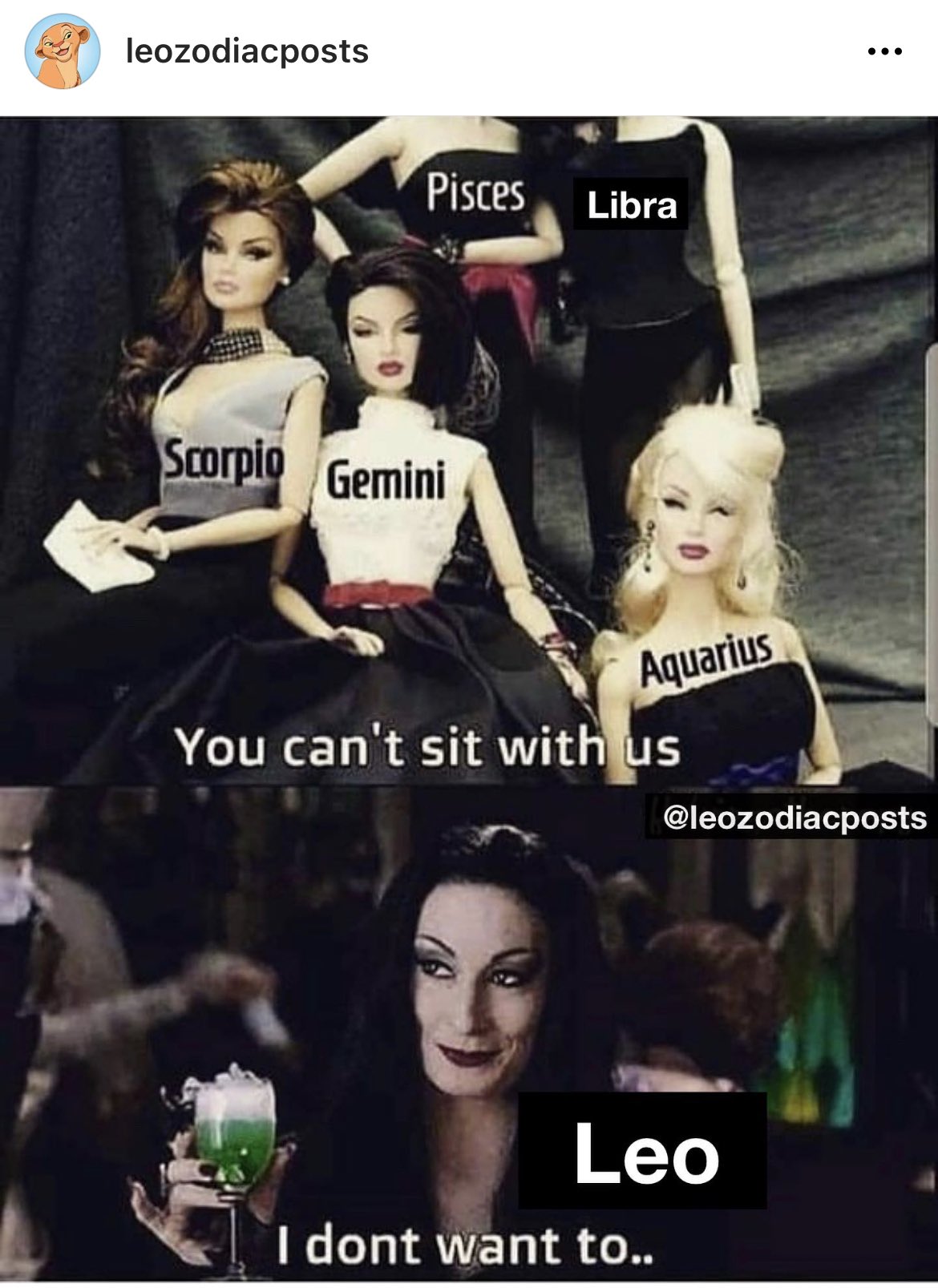
Now, I'm sure a real astrology girl, one that can do a full moon chart could explain how these memes are non-contradictory, contentful demonstrations of a real personality science because both Virgos and Geminis are air signs or something and both have a fierce and empowered independent streak in low agreeability trait. Here's one for Taurus, one for Leo, one for Libra, one for Capricorn, one for Scorpio makes 7 out of 12 star signs thus far with the simplest explanation being that Astrology works on Barnum statements, not that over half the population share a defining fierce streak. I'm confident I could do the same with MBTIs given that basically the MB crowd and the Astrology crowd pretty much produce the exact same concept, they just both probably look down on each other as deluded.

I think I stumbled across Mina Le's Youtube channel while looking to understand the utility of the manufacture of garments. Very much on a journey to expand my agency and step out of dependency on others to produce garments I want to wear. I just wanted to take the first step on the Dunning Kruger curve to understanding how little I know about the clothes I wear every day, and I first watched her video on some wool jumpers that I personally would never wear:

It was a deep dive into the history of the production of clothing and evolution of the market that just happened to use an "iconic" look I have never lived in a climate to give two shits about. Furthermore, while I could be absolutely persuaded that in 2023 one can obtain a machine knitted polyblend take on an old utilitarian jumper from some windswept craggy rock on the northern isles of the UK that was stitched by hand straight off a sheep's back and the new mass produced articles are objectively worse, for the purposes of a photo shoot, it does not look objectively worse unless one has been trained to care.

How long does one need to be informed that polyester doesn't breath and irritates the skin? 

I never finished that first video, because once it got into the weeds of tips as to how to avoid the Australian farming practice of whatevering sheep to prevent flies from parisitising their rectums or whatever, I just couldn't care. But as the internet including Youtube is want to do, you know, I get bored and I listened to a few more of Mina's video essays on fashion topics.

These quickly moved away from my interest in fabrics and how to stitch them and what possibly indicates quality vs slavery, to just well...the archetypal story about fashion - what are women doing now and how to jump on board.

Mina Le is interesting, charming even, she'd probably be welcome in my friend zone. I don't want to overstate it though, she's on the cusp of people I would forget existed if they were in my year at high school. I think with her memorably raspy voice and lack of grace and poise, she probably would have grabbed enough of my attention from time-to-time to not triage out the memory of her. But she's not that interesting as a grounded host of a youtube channel. Just to look at the thumbnails, I get a data set from which I can induct that if Mina Le is somewhat of an expert on fashion, there is no fashion expertise. That she is someone with an interest there is no doubt, that many people share her interest is attested by her subscriber count and viewership, that the content is interesting...

Well, I certainly reached my saturation point. This channel is an analogue to the channels on the subject of basketball that do a deep dive into the latest trend of floor-spacing/pick-and-rolls/iso-plays/reversals etc. that miss the big picture of Kobe won 5 championships while you obsessed over Yao Ming's footwork, or James Harden chokes every post season while you were having your minds blown by the way he was revolutionizing NBA offense. Both fashions on the streets and tik tok, and fashions in sporting tactics and strategies both have the common feature of setting aside the tricky and nebulous variable of human psychology in order to emphasize what is easily controlled like behaviour.

Much of Mina's content takes the forms of explainers: "explaining the hyperfemininity aesthetic" "explaining the gen z maximalism trend" "explaining the old money aesthetic" "everything you need to know about Japan's kawaii industry" "everything you need to know about the courset trend" "explaining the ballet trend in fashion. (balletcore)" "why do we wear impractical shoes?" "Celebrity courtcore: How and why celebs dress up for trial" "why are we so obsessed with scammers."

I am not fit to judge the actual content of most of those video titles, given I reached my saturation point with Mina Le, relatively quickly, which is a shame because I like to have something on in the background while I draw and am often looking for interesting and informative content producers. The titles I've shared by themselves, likely function mostly as clickbait to get undiscerning fashionistas to give the channel a try, they likely sound more vapid than they are.

My saturation point however, was watching "explaining the hyperfemininity aesthetic" and feeling like I was watching one of those miraculous machines where no matter what you put in the top, once you turn the handle the stuff that comes out the bottom is always the same. Specifically, Mina often in her deep dives finds thoughtful articles written about aesthetics to go along with historical precedents, origins, cycles etc. Those articles invariably conclude that whatever women are doing it is something to the effect of "stepping into their agency and defying the mores of the time that keep them under patriarchy." A conclusion that can be reached whether women are dressing up as infant girls with pig-tails in barbie pinks sucking on pacifiers with frilly skirts that reveal underwear that says "spank me" or whether they are getting short androgynous haircuts, wearing minimal makeup exaggerating their eyebrows and wearing blazers with shoulder pads. 

Nassim Nicholas Taleb, I think drawing on Nietzsche admonishes his readers to not confuse the unintelligible for the unintelligent. The inverse is also I feel, a worthy caution - do not confuse the intelligible for the intelligent. 

This appears to be women's video games. Where one can certainly be diverted for hours at a time by "understanding" why "we" "all" dress like little girls now, but it's likely just the same behaviour - adolescent women broke off and found some way to express a distinct identity to their older siblings and parents, then the older siblings and parents tried to imitate them necessitating some new iteration. Or some highly esteemed popular person started doing something, so plebs starting signalling their allegence by imitating them necessitating them doing something to distance themselves from the prole-drift which the proles were eagerly anticipating as the next thing to do.

It is much the same as somebody beating a video-game 100% completion 0 hits. It's not a real achievement, they bought into someone elses game which diverted them from creating something of their own. 

In the sense that the medium is the message, both fashion blogging/vlogging and livestreaming games, reacting to red carpet televised events like the Oscar's carpets or the Met Gala Ball, now make being a hobbyist potentially lucrative. The Far Side cartoon of parents imagining all the job ads for a kid that plays video games has not aged well, though it could potentially out live the influencer economy when we all look back with chagrin at that period of history where people worked hard to transfer money to hobbyists they lived vicariously through.

Lastly, Mina Le does strike me as someone self conscious, someone who is uncomfortable with asking her viewers to sustain her financially. She seems like an okay person that I would not have taken the time to ridicule in highschool unless she had walked into a rake or coffee table in my presence and the ridicule came easily. She is, amongst the videoessayists, one of the better ones. 

I write out my thoughts, because that confusing an interest with something interesting, confusing the intelligible for the intelligent has broader implications. I see it as societies path away from being broadly right to exactly wrong. 

Mina, I can actually stand. The same I cannot say for Big Joel, Basketball Break Down, Gil's Arena, Lindsay Ellis, Patrick H Williams...pretty much most video essayists and cultural commentators offer painfully extracted opinions bloated out to 30 minutes or more pulled straight out of their arses and presented as authoratative and researched takes. It's a genre popularized by a medium that society has not yet learned to interact with any discernment and it has lead to a pandemic of people acquiring beliefs believing themselves to be acquiring knowledge.

Mina Le is one of the better ones, and if you read her bio on her page "just a gal who likes fashion and movies" we get an honest disclosure of her qualifications to explain any of the social phenomena that form the subjects of her videos. It may not be a sufficient or necessary counterweight to the presumptive titles of those videos - where someone like Prof. Tim Snyder of Yale who criticized Putin for writing an essay titled with the word "On" because "On" presumes that something is. Titling something as "explaining" might presume possession of a definitive and solitary explanation, where the content is usually post hoc rationalizations offered by other observers of a phenomena (the consensus is that Alexander McQueen brought back low-rise jeans, where I feel Mariah Carey is a much more credible explanation for why it hit big at the turn of the century. Muffin tops and arse cracks are a credible explanation as to why high-rise jeans came back for women rather rapidly.) 

Yet, just as there are likely real reasons to drink wine from a glass goblet with a stem and whiskey from a tumbler, Mina Le probably shed's some real insight into historical facts and what not. Hence I could watch Mina Le for a while, without hate watching, I mean I never hate watched. I don't think Mina is fashionable, but I also don't care. Like I don't need someone to own 6 properties before I deem them qualified to tell me about property investment. 

Big Joel on the other hand, I do hate watch. He's like the bob's burgers of youtube. I can watch infinite Bob's Burgers and never spot a joke or gag, yet understand it to be beloved, Big Joel however much of his content I've watched, I've never spotted any actual insight, yet understand him to be beloved. Like beloved like a show that actually makes people laugh, or beloved like a commentator who shares actual insight.

I recommend Mina Le as a valuable example of a content creator that can be watched in order to extract the content archetype and stop watching. Mina Le on everything is talking to the story of reconciling the need to fit in, with the person who needs to fit in. That's fashion.

Monday, February 12, 2024

Quick Sketch: On Evil

 I've probably been mentioning this about as often as someone mentions they are vegan, but I need to come out as an Igtheist, or Ignosticist if brevity ain't your thing. Totally compatible with being Atheist, Igtheist is the position that basically I don't know what the fuck anyone is talking about when it comes to really metaphysics and that needs to be flagged when I quickly bash out some words about "evil".

So in an attempt at clarity, take for example the exercise of "prayer" of course I understand that prayer is something people do, people clap their hands together face some idol or direction or maybe just bow their heads or look to the sky. I understand that prayer is a thing that exists and I could point to people praying and say "that's some people praying." Sometimes even this exercise is intelligible, like in a Shinto shrine in Japan when you see someone ring a bell and clap and throw a coin in a big wooden box and they pray for good grades or to have a baby boy instead of a girl, or that their grandma lives to be 115 by getting over the cold she caught at 107. Shinto has evolved to become a fairly clear cut placebo prayer procedure - you buy sugar pills, you take the sugar pills, you feel better and maybe even coincidentally get what you want when you want it.

I can also make sense out of how people more generally only pray for shit that is out of their control. People don't pray for lunch unless they are starving at sea. If there's a supermarket and they have cash they don't generally tend to ask the creator of the universe to help them out. But, and here is where it breaks down, when they pray to be cured of cancer or to get selected for a reality tv show, and they are praying to a monotheistic tri-omni plus god, the whole exercise is unintelligible. In fact, a tri-omni god is unintelligible or at least indistinguishable from nothing at all.

A prayer enthusiast could probably try and inform me of what they are doing, but as an igtheist they generally don't want to. So my position on all that shit, prayer, evil, good, sin is not merely that I don't know what you are talking about, but that I have no confidence you know what you are talking about.

Boom. Evil. What is it? Is it a thing? Short answer, no. Whatever it is it has to be subjective. 

A while ago though, I watched an interview with one of the many people struggling with the social friction of the times, and these people tend to fall into one depressingly predictable camp.

People I've noticed have a bit of a USB mindset, by which I mean if they try one thing and it doesn't work, then they try another thing and that doesn't work, they tend to try the first thing again. This works for USB sticks. If at first you don't succeed, then at second you don't succeed, it probably was a false negative the first time, provided you really tried to make the second thing work.

For me this describes the swing voters that must exist that are always dissatisfied with the incumbent government and feeling nostalgic for the last incumbent government they were dissatisfied with, hence you get voting patterns of conservative, reform, conservative, reform, conservative, reform. Which would be fine if the switch flipped via a recognition that it was variously time for necessary reform or time to conserve the good times. But typically it's like inflation is too high and wage growth is too slow from 1976-2024 and counting so you just vote out whoever isn't addressing it and vote in someone who won't address it.

It also appears to be the USB mindset of people who do not like the unexpected turn secular societies have taken in the 21st century into a form secular puritanism. A depressing number of people bitten for expressing common sense views that stand in juxtaposition to presumed collective ideals go to their rooms and wax nostalgic for society under the church.

I don't have it in me, to understand how men in dresses preaching horseshit, meaningless drivel in an activity that takes a full quarter of one's weekly downtime has any appeal whatsoever. Alas, fucking alas, a bunch of people do. This is not a USB stick where the answer to the new horseshit is a revival of the old horseshit. The problem with behaviour based on maps that do not describe the world very well is to dust off old maps that became unpopular because they do not describe the world very well.

This was an interview however with someone otherwise clearly intelligent who put it to her host, a well known atheist and sceptic, the question as to whether he believed the universe has moral laws.

To outline my understanding of such a question, it's like observing a Newtonian law of motion like everything in the universe remains at rest unless acted upon by another force (your coffee won't ever jump off your desk and commit suicide, but if the desk gets bumped hard enough it will spill) and thinking that the universe might punish lying.

There is of course some evidence that the universe punishes lying, but not enough to be conclusive. There are plenty of lies that probably turn out to be inconsequential, like I once lied to get out of a work shift to go to a gig, then saw the guy from work I spoke to to cancel my shift at the gig, but he didn't see me was it sufficient for the universe to make me mildly uncomfortable during the gig? I feel these are more social consequences that are part of course of a greater universe but it is entirely plausible, if not demonstrated that one can be a pathological liar and enjoy wealth, avoid prison and produce offspring.

Furthermore, just because a behaviour is compatible with the physical material world we live in (like climbing down trees instead of leaping from the upper branches) doesn't mean that anyone or anything wants us to behave that way. An idiot that jumps out of a tree because he doesn't understand that injuries grow exponentially in severity the greater the distance fallen may not live like someone who climbs down to a survivable height before jumping out of the tree, but their rotten corpse provide energy and nutrition to the biosphere that on the whole is largely indifferent to that idiot being dead and their more sensible contemporary being alive.

So Hitchens used to say that he believed in evil and defined it as "the surplus value of totalitarianism" where "you've made your point but you keep on going." For example, by this definition, Hannah Gadsby could be considered evil in relation to Louis CK. Asking work colleagues if you can masturbate in front of them is unacceptable behaviour whether they agree to it or not. Louis CK got exposed and took a massive financial and reputational hit. Consequences. It is pretty clear, that society disapproves, but Hannah Gadsby differs from the emergent consensus (that Louis is allowed to work, people are free to associate with him, venues are allowed to book him) in expressing views congruent with anything short of Louis CK being a destitute persona non-grata is insufficient to making the point. (Probably, I give her the benefit of the doubt that she feels the social response insufficient, rather than her views coming from a pure vindictiveness, her wanting a response surplus to the making of the point is not something she herself views as surplus. But Vlad Tsepes I'm guessing never looked out the window of castle Dracula at all the people slowly dying impaled alive upon poles for suspicion of petty theft and thought "you know I really am excessive." He could have just thrown those Germanic ambassadors out to make his point, he didn't have to have their hats nailed to their heads. Totalitarian is as totalitarian does.)

Hitchens is pretty good but he's no Abe Lincoln:

It is the same principle in whatever shape it develops itself. It is the same spirit that says, "You toil and work and earn bread, and I'll eat it."

Okay, so that's a multi-valent statement if ever I heard one, it could simultaneously be quoted as an argument against pinko Commies, and quoted in an argument against capitalism and "free" markets. This president being my favorite leader ever, keep in mind presided over the largest mass execution in US history, and that's not a euphamism for the civil war, it's a literal execution of a bunch of Indians that did something rebellious in light of annexation and probably broken treaties by the States. #CancelAbe. 

I think it describes as close as we'll get to a moral law of the universe.

So it might seem ambitious and that I have already rambled on too long just to get here for a post I called a "quick sketch" but if you are reading this it means I published it and vis-a-vis therefore I published it and quickly.

The fundamental observable nature of the universe is that it is dynamic. It moves. It is not static and therefore behaviour is possible. Consequences are possible. All that shit. It's very simple, it's all around us all the time, but that's the basics.

A dynamic universe, I assert, doesn't work if there's no risk premium. It can't fucking sustain life and thus we would be talking about the morality of rocks.

Picture a valley where a bunch of tribes have figured out how to share natures bounty and subsist on the fruits and the game of the valley by taking turns, biting their lips and limiting the expression of dissent to passive aggression, never actual aggression. 

The people survive but nobody is really happy there. Then one day, one tribe are like "fuck this I can't take our neighbouring tribes all night singing anymore. We're leaving the valley!" and leads their people out of the valley into the unknown.

Outside the valley could be endless uninhabitable wasteland. That has to be a possibility. If it were guaranteed however, there would be no risk premium for exploring the unknown and this particular incidence of abiogenesis occuring in the universe would be the equivalent of lichen growing on a rock somewhere before eventually dying and disintegrating back into inert matter with little consequence to itself. However, if there's a possibility that this tribe stumble for a couple of days through a wasteland, gradually beginning to doubt themselves, before they climb the next hill and discover a verdant, beautiful and heretofore uninhabited valley, then this universe has a risk-premium.

That is, this tribe gets a huge payoff for potentially risking everything and losing. It pays not to maintain the status quo. Not all the time, not necessarily most of the time, but when it does the windfall has to be proportional to the risk otherwise nothing works.

We can't have the society we have under conditions where if somebody is asked to quit their paying job to join a startup that is going to invent robot taco stands, the deal has to be "quit your job that pays $150k a year in return for a 30% stake in this venture that could be either worthless, or worth billions."

Taking risks has to, has to have a potential payoff that is greater than not taking a risk. It's why we can be certain that the music industry is worse and culture impoverished once you program the mp3. It might be hard to notice that Taylor Swift is no Madonna, given all the revenue she generates, but that is because there is less incentive to be Madonnas now, so the new Madonna's don't exist. 

Better example, the NFL is big money, the superbowl has famously expensive ad spots. It's the biggest sport in the US. For every one person watching the NBA in the United States, there are ten people that watch the NFL. 

The highest paid NFL players get between $50-$55 million per year. The highest paid NBA players get about the same. The NFL is a brutal sport, it's really hard to do well enough long enough to get a guaranteed contract and then you shoot yourself in retirement because of acquired brain injuries.

The best players in the NBA at the moment are variously Canadian, Greek, Serbian, Slovenian, Cameroonian etc. there are almost no foreign national players in NFL it is nowhere near becoming a world game, there are a few Australian punters or kickers, that's it. 

This can in part, and probably mostly be explained by the risk premium not being there for NFL despite it's domestic popularity. It is a quirk of US culture that foreigners look at and pass. Unless you are an Australian AFL full forward that can boot an ovoid ball for 60+ meters and decide instead of playing a real role in a dynamic and democratic sport, you can play a walk-on role for much more money in a league and code you never cared about.

The NBA reaps the fruits of diversity, whereas the NFL probably doesn't and that's because the risk premium is there for the NBA such that 90s kids the world over onwards can find it worth their time to gamble on a career in basketball. They don't do that for grid iron, the risk premium isn't there for anyone to build the code specific fields, purchase the expensive equipment and fill all the elaborate and convoluted defensive and offensive positions. It's not that NFL is a bad sport, it's not ten times the size of the NBA for no reason, its just the potential payoff isn't there for explorers t strike out for NFL El Dorado.

The risk-return relationship, is as close as I can deduce, a mathematical law of the universe - uncertainty has to potentially pay off. Like you cannot and should not sell a raffle ticket for $2 if the first prize is $1. Even if the expected value of a lottery ticket is lower than the cost of entry (as lottery picks exist today, hence their reputation amongst economists as a "tax on stupidity") the potential payoff has to be massive, $4.95 has to be attached to the dream of millions, even if there's a 1 in a billion chance of actually winning.

It also is a mathematical law of the universe that I feel has social implications, a mathematical law of morality. Risk takers have to get the risk premium.

Meaning evil is simply taking the risk premium, without taking the risk. We have a name for people who commit such evil, but no it's not the government who comes and taxes your income. Okay, let me be clear, the government takes a risk building roads and schools and hospitals and deploying its monopoly on violence to enforce property rights that allow the governed to do something with the land and infrastructure risking that those people will make something with the civilization provided to them and sustained for them and as such the government is entitled to its risk premium collected from every individual bet it made most of which pan out meh like me.

No the name is "rentier" these are the characters that fit the bill of "You toil and work and earn bread, and I'll eat it." though toil and work in this case, involves taking the risks. Chomsky puts it as "socialised risks and privatised profits" such as when taxpayers bail out a private company that then continues to operate exclusively in the interests of its shareholders. Rentiers are evil because they put the dynamism of life at risk by killing it, such that we return to a Universe of rocks, with no interesting thing to say about morality or even a mouth to say it with.

Don't eat the risk premium unless you earned it by taking risks.