22 Short Posts About Representation in the Media
My interest was piqued in representation a fair while ago and I have at least one other draft post about it sitting in a backlog of unfinished drafts. Recently my interest has been piqued again but coming from different sources converging on the same theme.
Mostly, I find 'representation' itself an ambiguous concept - undefined. For example there's a question of that people are represented, then a distinct question of how people are represented. Then with concepts like 'write what you know' and also I guess 'cultural appropriation' there's who gets to do the representing. Even when I try to restrict myself to 'representation in the media' there are the in-front vs behind the camera representation, particularly who directs and who writes the screenplay.
So not quite a listicle, more a loose collection of thought cousins as at this writing I have not determined an order to present my various ideas on the subject in. So... splat:
See it in 3D at IMAX
"Hey, remember when movies were bad because they were only in 2D? Isn't it great that movies are good now because they are in 3D! Yeah, movies didn't suck because they had shallow, uninteresting characters, non-sensical plots, a lack of originality... no, they were bad because they were 2D..." ~ Me. (I'm 30% sure I said this out loud at least once, but not confident I had an audience.)
3D Cinema was a gimmick. I recall seeing a film at IMAX that actually explained that 3D was revived to try and give Cinemas the edge over improved home cinemas and keep the industry alive. I recall for like a decade having the visceral response of 'oh fuck... it's in 3D? Fuck it.' as the market failed to realize that I hated 3D screenings, I often felt hostage to 3D. It meant I had to pay $30AUD to see a film, and wear an uncomfortable set of plastic glasses over my glasses, and worst of all to attain a visual effect incapable of swaying my opinion of the film.
In that whole mad fad that I fucking hope for the fucking love of humanity is fucking over, only James Cameron ever treated 3D as a cinematic possibility with Avatar, rather than a gimmick. The only mainstream director (and I'm not aware of any indie auteurs that leaned in to 3D Imax) to say 'what are the possibilities of this technique?' rather than just use it as a gimmick to try and extract premium prices from the public.
The other hero of the dark years of 3D, is Christopher Nolan, whom refused to release his Batman movies in 3D and for all I know, may have been that voice of reason with sufficient clout to finally end the farce. It may have been the single best thing about his Batman run.
Now with so much content, with important qualifications I'll treat separately, I feel I can substitute my exact sentiments about 3D with 'representation' and or 'diversity'. I also feel I could make some substitutions to force MLK's 'I have a dream' speech back me up. But I won't.
The point being that the demographics of a cast have absolutely no impact on whether a movie is good or bad. It's really just the classic ad hominem fallacy.
A James Bond movie isn't bad because a white man is playing James Bond again. Casting has an impact, to be sure. There is variation to be observed between different white men playing James Bond - Sean Connery, Roger Moore, Pierce Brosnan, Daniel Craig. Fuck, I seem to recall Daniel Craig's casting being a minor stir because Craig is blonde.
The greater impact I would assert, is the quality of actor. The best argument for considering Idris Alba or Gillian Anderson for playing 007 is that they are quality actors. Not that the franchise could be reinvigorated by casting Kristen Stewart or Chris Tucker as 007.
The best contemporary example of diversification as a gimmick, is the 13th Doctor - Jodie Whittaker. Whom we know can act from her work in Broadchurch, just as we know Chris Chibnall can write and direct and run a show from the same series. We know from seasons 2 & 3 of Broadchurch that he is capable of producing compelling television beyond its optimal run (one season).
I've probably missed my chance to run to the defense of Jodie and Chris's run on Doctor Who. But I have had the best of intentions to point out that Doctor Who was showing its fatigue in the Matt Smith incarnation (11th doctor). For me personally, it was during Peter Capaldi's run as the 12th doctor that I had my personal epiphany of 'Why am I still watching this?' and then the 13th Doctor was brought in much like Poochy to beat a dead horse back to life. (and tragically like Poochy or New Coke, if the series is revived by reverting to a male Doctor for the 14th incarnation, then it is representation as 'absence makes the heart grow fonder')
I mean fan favorite member berries like Daleks, Cybermen, The Master had been milked. It just wasn't exciting to see the latest way Daleks and Cybermen were going to take over the world.
If nobody else realized it consciously, the casting of the 13th doctor gave an opportunity, a fucking isolated controlled experiment, in its execution to demonstrate that Doctor Who was neither good nor bad because of the gender of the Doctor. I can only speak for myself, but when Jodie made her debut as the doctor my reaction was - oh, it's just Matt Smith again. I've seen this. (To this point, I recommend youtuber hbomberguy's video on Stephen Mophatt)
More vs. More of the Same
“To be born into, to go to school, to study, to learn, to play, to worship, to love, to work and to die in segregation and not have one single person who loved, mentored or guided me convey that there was any loss.” ~ Robin DiAngelo, White Fragility.
The best argument I could conceive against a lack of diversity, representation and for more diversity and representation is that everyone is impoverished by homogeniety.
The most likely candidate to constrain this argument is 'diminishing returns' a simple example of which I can go to is my exhibitions as an artist. For arguments sake, let's say that with a budget of $1000 I could stage an exhibition that could bring in $1600. If someone was to go 'Wow! that's a 60% return!' and eagerly write me a cheque for $1M, holding everything else constant with a million dollar budget by maxing out advertising and my art output I could probably make $3,200. The same as if someone had given me just $4k instead of $1M - which would still result in a loss. For my business model, I was dependent on keeping my exhibitions cheap and infrequent.
Applying the concept of diversity to this, in my own mental short-hand I feel there are two outcomes - 'more' which is good, and 'more of the same' which is bad.
Examples of 'More' are: Moonlight, Parasite, Spiderman Homecoming, The Good the Bad and the Ugly.
Examples of 'More of the Same' are: The Ring 2002, The Lion King 2019, Dr Who Seasons 11 & 12, Star Wars: The Force Awakens, Captain Marvel, Ghostbusters 2016 etc.
I should point out that World Cinema has been providing us with representation and diversity in the desirable 'more' category since forever. While Hollywood seems dominant in a globalization sense, there's not much about history that makes this necessarily so, but I must plead ignorance as a non-historian of world cinema. New Zealand cinema punches well above its weight. Australian actors are well and truly overrepresented in US productions, Hong Kong cinema appears in a lull, with no modern analogues of Jackie Chan and Jet Li. Bollywood appears to have always thrived, Nollywood is incredibly prolific in its production. Historically Germany, France and Italy have had ebbs and flows in cultural significance (German Expressionism, French Avant Garde and 'Noir' films, Spaghetti Westerns, Giallo etc.) as has Hollywood.
'More' enriches me as a consumer of media. I'm exposed to new stories, new concepts, new techniques. It uses demographics to create a diversity of art. 'More of the Same' does not. It uses demographics to repackage and resell something I already have.
Such that all I can say is: 'I commend you on your demographics.' And it is important to say that there is more to diversity and representation than the entertainment and cultural enrichment of the audience. In a business model like Disney that I'd describe as low-risk-modest returns, or what Nassim Nicholas Taleb might describe as 'betting dollars to make cents.' where they buy up expensive IP with an established fanbase, throw lots of money at it to polish and package it and then hope to recoup the budgets in the opening weekend. I would speculate that their desire as a business is to work out a cookie-cutter/fill the blanks formula.
But I will defend representation's benefits in getting more than just white men paid. If you are going to repackage and resell an old product that adds nothing to the culture, it is better if the money goes to women and people of color and LGBTQ people. Divvy up that monopoly pie.
The major component of course, is that they are just remaking past successes. The diversity or improved demographics are the 3D gimmick, and more often than not - it just gets in the fucking way, and not even in the sense that you are like 'wow! I'm so distracted by this diverse cast I'm not noticing the producers reaching into my pocket and taking my money.' (such as I suspect was the case with Avatar's 3D immersion in a fantasy world or Sin City's unique color grading) but more in the 'the fixation on the demographics is making me painfully aware that this movie has nothing new to offer me' sense.
All of which to say, is that 'More of the Same' gives me a sense of foreboding, it opens the door to historically under-represented people being made into pariahs for one. Consumers learn over time and build defense mechanisms against marketing. 3D stopped working. Bullet time stopped working. People realized 'The Hobbit' trilogy is inferior to 'The Lord of The Rings'.
So what happens when Ghostbusters 2016 fails to break even? When Doctor Who Season 11 sees ratings collapse? When Marvel come out with a box office bomb as the Star Wars franchise did... it will most likely be for the usual reasons big budget movies fail - executive interference producing a shitty movie - but because those people have to find themselves guilty; I feel it much more likely that they will conclude that the gimmick has stopped working, and diversity and representation will be blamed for the losses.
Perhaps the best example might be 2012's Total Recall remake of the 1990 film of the same name. A heterosexual Austrian male lead was replaced with a heterosexual Irish male lead. It made $198 million at the box-office in 2012 money, compared to $261 million for the original in 1990 money ($458 million in 2012 according to this inflation calculator).
Clearly, Total Recall was just a bad remake that nobody really wanted and had Kate Beckinsale been given the lead role and Colin Farrell cast as the supporting antagonist role, it would not have turned the movie around. But its failure can be analyzed with a control for social justice, which a similar film like Terminator Dark Fate cannot. A Mexica John Conner, a female Michael Bien/Arnold Schwarzenegger, a Mexican T1000 all propped up by returning icons Linda Hamilton and Arnold Schwarzenegger.
Dark Fate was bad for the same reasons Total Recall was bad. Nobody wanted it to be made in the first place and there was nothing compellingly new there. It was even more egregious than Total Recall 2012 though, because Terminator Genisys, Terminator Salvation and Terminator 3 had all already proved that there just weren't enough legs in the premise to keep carrying a franchise.
There is one curious and notable exception to "More" being a repackaging of pre-existing material and that comes in Musical Covers: Changing a vocalist, remixing or rearranging can have a huge impact on a song, and sure, bad covers exist, but the potential for "More" through covers seems endless. Seu Jorge's Portuguese covers of Bowie, Norah Jones covering Blackhole Sun, Sinead O'Conner's rendition of Prince's Nothing Compares to You, the White Stripes covering Jolene.
I suspect this is because of 2 factors: 1. There are no 'big budget' songs. The cost of producing 'Thriller' or 'Saturday Night Fever' is not 800x that of producing 'Montana' or 'Enter Sandman' so you don't have record labels or whatever saying 'if we're going to put $125,000 into a single we need to see a return, so fuck this 'Rolling in the Deep', who knows if it'll hit. Let's just record Thriller again.' and 2. Songs are far more timeless. 'Titanic' is the only film I can recall morons paying to see hundreds of times and I am still perplexed as to why. For the most part people will listen and listen and listen to songs they like and do not demand sequels in an attempt to experience hearing a song for the first time again. So if covers exist you can in a matter of minutes listen to the original and three covers.
On my first ipod for example the song I had the most versions of was Cyprus Hill's 'How I could Just Kill A Man' not my favorite song in the world but I had the original, I had Cyprus Hill's Spanish version, I had RATM's cover, and Rage performing it live (from the same album) with Sen Dog and B-Real. And each version added something, it was "More" not "More of the Same."
"The Stonecutter Problem"
"I don't want to belong to a club that will accept me as a member." ~ Groucho Marx.
The Stonecutter problem is based on this episode of the Simpsons where Homer is dealing with his personal feelings of exclusion. We might also be able to skew a reading of the famous Groucho Marx quote to illustrate it.
One argument for representation, and particularly representation of diversity is the 'You can't be what you don't see' argument. But the stonecutter problem is where you are trying to avoid or remedy a feeling of exclusion. I guess there's a strong and a weak version of the Stonecutter problem.
Weak version: You get your turn to be included, but you aren't equal because the other club members have not experienced your exclusion. They experience no jealousy, alienation etc. So the repair doesn't feel complete. Lenny and Karl aren't jealous of Homer's new chair.
Strong version: You get your turn to be included, and the previous club members lose interest and/or resign, killing the very club you sought to be included in. The Stonecutters disband and start a new secret society of the 'No Homers'.
This is pure speculation on my part, an attempt to see the emotional drive that produces much disappointment. I am fairly confident it is one of the ways in which to fuck up representation in media, but all I have to go on is an impression.
A specific example might help - Ghostbusters 2016, when the trailer dropped I made an error: I evaluated it as a trailer for a film that I might or might not wish to see. The commercial and critical failure of Ghostbusters 2016 is now a matter of historical record, but the impression I got of my failure as a viewer (I still haven't seen the film) was my failure to acknowledge that boys had had their turn in 84 and 89, where the girls all politely had to sit and watch us have our fun, and now we were breaking our obligation to sit and watch the girls have their fun.
The Stonecutter Problem arises when someone basically gets blinkered by their own emotional reaction to being excluded, and fail to see it from a wider audience perspective. The emotional reaction to being excluded is an awful feeling I can relate to.
In Grade 6, one of my friends who'd until that point invited me to every one of his birthday parties since grade 3 or so, didn't invite me that year. I'd apparently lost my place to another cooler kid. The problem was that I wasn't invited because we'd grown apart and the birthday boy just didn't want me there.
When I confronted him though (and this is an 11 year old's confrontation) he gave dishonest reasons like a strict quota on the number of kids. I managed to back him into a corner where I said that he shouldn't invite new cool kid, because he'd never been before, and he said what he'd do is flip for it and pulled out a coin. Heads cool kid, tails me. The coin hit the ground and as I looked at it, my friend or the new kid (I can't recall) stomped on the coin and declared that it was 'heads'. It may have been, but it became clear to me, even though I lacked the vocabulary at the time that I was witnessing a farce, a rigged parody of fairness designed, I'm sure, to spare my feelings but instead doubling the insult.
Anyway, the emotional impact was severe enough that I can recall an event from 26 years ago. The point being that being excluded sucks.
In part, I suspect that this is a non-insignificant factor in describing how efforts to increase representation can exacerbate the cruelty of exclusion rather than relieve it.
Imagine as I can, that the popular kid with wealthy parents in your class, has a party and you weren't invited. They hosted it at mini-golf and had pizza, with ice-cream cake and every kid got a gift bag with a toy and candy to take home with them. All the kids that went are talking about it on Monday at school and it makes you feel really bad that you didn't get to go.
But you devise a solution, you talk your parents into ponying up for your own party at mini-golf with pizza and ice-cream cake and they sit up with you making gift bags with toys and candy and the best part is everyone's invited. Even the popular kid that didn't invite you.
Then the party comes and only 3 friends turn up, kids that also weren't invited to the last mini-golf party.
It breaks my heart picturing this.
In the scenario, it is likely that both outcomes (not being invited, and not turning up) are driven by the same phenomena: you aren't popular. It doesn't help that there is nothing novel or unique about the party thrown - it is in fact an attempt to reverse engineer someone else's popularity.
From that very relatable and moving scenario, I have to employ cognitive empathy to try and imagine what it was like for a girl in the late eighties to go and see Ghost Busters, or watch Doctor Who, or girls in the 90s to go see James Bond movies, or Black kids seeing Disney Animated movies through the 90s or comic book adaptations in the 2000s and 2010s, or an Asian watching any of the first 6 Star Wars films.
I don't know if it was roughly analogous to being a white boy watching NBA games in the 90s, or listening to Hip-Hop in the 2000s (from the 90's Australians had a bunch of catch up to do. I'm still catching up on 80s and 90s hip-hop) the Japanese don't depict themselves as Japanese in their own Animations (think the titular Sailor Moon) but there's nothing I can draw upon in my experience to understand why someone would stand up and demand to know of J.J Abram's 'Why aren't there any Asians in Star Wars?' and maybe it is analogous for most Asians to see someone with whom all they have in common is a broad non-specific ethnic identity ask that question and be as baffled as I am that any male would ask 'why aren't there any boy crystal gems in Steven Universe? (Steven, the titular character apparently doesn't count)' Though, I am not a child largely unaware of the history of children's cartoons that predate me, so I as an adult just can't understand how much it might matter to a little boy that the alien race of Crystal Gems are universally female.
I can imagine though, that if you identify with Ghost Busters and want to play it in the school yard during recess or something, that being excluded because you're a girl feels terrible.
"The Stonecutter Problem" then lies in it not being enough for you to be told you can be a ghostbuster, a time-lord (and a specific time-lord at that, not the lady time lords from the 80s), a jedi, a superhero, a pirate, a knight in shining armor, an astronaut, a spy, a race car driver etc. You need other people to care as you do that you can be a ghostbuster, a specific time-lord, a jedi, a superhero, a pirate, a knight in shining armor, an astronaut, a spy, a race car driver etc.
It's not that you can't enjoy mini-golf, ice cream cake, pizza and candy all by yourself. It's that nobody cares if you enjoy mini-golf, ice-cream cake, pizza and candy. And if you care that other people care then it's not enough to throw a party, the feeling of exclusion can only be alleviated if everyone attends.
When Homer asks Lenny and Carl if they are jealous, I feel it alludes for me, to the concept of an etiquette of turn taking.
The best remedy for the Stonecutter Problem is to adopt a differentiation strategy instead of a market penetration strategy. Aka 'More' through differentiation rather than 'more of the same' through penetration.
The Stonecutter problem has no remedy through simply trying to rehash a bigger better version of an old idea. I don't particularly want to see 'Romeo and Julian' or 'Antonia and Cleopatra' I would much prefer to see 'Moonlight'. I have limited interest in Miles Morales' as Ultimate Spiderman, or Gwen Stacy as Spider-girl, I'd much rather watch Steven Universe.
We could readily recognize this lack of remedy at a dinner party if somebody told a joke that got a laugh, and then another guest said 'you know, I'd really like to tell that joke as well.' (certainly there are some long form jokes like 'the Aristocrats' where a whole party of people can retell the same joke, and it's kind of the point.) But generally with media in particular, there is a first-movers' advantage.
Just try and imagine how to remake 'The Sixth Sense' the 1999 box office hit in 2024 with women of color in the lead roles. In fact I hazard a guess that by now we know how Hollywood would remake this and it would flop because 'twisting the twist' would not be enough 'more' and too much 'more of the same' where we the audience have to sit through the whole set up and premise to have the non-sensical revelation that the girl who sees dead people was dead the whole time and the adult was in fact the psychic. [mind blown sound effect]
Hypnotic Crab Juice Pancakes/Investment in Media Effects Theory
"If it were true that children mimicked their teachers, you'd sure have a helluva lot more nuns running around". ~ Harvey Milk.
"Michael Moriarty was very good as that, um, Nazi. And as soon as I switched off the third episode, I, er, got on, er, got on the number eighteen and got up to Golders Green and I must of, must of slaughtered about eighteen thousand before I realised, you know, what I was doing. I thought, the fucking television has driven me to this." ~ Peter Cook, Derek and Clive Get the Horn 1979.
“The mind, as a defense against the volume of today’s communications, screens and rejects much of the information offered it. In general, the mind accepts only that which matches prior knowledge or experience.” ~ Al Ries, Positioning: The Battle for Your Mind
"What would Jesus Do?" ~ Charles Spurgeon.
The effect of media is an open question. A question of how strong or weak media effects are. I find an 'investment' in a strong media effects hypothesis interesting because it solves a strange conundrum of consumer behavior: people demanding content that they then do not consume.
Examples brought to my attention are: The CW's Batwoman, The Thirteenth Doctor, Sina Grace's run on Iceman, Eva Ewing's run on Ironheart and I'm sure there's more.
One of my most frequent marketing professors Brad oft alluded to a debate (in the early 2000s) as to whether marketing was a strong or a weak force. In his opinion, it was weak, and that's probably what I would say of media impact on audiences.
It's a confusing thing for me to contemplate though, and it was particularly difficult within the context of learning marketing because you tend to look at famous successful campaigns and dominant brands.
I'd describe it to myself thusly (probably): Marketing can appear strong when you take a sugary carbonated beverage and relentlessly build an association between it and having a good time while you are young in the summertime. But substitute a sugary carbonated beverage for a hot goat-offal based stew and relentlessly build an association between it and having a good time while you are young in the summertime and marketing suddenly is completely impotent.
Similarly, in my long stalled-at-the-gates series of posts on my own superficiality, I have posed the strong and weak interpretations as strong 'we are sold sex' and weak 'sex sells'.
So all of the above is to say, I believe the media can nudge, but it can't push and it certainly can't shove.
Now allow me to try and illustrate trying to change society for the better through media effects: Something I genuinely believe is, that our society, and particularly democracy is impoverished by economic illiteracy. I notice that young people love reading comics, and so I decided I can boost the economic literacy of the nation by creating a comic about economic theory.
Dovetailing with the "stonecutter problem" above, what I would run into in a free marketplace like comics, is the fact that I'd overlooked that young people don't love reading comics, they love reading comics about giant robots and magic powers.
There's an episode of Warner Bros. 'Pinky and the Brain' where Brain's plot to take over the world is to make a syrup out of a certain species of crab that has mind control properties. He plans to serve this syrup with pancakes at a pancake jamboree. The major obstacle though is that the crab syrup tastes really bad, and he tasks Pinky with perfecting the recipe so it's palatable. The pancakes are a big success and when Brain asks Pinky what he did to make them taste good - the answer is that he left the crab syrup out, thus thwarting another of Brain's plans for world domination.
I stongly suspect that Hollywood, the Comics industry etc. is in the process of figuring out that the way to make the media palatable again is to take back out of it, what has recently been put in.
'Investment in media effects theory' is actually the answer to a number of mysteries in the domain of representation - specifically 'how' people are represented in film. One mystery is why people work on intellectual property (IP) that they do not like and are not familiar with because they do not consume it. Another mystery is why owners of expensive IP are bringing in outsiders (kind of analogous to when Wall St Investment firms got obsessed with hiring Math and Physics Phd's instead of Finance and Investment graduates, see the Global Financial Crisis, LTCM, Antifragile, The Big Short) to work on their IPs. A third mystery (and that's sufficient) is when these collaborations/concessions result in commercial and critical* failure - why the audience is often blamed and why there is doubling-down on the strategy.
An example of attempting to apply media effects theory is when the NRA suggests violent video games contribute more to mass shootings than the availability of firearms. I can't possibly fairly represent what advocates of media effects theory actually believe, because the position is unintelligible to me, so my apologies for the following characterization: As near as I can guess proponents adopt a view that our lives are an imitation of art and not vice versa, that the composition of society is essentially arbitrary and an important lever is how we portray society via media.
So this is an idea that we are trained into an identity, not exclusively through media but I can't do the theory justice (and I will plead ignorance to the full extent of the theory, I'm not going to read Gramsci's prison notebooks to understand cultural hegemony and all developments on his notions since), it more shows up in my periphery with comments like 'because x are trained/raised to be y.' eg. boys are raised to repress their emotions, women are raised to be deferential etc.
I can think of clear cut examples where this is the case, eg. when fathers teach their sons to shake hands but not their daughters, or mothers offer their sons seconds but not their daughters. But these are domestic settings, and even though this is the most quote heavy section here's another:
So, when parents, convinced of their crucial roles in shaping the futures of their children, ask me, “What can I do to make sure this kid turns out well?” they are often surprised at my response: “Not much, but maybe cutting down on the fights and not trying to control your child’s every decision might help to make everyone happier right now.” ~ Gordon Livingstone M.D., Too Soon Old, Too Late Smart, Ch. 26: Parents have a limited ability to shape children’s behavior, except for the worse. (emphasis mine)
Why do so many white boys grow up to have a closer resemblance to Lex Luthor than Superman? And why then do so few grow up to resemble the Joker (especially the ones who really try to)? In fact why do so few boys grow up to be men that resemble superheroes or even heroes at all? Why do so few boys ever go on a life changing adventure? Most men, I suspect upon analysis resemble their fathers. Except... are effeminate gay men raised to be effeminate? is it mum or dad's fault? (hopefully this is a rhetorical 'no')
I'm agnostic on just how strong 'nurture' or 'environmental factors' are in shaping a person. I am convinced that there's no such thing as 'Tabla Rasa' or a 'blank slate' I feel the most likely is that genes and environment interact, and here I defer to experts' tentative position and am unconvinced by "experts" who are convinced of their position using a methodology that boils down to 'literary criticism' or even personal revelation.
The strong version of media effects theory or 'powerful effect' which, I'll get personal here, should be as readily falsifiable from direct personal observation as a flat earth. More so even.**
It's that there are very old, very influential organisations dedicated to shaping people into certain personalities, namely: organized religion. What we can observe, even in historical periods at which institutions like the Holy Roman Catholic Church were at the height of their power, through to the remaining pockets where Christianity remains influential today; they fail, again and again, to produce Christians, or people at least who enact the teachings of Jesus of Nazereth.
From emperor Julian the Apostate, to Pope Alexander VI fathering Cesare 'Borgia, to Holy Roman Emperor Frederick II, through to Joseph Stalin who attended a Spiritual Seminary and achieved high grades before losing interest and turning atheist, to former Australian PM Tony Abbott who appeared to study the bible and identify most with Judas Iscariot. This can be carried through to today where thankfully we are no longer dependent on history's focus on people in exceptionally privileged positions. Youtube is full of quite ordinary people raised in incredibly religious communities from Southern Baptist to Catholic to Mormon to Mennonite who despite all the energy and effort and reinforcement both positive and negative - even to the point of creating specific religious media, religious media platforms, conversion therapies, religious theme parks and 'museums' etc. these children grow up to be very different adults from the mold they were pressed into in childhood.
Rather than getting too diverted, there are two readily observable basic inefficiencies produced as bi-products 1. - people who outright reject the media influence - the long history of athiests, diests, heretics, apostates, military crossdressers etc. and 2. people who pay lip service to the media message aka hypocrites - the long history of corrupt performers of the media package, popes with mistresses and children, pedophile priests, gay homophobes, health ministers that break their own Covid guidelines, thru to Catholics that get divorced, use contraception and eat red meat on Fridays etc.
I'm sure there are analogies in Orthodox Jews who do not eat kosher and Muslim's raised in more theocratic countries like Iran, Saudi Arabia etc. who drink alcohol and take recreational drugs etc.
One of the biggest things with religion is just the poor rates of Church attendance for people who identify as religious, a direct analogy can be made with audience attendance with media content that is directly attempting to change the representation of peoples.
Needless to say then, I'm skeptical of a media theory that presumes 'the reason women are women is because the media tells them to be women, and if we told women to be men then they would become men.'
But it would appear, that people are invested, if not in that straw-man view, a more sophisticated version of that view, perhaps 'what's holding women back is that we aren't telling them that they can be and do anything.'
That somehow Neo, Batman, Superman translate into President of the United States, and perhaps that Iron Man, Spider-man and Doctor Who translates into Elon Musk and Steve Jobs.
From this we've seen a kind of intellectual property game of 'Risk' or 'Go' break out where we've seen characters like Thor and Doctor Who switch genders and other characters like Captain America, Ghost Rider and The Incredible Hulk given new incarnations with different ethnicities.
One of the ways in which 'how' group identities get represented goes wrong is I suspect, driven by a misplaced confidence in media effects, the strength of marketing or whatever. A plain and simple form of motivated reasoning. Where it is assumed that people buy coke in the summertime because they are told to buy coke in the summertime and while the effect of advertising is not nothing it isn't a simple matter of telling people to heat up some tomato soup in the summertime instead.
This is but one factor that I think helps botch earnest attempts to do good through media representation, because the investment is possibly an emotional one, an unwillingness to face potentially ugly realities, like that there is a reality rather than some Kantian transcendental ideal conception of reality subject to the limits of our language.
*the 'critical failure' is dubious, activism directed at critics has kind of neutralised the professional critic, such that it appears revealed how little impact professional critics have compared to something like movie trailers in impacting the box-office returns or tv ratings
**If you live in a city it's hard to get a horizon, and not everyone has access to a sea or ocean where they can readily observe the tops of ships appearing on the horizon before their hulls. By contrast most people lead banal and mediocre lives (if you don't believe me, just name 3.6 billion remarkable individuals you have heard of). Nobody tells anybody to be mediocre, with the possible exception of magic realism, school career counsellors and Marxist regimes.
Nerds Ruin Everything
Look, ladies, nobody gave a shit about the Jump Street reboot when you first came on. Anyone with half a brain, myself included, thought it was destined to fail spectacularly. But you got lucky. So now this department has invested a lot of money to make sure Jump Street keeps going. We've doubled their budget, as if spending twice the money guaranteed twice the profit. ~ Deputy Chief Hardy, 22 Jump Street.
Whatever definition of nerd is out there, on dictionary.com, urbandictionary etc. I'm not particularly interested. What I personally use as the defining trait of a nerd is this: a lack of imagination. This may seem counterintuitive, as nerds like to read fantasy stories, comic books, sci-fi etc. indeed they may seem to be fixated on fictitious worlds over reality.
Why I feel it is the defining trait is because nerds consume so much fictitious material. There's an idea called Sturgeon's Law that is: ninety percent of everything is crap. The way it works is that Metallica are great, maybe Slayer too, but 90% of thrash metal acts are crap. Dune is great, Ender's Game is great, Neuromancer is great but 90% of sci-fi is crap. Dragonball Z is great, One Piece is great but 90% of Japanese comics are crap... and so on and so forth.
Nerds, through lack of imagination are the people that voraciously consume that 90%. When ratings of a show drop precipitously off from 1 million viewers in season 1 to 200k viewers by season 4, it's the nerds that remain. It's the nerds that read fan fiction.
I define nerds, subsequently very much by their consumer behavior. There is almost no need to do market research to determine what nerds want, what nerds want (seemingly always) is more. The moment one knows they are not a nerd is when they utter the words 'please stop.' These nerds are the people that don't realize there's no more story in the Terminator franchise, they just want to see more time-travelling robot assassins.
This is a very valuable market if you are risk averse, and probably why movies like 'The Green Lantern' 'Iron Man' 'The Fantastic Four' 'Spawn' 'The Fantastic Four' 'Superman Returns' 'Man of Steel' 'Aquaman' etc get greenlit.
Because we live in a world where you can make a perfect movie like 'Moonlight' win best picture and almost nobody will see it ($65 million at the box office), but you can make Fantastic Four and still get $168 million at the box office.
Of course, Moonlight made around $61 million dollars for the investors who ponied up $4 million, by contrast the Fantastic Four lost an estimated $100m, Ghostbusters 2016 lost $70m, Green Lantern 2011 an estimated loss of $75 million.
The problem being, that if a big studio was to approach Moonlight director Barry Jenkins and say 'we loved Moonlight, here's a $100m budget for your next movie and here's $100m marketing budget go make us a sequel.' Barry Jenkins isn't going to make Moonlight + expensive CGI Aliens vs Ghosts set piece. He's going to make a CGI prequal to the Lion King that gives us an origin story for Mufasa, a film nobody but the studios and Disney nerds are asking for. This is because Moonlight has its fans like me, but it doesn't have its fandom.
One cannot scale up good dramas that speak to the human condition, that find beauty in the banal... unless you slap some nerd bait on it. Joker 2019 made over $1 billion at the box office where its Scorsese inspirations 'The King of Comedy' made an inflation adjusted $6m 2019 dollars against an inflation adjusted budget of $50m 2019, and Taxi Driver only made $127m in 2019 money... it seems Scorsese's error was that he didn't bait nerds for his movies, but back in the 1970s nobody had discovered you could do that yet, and nobody needed to because people still had to go to the cinema, TV wasn't a substitute yet. See him speaking about the film here.
It isn't that comic book movies or comic book characters are inherently bad. It's the sad milestone that people need to be tricked into seeing movies at all. Like being unable to get a person to try risotto unless you make it a topping on a pizza.
But this is the situation, and an important piece of how representation and diversity goes bad, though in and of itself it has nothing to do with diversity and representation.
You are a studio executive and you are tasked with taking $200m and turning it into $500m (you've done your job) and if you want a promotion you need to make $1b out of that seed. I know via my art career how to turn $1000 into $1600, but that doesn't mean I know how to make $10,000 into $16,000 or $100,000 into $160,000.
It turns out you are dealing with a public that are incredibly fickle as to what movies they go to see, with a notable exception of fantastical people that will see just about anything so long as it was a comic book once. Not only that, but they'll talk about it. They'll post reaction videos to the trailers and trailer breakdowns.
So nerds are the big fat demographic whale studios are trying to harpoon, but nerds are not enough. Because the other problem is that when you are dealing with people that continually fail to realize that what makes a movie good are good characters and a coherent plot that is about something, is that a film like 'My Dinner With Andre' is incomprehensible to them. So it costs a lot to make all the explosions and lazers and flying reptiles and ninja robots required to hook the nerds in.
Somewhere, probably around the Sam Raimi Spider-Man movie, Hollywood figured out that if you make a comic book movie good then you can get big profits. Nolan then demonstrated this with his run on Batman, alas via cherry picking some of the best storylines ever produced in the source material. Once Marvel perfected a formula for billion dollar box offices, the nerds had effectively captured Hollywood.
So Hollywood is very interested in nerd 'culture' because it is a proven money maker (Capitalism) and table-rasa-false-consciousness activists are very interested in nerd 'culture' because it is a proven eyeball grabber (Communism) and people who don't give a shit at all combine with people who give way too much of a shit to shit on the pizza repeatedly.
Nerds are addicts and now media is addicted to those addicts.
The Tyler Perry Moment (Recourse to 'A Lack of Commitment')
"The thing about his [Tyler Perry's] plays is that he's very very Christian, and he's deeply religious and so what you see is when you watch his plays or his films...there's always a point where the narrative stops dead in its tracks and the character either bursts into song to sing about Jesus or some other character begins to talk about you know we need to just pray right now and praise god and this sort of a thing and I feel that's how people feel, you know, maybe on a subconscious level when they're watching their, you know, favorite movie and...[lengthy exposition about Avenger's Endgame]...all the female characters...all find a moment to unite together and have this girl power moment...it's just you've stopped the plot and the forward progression of the story to preach to me about how women are great..." ~ Clifton Duncan, transcribed from this interview.
"No, that was me allowing you to make a choice about your own future. That was me… respecting you." ~ The 12th Doctor, "Kill the Moon."
"Yes I'm a woman, gender is a spectrum." ~ Griffin, Disenchanted 'The Limits of Immortality'
"Kids, say no to drugs." ~ Itchy and Scratchy. 'Dazed and Contused'
So I'm stealing 'the Tyler Perry Moment' from Clifton Duncan because for me it aptly describes how to do representation wrong. These moments all basically contravene the 'Show, Don't Tell' trope and it also helps I feel, explain a mystery, though as an answer it is purely speculative.
The mystery being the modern day phenomena of gaps in critical reviews and audience receptions. Unfortunately, this can't be isolated to one effect of Tyler Perry moments. There's also plausibly 'review bombing' and it could be a more general phenomena where professional critics consume a lot of media more so than the general public and wind up with discreet personal tastes (for example, critics are obliged to see both 'Saving Private Ryan' and 'The Thin Red Line' where the public just goes to see 'Saving Private Ryan' and consider it in isolation, not comparison to 'The Thin Red Line') - I don't know what this is called but I'd say it's akin to the artist's artist, the musician's musician, the comedian's comedian.
Anyhoo, it feels to me more so a product of tribalism, I may be describing something that is essentially redundant to 'virtue signalling' but this isn't so much as signalling something, as beating the audience over the head with it. Which of course is hyperbolic.
I first noticed it creeping in to Peter Capaldi's run as the 12th Doctor. Which premiered over the course of 2013-2014 so it tracks with the timeline of when Jonathon Haidt started formalizing the phenomena of 'Social Justice' with Greg Lukianoff for their article in the Atlantic.
By 24th of June, 2017 the Doctor had started to feel like he was 'virtue signalling' and definitely meeting the 'Tyler Perry Moment' of stopping a plot in its tracks to have a moment:
The Doctor: Yeah, I think she was a man back then. Fairly sure I was, too, but it was a long time ago.
Bill: So Time Lords. Bit flexible on the whole man/woman thing, yeah?
The Doctor: We're the most civilised civilisation in the universe. Billions of years beyond your petty human obsession with gender and its associated stereotypes.
Bill: But you still call yourself "Time Lords". ~ Episode "World Enough and Time."
I cannot be bothered digging for more quotes, I just felt that a large effort was being made to retcon a show that had been in and out of production for 60 years. The above exchange was directly contradicted by the comic relief created when they similarly retconned the First Doctor in the special 'Twice Upon A Time' to have really antiquated and overtly sexist and racist views, never actually present in the First Doctor's run.
And I don't mean to pick on Doctor Who, I can remember CW's 'Arrow' unbelievably deciding to tackle the Gun Control debate. I was enjoying HBO's Lovecraft Country when a scene has a white character reference that Titus Braithwaite was in the business of 'transportation' and another character whispers (effectively to the audience) 'that's code for slavery.' or something.
Raising the question 'Who are Tyler Perry moments for?' Under the guidance of 'Show, Don't Tell' many of these scenes would objectively be improved if you cut out the expository dialogue, leaving it to the audience to deduce for themselves. It reminds me of an event held at my college by the Christian students called 'How can we say Jesus is the way?' where a young pastor was invited to make the argument that Christianity was the one true faith. This was post 9-11 boomtime of New Atheism, and it was Australia, so most of the Christian population of our college was of South-East Asian origin.
The atheists that had been explicitly invited were treated to some testimonials, music and an explanation of what Christians believed - as though they assumed we'd never heard of Christianity. Almost like we were expected to react to hearing the amazing event of Jesus dying and being resurrected with a 'woah!'
And in some sense, with Tyler Perry moments, I feel as though the same reaction is expected of the audience - like double takes and 'wha-wha-wha America had slavery?!' 'Shut the front door! Women can do maths?!' 'Woah, that transwoman doesn't eat babies?!' but just because these are how these moments come across doesn't mean it's what it's for.
Some people when considering the facade of their house might give precedence to beauty, harmony, heritage etc. such that they strive for something that looks like this:

Others however might decide that the most important aesthetic consideration is loyalty to their sports team:

I am in a subset of men that over my years have attracted, on occasion, 'nice girls' which are the female analogues of 'nice guys' which are unrequited romantic suitors (I'm not going for some extreme INCEL definition here). It gave me a chance to observe a set of behaviors often constrained by an inability to just ask me out (so I could then reject them, and give closure) The inference I drew was that there was a basic hypothesis at play - if I flirt, and he likes me, then he will ask me out. They flirted, I didn't ask them out, but instead of concluding that I wasn't interested, they ruled the experiment inconclusive as they mustn't have been overt enough. I would then generally experience more brazen attempts, BIGGER hints that they were interested, and when I failed to respond I could read the confusion on their faces as they reflexively rejected the hypothesis that I had read the signals and just wasn't interested.
In a similar way, maybe the Tyler Perry moment is born from a similar inference - these unbelievers mustn't have heard that Jesus died and rose again maybe we need to state it more bluntly? These proletariat can't see through the false consciousness maybe we need to mention the worker's utopia again? Men and women still appear to broadly conform to gender roles maybe our strong female characters simply weren't strong enough?
The Tyler Perry moments then likely become a sense of misguided activism, how to represent people, or the past simply becomes heavy handed and it allows the audience to question the premise of their media consumption - was it for entertainment or was it to be preached at/lectured too.
Party like it's 2021
These are my principles. If you don’t like them I have others. ~ Groucho Marx
Captain: Herr Zeller, some of us prefer Austrian voices raised in song to ugly German threats.
Zeller: The ostrich buries his head in the sand, and sometimes in the flag. [He turns toward the Austrian flag, prominently displayed] Perhaps those who would warn you that the Anschluss is coming - and it is coming, Captain - perhaps they would get further with you by setting their words to music.
Captain: If the Nazis take over Austria, I have no doubt, Herr Zeller, that you will be the entire trumpet section.
Zeller: You flatter me, Captain.
Captain: Oh, how clumsy of me. I meant to accuse you. ~ The Sound of Music.
I stayed in the Hostel at Salzburg, described in my Lonely Planet Guide to Europe, accurately, as screening 'The Sound of Music' every evening. Despite this, I have still not seen The Sound of Music, and I admittedly don't know much about it. But I saw the below scene and had a visceral reaction of 'yeah right.'
America Again!/Mary Sues
"An elephant is a mouse built to government specifications" ~ William B. Widnall.
"A camel is a horse designed by a committee." ~ Sir Alec Issigonis.
"Sure he was great, but don't forget that Ginger Rogers did everything he did, backwards… and in high heels." ~ Bob Thaves.
"I remember when I was a boy and I heard repeated time and time again the phrase, 'My country, right or wrong, my country!' How absolutely absurd is such an idea. How absolutely absurd to teach this idea to the youth of the country." ~ Mark Twain.
"Homo sum, humani nihil a me alienum puto/I am human, and I think nothing human is alien to me." ~ Terrance.
I feel reasonably confident that anybody interested in representation would be familiar with the 'Mary Sue' concept, a quite large pop-culture op-ed compiler is called 'The Mary-Sue' and it falls under the category of how someone is represented. The concept of Mary-Sue itself has probably suffered concept creep, which is to say that if an actual author (as opposed to a fan writing fan-fiction) writes a character like a Mary-Sue, these days they are just called a Mary-Sue.
So let's talk about getting representation wrong, whether or not it is pedantically speaking a 'Mary Sue'. One way to get it wrong is through the cognitive distortion of splitting. This failure has one manifestation represented in the live action Mulan, Captain Marvel, Rey from Star Wars and the CW's Batwoman. But the logic is well articulated by Stephen Colbert in his Google Authors talk freely available on Youtube:
"Clearly our country's in trouble, yes? ... we want to rebecome the greatness right? But if I said 'never were' that would mean America was never great, right? And if I said we presently aren't, then that would mean I was criticizing America, which you mustn't ever do. Therefore, it's America Again: Re-Becoming the Greatness We Never Weren't." ~ Stephen Colbert.
And what I'm getting at here with the 'splitting' concept is that it feels very much like design by committee, more so than a nerd who is not very good at writing getting over stimulated and trying to explore the concept of 'wouldn't it be cool if I was the coolest at everything?'
It's more like a screenwriter is commissioned to write a story about a team of female spies. They decide to make the characters distinct and interesting, one is a combatant, a master of MMA, another is a tech-savvy hacktivist, the third is a classic feme fatal, seductive and manipulative. The studio sends back notes saying 'the martial artist needs to be tech-savvy and the tech-savvy one needs to also be good at martial arts because we don't want to suggest that powerful women are dumb, or that smart women aren't powerful. Also, they all need to be considered sexy, because sexiness is subjective and beauty ideals vary, and the seductive one needs to be good at martial arts and tech-savvy because her power cannot be derived from her sexuality.'
The screenwriter rubs their eyes in vexation, but decides they can make the characters distinct by giving them different back stories and motivations instead. More notes from the studio: 'Our market research doesn't like "growth" because it implies that these women weren't always strong powerful characters, and if they can learn then they are somehow responsible for their own limitations, acceptable backstory is that they were always perfect just convinced to hold themselves back by a sexist dad.brother/male teacher.'
And so on, until you find that you just can't write a story about somebody who was always perfect and the world just needs to recognize that.
Leaving you with one story and one story only - an uber woman has been convinced to repress her true power. It turns out that this suffers from believability, and just isn't entertaining.
Okaaaaaaaaaay Boomer
“It is easier to build strong children than to repair broken men.” ~ Frederick Douglass
“Victorious warriors win first and then go to war, while defeated warriors go to war first and then seek to win” ~ Sun Tzu, The Art of War
“The children now love luxury; they have bad manners, contempt for authority; they show disrespect for elders and love chatter in place of exercise. Children are now tyrants, not the servants of their households. They no longer rise when elders enter the room. They contradict their parents, chatter before company, gobble up dainties at the table, cross their legs, and tyrannize their teachers.” ~ Socrates
This section really just reiterates that a strong interpretation of media-effects theory, is nothing more than wishful thinking.
There was a concerted effort to raise baby-boomers to be model citizens throughout 50's and 60's America. I guess the best counterargument would be that the systemic use of power, while having a much greater stranglehold on media consumption, was clumsy, unsophisticated.
Another thing to point out was that very few boomers rebelled and became hippies, many grew up quite conservative. Many boomers have been on the wrong side of history, participating in or supporting the Viet Nam war and opposing gay-marriage.
But I would not take a 'strong' stance against media effects in the opposite direction - that it does nothing. I think marketing can nudge, but it can't shove. It could reinforce irrational norms and provide fiction to actual education - particularly where people hold views on subjects that will likely never be directly relevant to their lives: like refugees.
I for example, only found out this week that learning styles, especially VARK are pseudoscience. Given that I learned about learning styles after I had left high-school, it was unlikely that I'd ever have to re-examine this, it's also unlikely that underpaid overworked educators are going to bother to develop 4 lesson plans, instead of 1. Maybe a charter school one day might offer 4 'streams' for each learning style, but when am I going to enrol anyone in a charter school?
The point being, that I don't understand why it isn't painfully obvious to anyone raised in a secular society that propaganda is inefficient? For one, it's a secular society. At best one could argue that religion dropped the ball by allowing Voltaire to publish Candid or something, or for not burning the Deists and their books at the stake.
I would argue that religions dropped the ball by not describing reality very well. And so too, with the social education films screened to baby-boomers.
I suspect education is only powerful when it rolls down hill - which is to say, when you can rely on the children leaving the classroom and seeing the lessons actually play out in the world. I mean I returned to University as a mature age student having worked in a corporation for three years, and some lecturers had the audacity to tell the bold faced lie 'employers really care about [academic] referencing.'
Business degrees are rich picking grounds for a demographic to determine what wins out when rubber hits the road - theory or practice?
Istanbul or Constantinople
Oscar Wilde: I wish I had said that.
James McNeill Whistler: You will, Oscar, you will.
“If I'd lived in Roman times, I'd have lived in Rome. Where else? Today America is the Roman Empire and New York is Rome itself.” ~ John Lennon
Similar to the stonecutter problem, this is where representation is motivated by a kind of envy. More the question of who is represented.
Somewhere is always going to be the cultural hub. Somewhere is always going to host the cultural hub.
Once upon a time that cultural hub was Constantinople, 'The Queen of Cities', Rome 'The Eternal City' had fallen, sacked by the Vandals or the Goths or the Visigoths. It doesn't matter for my purposes.
It was also multicultural, known as 'the city of strangers'. But what makes Constantinople a great example is its eventual conquest by this guy:
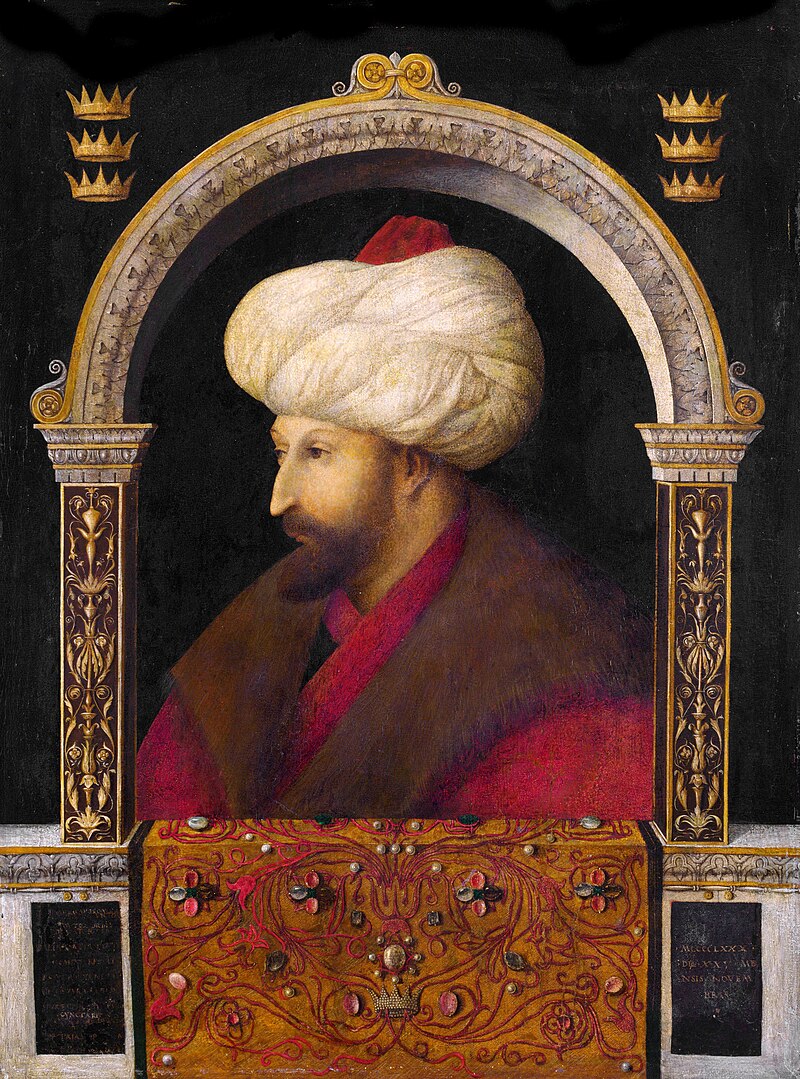
Mehmed II, 'Mehmed the Conquerer' and as such there's a change of dominant culture and dominant creed (Roman to Turkish, Eastern Orthodox to Islam) yet, post conquest Constantinople remained a cultural hub:
He gathered Italian artists, humanists and Greek scholars at his court, allowed the Byzantine Church to continue functioning, ordered the patriarch Gennadius to translate Christian doctrine into Turkish, and called Gentile Bellini from Venice to paint his portrait[83] as well as Venetian frescoes that are vanished today.[84] He collected in his palace a library which included works in Greek, Persian and Latin. Mehmed invited Muslim scientists and astronomers such as Ali Qushji and artists to his court in Constantinople, started a University, built mosques (for example, the Fatih Mosque), waterways, and Istanbul's Topkapı Palace and the Tiled Kiosk. Around the grand mosque that he constructed, he erected eight madrasas, which, for nearly a century, kept their rank as the highest teaching institutions of the Islamic sciences in the empire.- From Wikipedia.
Yep, that portrait is painted by a Venetian. Not, amazingly, a Venetian blind, but a Venice born Italian back when Italy was a bunch of city states. You can read more about the conqueror's multicultural patronage here.
Now there's probably an extent to which Mehmed II, did not pull himself up by his own bootstraps. But a broader point is that nobody establishes a dominant culture by themselves, and then with very few historical exceptions people are generally not born into a culture they are responsible for.
A natural migration can be expected then from people from dysfunctional places in the world that they aren't responsible for to relatively functional places in the world that they also aren't responsible for, and I suspect it naturally gives rise to a sense of unfairness. To the victor goes the spoils and in terms of cultural production, you are the spoil and the cultural hub is the victor.
That could possibly give rise to a kind of 'blaming the audience' one of the most dead-end approaches to creating content. 'Man why aren't all these Eastern Orthodox Christians interested in Roman Catholocism?' 'Why aren't all these Muslim's more appreciative of bacon?' 'Why are all these straight people not into Ru Paul's drag race?'
But upon reflection it seems natural to me, that if I produced content for an Australian market, where my own ethnic group is the dominant mass-market then it would be relatively easy for me to create content where 'I can see myself on screen' (setting aside Australian media institutions' commitments to diversity, equity and inclusion) but if I were to move to Shanghai or Beijing, or to Istanbul-in-the-rein-of-Suleiman-the-Magnificent-in-the-1500's I might find opportunities to get my own cultural identity represented on screen scant, (and where those opportunities do exist they prove much less lucrative) and much more opportunity to portray the dominant culture to itself.
But Mehmed II was painted by Bellini, and Suleiman painted by Titian, and White Australians are way overrepresented in Hollywood (Cate Blanchette, Toni Collette, Nicole Kidman, Rose Byrne, Isla Fisher, Rebel Wilson, Naomi Watts, Chris Hemsworth, Heath Ledger, Hugh Jackman, Jai Courtney, Eric Bana, Geoffrey Rush, Simon Baker, Sam Worthington, Guy Pierce, Russel Crowe, Hugo Weaving, David Wenham, Noah Taylor, Joel Edgerton, Ben Mendelson, Brian Brown, Mel Gibson... but rarely get to play Australians.) a culture can viably become enamored of a foreign or non-dominant culture.
The market might demand its own version of 'orientalism' where the production of culture is non-dominant but the subject is local dominant - some examples that come to mind are Mulan (the original), Kung Fu Panda, Coming to America, Black Panther and Avatar: The Last Airbender, more subtle expressions might be the Matrix and John Wick (leveraging Hong Kong cinema aesthetics) or Gwen Stefani's solo career (leveraging Harajuku Japan) just as Mehmed and Suleiman had themselves painted by Italians, but not as Italians 'Paint my impressive turban per favore.'
In this regard, often the complaint about a dominant culture is that they are just like the people complaining about them. They want stories about themselves, they want content they can relate to, they want to preserve and celebrate their heritage, they want to gloss over inconvenient facts, they want to skip cueing and take another turn, they labor under an illusion of superiority, they overestimate their own entitlements.
How this can fuck up, is that once again you produce a product that the mass-market doesn't want, on a mass-marketable budget and rely on people being too afraid or too polite to point out that while they may like the trappings of multiculturalism they aren't particularly keen on the idea of swapping places with a minority.
The Ease of Overrepresentation
"Mathematical!" ~ Finn, Adventure Time.
"This is the power of math people!" ~ Sylvia Tilly, Star Trek Discovery.
We've all thought about counterfeiting jeans at one time or another, but what about the victims? Hardworking designers like Calvin Klein, Gloria Vanderbilt,or Antoine Bugle Boy? These are the people who saw an overcrowded marketplace and said, "Me too." ~ Homer J. Simpson.
So in the interest of brevity, just some numbers straight up: In Western Cultures, L 0.5~1% G 2~2.5% Bm 0.5~4.5% Bw 1%~11% T* <1% Sources here and here.
In the 90s Sitcoms were filmed in front of a live studio audience, the studio set was generally some kind of interior, in this format you got shows like Seinfeld with 4 central characters and Friends with 6 central characters, Home Improvement had 7 central characters (3 kids), Married With Children 6 central characters, The Cosby Show 6~7 Main Characters.
Malcolm in the Middle quietly revolutionized the sitcom with a single camera set up, and ditching both a laugh track and/or live studio audience it had 6 main cast (weirdly including Francis who generally didn't share scenes with the other 5 family members). The Office was adapted in the 2000s to the US market and started a trend of large ensemble sitcoms where the Office has 12~13 core cast of characters, Parks and Rec. about the same, 30 Rock had about 8 or 9, Brooklyn 99 about 9, Modern Family 12 with half adults half kids.
Just in sitcoms, if we chose enough examples we could aggregate 100 on screen characters to which, if it were life and a random population of characters, we'd expect two to three gay men, 5 practically bisexual women and maybe if lucky a lesbian, and we might expect with a one-in-ten odds one trans character.
So this point is more how an analysis of representation can be messed up by looking at an aggregate of IPs resulting in a fallacy. Specifically the gambler's fallacy. It's that each IP is a new iteration.
If you will, imagine one of those arcade prize-grabbing claw machines (but imagine that the claw can actually grip the things it grabs). Each time you make a show grounded in the real world, set in the present or the past, like a sitcom or drama, you hit the button and the claw picks up 4 to 8 characters from a representative sample (say 10,000 potential characters) and drops them down the chute. But every time characters are taken from the 10,000, it is automatically topped up again to reflect the general population.
The gambler's fallacy is where you tell someone that a fair coin is flipped twice and twice comes up heads. People have this intuition that it's due for a tails, and if asked the odds of the next flip they will say it is less likely to be heads and more likely to be tails.
This translates into media as, if a studio greenlights a pilot and the writer is basing it on their life and none of the six central characters are LGBTQ+, then the studio greenlights another pilot based on the writers life, the odds of the next 4 characters being LGBTQ+ have not increased because the last writer didn't have any LGBTQ+ characters.
How media can get this representation wrong, is when a type of character becomes trendy - they see an overcrowded marketplace and say 'me too', take for example retrograde amnesia which probably wasn't so much trendy as a useful plot device, or a hybrid of 'trendy + convenient' plot device results in overrepresenting billionaires like Bruce Wayne, Tony Stark, Scrooge McDuck through to pure trendiness - serial killers like Hannibal Lector and Dexter.
I picked a focus on LGBTQ+ identities, because there's a strong argument to be made that these identities are so rare and randomly distributed in the general population that children grow up isolated, hence media representation and particularly counternarratives to stigmatising stereotypes can be far more valuable to those kids and the kids around them than just reflecting the identities we are statistically most likely to come across. (here's a decent write up on counternarratives IMO)
Representation I feel is done much better through context rather than quotas. BBC program 'Queer as Folk' statistically way overrepresents gay men. But the characters aren't randomly generated from census statistics. It's a show about gay friends. Same for 'The L Word' or 'Transparent' etc.
And that does reflect life. You are more likely to know either 0 or many of any small identity group, because identities tend to cluster. People tend to be by-and-large homosocial. When I've been to a lesbian friend's party, she didn't have 90 straight guests. There were lots of lesbians. Straight people were probably still the majority because we are just too numerous to be avoidable.
The limitation though is offering a counter-story to fight prejudice, if for example a show about gay men is only watched by 2% of the market, or the L Word can only get 1%, or Transparent <1%? And the commercial considerations like how much producers can spend on a show that only has niche interest. Therefore you may be able to make a show about gay friends living in an apartment, but not gay friends battling CGI Giants with CGI dragons.
So media may historically underrepresent all kinds of identities, but a show like Friends is representative in that 6 people living in New York have no black friends in their core friendship circle, in exactly the same way that She-Ra Princess of Power is representative of LGBTQ+ scenes.
See 'Istanbul/Constantinople','Tyler Perry Moments' and 'Investment in Media Effects' as to why activists might want to glom representation onto more mainstream properties like 'Lord of The Rings', Batman, Spiderman etc.
*T is currently too poorly defined, and probably too little understood to be accurately estimated.
"Brown Eyes, Blue Eyes"
"I got a right to be hostile, man, my people are being persecuted!" ~ Flavor Flav, Public Enemy 'Prophets of Rage.'
"We can argue all we like, but if capital punishment is being inflicted on some man, we are inclined to say: ‘It serves him right.’ That is not the spirit, I believe, in which legislation is enacted. If in this present age we were to go back to the old time of ‘an eye for an eye and a tooth for a tooth,’ there would be very few hon. gentlemen in this House who would not, metaphorically speaking, be blind and toothless." ~ George Perry Graham, 1914
"The Roundabout PlayPump is a system that uses the energy created by children playing to operate a water pump. It is manufactured by the South African company Roundabout Outdoor. It operates in a similar way to a windmill-driven water pump.
The PlayPump received heavy publicity and funding when first introduced, but has since been criticized for being too expensive, too complex to maintain or repair in low-resource settings, too reliant on child labor, and overall less effective than traditional handpumps. WaterAid, one of the biggest water charities in the world, opposes the PlayPump for these reasons.[1][2]" from Wikipedia 'Roundabout Play Pump'
I increasingly feel that while laudable and preferable to 'straw-man' arguments, 'steel-man' arguments are a bit of a pie-in-the-sky. I don't have much confidence in my ability to find the best counterarguments to a position of which I am tentatively convinced, let alone create them. All I can say is that often, with the privileged access to my own mind, I can think of better counterarguments than ones offered. But I guess if you can come up with a really good steel-man you would actually just be convinced of the position.
There are exceptions - for example I have a degree of confidence so high as to say that I know there are no compelling arguments for the existence of a god, and it's because it has been searched for by skeptics and believers alike for centuries; it just isn't going to be an obscure understanding of a technicality hidden in a research paper written somewhere in the 1970s.
But as I write this 'The Masters of the Universe: Revelation' just dropped on Netflix and it has produced one of these mysterious disparities between critical acclaim and audience reception - as at writing Critics give it 97% from 36 reviews and the audience gives it 28% from 1551 reviews.
I cannot claim to be a fan of He-Man, I had some of the toys as a kid in the 80s but cannot really recall seeing the show or anything about it. My memories of He-Man are more firmly embedded in the mash up with Four Non-Blondes 'What's Going On' Youtube clip, always enjoyable:
Instead of a Michael Bay-esque nostalgia cash grab, with a strange foreboding, He-Man is written if not out of the show, out of the spotlight in the first episode, with Teela replacing him as protagonist of at least the first 5 episodes.
At the end of the first episode, I myself had to concede 'what were they thinking?' at the sheer ham-fistedness of the bait-and-switch. But it provides me with a good example of one of the better arguments for deconstructing old intellectual properties - 'Brown Eyes/Blue Eyes' based on the classroom exercise of teacher Jane Elliot, where school children are divided into groups based on eye color, and the blue eyed students are then degraded and oppressed and humiliated. You can read up on it here, if you are unfamiliar.
The intuition comes from, I suspect, the same place as 'the Golden Rule' but instead, as literally teaching people a lesson - 'how do you like it when it happens to you?' with the intuitive understanding that the natural answer will be 'not very much' and a valuable lesson is learned.
In this case, the new He-Man show can be read as 'how does it feel to have the character you identify with sidelined, and to have to watch content that you can't relate to?' and the audience appears to say 'it feels like half a star out of five.'
The problem is that 'Brown Eyes/Blue Eyes' while it sounds like it should work on some intuitive level, is not a very good steel man, it is probably a straw man as it runs a specific predictable risk:
In some courses, participants can feel frustrated about "their inability to change" and instead begin to feel anger against the very groups to which they are supposed to be more sensitive. It can also lead to anxiety because people become hyper-sensitive about being offensive or being offended.
Here's Coleman Hugh's speculating on the origins of 'pride'.
So just to put into context Masters of the Universes: Revelation the 97% critic score v 28% audience score for Part 1 as at writing. She-Ra and the Princesses of Power has 97% critic, 87% audience. Steven Universe 100% and 87%, The Legend of Korra 89% and 79%. Other Kevin Smith creations: Tusk 45% and 36%, Yoga Hosers 23% and 35%, Cop Out 19% and 39%, Jersey Girl 42% and 48%...
From these contextualizing statistics we can infer that
1. Kevin Smith, particularly latter career Kevin Smith is not particularly good at his job, and we can predict that projects he is attached to will not be highly rated. We should have expected a low critical score simply because Kevin Smith was involved using past performance as a predictor of future performance, though performance turn-arounds 'come-backs' are not unheard of.
2. Progressive animated series find their audience and operate in a media market where they find critical and popular acclaim and commercial success - Steven Universe, She-Ra Princess of Power, The Legend of Korra..
So I think in this particular case, Hanlon's Razor applies - it isn't the product of malicious intent or a conscious agenda, it is the sheer incompetence of marketing the wrong product to the wrong market, and/or wrong person for the job - in this sense it is consistent with Doctor Who seasons 11 (90% and 20%) and 12 (78% and 16%) - wrong person for the showrunner job in the wrong situation (franchise tired) and incompetence (mini-chloridians again)
I feel, just as an example that through Kevin Smith's incompetence and probapossibly some Netflix executive that was like 'the whole reason we greenlit this show was to trade off 80s nostalgia so cut a trailer that does that!' that they tripped on an anxiety that is out there humorously articulated by satirical fictitious twitter personality and self styled 'world's wokest woman' Tatania McGrath 'It's not okay to be white.' just in this case that it's not okay to be straight, male and white. The anxiety is that diversity, equity and inclusion is 'code' for 'no straight white men.'
I suspect that purely accidently they created a product that sent a message 'you aren't allowed to have shows anymore.'
Because that is the partial finding of Brown eyes/Blue eyes and diversity training in general:
Despite purported and intended benefits, systematic studies have not shown benefits to forced diversity training and instead show that they can backfire and lead to reductions in diversity and to discrimination complaints being taken less seriously.[3][4][5]
Where what in hindsight seems obvious if we just changed the specific oppressor-victim dynamic. Imagine a mafia boss killed a small business owner's child because they refused to pay protection money. Then to try and stop the cycle of violence, the small business owner kills the mafia boss' child and says 'how does that make you feel?'
So this is a way to fuck up who gets represented, whether intentionally or not, and sending the exact message that is so well received by historically marginalized people: 'we'd all prefer it if you tried your best not to exist.'
Freedom of Association
"Green is not a creative color." ~ Don't Hug Me I'm Scared 'The Creativity Song'
Deals were done on the Golf course, then women started learning golf, so they moved to the strip clubs, then women started going to strip clubs with the men. In 1989 Rotary club leadership voted to permit women to join Rotary Clubs worldwide. etc.
There are only two things necessary for the historical pattern of economic and executive exclusion - 1. cronyism - the tendency to be biased towards people we socialize with, and add to that - 2. homosociality/homophily - the tendency to socialize with people who resemble us. People with whom 'we have things in common'.
In my view cronyism = bad, homosocial = fine, a human right even. With the trouble being that it is hard to keep homosocial tendencies from foolin' with the farmer's daughter of cronyism.
The business world has been grappling with this tricky problem for years - people have to declare conflict of interests, positions have to be advertised publicly, appointments made by committees, people divesting themselves of an interest before public office, blind trusts etc. The NFL has, since 2003 had the Rooney Rule and of course, despite all the efforts to control for cronyistic tendencies, people still try for cronyism all the time.
The divide between public and private has been eroding far as I can tell. But my feeling is this history of boys clubs has translated into a sensitivity to boys' homosociality.
I don't know what contemporary attitudes are to a story like 'Stand By Me' where four boys go off on an adventure in search of a dead kid's body, but is there a problem particularly when targeting children to make properties like that?
I don't even know the statistics if people in general are more likely to write a cheque to help out a childhood friend than a stranger (say through a donation to a charity or scholarship trust etc.) Such that to close gender gaps, race gaps etc. we need to start early to arrest homo-sociality in order to prevent later cronyism.
These are the interesting questions for me, of whether a double standard is necessary, when a lot of progressive movements are based around 'solidarity' and freedom of association.
The automatic presumption, skewed by history is that if a bunch of straight white men get together they are immediately going to form a hate group, whereas I feel the history is actually more in line with the Stonecutter problem, of these groups of friends who bear a superficial resemblance to each other won't form a hate group but instead a futsal league, and it might look fun and why wasn't I invited? And why don't they feel the same way about not being invited to our book club? (See the Stonecutter problem, and Istanbul/Constantinople).
I feel in this way arts and entertainment can get confused with the exploitation of fossil fuels, being that art is not an exhaustable pool of resources. Though it's not quite the same as hosting a dinner party with friends. For one thing, if you have a media market where it's 80% white and 20% people of color, and we adopt an 'each to their own' attitude, then 80% of the market revenue is available for 'Friends' and only 20% for 'My Wife and Kids'
I've noticed this particularly with British Panel Shows of late. Qi (pronounced Kew-eye) is a particularly good example because it has been running since 2003, so it has a pre-and-post-diverse incarnation, with no impact seemingly, on the ratings. Early Qi generally featured 3 male guests and 1 female guest if any. Statistics not helped by Alan Davies' status as permanent panel guest that continues to present day. Present host Sandi Toksvig, Jo Brand and Sue Perkins come to mind as frequent female panel guests. As recently as 2014 there would still be all-male 'Manel' episodes.
In present day, the boys club has been dismantled. but for Alan Davies' permanent status there are even episodes that have had all female guests. Again I would stress that there's no discernable impact on the ratings, I know some statistics but not enough to at-a-glance account for a show's natural and gradual decline the longer it goes on, the impact of the Covid Pandemic and an audience migration from TV to the internet. I still watch the show. So as it demonstrates a kind of freedom of association, I will point to the purely subjective - it doesn't feel natural, panel shows and podcasts creating a sense of familiarity, like the viewer or listener is hanging out with friends has always been artifice, but now the illusion is shattered.
Male homosociality is conspicuously absent on Qi. It seems unnatural, because guys still hang out with guys that are very similar to themselves. When I imagine it in a secondary school setting, the diversity has moved the context from the school yard at recess, to some event orchestrated by administration - like an assembly, and it feels 'tokenized' even though I am convinced that Sandi Toksvig is sincere in her efforts to champion diversity, equity and inclusion.
So with 'freedom of association' I think the simple question of how to fuck up who is represented is to force it, like a snooty, old-money, private school trying to present itself as discrimination free while still signalling it is an old-boys club or finishing school for women to potential buyers. In my own secondary school experience periodically half my year level would go off to camp for a week, and half stayed on campus and while the situation was still imposed by administration, it just changes the dynamic in playground. Codependent friends would get seperated and somebody who was a dick might suddenly become quite nice. Classrooms would get quieter, there'd be more interaction between the sexes in class. Women were less able to cluster in clicks and it was often easier to flirt.
In this way, I suspect diversity is imposed on the on-camera talent first, and then behind-the-scenes follows later when activism gets to it. I'm thinking of things like the Bectal test being about what is happening on screen, not in the directors chair, the writers room etc. Rather than casting panels by DEI quotas, I suspect the way to reap the benefits of diversity are to put talent together in office spaces, writer's rooms etc. and see if anyone clicks. And if a stereotypical male class-clown doing dark comedy doesn't click with a wheelchair bound ventriloquist and her puppet character 'Alfonso the Chicken' then leave them free to disassociate.
So Lesbians Can Use Cutlery?
It is one of the strange ironies of history, that in a nation founded on the principle that all men are created equal, men are still arguing over whether the color of a man's skin determines the content of his character. ~ Martin Luther King.
“What gains? All you have gotten is tokenism — one or two Negroes in a job, or at a lunch counter, so the rest of you will be quiet.” ~ Malcolm X
It’s cold for April and Price walks briskly down the street toward Evelyn’s
brownstone, whistling “If I Were a Rich Man,” the heat from his mouth
creating smoky plumes of steam, and swinging his Tumi leather attache case.
A figure with slicked-back hair and horn-rimmed glasses approaches in the
distance, wearing a beige double-breasted wool-gabardine Cerruti 1881 suit
and carrying the same Tumi leather attache case from D. F. Sanders that Price
has, and Timothy wonders aloud, “Is it Victor Powell? It can’t be.”
The man passes under the fluorescent glare of a streetlamp with a troubled
look on his face that momentarily curls his lips into a slight smile and he
glances at Price almost as if they were acquainted but just as quickly he
realizes that he doesn’t know Price and just as quickly Price realizes it’s not
Victor Powell and the man moves on. ~ Brett Easton Ellis, American Psycho.
This one is fairly easy, it's screwing up representation by forgetting to add any content to a character.
I feel 'American Psycho' should, but never could be, a mandatory text for marketing students as they embark on the world of trying to build brand equity. Not because of the psychotic depiction of 80s Wall Street excess, but because of the lengthy descriptions of what characters are wearing for the first half of the novel. The importance of this is that being told that 'A figure' has 'slicked back hair and horn rimmed glasses wearing a beige double-breasted wool-gabardine Cerruti 1881 suit and carrying a Tumi leather attache case from D.F. Sanders' conveys to us Patrick's (the narrators') delusion that these descriptions are in any way meaningful.
I am quite enamored of this literary device at so shattering the illusion that our clothes say anything of interest about us. The most we could infer is a vocation.
This comes about when representing a historically oppressed group identity neither adds nor subtracts from the story being told. There's a bias to a character being irrelevantly gay, or irrelevantly a minority in that it just proves distracting. A great example being Netflix's recent trilogy of 'Fear Street' movies. Now nobody expects anything adapted from RL Stein material to be fine art, but in having a black lesbian protagonist it... has nothing to do with anything.
So with something as banal as using cutlery 'you can't be what you don't see' doesn't apply. It could apply in the sense that there's no need to depict cutlery use on the big screen, or driving a car, shooting a gun, doing maths, public speaking, medicine, running for office, scientific research, riding a bicycle, skating, paragliding, rock climbing...or anything else we can readily see people doing because they aren't a function of identity, so much as having hands, legs, eyes etc.
Given that so often, the function of a protagonist or main character is to present someone blandly relatable to the audience; so they may vicariously experience a fantastical world through their eyes be that a cantina on Tatooine, or the Dining Hall of Hogwarts, or even just coping with a supernatural terror like Freddy or Jason in an otherwise quite grounded world. (Also potentially why amnesia is an overused plot device, it allows a protagonist to know as much as the audience, excluding soap operas of course...) It shouldn't be surprising that the main character is often less interesting than supporting characters more at home in a fantastical world. It also shouldn't be surprising that changing the racial or sexual identity of a protagonist has little to no impact on the story.
Hence why not? It's easy to make substitutions of race, gender and whatever else when a characters main function in a plot is to go on an adventure where they meet characters more interesting than themselves. What seems cruel are concepts like 'tokenism', 'pinkwashing', 'purplewashing' that make it hard to avoid a 'damned if you do, damned if you don't' set up.
Will you then need to make a Mary Sue, or cram in Tyler Perry moment speeches such that there is some point to diversity other than to demonstrate that lesbians can indeed, also use cutlery or less facetiously that people other than little boys can go on adventures. Or conversely that lesbians also cannot bust ghosts, leap tall buildings in a single bound, run faster than a freight train and shoot laser beams out their eyes, use the force, transform from car into robot, fight dragons, travel through time in a box and everything else little straight white boys can't do.
And keeping in mind that since 1955, a little over 5 billion people were born. Roughly half of which are male, 22 men (including incumbent Dwight 'Ike' Eisenhower) have been President of the United States with only 21 of them being white. Keeping also in mind that of the 5 billion people born since 1955, only 161 million are eligible to run for US president (probably less, since I'm sure immigration adds to the US population clock figures significantly.) From less than 161 million out of five billion, only 24 more men have become President including assassinations, resignations and one termers. Yes 24/<161,000,000 is infinitely larger odds than 0 for women, and marginally greater than 1/<161M for POC. These odds however are retrospective, and given Hillary being the Democratic Candidate and Kamala Harris being VP I doubt any but the most devout subscriber to an all powerful patriarchy believe the odds are actually zero.
(An Aside, but I remember when Barack Obama was the Democratic Candidate, and John McCain was a clear underdog, having friends crack the joke 'it's called the Whitehouse not the Blackhouse.' often POCs, who seemed to literally believe that something would magically intervene to prevent a black man from being president.)
But again, there's a real world practical benefit for diverse casting to match diverse (ethnically, sexually) characters and that is by casting an actor of color in place of another white guy, that actor gets paid. Divide up that pie.
So to answer 'why not?' there really has to be a pie, where the more there is for white men playing straight white men, the less there is for everyone else. Particularly in fantasy settings, or sci-fi settings where to get on board with the story requires a suspension of disbelief, then there is no issue of believability or plausibility.
The big way to fuck up diversity and produce tokenism though, that I would hope to get to here is to remember diversity but to forget to add any content to the character.
Sci-fi movies like the 5th-element feature African-American Presidents (that I doubt inspired Obama to run) and shows like Battlestar Galactica and Veep feature female presidents (that are more likely inspired by Hillary than inspired Hillary to run) and these characters need not have any character traits beyond being President. However I do suspect that we couldn't arbitrarily have a Han Chinese president, or Devout Islamicist president because the audience can't imagine how they might get there, even if these identities don't feature any actual character content.
And that's it really, a circle back to 'more' vs 'more of the same' but in this case, the more-of-the-same is driven by banality. Where there is no point to the diversity, we get the mirror image of there being no point to homogeneity. Inviting the question of 'what are you complaining about?'
Well for me, I want a return on diversity. Otherwise, if I am essentially a disabled, queer, woman of color and she is essentially me and we can both use cutlery, 'diversity' is a misnomer, tell her story to me so I can learn something.
Searching for an Unprecedent/Vicarious Advocacy
“Everything is theoretically impossible, until it is done.” – Robert A. Heinlein.
My Grandma was sharp as a tack, loved school, loved learning, loved reading and history. She died at age 93 a few years ago, one of those members of the greatest generation that lived through the great times of the Great Depression and World War II, sequel to the Great War.
I'm not a student of history, particularly the specific applicable history here. Such that I do not know if back then my Grandma couldn't have gone to medical school, or didn't go to medical school. I mean I do happen to know that my Grandma couldn't have become a doctor or a lawyer or an engineer or a theoretical physicist because her parents refused to continue paying for her schooling.
The distinction in my mind that would be a very much narrower sense of can't vs don't is more to say that 'can't' refers to legal-institutional obstructions, like a military refusing to enlist women (and ignoring the history of military cross-dressing). 'Can't' describes when someone shows up at a gate and a gatekeeper says 'no, you're not allowed.'
Whereas don't refers to psychological and social obstructions, or even just the presence of more appealing alternatives. The more tragic case where someone looks back on their life with remorse and says 'I never realized until it was too late that people like me could be a...' but it isn't to say all responsibility falls on the person who doesn't act on the opportunities available to them. I would include under don't well founded psychological obstructions, like having to be the only female in an engineering course where society is generally homosocial, or having to choose to be the only person of color in a country club etc. Or otherwise penetrating some society that while not objecting to your presence has never catered for you - nobody is stopping you from joining but you'll have to find your own smoking/prayer area etc.
The tragedy of the 'don't' scenario, the missed opportunities and wasted potential for a category of person who truly “can't be what you can't see.” in many ways are like all the people who have never considered the possibility of living in Braga, Portugal or Dushanbe, Tajikistan or Owase, Japan or Lome, Togo or Creswick, Australia.
A preliminary step to relocating somewhere may be said to be an awareness of the place's existence. (And apologies to those who were already well aware of Braga, Dushanbe, Owase, Lomo and Creswick I chose it because they were obscure to me... well except Creswick, its Dinosaur Park and Land of Miniature were advertised regularly where I grew up.)
But my feeling is that any strong interpretation of the assertion 'You can't be what you don't see.' is patently false. It is false because for everything that has a precedent, was prior to that precedent being set, unprecedented. And the actual initial precedent can be hard to find, even with the modern convenience of Google.
Using the example of women in comedy - a point first made to me by Andrew Doyle in an interview about how he (a UK citizen) grew up watching Roseanne, The Vicar of Dibley, Absolutely Fabulous etc. while the discourse acts as though female comics first appeared in 2016 or something.
A little digging can take you back to 'I Love Lucy' and the career of Lucille Ball, who followed in the footsteps of Fanny Brice which is where most e-paper trails end. The problem being that comedy is older than Television and Radio. Groucho Marx and the Marx brother's came out of the vaudeville tradition in which there were numerous women. There's music halls and theatre stages... satire arguably dates back to ancient Egypt, and that's kind of the historical scope with which to find the unprecedented first female comic, with mediums that lacked authorship.
So setting aside that a certain opacity in history makes it hard to find out whether a pioneer was truly a pioneer or simply the first documented. Just through an act of deduction, we can infer that any true pioneer becomes something they had never seen.
In some logistical sense, I may need to find out about the existence of the city of Braga before I decide if I want to move there, but from my own standpoint, I employ a much more general rule - I can live anywhere with the basic provisions I need (the means to get there, the means to obtain water, food, clothing and shelter.) Likewise, I imagine for I am not a feminist that some similar heuristic is employed by women like 'I can do anything men can do.' such that a strictly female precedent isn't necessary, only a precedent - this may have applied to historical figures like Amelia Earhart and James Barry.
So the weak form of 'You can't be what you don't see' might be referring to a psychological profile that will never themselves be a pioneer. Which steering back to the scope of this post - representation in media - would be along the lines of addressing.
So I'm guessing that nobody consciously advocates for a strong interpretation of 'You can't be what you don't see.' but instead advocates for 'You can't be what you don't see.' speaking about someone whose risk profile is very low, a subset of the population at large; which is to say: vicariously, on behalf of people that the imagination to substitute their characteristics into some desirable role, like changing the gender, skin color or sexual orientation of any figure in history or the history of fiction.
And I'm guessing the common characteristic of this imagined demographic is small children. Where representation becomes a positive mirror of censorship. So 'I know Freddy Kruger isn't real but my child doesn't.' translates to 'I know women can be fighter pilots but my children don't.' Some version of the 'Draw, See, Think.'
Somewhere in the representation side though is an implicit assumption that children are basically engaged in a process of stereotyping themselves.
Which would all strike me as an innocuous (if condescending) experiment. But there's other angles.
For example, another angle might render a lack of an unprecedent irrelevent. A kind of Maoist constant revolution view where it doesn't matter that Dawn French created and headlined two of the most popular sitcoms of the 90s, if women can't headline the most popular sitcom right now. Which introduces a kind of zero-sum, where if Modern Family (men, women, gay, straight, whites, people of color) is losing the ratings battle to Two and a Half Men (men, straight) or The Big Bang Theory (men, straight) then something must be done because 'the children can't be what they don't see'.
While I'd concede that in dynamic markets you can get trends in production and financing, like how right now its probably much easier to get a 'John Wick' knockoff greenlit, and very hard to get flavor of last month's 'American Beauty' knockoff produced. It may be the case that we notice now that it is no longer the 90s and that sucks for female comics chasing the dream of a sitcom.
However 'you can't be what you don't see' makes no sense in a dynamic market like media where trends and fads fluctuate and so do the fortunes of certain identities. Once you have a box-office hit featuring a double amputee in the titular role then we know, on a limited timeframe that a double-amputee can headline a box-office hit. Until next month where Ryan Reynolds tops the box office with his biopic on the life of Ryan Gosling. Then if not grounding representation in a precedent or lack thereof for the benefit of some demographic that cannot create their own potentials, it simply becomes a truism of 'you can be what you can be.'
Shallow Wells
Mr. Burns: Get me Steven Spielberg.
Smithers: He's unavailable.
Mr. Burns: Then get me his non-union Mexican equivalent. ~ The Simpsons, episode: A Star is Burns.
Again on 'who' gets represented, I want to return to a quota based solution/box-checking solution with a different angle than ease of overrepresentation.
To that effect, for arguments sake I'm just going to say that overrepresentation in some cases is good. I'm assuming that. As alluded to, there are some consumers of media that might belong to groups that are relatively rare. They may be isolated while young, from any positive role models, particularly identity traits that to our present knowledge, crop up randomly in the population like queer identities. It may also be that if we demonstrate that a certain identity group can succeed it might pump-prime the pipeline for the future.
And to be clear, I'm not talking about programming like 'Queer as Folk' 'Ru Paul's Drag Race' or 'Redfern Now' where the program is about a subculture of an identity group because it is intrinsically interesting. This is more where we make a value judgement like 'news anchors are respectable, so we can best change public perception of this oppressed group by casting a member as a news anchor.' etc.
So even putting all other considerations aside, the laudable attempt to provide a positive counternarrative through representation for oppressed minorities. The 'Shallow Well' is a way to fuck it up.
It's simple straightforward maths - if say you are casting a panel show and you want equal representation of male and female comedians, this quota based representation is based on the proportions of the population at large (close enough to 50/50) and not on the comedian pipeline. If there are 10 males on the standup circuit for every 1 female comedian (I don't know the actual numbers) in a country like the UK where there might be only 10,000 comedians booking gigs and performing at any given time. Then the 2 males have beaten out 1,000 other men for their spots on the panel, and the 2 females haven't (by virtue of the quota) beaten out 1,000 other men, but 100 other women.
Ayyyyyyyyyyyy... I can't do the maths, but it's this very simple principle that to be a man on a comedy panel show you may have had to win Best of the Fest at Edinburgh Fringe Festival where to be a woman it certainly helps to have won an Edinburgh Fringe Festival award but not as much as it helps to just be a woman.
This representation strategy fucks up when you look worse coming from the non-competitive quota in comparison to those who are drawn from the highly-competitive quota. I suspect, it is much worse at charging the pipeline than the women who made it as comedians prior to representation quotas.
I think no intellectual framework perhaps better illustrates quotas drawing on shallow wells as Ibram X Kendi's conception of Anti-Racism: One foundational Anti-racist principle is that inequality between racial groups (however defined) is evidence of racism.
Comedy is subjective but apply this to a sport like the 100m sprint, and we can see gross inequality that (by Kendi's definition) must be explained by racism. To reduce racism, simply make the outcomes equal - have a 100m sprint event for Blacks, 100m sprint event for Whites, 100m sprint event for Latinos, 100m sprint event for Asians etc. (being that I don't subscribe to a belief in biological races, I don't know how to divide up the populations, so apologies for these broad, largely meaningless and antiquated categorizations) and make all the prize money equal.
This would mean that Christophe Lemaitre's pb of 9.92 seconds is worth as much as Su Bingtian's pb of 9.91 seconds and is worth as much as Usain Bolt's 9.58 seconds, and I would have to ask Kendi, but if Robson Da Silva counts as Latino rather than Black his 10.00 second South American record would also be equally valuable.
But I for one would expect that public interest would not dutifully observe the equality between events but instead show diminishing interest in line with performance. (There's also an interesting question of whether the racially segregated athletes' own performance would drop when no longer competing against the strongest competition)
When it comes to representation in media rather than sports (though there's considerable overlap) I don't think attention would be apportioned in totality to performance, but also have a large degree of novelty. Changing the skin pigmentation of characters with magic powers, or the gender of characters wielding magical technologies is just not as novel as one might think.
I was at a live gig, back before Covid, back before I set off for sunny stormy Mexico, where the very white frontman of the band did an 'acknowledgement of country' which is unusual at a music gig, more common at formal meetings, ceremonies, formal speeches, formal events, protests etc. But anyway, pertinent to representation, it was what he said next which was a kind of confession or public flagellation that they don't do enough for first nations people and they need to do more to get them on the lineup.
Now far from feeling that Melbourne's live music scene should be a white's only club, I more object to this kind of thing because it evokes an image of well-meaning white Melbournian hipsters patrolling the streets in vans looking for indigenous-looking people to abduct and force to perform in the 9pm slot of a Tuesday night gig at Some Velvet Morning in Clifton Hill, or Bar Open on Brunswick St.
Indigenous musical acts exist to be sure, I've seen them, mostly hip-hop acts, which don't necessarily pair well with an otherwise folk or punk line-up. Historically Australia has produced a lot of indigenous Music acts spanning almost every genre, I'm sure that list is not exhaustive, but at a glance it appears to number in the hundreds of solo and group acts.
Prior to the pandemic, Melbourne boasted something like 60 gigs a night. By contrast Melbourne's indigenous population is 0.5%. Crunching the numbers in an Ibram X Kendi-style framework, I'd say 55 of those 60 gigs probably have three acts on the line-up making for 165 acts per night to book, plus five acts doing things like residencies and playing 3xhour-long sets with no support acts. So 170 acts per night, Ibram would conclude that Melbourne live music is racist if less than 0.5% of those 170 performers are indigenous which means collectively Melbourne needs to book 1 indigenous act per night.
If the average act size is 2.5 people, then we need roughly 3 indigenous musicians doing an hour long set per night. It seems far more likely to me, that if anything, indigenous musos are already overrepresented statistically in the Melbourne music scene.
Complicating the white frontman's sentiments, is that music is a scalable profession. There are a few musicians that make fat stacks of cash, but for the most part performing music in Melbourne is often anti-compensatory, hence the saying 'don't give up your day job.' (Early on in Melbourne's lockdown, I saw a friend share a musician's post on facebook where he crunched the numbers on all his cancelled gigs and figured out he was saving $200 by not being able to perform) In some cases, a successful indigenous musician like Briggs would be doing this frontman a massive favor by putting them in a support slot.
Furthermore, by Kendi's rules for racism/anti-racism to be not racist would be across industries where the indigenous make up 0.5% of CEOs, 0.5% of brain surgeons, 0.5% of Golf Club owners etc. in Melbourne. and that most bands I know, play on average 1.5 live gigs a month.
So inadvertently, I think this frontman was expressing nice sentiments without crunching any numbers, and possibly while enjoying the highs of performing and not the lows of the other 27 days of the month working a shitty job to finance his music career.
In the case of Melbourne live music, this quota-based representation would never be practical or desirable to do like climate change representation where some 98% of climate scientists get 2 minutes on a news panel and the 2% climate skeptic also gets 2 minutes.
What about the big-time though? Is it desirable and laudable to overrepresent disenfranchized minorities on national and syndicated media, like news anchors, panel show guests, live music acts on talk shows etc? I'm just going to assume it is.
Using again the examples of Qi (BBC Quite-interesting panel show) or 8-out-of-10-cats, or whatever British panel show you like where there's a host and one or two team captains and 3 or four guests for some 20 episodes, and you work from premises like White heterosexual males represent about 30% of the population but they are doing fine and don't need proportional representation, but male-and-female British Nigerians represent 0.15% of the population (2001, sourced here) but this population needs representation for various statistical reasons.
So just assuming 80 guest spots per season, paying say 2,000 pounds per appearance plus any subsequent benefits (of a raised public profile) and for logistical filming reasons it is better to book one guest for multiple episode recordings with slight rotation, the studio checks certain quota boxes for people of color, women, people with disabilities and ensuring at least one of these groups has at least one representative per episode it's easy.
Qi season one had 9 guests that were not white straight men, leaving 27 spots for white men for a total of 36 guests. It's most recently completed season 'R' white straight men clocked 13 guest spots, with queer, poc, disabled and women (non-white straight men) making up 35 guest spots for a total of 48 (3x16 episodes).
So Qi has made progress, giving disenfranchised minorities representation is a good thing and white straight men are no worse off. Qi is definitely not a controlled experiment however, and possibly not even a natural experiment. Qi may be like the Marvel Cinematic Universe where its uniqueness drives a kind of monopoly. I do not have an alternative less-representative Qi that I can choose to prefer, though I might prefer older seasons to current ones, but I do not know how common that sentiment is or how to measure it objectively.
Putting that aside for example if it screens an episode and the ratings are relatively high - to what can we attribute that? Was it the combination of guests or a guest in particular? It is not unprecedented for a guest on Qi to only speak once in the final edit, particularly first-timers, it is unlikely in my view that such guests contribute anything to the ratings at all. Jimmy Carr is a high-profile very popular comedian, if he is on a show with two relatively unknown comedians from minorities, and that episode has a ratings spike, is it more likely it was due to Jimmy Carr's presence or because of the improved representation?
Was it the guest on that show, or was it a guest on the previous week's show whose performance inspired more people to tune in again the next week after hearing about last week's show around the water cooler?
One area I can say Qi and Quotas really fucked up for me, were between series J and K (2013-14) where Australians and New Zealanders were way overrepresented and these countries have a combined population of approx 32 million, a bit over half of that of the entire UK. Here there are two distinct classes of AUSNZ comedians that have made it in the UK/US big markets (Adam Hills, Rhys Darby, Hannah Gadsby, Tim Minchin) and comedians who hadn't (Cal Wilson, Julia Zemero, Colin Lane).
I can't find or verify, that this was a quota imposed by AUSNZ by partially funding Qi and demanding our homegrown talent get screen time. And in many recurring themes I suspect it was because some Australian media people noticed that Australian's liked watching this particular foreign content and resolved to force local content into our eyeballs via it. I hated it. Seems the BBC did too, and it thankfully stopped, and we are all spared Australian mediocrity.
Quotas II: Intersectional Boogaloo
A new "00" agent who entered active service some time after Bond's retirement and was assigned the 007 number.[22][23] Lynch has said that she hopes her character brings a new layer of relatability to the world of espionage: "When you're dealing with a franchise that has been slick for so many years, I wanted to throw a human spin on it—to deal with anxiety and be someone who's figuring it out, completely on her toes".[24] ~ From Wikipedia: No Time to Die.
"Thou hypocrite, first cast out the beam out of thine own eye; and then shalt thou see clearly to cast out the mote out of thy brother's eye." ~ Matthew 7:5, Jesus' Sermon on the Mount. King James Version translation.
“Now take everything I have said up unto this point, and replace ‘man’ with ‘white person’ … [and] with ‘straight’ or ‘cis’ or ‘able-bodied’ or ‘neurotypical’ … Every single one of us has an enormous responsibility to be very, very careful about the lines we draw.” ~ Hannah Gadsby, from speech at Women in Entertainment Gala.
I'm no fan of intersectionality. In the past I have compared it to the 'Pirate Game' logic puzzle, and I included the Jesus' quote above for the purpose of comparison. Any time I see intersectionality invoked it takes the form of 'thou hypocrite, first cast out the mote of thine own eye; then and only then shalt thou see clearly to cast out the beam of thy brother's eye.' which is to say, it is used to attack allies, far more than cis-het white men, the patriarchy, white supremacy or whatever.
I also don't believe 'the enemy of my enemy is my friend' either. And that intersectionality is baseless. But there is a curious phenomena when it comes to the intersection of intersectionality and representation in media.
So as at writing (this bit, how time flies) the new Bond movie has dropped, and I haven't seen it. I intend to, but when I was looking it up on Wikipedia because I don't give a shit about spoilers, I saw the above description of the actor Lashana Lynch on her character.
Intersectionality focuses on the intersections, not the streets of oppression. So if you have James Bond as a White Straight Male, and he's never been anything else, rather than change one of those identities - like a White Straight Female you change more than one. And to be clear, Nomi the character is a new character with the 007 designation, not a black female James Bond, since the former and current 007 coexists in the same film.
Pleading ignorance to the actual film, the point is that we skip over a Straight White Female 007 to a woman of color 007 (in contrast to the 13th Doctor, who is only a gender swap) and furthermore by the description, it doesn't even sound like the new 007 gets to be cool calm and collected, or suave or really play the character of James Bond in any way, because instead she is anxious.
Another example being Rose Tico when you compare her to Rey, in the last Star Wars Trilogy. Rey is one street away from Luke Skywalker, their streets intersect pretty quickly at 'man' and 'woman'. I'm not sure if Rose has an analogue, being that she's introduced in the subverted expectations movie. She is Asian, a Mechanic, and though it is subjective she is not media 'beautiful'. She's at least two intersections from Princess Leia and Han Solo and Chewy and Lando Calrission.
(I'm aware a limitation of Rose Tico as an example is that Asian activists and allies have a particular gripe with a history of fetishization of Asian women in media. An inversion of other ethnic minorities that have felt excluded from beauty ideals, hence it may not be intersectional at all that Asian women are now being represented as non-conforming to beauty ideals - Rose Tico, Katy from Shang Chi, Cassandra Cain in Birds of Prey. [Confusingly, these women will also be referred to as 'beautiful' just not the 'beautiful' that is spoiled for choice on Tinder, or gets a million male instagram followers)
So intersectionality strikes me as taking a situation where Men have been on the 1st place podium for over a century in Media, getting to be whip cracking archeologists, ghost busters, international spies, knights of the round table, illegal street racers, jewel thieves, vigilantes, astronauts, magic space jesus, jesus... whatever. Then someone is in second place, could be white women, asian men, black men. I am not going to do the intersectional calculus. And right down the end we have a theoretical person that is queer, black, female or feme and disabled. For ease of analogy, lets say they are perpetually in 10th place.
Making the quotas intersectional thereby becomes non-progressive, because 10th place goes up to 1st place, 1st place can go 2nd or 10th who cares where the white men end up, because the returns are diminishing, 2nd place has historically got a cracker compared to the massive cash prize and all expenses paid tropical resort holiday that 1st place gets.
We also exacerbate the previous way to fuck up who gets represented with Quotas in the first place. Where people drawn to fill quotas from shallow pools are presented alongside people drawn from quotas in uber-competitive pools... just due to numbers.
Rosie Jones recently made her debut on Qi, and while I don't find her funny personally, power to her. She's an accomplished writer and festival performer, she's paid her dues and done the work and pursued her dream and is now going through the amazing experience of realizing those dreams. (Or not enjoying it...you can listen to Rosie Jones complaining about not being in Hollywood here, unfortunately, with a no-doubt time constrained cartoonish characterization of the whole representation debate) She is a woman, a lesbian and has cerebral palsy. But is she the best disabled lesbian comic in the UK, or the second best?
With disability being a very, very broad category that might include color blindness, an inner ear problem or chronic back pain through to ALS or quadriplegia it is probably as a category subject to its own intersectional analysis (I can recall an episode of Britain's Missing Top Model where a contestant expressed concern that her disability wasn't 'visible' enough presumably to be tokenized as disabled - my inference) it is likely that Rosie Jones is, if not the best disabled lesbian comic, simultaneously both the best and worst lesbian-with-cerebral-palsy comic, due to the likelihood that there is only one active in the UK.
If I would hazard a guess, it's that Rosie Jones' journey is likely unabetted by intersectional quotas, though she's begun her rise in 2016 when intersectionality would have already been in the activist lexicon. But prior to activist demands for better representation, there were comedians that made profiles on their own. On disability street (it may be a bit Australian) but there's been Steady Eddie and Stella Young (having heard self-deprecating cerebral palsy jokes from Steady Eddie in the 90s, it is possibly why I don't find them funny from Rosie Jones now, I also suspect that Rosie Jones was unlikely to have been inspired by Steady Eddie, setting her own precedent). And in the lesbian dimension Ellen DeGeneres, Hannah Gadsby, Sue Perkins, Sandi Toksvig, Wanda Sykes, Lilly Tomlin, Tig Notaro...
Intersectionality by definition means you are talking about minorities within minorities. When British magician Derren Brown changed track in his career from making programming about how brilliant he was to trying to help transform people's lives through his hypnosis and massive resources, one thing I found annoying about the message of specials like 'Hero at 30,000 feet' 'Apocalypse' and 'Savior' is that ordinary people are capable of turning their lives around if just given the opportunity, laudible and moving as it is, I feel like yeah, society is full of people that if we just spent $500,000 each on (actually we probably do this already, if we just gave $500,000), would probably succeed.
In the same way, there's enough lazy systems in place that an opportunity given to literally anyone can set them on a virtuous cycle. For example all the dipshits that worked for the Trump administration get publishing deals and press circuits for writing tell-all books about their time in the Whitehouse. I imagine getting onto a BBC panel show does wonders for anyone's career whether mediocre to genuis.
The minority I want a quota for is the talented, and talented can overlap with all the identity intersections you can throw at it. This is generally overlooked in intersectional theory, even though near as I can dissect it, squandering talent and potential is the great evil of discrimination.
The Legitimate Thought Crime of Making Ayn Rand Look Insightful
"Those touchy mediocrities who sit trembling lest someone's work prove greater than their own - they have no inkling of the loneliness that comes when you reach the top. The loneliness for an equal - for a mind to respect and an achievement to admire." ~ Ayn Rand. (not a philosopher)
"The trouble with the world is that the stupid are cocksure and the intelligent full of doubt." ~ Bertrand Russell. (actual philosopher)
I've only read 'The Fountainhead' which was my first exposure to Ayn Rand and curiosly I was given this book by a friend that I and many others might describe as 'sufficiently woke' even though Ayn Rand is the darling of right-wing conservatives and libertarians.
I would briefly review 'The Fountainhead' as 'diverting trash' probably appealing for many of the same reasons '50 Shades of Grey' or 'Telenovellas' are, which is, you have to know if a man and a woman are going to ever bone so you keep reading. (I would Concur with the Jon Oliver voiceover that says it is popular with teenagers but you are supposed to grow out of it.)
More technically, 'The Fountainhead' proceeds from the accident fallacy, which is its protagonist Howard 'Red' Rourke, whom we root for is a genius who knows exactly what he wants to do and it is exactly what everyone else needs but does not yet know they want. Howard as a character does not translate to reality, so a philosophy of 'move bitch, get out da way' does not work as Ayn Rand describes. The Fountainhead contradicts Bertrand Russell's observation about the cocksure stupid and the doubtful intelligent, a quote I am obsessed with because it goes deeper than you think, and/or predicts the Dunning Kruger effect.
The problem being that as much as Ayn Rand is not descriptive of how brilliance and geniuses and progress occur, it is coupled with a reasonably insightful description of how socialism produces mediocrity.
Earlier I quoted the... joke? from Disenchanted, easily the least funny of Matt Groening's properties, of 'I'm a woman, gender is a spectrum' a... joke? that still bends my mind like a pretzel, giving me the haunting feeling it is supposed to be a joke, but that I don't know where the joke is.
Not wanting to get redundant with 'Tyler Perry Moments' I hesitate to also include this edited clip from BBC 3 program 'Shrill' on cultural appropriation:
I can't give the whole 3 seasons and 22 episodes of 'Shrill' a fair shake, all of it I've seen is this bizarre and perplexing clip above, and apparently the show is written by white women and near as I can tell this clip comes from season 3 episode 1, written by Lindy West and directed by Carrie Brownstein (one of my favorite comedic actors from Portlandia fame).
This is more about life imitating art (probably through some kind of cyclical nature) and the danger of making someone like Ayn Rand who might insightfully recognize and describe an existing problem (collusion and celebration of mediocrity) as also being insightful with her diagnosis (need to get out of the way of uncompromising individuals). The following are excerpts from chapter summaries of the Fountainhead sourced here:
Ike, a member of Toohey’s new Council of American Writers, reads his play at an informal meeting. The play is awful, but like Toohey’s young architects, the young writers congratulate each other on their mediocre talent. With Toohey’s help, they have become the nation’s literary elite. ~ from Chapter 6
and:
Whenever Dominique asks about Wynand’s newspapers, he coldly responds that he will never apologize for the Banner. In the spring, Wynand leaves for a publisher’s convention. When he returns, Dominique brings him to see the play of one of Toohey’s protégées, which the Banner has highly praised. Dominique forces Wynand to face the world he created. She calls them both traitors—herself for sacrificing happiness in order to escape the world, and Wynand for sacrificing his integrity in order to control it. ~ from Chapter 8.
It's the exchange between the characters of Dominique (who's an inscrutible psycho) and Gail Wynyard about seeing one of the 'Council of American Writers' plays that stuck in my mind all these years.
As at writing this section, Dave Chappelle's comedy special 'The Closer' dropped on Netflix and Hannah Gadsby weighed in, and there's been a bit of back and forth. However at this point, I'm tired of Hannah Gadsby to the point of being done with her. She's a successful comedian, power to her, Nanette blew up, literal power to her. Because of such power, I tried to engage with her worldview and have found it to be largely incoherent and joyless and being 'done' with her is not giving enough fucks to justify this conclusion as she certainly seems to never care about justifying any of hers.
Nanette sucks, and audiences actually agree - I've heard it described (initially second hand through Blogging Heads TV's 'Feminine Chaos' channel, but now first hand as 'a Ted Talk not a comedy special' and the audience score reflects it. Reading the audience reviews I feel, gives a fair impression that everyone depending on their values can justify their score be it 5 stars or 1/2 a star.
'The Closer' is different in so far as it is more recent and more recent reviews are probably reactive to the media cycle, even when they are 5 stars saying 'Dave says what everyone is thinking' can't possibly be justified unless you are the universal consciousness Deepak Chopra goes on about.
But I would come down and say 'The Closer' is a comedy special, 'Nanette' is a long-form Tyler Perry moment. It's something that Toohey-like journalism has pushed to the fore, where Chappelle stands out for integrity. Such that you wind up with a critically panned, audience favorite in 'The Closer' and a critically acclaimed, audience consensus rejected piece of mediocrity in 'Nanette'.
Netflix has also released 'Kate' and 'Gunpowder Milkshake' and both are uncontroversially mediocre. They are derivative of works like 'Atomic Blonde' and while there are piles and piles of mediocre action films fronted by men (Liam Neeson alone may be known for the 'Taken' franchise but have you seen 'Non-Stop', 'Honest Thief', 'Unknown', 'The Grey', 'Cold Pursuit', 'The Ice Road'...) but white men have Die Hard, Lethal Weapon, Speed, John Wick 1 & 3, Under Siege, First Blood, Rocky I, II, III, IV, Rocky Balboa etc. so there's no spotlight on mediocrity without representation being in the mix.
Again it's one of the ways to fuck up representation, and it relates to the ease of overrepresentation, shallow wells, Quotas II: Intersectional Boogaloo, and an investment in media effects theory.
What is more interesting, is when someone like Hannah Gadsby gives the impression that comedians like Dave Chappelle and Louis CK shouldn't be allowed to perform.
What makes Ayn Rand look dangerously insightful is when you get rules like 'Punch up, not down' that can then translate into what I will dubiously dub 'attempted forced mediocrity' and will dubiously justify as thus: Punching up is easy. I just had 5 years of Trump jokes, I got tired after 4 days. I get it, he's a buffoon. One of my favorite comedians during the Trump years was Michelle Wolf, because she actually took the conversation somewhere else, and held the media accountable for helping Trump through punching up relentlessly.
During the Vietnam War, which lasted longer than any war we've ever been in - and which we lost - every respectable artist in this country was against the war. It was like a laser beam. We were all aimed in the same direction. The power of this weapon turns out to be that of a custard pie dropped from a stepladder six feet high. ~ Kurt Vonnegut.
Punching down is hard, it's high risk, therefore high reward. When Louis CK returned to standup at the Comedy Cellar for the first time since he admitted wrongdoing for his history of sexual misconduct, I remember articles like this coming out, suggesting comedians I could substitute for the hole Louis CK left in the market.
Among those speaking out against C.K.’s “comeback” was Top Chef host and surprise comedy expert Padma Lakshmi, who not only recommended supporting comedians “who are actually funny” and “haven’t harassed women,” but gave us a list of almost 20 names...
and:
Her list is honestly flawless.
I am going to suggest that the above last statement is false. I am going to use the market as the authority I appeal to, because as near as I can guess, the comedians that stepped into the vacuum left by Louis CK were most likely Bill Burr and/or Kevin Heart, maybe even the triumphantly returning Dave Chappelle. And these are also substitutes, not replacements. Louis CK's success was not at the expense of Burr and Heart, or anyone. They might be comedians you discover when you aren't allowed to enjoy Louis CK anymore.
While some comedians on 'comedy expert' Padma Lakshmi's list are famous and established, most of the list have not become household names. Nobody before or since has recommended I watch any of their material.
What I would suggest is the case, is that they are not substitutes for Louis CK. It turns out that Louis CK is a rare talent, now hamstrung by the stigma of association. There are I understand, people who are in the 'you can't separate art from artist' camp, a camp I'm not in, but I can have some sympathy for the system of incentives that lead people to enable and cover up the misconduct of their paycheques.
There's an alternate hypothesis at play also, which is that everyone is equally talented and a powerful conspiracy keeps diversity out. In comedy I saw a laudable project, and very humanizing shattering of cognitive dissonance when a woman attempted to shoot a documentary based on the premise that men conspire to help each other out by only laughing at men and not women. What was laudable was that instead of merely asserting this conspiracy, the subject of the documentary tested her hypothesis by dressing as a man and testing out her material.
This hypothesis should be easily falsified, one has only to go to an open-mic comedy night in your local city and watch man after man fail. The documentary doesn't pan out as planned though, namely because the aspiring comedian discovers that she isn't failing because she is a woman and male gate keepers are keeping her out, but because her material sucks.
Ayn Rand's 'insight' comes back into play when you fail to observe all the female comedians that made it historically without diversity, equity and inclusion policies including but not limited to Michelle Wolfe, Amy Schumer, Dawn French, Roseanne Barr, Julia Louis Dreyfus, Wanda Sykes, Stella Young, Lucille Ball, Sarah Silverman etc. nor all the men who fail in comedy available pandemic permitting at your local open mic night, but you persist in the conspiracy theory by taking recourse to concepts like hate speech and privilege and white supremacy effectively insisting that what gets represented has to be the same.
There are examplary comedians who work clean (no swearwords) like Jim Gaffigan, but I don't want the market to be all 'Dry Bar Comedy' I've watched some of their clips and find it a reliable way to be mildly amused, it appears to be Comedy for Christians or something.
That's the enforced mediocrity, comedy that pulls all its punches with a folksy kind of 'charm' fuck that shit.
I Like Your Old Stuff Better than Your New Stuff (See it in 2D Black and White on Mubi)
I see your band now and it's not too bad
You're nothing like you used to be
Please write some songs that really do not suck
Please become what you were before
I like your old stuff better than your new stuff (x4) ~ Regurgitator, "I Like Your Old Stuff Better Than Your New Stuff"
At last, a nigga rappin' bout blunts and broads
Tits and bras, ménage à trois, sex in expensive cars ~ The Notorious Big, "Hypnotize"
They say you can rap about anything except for Jesus
That means guns, sex, lies, videotape
But if I talk about God my record won't get played, huh? ~ Kanye West, "Jesus Walks"
As at writing 'The Squid Game' has been the most recent Netflix sensation. It deals with old ideas like economic class, its cast of characters is almost entirely Korean, with the exceptions of two Pakistani characters and two North Korean characters. This likely reflects South Korea's demographics, being ethnically homogenous (99% of Koreans are ethnically Korean).
It has pretty much no Tyler Perry moments, and much like most Korean and Japanese content, they dispense with deconstruction and demand hefty suspension of disbelief to buy into the premise.
The success of the Squid Game over and above more diverse and woke content coming out got me thinking about something an old high school friend of mine once said about the 'this band's new stuff sucks compared to the old stuff...' he pointed out 'but you can still listen to the old stuff.'
Herein arrives a way to actually measure (in theory) whether you are fucking up representation in the media. If people actually prefer a) old content to contemporary content and/or b) foreign language, exotic culture non-woke content to woke content.
I am fairly confident for example, that Western Comics (DC, Marvel, Image, Darkhorse, IDW, Boom! etc.) are in decline despite the adaptations dominating the box office. On the other hand, Japanese comics (Manga - Shonen Jump etc.) are on the rise and beating out American comic book sales. Part of this is no doubt, the Business model of comics like Shonen Jump where the artwork is black and white printed on newsprint and sold in bundles on a weekly basis, with collected editions selling in small books of individual titles. By contrast western comics come out monthly, are individually expensive and require stores to pre-order them from a distributor and subsequently forecast their sales.
But I also suspect Japanese comics are like McDonalds, they are generally formulaic and thus reliable, rarely political and have no obligation to be progressive, woke etc. they live and die on their entertainment value - a combination of humor, sex and violence. Dr Todd Grande in reviewing 'The Squid Game' phenomena (I'm aware that Korea and Japan are different countries with an oft acrimonious history) is most likely popular not because the social commentary resonates, but because of the children's games and homicide.
Similarly, in my household we watch a lot of Simpsons generally two episodes a day, Seinfeld, Malcolm in the Middle etc. It could be because we are simply old, also its always worth keeping in mind that there's 9 seasons of Seinfeld whereas a contemporary program like Ted Lasso (or Cobra Kai) has 2 seasons and we have to wait a year to watch more, even though I quite like it.
But 2021 is as far away from 1991 as 1991 is away from 1961. My parents didn't have Netflix in the 90s, but they had time for Seinfeld and the Simpsons (though at one point my mum wanted to ban it, because she thought Homer was such a bad role model) and no time for the sitcoms of their youth - Bewitched, The Brady Bunch, I Dream of Jeanie... I suspect because for all the nostalgia in the world, these shows sucked.
I don't know enough about history and the history of media to comment with any qualified opinion, only speculate. Like I know there was McCarthyism, I know prior to the 80s Batman comic books were sanitized, wholesome affairs before Alan Moore and Frank Miller and no doubt others came in and created the dark, gritty and sometimes scary Batman most people are familiar with today. I know 'The Victorian' era was a time of widespread sexual and emotional repression in the British Empire. There was Mary Whitehouse and the video nasties.
The point being that it seems to be a recurring bad idea that produces bad art - and not representation as such, but promoting wholesomeness through media. My feeling is that its probably something that ebbs and flows, like a little seems like a good idea, and somebody gets praised for it, then it takes off, then it saturates the market, until some little indy venture says 'fuck it' and then it becomes a surprise hit and then the big dollars chase that.
I've heard that back issues or reprints of comicbooks in America are selling better than the new editions, or something like that. Probably proportionally selling better than one might expect. And yeah, my sympathy is with the kid that would rather read the Dark Knight Returns, the Long Halloween, Batman Year One etc. over reading about Tim Drake going on a date with another dude, something only a tiny fraction of teenage boys can relate to.
Now let's listen to an awesome song from 1997:
Viewpoint Diversity - The Least Popular Form Of Diversity
"The Misconception: Your opinions are the result of years of rational, objective analysis.
The Truth: Your opinions are the result of years of paying attention to information which confirmed what you believed while ignoring information which challenged your preconceived notions." ~ You Are Not So Smart podcast article 'Confirmation Bias' see also 'Desirability bias'
“If one were to attempt to identify a single problematic aspect of human reasoning that deserves attention above all others, the confirmation bias would have to be among the candidates for consideration. Many have written about this bias, and it appears to be sufficiently strong and pervasive that one is led to wonder whether the bias, by itself, might account for a significant fraction of the disputes, altercations, and misunderstandings that occur among individuals, groups, and nations.” ~ Raymond S. Nickerson (filched from the above article)
"As commonly seen strict churches employ various means of keeping their ties in their church strong while limiting excessive access to other groups such as dress code, eating habits, and rituals that prevent mixing with other groups. The implication of these, “strict demands ‘strengthen’ a church in three ways; they raise overall levels of commitment, they increase average rates of participation, and they enhance the net benefits of membership.”[7] Complying with these demands prevent the members of a church from free loading within the group and promote group solidarity. The strict rules that govern and regulate a church actually help and promote the strength of the ties within the group. Those who don't comply with these strictures are screened out leaving only those who do comply and comply earnestly.”[7] These strict doctrines and regulations serve to keep the church strong and together while screening out members that may actually harm the church unintentionally by being free loaders within the group." ~ Taken from Wikipedia 'Theory of Religious Economy' page.
At one point, I studied to be a financial advisor. I had grandiose dreams of starting a managed fund that was ethical - probably a negatively screening ethical index fund (this was back when 'ethical' had a much narrower definition, even so, 'what's ethical?' was still a pertinent question) but I never realized it, because studying to be a financial advisor disillusioned me.
My degree in Economics & Finance, was fascinating and valuable, but when I got into the meat of courses regarding financial advice I discovered this subject didn't involve as I imagined being given a bunch of case studies and devising financial plans, offering advice and then having these critiqued as we learned the full smorgasbord of investment options. Instead, it was I would say 80% 'How to cover your arse legally, from being sued by disgruntled clients.' It was very much 'have them sign this, and this, and this, and this.' and ultimately I was left with the impression that so long as I was covered legally the contents of my advice were more or less inconsequential.
So I picture my financial advice practice playing out as such: Client comes in excited about some investment (property, stocks, foreign exchange, gold, bitcoin...) whatever. Somewhat like 'street epistemology' my aim as a good and diligent financial advisor would be to move their confidence interval in their get-rich-quick scheme from 90 to 50% by providing them with a bunch of information to consider. Essentially adjusting their 'expected value' downwards, then if they still had the stomach to risk actual money then the investing would go ahead.
Problem is, I imagine what most clients want is not advice but reassurance, permission even.
In my narrow world view, one is only a hero if they understand the risks they are taking. If they don't then they are just lucky.
From my perspective, much of the activism targeting media resulting in decisions and policy about representation are opting for a strategy something akin to 'World War II wouldn't have happened if we could just prevent Hitler ever having a bad thought about Jews by controlling the messaging of the media he consumes.'
In general, though the optimism is beautiful, the idea that we have the solution to any intractable problems and it just requires a greater commitment is one that deserves a confidence adjustment downwards.
So the question of representation in the media itself, seems to have produced an answer that itself is resilient to viewpoint diversity.
I'm again taken back to my undergraduate days doing marketing and one of the biggest epiphanies I had. This was back in the early 2000s, iphone was still speculative fiction, the ipod reigned supreme, ipod touch wasn't out yet but the world had begun to throw away their cd wallets in favor of portable mp3 players. Seeing how big and lucrative this market was, other companies were scrambling to even take a bite out of Apple's market share.
Some tiny minority of tech nerds bothered to give competitor mp3 players a chance. I don't even recall any of these being one of them. People were more likely to buy an ipod mini or an ipod shuffle than buy one of the cheaper alternatives to an apple ipod. Somewhere in there I had the epiphany: consumers hate competition.
This was why Australia had to institute the Australian Competition and Consumer Commission (ACCC) because consumers don't want choice, they want the best, and the best way to ensure you have the best is to have no choices.
In the early 2000s, prior to the iphone it was stressful for many to buy a mobile phone handset. What if you bought the Samsung whatever and it turned out the best phone to have was the Motorolla Razor? You could be locked into a less than coolest phone for 2 years.
Luxury brands were just taking off, Masterchef and Top Gear were bringing luxury to the proles. A mining boom was reinforcing a message that people who were in no way extraordinary could be rich. I did countless marketing projects on gourmet projects, it nearly killed me being forced to understand why someone would buy gourmet shortbread, or how a pasta sauce could compete with Leggos (whose add campaigns featured celebrities speaking in Italian, knocking off long time market powerhouse Dolmio with their positioning as 'authentic')
People are status conscious, status anxious and bringing it full circle and back to representation of viewpoints in Media is an article by Rob Henderson on 'Luxury Beliefs' if the beliefs you hold confer social status (see also Virtue Signalling, Costly signals) then competing viewpoints to consider would cause the same anxiety as having to choose cellphone handsets.
Ibram X. Kendi is frankly an embarrassment the equal of any George Bush or Donald Trump, and despite my best efforts to not feel sorry for millionaires I do feel he is a victim of tokenism thrust by the times he lived in into a role he was no way prepared for. What I will concede that I like about Kendi, is that by his overly simplistic affirming-the-consequent definition of racism, his own life's work is open to being evaluated as "racist" should it result in greater inequality between racial groups, despite his presumably ernest attempt to close all race gaps.
But if you take the charge of 'racist' and diminish people's confidence that they know how to avoid this charge, it is understandably stressful.
I still think about the time I sat in the front room of a friends house back in December of 2016, when Donald Trump was president elect, and the entirely white crowd had just spent some two hours singing Christmas Carols, and I don't know if you've ever looked at the contents of the lyrics of Christmas Carols, and sure technically Jesus was a Palestinian Jew, but it's all 'the greatest thing ever has happened the king of Christendom has been borne and we are going to rule the motherfucking world!' with the notable exceptions of the best Carols 'Oh Christmas Tree' 'Good King Wenceslas' and 'The 12 Days of Christmas' because they aren't about impending Christian conquest.
And at the end of celebrating the might and right of Christendom, our host made a speech to this all white crowd of middle-class Australians about how we all had to stick together for the next 4 years. You may be picturing some kind of Christian conservatives, but it was an irony seemingly lost on all but me, that these were the progressive left-wing theatre and arts crowd. And I'm fairly sure, that to a man, the people there would be horrified to have this cognitive dissonance pointed out.
I recently heard an alternate turn of phrase for this phenomena 'Live Right, Vote Left' that probably pairs with the hypothesis of 'luxury beliefs'.
Greta Thunberg recently delivered another if not insightful, at least memorable speech that will probably be known as the 'blah blah blah' speech, that probably is an instance of media being representative of our times. What people want most is a product that is very cheap and highly effective at avoiding scrutiny.
This product, throughout time has been known as 'lip service' or as Greta and the kids put it these days 'blah blah blah'. Magical words that can get the mob to pass over you, to question those magic words kills the magic, just like how psychics for some reason can't contact dead people if they are put in a controlled scientific setting.
I have come to believe that it is highly stressful for Joe Nobody who just wants to live their best life to be given options on how to not be labelled a racist and no certainty and a strain on his cognition to have to figure it out. This can be expanded for sexism, religiosity and whatever else.
Viewpoint diversity is currently the social equivalent of one person with new sunglasses letting a friend try them on, and a third friend saying 'woah they look really good on you!' with an enthusiasm exceeding that directed at the owner of the sunglasses.
Congratulations on reaching the end.