Friday, September 30, 2022

Rust Bros. vs West Coast Conversions

 Yeah, as per my last post, I recently dislocated my shoulder eating shit on a run. It happens. It was the first time the shoulder went back in more or less by itself.

That happened the first time I ever dislocated a shoulder, which was in Melbourne when my bike wheel got caught in tram tracks in the rain, disappearing from beneath me and I flew over the handlebars to eat shit. A driver stopped to ask me if I was okay, and I picked my bike up as I told him 'I think my shoulder's dislocated' and it went back in as I said that.

That was my right shoulder though, and I got it examined in an emergency room and the doctor said it looked okay, no deformaties and discharged me. It was the next day, putting on a t-shirt that I discovered it hurt like a mother-****.

So, with my recent shoulder dislocation, the same thing happened. By the evening all the shoulder girdle muscles pulled up sore and were effectively imobilized. Because it's my left it kind of ruled out drawing or typing, even washing the dishes, my major occupations here, so I wound up on the couch binging the car restoration shows on Netflix.

This started with Gotham Garage - Rust to Riches. A quality reality drama. Lame jokes, beginnings, middles and ends, staged haggling exchanges and big reveals, with quirky characters that all remain PG rated. 

Pretty much any given episode of that show, they'll finish two cars so its quite satisfying. As compared to unconstrained, perhaps more authentic Youtube channels that follow builds the shops are doing in painful detail over the course of 8 months, and you get a 1 and a half hour update on fitting the spare tire 3 months into the build.

Anyway, I ran out of that and Netflix suggested I should keep the binge going with Rust Valley Restorations.

This show is different, but in a good way. It's more like my beloved Gordon Ramsey's Kitchen Nightmares, minus Gordon Ramsey coming to help the business at all, and a study in incompetence, dumb luck, and unconstrained addiction.

Again, stuff happens every episode, though you wont necessarily see a car get finished. They might visit one of their mums and blow something up on a farm. 

You get this fly-on-the-wall view of a business made up of kind likeable people who have seemingly no idea how to run a business. 

I ran out of that show too. By now, I had a problem though, and impatient to wait for new seasons of either businesses future endeavors, I resorted to watching West Coast Customs.

It was a hold-my-nose consumer decision. The opening credits turned me off. Anything where the presenter identifies themselves as a CEO, and within 15 seconds of the shows opener (and Netflix trailer) the host says '...what started as a $5,000 loan from my grandfather became this...[shows knuckle tattoos that read "self made"]'

I mean, you just said you got a loan from your Grandpa. That's the very antithesis of "self-made" which is never true, or at least never the most plausible case. To believe oneself to be self-made, requires some fine tuning of the scope. 

Anyway, turned off, my problem drove me to dive in anyway.

West Coast Customs, looks, superficially like a successful business, in contrast to Rust Bros. I went into West Coast Customs as I did with Rust Bros, blind. algorithms threw these shows up. So I didn't know, West Coast Customs was the shop that did 'Pimp My Ride' for the first 4 seasons on MTV. 

I didn't know there was an intermediate show called 'Street Customs' or whatever. 

Anyway, here would be my brief summary of 'West Coast Customs' (WCC): "A cautionary tale in the perils of success."

Season 1, episode 1 begins with customizing an Armored vehicle for Virgin Gaming. (Now, the episodes strike me as at the very least, out of chronological order on Netflix.) but after watching Gotham Garage and Rust Bros. this was a very in-your-face-corporate-gig to begin with. So like many of the shows that followed it, you see 3D renders of the concept they are trying to build. And we get the first caution of success - corporate gigs, and subsequent boredom.

I skipped most of the episode, and just watched the last 10 minutes. And really, I can see how it might seem cool to hang with Richard Branson for a few minutes and a photo shoot, and get a big corporate gig to try and push a division of a well known brand. It's almost a 'behind the scenes of an instagram post' show. Money and budgets aren't discussed, from what I've seen, at all in WCC, so I'm being hyperbolic when I say that we get 40 minutes to see the journey of customizing an armored car in exchange for a photo op with Richard Branson. 

I can immediately see, why WCC turns out to have never managed to rate as a tv-program. The reality of big money is boring and ugly. I would say for anyone who has watched the first 3 seasons of Rust Bros. needs must watch a few episodes of WCC to get a heterodox perspective and contextualise what the Rust Bros. are doing with their lives and finances.

In the culture war, there's a lot of jibber-jabber about 'Woke' media, and WCC predates diversity quotas for Academy Awards and DEI/JEDI etc. becoming an expensive signal that leaves its fingerprints over media products like the MCU, Star Wars, LOTR: The Rings of Power, the Wheel of Time, Doctor Who etc.

What's unfair, and what I'm going to say, is the woke-stuff is identical to the corporate-stuff in principle. One culture says 'Hobbits and Elves have to be black, because these interest groups want to see black Hobbits and Elves.' and Corporate culture says 'The armored vehicle has to be Virgin red, not McDonalds red, not Ferrari red, not Honda red, not Coca-Cola red but Virgin red.'

The lesson is more for the woke, because (Inside) West Coast Customs as a show, just doesn't work for me, and I attribute that to corporate culture. So don't imitate corporate culture. Both cultures currently, try to force an affiliation with stuff people like. Anybody who has been inside a corporation, has probably experienced C-suite and the marketing department attempting to make the employers passionate about the brand.

So, I'm like 'Virgin Armored Vehicle...odd choice for a first episode, but probably just wanted the star power of Richard Branson to launch the show, even though nobody but Militia members probably dream of ever owning an armored vehicle.' So I go to episode 2. the client is Alienware (A computer manufacturer) and they are customising an RV/bus. Episode 3. the client is a smoothie company, converting another RV. so I skip these two episodes.

In episode one, on the edges of the shots of the Armored vehicle, you can see interesting cars on the periphery the shop is also working on. All of them intrinsically more interesting than a corporate flagship vehicle. So I was searching for those, where they don't strip out an RV and fill it with couches and tv screens and then wrap it in corporate logos, and the first I found was a muscle car... for Monster Energy Drinks to give to Jonathon Davis (lead singer of Korn, somewhat dating the show).

That episode I watched start to finish. and it's like an interesting build, because it isn't converting a bus or a 4-wheel drive into a corporate banner. It's converting a modern GTO muscle car into a 60s muscle car as a corporate banner to gift to a celebrity. Davis seems really appreciative of the end product. But being the first full episode I watch, I start to get the impression that the shows host Ryan, the 'self-made' man from the intro, does almost nothing of the actual building the vehicles.

Therein lies another cautionary tale of success, Ryan creates business for his business, but this translates into creating problems for the business. The corporate gigs that almost exclusively populate the show - (indicating that the business is only viable when you have corporations that can write off a vehicle as a business expense against tax.) - come with tight deadlines, budgets and specifications. 

Here Rust Bros. and WCC have something in common - jobs in the shows tend to revolve around the business owner agreeing to a job for too little money to be delivered in too little time.

Where Mike, of the Rust Bros. tend to discover that the frame is rusted out or the engine is bust, and he lives by a code of 'No Crap Leaves the Shop' it winds up costing Mike as his employees/friends throw their hands up in the air in frustration that Mike is driving himself out of business.

Ryan by contrast, it turns out shunts the costs of underquoting and overpromising onto his employees. WCC (the business) got investigated by the US government resulting in him having to back-pay employees for their voluntary overtime that was actually illegal. 

Jonathan seemed stoked by the Monster energy muscle car. I think this reflects better on Jonathan than WCC. I can't read his mind, and I wonder if he, like I, would be like 'this car's awesome, can't wait to get all the Monster energy branding off of it.' like I would. Sure it's risky if your record label is an energy drink (when did that happen?) but I'm making a presumption that the show worked something like this...

INT. Executives are meeting with representatives of the marketing department.

Marketing people 'We are chasing the 18-34 year old market, and they love this Pimp My Ride show on MTV.'

Executive 'Great can we buy an ad-spot?'

Marketing people 'No, the show no longer runs. But we can do something better.'

Executive 'What's that?'

Marketing people 'We can get a ride "pimped-out" to be a totally "pimp" Landcast Crop Irrigation tractor to feature on their new show 'Inside West Coast Customs'.'

Executive 'Cowabunga! That's totally wizard! People don't watch ads, but this will be a 40 minute ad for how cool our Crop Irrigation systems are TO THE EXTREME!!!'

Marketing people 'Yeah and a superbowl ad costs 30 billion for 4 seconds, this would only cost us $500k for a car and it's all a tax wright off.'

Executive [does Fonzi thumbs] 'Heeeeeeeeeey! That's the ticket. Now let's all do the bartman!'

END SCENE.

Which is to say, WCC are a somewhat successful advertising firm, where uncaring, unfeeling corporations commission billboards with wheels to justify a 40 minute ad for their brand and WCC, to then be forgotten or written off.

That's (apparantly) what success looks like.

It doesn't work as compelling television though.

I watched another episode where HP had some SUV converted into pretty much the exact same car but with HP logos spray painted all over it and a bunch of HP computers, tablets and laptops crammed into the trunk. Also an episode where they took some rich guy's Audi and coated it in Chrome and crammed in a bunch of LEDs to make a Tron car. Probably the most intrinsically interesting build of the episodes I watched.

The breaking point though was when Discovery commissioned WCC to build a hot-dog cart for a hot-dog vendor that warned people not to enter the Discovery HQ lobby when a nutcase strapped with bombs was taking people hostage.

We see Ryan, the host fly out to Discovery HQ get told the story, then fly back to LA, meet with some food truck owners that tell him a hot dog vendor needs a grill to grill hot dogs on, a steamer to steam the buns and a sink for sanitation. Then they buy a hot dog stand and customize it with a sign, tv screens, speakers, awnings...

It's not exciting, and while being "different" you wonder how they are going to wring 40 minutes out of decorating a basically finished second hand hot-dog stand.

The magic trick... is that they can't. The episode turns out to be an ad for WCC's partnership with Best Buy.

At this point, we discover the show Inside West Coast Customs, is ostensibly a retelling of the Pixar Movie 'Ratatouille' removing the young chef and the rat, and focusing exclusively on the former sous-chef's expansion into frozen ready meals using the former head-chef's brand.

The episode is mostly dedicated time-wise to this partnership, that results in the chief electronics guy's workstation in the WCC shop being converted into a 'Best-Buy' shop, and running some Best-Buy staff through Ryan's '7 step customization' process - the frozen meal analogue to car customization soon to be available at any Best-Buy location I guess.

Then the hot-dog stand is presented to the hot-dog vendor with underwhelming results. And I was done. I'd seen enough.

Comparing WCC to Rust Bros. The High Price of Success

"Cheap fabric, and dim lighting. That s how you move merchandise" -Morty Seinfeld.

Maybe Rust Bros. perpetual financial strife is a fiction, it's hard to tell whether the History channel has a policy of like 'don't interfere with nature, don't try to save the antelope because you could be killing the lion.' type strict documentarian policy. 

Mike and his shop appears to grow through the 3 seasons in staff members and shop capabilities, despite you never really seeing them get a payday. There's also an episode where it's revealed Mike has bought back vehicles he'd sold in previous episodes, which to me leaves open the possibility that the sales and the happy customers were staged in the first place. (Much as I'm 100% certain every barter scene in Gotham Garage is a staged exchange.)

What is convincing is how often the cast members injure themselves through sheer stupidity and incompetence, not just in hit-to-pass races or demolition-derby's, or just using a blowtorch cutter without gloves and burning themselves, or smashing out a car window with their fist while holding a hammer. 

I wondered if the Rust Valley Restorations ultimately ended with a death-on-the-job or some such debacle, so I gave it a google. Turns out the business has a 4.9 out of 5 star rating on google, with some 1500 reviews. Most, obviously, are not customers of the business but fans of the show. But going through it you find reviews from actual customers and tourists that testify to a 'what you see is what you get.'

Mike's 'No Crap Leaves the Shop' contrasts directly with the supposedly more-successful West Coast Customs whose business model is better described by Morty Seinfeld. Otherwise expressed as 'only crap leaves their shop.' admittedly I'm ignorant of the work they've done for clients like Shaquille O'Neil and Justin Bieber. There's nothing to suggest WCC are actually incompetent, especially since Ryan and WCC appear to have little to no attachment to or interest in the staff that work overtime to fulfil the contracts Ryan agrees to. 

It just turns out the money might be in the corporate gigs. Whereas Mike of the Rust Bros. appears to refuse to sell his vehicles to customers that don't appreciate the cars, even when they are rusted skeletons. 

Pimp My Ride the show that gave WCC I'm sure 100% of their brand equity, was like most reality TV - fake. The builds were based around gimmicks the proverbial 'Yo Dawg, I heard you like bowling so we put a bowling alley in your bonnet so you can bowl while you driving.' Or a hydraulic skate rail so a skater now had a portable 2m skate rail available at the rear of their car wherever they could park their car to skate.

Nothing I saw was practical, the customization was superficial, centred around gimmicks and cramming TV screens and gaming consoles into piece of shit cars. 

But it was a successful formula. It got WCC the corporate clients with big $$$ to make more gimmicky crap. 

Here's Ryan's 7 steps to customization:

1) Wheels & tires
2) Graphics
3) Accessories
4) Interior
5) Audio
6) Detail (Wax on, Wax off, as mister miyagi would say)
7) Safety & Security

Inspiring right? and my impression of the show was you order wheels and tires from a parts catalogue, you get your computer guy to print out the graphics. Accessories you get from a parts catalogue. Interior you have done by a Mexican guy who hasn't seen his daughter in three years. Audio you get out of a pre-packaged box and install. Detail is buying car-wash products. Safety and security is optional.

Raising the eternal question - is it better to go bust trying to do good work, or get rich making crap?

That's the high price of success. Ryan doesn't make or even customize cars. He is a suit, minus the suit. Mike is an old man you constantly see on his back head under a car or down in a muddy field going through shit. Despite the incompetence, the disorganization and the poor judgement on display, Mike and the rest of the Rust Bros. characters and even the more successful businesses in the area like JF Customs etc. that the show follows, are all likeable and like the Rust Bros.

The Rust Bros. was a dream first, and struggles to become a business. I want them to learn, grow and ultimately succeed. I don't know what West Coast Customs was meant to be, there appears to be a vision at it's core of not having to outsource any part of the customization process - you have bodywork, wiring, paint, interior etc. all in a one-stop shop. There's economies of scale and value added there. I'm not sure it's a dream though.

It's more a business strategy that might work or may not.

Complicating the comparison, is the fact that if business teaches us anything, ever, it's how often success can be illusory.

WCC just from the initial impression, seems like a strong candidate for a business that actually isn't that successful. Ryan is reportedly worth $20 million. But once I contemplate how much of that is likely tied up in illiquid assets, I wouldn't be surprised to learn on any given day that WCC is broke. Ryan is a guy who's success is hanging out with celebrities. Maybe he and Shaq literally hang, but I feel mostly it would be more there's photos of him with a bunch of celebrities.

Let's presume though, that Ryan's business brings in dollars, is on the up-and-up and is heading for the moon, even if the business isn't subsidized by a TV studio budget. Let's say that even without a 40 minute program watched by a few 100,000 18-34 year old's HP and Alienware and Virgin and Disney and whoever else is targeting that demographic would still pay them half a million to make a crappy custom RV wrapped in corporate logos and pumped full of flat screen tvs.

If that's what success in the car-shop world looks like, I'd rather fail. I never get the sense that anyone likes Ryan. There's so many scenes captured where nobody seems thrilled or excited. Furthermore, most interactions with Ryan and his staff appear to be him telling people they will have to work overtime. 

Ryan says things like 'everyone's replaceable.' In looking for the intro to WCC on youtube, I found the new intro that must come in in later seasons somewhere, and just like the initial intro involves Ryan following the $5k loan from his Grandpa with his knuckle tats 'Self-made' (presumably because 'self contradictory' is too long for a knuckle tat) the new intro features Ryan's voiceover stating 'We are West Coast Customs' while the visual is Ryan standing alone (and he is the only person to feature in the opening) in front of like 7 cars.

Rent Seeking, Passing the Buck - The Message We Get

“It is the eternal struggle between these two principles — right and wrong — throughout the world. They are the two principles that have stood face to face from the beginning of time; and will ever continue to struggle. The one is the common right of humanity, and the other the divine right of kings. It is the same principle in whatever shape it develops itself. It is the same spirit that says, "You toil and work and earn bread, and I'll eat it." No matter in what shape it comes, whether from the mouth of a king who seeks to bestride the people of his own nation and live by the fruit of their labor, or from one race of men as an apology for enslaving another race, it is the same tyrannical principle.”

― Abraham Lincoln, The Lincoln-Douglas Debates

When we talk economic systems, conversations tend to ricochet off rail road lines called 'capitalism' and 'socialism' which is a false dichotomy. For example there's also at the least 'communism', 'georgism' (a bit obscure), 'mercantalism' and 'feudalism'. 

Say there's a small village cut off from a city and its market's by a river, and somebody builds a bridge. They build a bridge and charge a toll. People in the village are happy enough to pay the toll, because they can access the city and sell their surplus produce for cash money now. It's a valuable service they are happy to pay for. This describes a capitalist economy.

But in practice, for example, what happens is that the villagers pay for the construction of the bridge, and then some friend of the local lord pays some $$$ for exclusive rights to collect tolls for the bridge. Or someone just sets up next to the bridge and collects the tolls. Or someone builds the bridge pure capitalist style, but then the villagers are like 'we could build our own toll free bridge!' and they do, but the original bridge builder petitions the lord to tear down the villager's bridge to enforce their strict monopoly. Or in practice somebody built the bridge, recouped their costs in tolls and started making a profit, and then they put up the tolls so they didn't have to work anymore and the villagers had to work harder, and then they passed the title onto their child who never worked a day in their life, and passed it onto their child, and their child until the bridge was falling down so they levied a tax on the villagers to repair and restore it.

In economic speak a 'rent' is an unearned income. Typically, one obtains rents by virtue of owning something. 

Ryan is a rent seeker. He owns a brand, and a shop. Despite the 'Self made' tattooed on his knuckles, it is likely that Shaquille O'Neal and MTV contributed most of the equity in the WCC brand, and by pretty much handing him a monopoly through 'Pimp my Ride' probably contributed most of the equity into the shop.

If finished cars are considered the "bread" in accordance with Abe Lincoln, Ryan and his corporate clients eat the bread, and his staff at WCC do all the sweating and toiling. By contrast, Mike owns land and assets in the form of all his car chasses and parts sitting on said land, and he owns a shop for restoring those cars. Mike's customers eat the bread, and his staff, and Mike sweats and toils to make it.

Mike could be a rent seeker, but the question is whether he should.

Profits are considered 'maximised' when marginal cost (MC) equals marginal revenue (MR). WCC for many years, had all their staff on fixed salaries, like corporate office workers. No penalty rates, no overtime. So for Ryan, his payroll is actually pretty much a fixed cost. He paid out the same amount of clams whether his staff work an 8 hour day, or 14 hour day. Marginal costs to Ryan are the materials - losing parts that have to be replaced, breaking parts that have to be replaced, etc. When Ish has to redo the upholstery on a chair, the MC goes up for the materials but not for the labour.

Mike at Rust Bros. when they damage a part or screw up an engine and have to rebuild or replace it, it isn't just the cost of the parts, it's the cost of labour too. Mike is running a business where his employees get paid, they can eat the bread and get fat. Hours along with parts, are the MC for Rust Bros.

What about MR? That's really how many jobs you can get done, how often you are turning over cars and selling them. But a simple example might be, if you get all the accessories done in chrome and it costs you $700, but it increases the sale price by $1,000. The chroming is a MC, and the increase in sales price is MR. I believe that putting a swimming pool in your property is a MC that decreases the value of your land MR. 

Mike operates most of the time on a FR, which is to say, the cost of the job is fixed, he quoted someone $20,000 and he won't ask for more. Then they discover that the frame is full of rust and it's going to cost $500 in parts to repair and $500 in labour. The revenue is fixed but the MC bumps up so Mike loses money. Profits are maximised when MC=MR and in the Rust Bros. case the MR is usually = 0 which means to maximize their profits, the Rust Bros. need to have no marginal costs.

Looking at the Rust Bros. business model, what we have is a field full of depreciating assets - Mike's collection of classic cars rusting in the field. What is unknown is how much those assets have depreciated by and Mike is constantly underestimating them. He's making the classic mistake picked up by Kahneman and Tversky of assuming the best case scenario.

Ryan's business at WCC is actually pretty similar. The revenue is fixed - the big difference is that Ryan doesn't draw on a field full of depreciating assets, he buys new and used cars to convert, or his clients provide them. MCs only occur through surprises and breakage. Like the Monster Energy muscle car takes longer than expected to fit onto the GTO frame causing delays down the production line. etc. But these MCs are passed mostly onto the staff. They pay in the form of voluntary overtime.

When Ryan says 'everyone's replaceable' to camera, that's when he becomes a rent seeker. He owns the capital, he literally doesn't work on the builds, so we really have to look at the employees as a separate entity. They have a FR of their wages, and MCs in terms of delays and overtime, and damage etc. When things go wrong MC increases, yeah for Ryan, he has to order new parts, but mostly for the employees. If they tape off an armoured truck, paint the wheel rims and then realise they didn't get the brand's exact pantone red, it's a 5 hour fix, which the painters have to do and Ryan didn't pay them any additional wage for it. 

Maybe their wage is decent, maybe it's more that the work is steady and there aren't that many custom shops. But it's the job insecurity that obliges them to do voluntary overtime. Aka working for free.

So making up some numbers, Ryan get's $500k for a job, the build lasts a month and $80k is budgeted for wages, (8 employees working 160 hours = $62 an hour) but instead of 8 hour days over 5 day weeks it turns into 14 hour days over 6 days a week (working on Saturdays) due to delays and redos and shit.

That turns the job into 8 employees working 336 hours. Without overtime penalties, just a flat hourly rate of $62 an hour the MC should at least blow out to $166k, instead what happens is the workers are still paid $80k so in effect that hourly rate more than halves to $29 an hour. I made these numbers up and the US govt investigation into WCCs found some workers were working for $6 an hour. 

The workers at WCC and Mike are more similar to each other than Ryan and Mike are, even though they are the owners. Also, Mike does work.

Mike's workers want Mike to succeed. There may be issues with workplace culture, where as is often the case with employees , they don't think big picture and take advantage of their boss' personality and disorganization. But that's really on Mike, especially when he undermines his own shop manager Avery. 

WCCs success or at least revenues might be contingent on having a reality show (the ability to do builds that are functionally just paid advertisement) but pulling out the tv show aspect and assessing both businesses we have an owner over in Canada losing money, and an owner over in LA accruing money (maybe). 

But the message we send in calling Ryan a success and Mike a failure is the Tom Sawyer whitewashing message Mark Twain satirized - where Tom Sawyer was not only able to persuade his friends to paint the fence for him, but pay him for the privilege. 

WCC were eventually forced to pay back wages it should be noted. But not really damages - like employees being taken away from their families. Maybe by season 4 it's all legit, and WCC suffers in competitiveness as Ryan is forced to stop underquoting his corporate and celebrity clients. I don't know, I don't intend to keep watching it.

As Cooper, Mike's son points out in maybe the first season of Rust Bros. Mike has a viable business, he just needs to learn to quote properly. The tricky thing is, his assets aren't stored in a manner where he could accurately assess how much they've depreciated. They aren't stripped so he can't tell if under the seats and flooring if the bottom is all rusted. They can only assess the doors, fenders, hoods etc. 

But that could be fixed with a margin of error.

And so to move out of these two niche businesses, I think the two shows while no doubt being 'fake' in terms of staged conversations, coached customer reactions etc. TV magic. They do reflect the macro-economy in a somewhat realistic way.

Our economy is largely based on seeking rents and passing the buck. There's the military industrial complex for example, and 200 year government leases where some private citizen is given the exclusive rights to monopolize some public asset. There are government sanctioned monopolies and PPPs (Private public partnerships) I've worked for firms where the only real customer was a government department that contributed 90% of the revenue, with small ad-hoc clients making up the rest. Yet there were CEOs and Directors and department heads drawing big wages with company cars, and sales execs and lots of highly paid individuals whose sole function was to squeeze down the MC of the casual employees that actually fulfilled the government tender for them, and as a form of hidden unemployment are probably the sole reason for the government tender in the first place. 

Capitalism is not bust. There are people who create tremendous value, like that bridge builder out there. We just tend to confuse someone who built something that improved our lives with parasites who contribute nothing but earn similar money. There's a big difference between Gina Rinehart and Bill Gates not just in their net worth, but in their give-and-take. Bill Gates love them or hate them, created something valuable if not optimal. Gina merely owns the rights to something valuable.

The Price of a Dream

By now, it should be pretty obvious, that I'd rather be Mike, and certainly rather work for Mike than touch Ryan or WCC with a syphilitic dick on the end of a pool cue on the end of a rake.

But suppose Mike hired a consultant to turn Rust Bros. around. And that consultant said 'big money is in the high end celebrity and corporate clients. They have deep pockets, and zero fucks given.'

And basically Mike is faced with the choice of going broke trying to restore classic cars, devoutly adhering to the original vision that had him fall in love with them. Or knock out cheap shit with gimmicks like a TV screen in your cup holder and another one on the steering wheel. Get a kid to spend 30 minutes creating a tile print of a corporate logo that can then by vinyl wrapped around the car, and most importantly start exploiting your labour, and don't pay them to work hard but pay some asshole to work them hard.

The price of a dream is often failure. It's a potent counter-argument to a frequent moral of another reality tv show I enjoyed 'Gordan Ramsey's Kitchen Nightmares'.

It's hard to reconcile the two.

Let me diverge a little to explain Gordon Ramsey's lesson. 

A fine example is in season 4 episode 2 of Kitchen Nightmares UK. The business is the Fenwick Arms, a traditional style pub, with an eccentric owner, that is going bust. The restaurant is basically a vanity project, an expensive one. The owner's mind is set on success being via a 'wow' factor. The big problem is what makes the eccentric owner go 'wow' doesn't map onto the local population at large. Mostly he buys 'fancy' plates. 

So Ramsay comes in does his usual thing of swearing and shouting. But I liked Kitchen Nightmares, largely because what was authentic is that Gordon cares, about food, about people. He'd get frustrated at people ruining themselves financially. He frequently gets frustrated that the hospitality staff are quite good, hard working, dedicated and loyal, and the restaurant owners are fucking things up for them.

Gordon works with the owner, and comes up with a campaign to promote the relaunch of the Fenwick Arms - "Real Gravy" and arranges a satirical protest through the town demanding real gravy. He customizes a strategy to get the eccentric owner to buy in. And the relaunch at least is successful.

But when Gordon revisits the Fenwick Arms to see how they are doing, he discovers the owner has basically reinstated his failing business model, demoralizing the staff and resulting in near complete turnover. 

It's not a unanimous, but recurring theme on Kitchen Nightmares - owners resolve that they'd rather fail their way, than succeed Gordon's way.

This might seem to make it hard to reconcile with Rust Bros. But there was something rare on Kitchen Nightmares. That was where Gordon went to a struggling restaurant, tries the food and finds it all delicious. There was a little Jamaican or Carribean restaurant this happened at. 

I think if Gordon went to Rust Bros. he'd approve of the cars Mike and co. are putting out. Classic cars, restored beautifully. He'd find the problems in the quoting, the storage conditions, the auditing, the stock take, the organization etc. 

I'll make the distinction between 'price of a dream' and 'price of a delusion'. The Fenwick Arms was a delusional vanity project. Not a dream. Menus put together by people who don't know what food is. Naming dishes you never eat, and are seldom ordered after yourselves. Serving frozen reheated dishes. Can't be someone's dream of a restaurant. The person is deluded. A narcissistic delusion.

And WCC, well, I think it isn't a delusion, just narcissistic. The dream Ryan appears to have achieved is feeling important, having celebrity friends and being rich. If metaphorically speaking, Gordan Ramsay was able to come in, sit down and eat WCC cars, he'd be finding the middle was cold, and frozen. Disgusting amounts of cheese and a talented but underappreciated and justifiably disgruntled work force frustrated by management.

I feel fictitious or not, Gotham Garage probably best illustrates an actual choice between the dream and selling out. They get high end clients, but don't like working for them. They are too picky, entitled and demanding. It isn't fun building for people that are really demanding. They don't get to create.

So instead, they try and rethink the dream and build custom concept cars to sell at auction. I'm suspicious as to whether in reality they really did sell. That seems fake, and maybe it's just the story of the show that keeps the show interesting. But decisions like that seem plausible. 

I should be able to think of a real world example. I did enough case studies in marketing. Certainly there's "prole drift" my favorite condescending marketing term that describes what WCC did. They don't produce custom cars like Gotham Garage does. They produce frozen tv dinners, via Ryan's 7 steps, none of which he takes himself. 

Prole drift happened involuntarily to Burberry, particularly in the UK. They even tried to litigate to stop it from happening. Basically, Chavs the british equivalent to Trailer Trash, Bogans in Australia, Narcos in Mexico, started wearing knock off Burberry gear. It became synonymous with Chavs, destroying it as a luxury brand.

But there's other examples, like luxury car brands facing the temptation to put out an economic 4 door saloon so they can get some of that sweet Toyota Camry volume business. And then they lose their traditional customers who hate that the Griswalds now think themselves equal.

In Conclusion

I like this conclusion. The lessons of Rust Bros. vs WCC illustrate that staying true to a vision or dream is complicated. Sticking to your guns can be costly or profitable, admirable or not. There's a frontier or equilibrium to be found. It may not be as simple as doing what works, giving the customers what they want as we might learn from Gordon Ramsay's Kitchen Nightmares. 

Are you dreaming? Or are you delusional? Or are you, simply a piece of shit?


Approximating Intelligence: How To Believe Anything You Want

 I'm agnostic as to whether James Lindsay's work at new discourses is a practical necessity. That's the premise of this post, but it wouldn't tell you much.

In the Simpson's episode "Lady Bouvier's Lover" Marge's mother is faced with a choice between marrying Mr. Burns or Abe Simpson. To which she rejects both suitors. And what I would state at the outset, is that if political camps are suitors, I reject both, and I think people forget that this is an option. 

The line I actually draw, is between poles of 'beliefs create reality' and 'reality constrains beliefs'.

And the central question I'm posing here, is IS it necessary to dig into Hegel > Marx > Lennon > Marcuse > Freire / Derrida > Foucault > Butler > Hooks > Crenshaw etc.

I say no.

But Can't I Already Believe What I Want?

Yes. Smart arse.

You can believe the universe is a chicken salad sandwich. This works fine for unfalsifiable beliefs. We can believe whatever we want where there are no stakes to settle.

I'm referring to a case like...

I'm taller than you.

It's generally good to be tall. Women who like men, generally like taller men. Tall men have better odds of becoming a CEO and better odds of becoming NBA players. There might be elevated risk of cardiac arrest in later life, and taller women can find themselves with fewer dating options etc. 

But generally, better to be tall. And I'm taller than you. I believe that. But you pull out a ruler, or a tape measure, or a marker or something and say 'let's settle this'.

Now if I believe what I want, rather than what our senses tell us, I'm going to look delusional.

That's why there's a technique for how to believe anything you want.

How To Believe Whatever You Want

SHUZAN held up his staff and waved it before his monks.
"If you call this a staff," he said, "you deny its eternal life.
If you do not call this a staff, you deny its present fact. Tell
me just what do you propose to call it?" ~ sourced here.

Similar to my last post in this series 'Conversation Starters' the technique differs only slightly. Rather than simply disregarding a generally accepted fact, asserting a false premise, in order to proceed with a conversation. The technique is a simple matter of disregarding the concept of knowledge itself. It's super tedious.

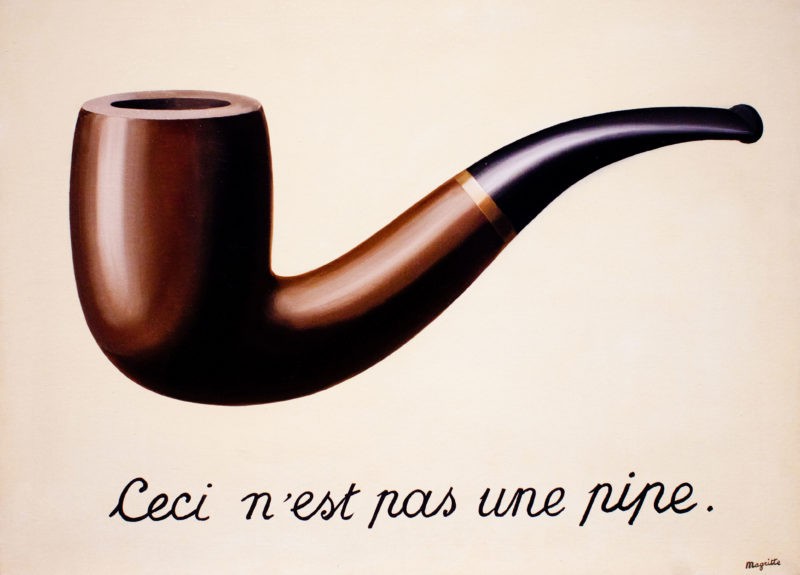
René Magritte – The Treachery of Images (This is Not a Pipe), 1929, photo: CC BY-NC 2.0 by Thomas Hawk

Basically you just create a gap, about an inch wide and then you cram a mile of spurious bullshit through it. What is that gap though? The gap is between language, and what language describes.

So we take Magritte's "The treachery of images" as an example. It's a painting of a pipe, with the caption 'this is not a pipe' which it isn't, it's a painting of a pipe. You can't pick it up, pack it with tobacco, light it and smoke it. Woah woaaaah woahhhhhhhh!

But as per the Zen Koan that opened this section, sweeping aside the esoteric language, you could do the same thing with a real 'pipe' because 'pipe' is "just" a word. What we mean when we say pipe, is wooden thing with a bowl and hole through it through which we smoke tobacco. And then WOAH WOAH WOAH you can do that with every word in my description of what a pipe is - 'bowl' is just a word we mean 'curved cavity in a substance that can hold other substances' and by 'tobacco' we mean 'green plant thing what has nicotine in it.'

And like 'woah' nothing really is what we say it is... therefore, women on average are as tall as men on average.

That's basically how to believe anything you want to believe. You dismiss the notion of a reality that constrains beliefs, by tediously using some variation of 'what is reality? It's *just* a word.' Shutting out the person responding to (what you meant as a rhetorical question) with: 'Reality is that which persists in the absence of belief.' ...Or you know, maybe you engage with pseudo-profundity by just asking: 

'But what is "persist"?'

  1. Open your palms and say 'who's to say anything is anything at all...'
  2. Then conclude 'therefore, [whatever you want.]'
That's it. Pretty much every time. This did not take me hours to illustrate, and furthermore, I don't think it necessitates a review of the literature, even if I drew on Zen philosophy and Surrealist paintings as examples. That's more to demonstrate that noticing a map and the ground are not the exact same thing is a common, pseudo profound intuition.

It may seem like you have a point, if you are working with a category that has fuzzy edges, like Wittgenstein's definition of a "game" but not so much when my old lady asks me if I want anything from the store and I ask for a "snickers". 

I have not, set her an impossible task. In fact it is quite predictable that she will bring me the exact thing I asked for. A mother fucking snickers.

It's the same if I ask her to buy a non-mass produced good like 'chicken'. Even in an alternative language that calls it 'pollo'.

One morning Shuzan asked his apprentice 'have you seen my staff?' and the apprentice said 'I have no idea what you're talking about.'

Which is to say, to believe anything you want, all you have to do, is ignore the entirety, and success with which language is conventionally useful. Ie. at describing things. 

It Begins and Ends With Zeno

You are sitting in a room, or somewhere outdoors. At some point, you will leave the area you are in. But to do so, you will have to first travel halfway right?

Surely you agree. And agreeing to that, you must agree that before you reach the halfway point to leaving, you'll have to reach the halfway point to the halfway point. Agreed?

And to get to that halfway point, between you and halfway, you'll have to pass halfway to that point. In turn half way to that. And half again, and again, and again, and again and again. Halfway to halfway to halfway to halfway to halfway...

An infinite number of subdivisions. 

That in my own words, is Zeno's paradox of motion. All of them. Whether it's Achilles and a tortoise, or an arrow in flight. 

Zeno is wrong. We could look east of ancient Greece to ancient India, somewhere between the 6th-2nd century BCE, where Kanada (Atom Eater) reasoned his way to the indivisible, the atom, such that any amount of space is not infinitely divisible, or halvable, but is finite such that we pass atom 2 on the way to atom 3 and that is all there is to it.

But much closer, allegedly/apocraphylly, to Zeno was Diogenes, who rebutted the argument simply by getting up and walking away.

Now let's turn Zeno on his side. Now he is standing atop a light-house having drunken an amphora of wine. Tipsy he slips and falls from the top of the lighthouse. To hit the ground he would first have to fall halfway, and before he can fall halfway...[three hours later] and halfway to that point. So Zeno and anybody else is fine. It is but a mere illusion that all objects accelerate towards earth at 9.8m/s^2 reaching terminal velocity when drag = acceleration. 

"And Yet It Moves"

Now we go from 5th century Greece BCE, to 16.5th century Italy CE, (Except we can't because first we'd have to get to the 2nd century CE and before that...[several years later] midday, and to get to midday we first have to get to 9am...) Where Galileo Galilei mutters under his breath 

'And yet it moves' 

after being forced to apologize for claiming the Earth isn't the stationary centre point around which the heavens revolve.

Some kind of trial had thoroughly proved, that the Earth does not revolve around the Sun using the very sound epistemology of consulting scripture.

Alas, when I said it begins and ends with Zeno, I was being hyperbolic. But it should for you. Diogenes rebuttal is rock solid. Zeno actually points the way though to 'how to believe anything' and it is, far from actually being interesting, the incredibly boring appeal to insisting language is, what reality was made of.

That language doesn't predominantly attempt to describe reality, but predominantly defines reality. It is somehow all the shit we talk about chickens, that render chickens unable to fly.

Giving the Devil His Due

The Church or whoever was giving Galileo a hard time just for speaking his truth, (incidently, the truth) provides an example of how the powerful can construct reality in the short term. 

Imagine a man old enough to be your father, but sexy enough to be your daddy... I'm detracting from the point I'm trying to make. Imagine you have a father or grandfather or brother or beloved male teacher or whatever, pick a guy you feel quite comfortable about. Then imagine that you discover he is guilty of 10 counts of homicide against women a-la-Dennis "BTK" Rader. 

A man that had a wife and 2 children and was a leader of his church.

Dennis the family man was a reality running from 1971-2004 or 5. Then the 'super' reality of BTK imposed itself on that constructed reality.

I pull out this case, because it's a kind of collapsing of two alternate realities that I imagine was super visceral for BTK's wife and kids. For his community and so forth.

It represents the kind of short-run concession I can make to the otherwise thoroughly unexciting notion of power-knowledge, grand-metanarratives and social constructivism.

Rader had the power to make himself known for some three decades (74~04) but he used that power to create a "reality" in which BTK did "not exist". The police didn't know who to arrest nor how to protect potential victims from him. 

Bodies turned up, as though nobody had killed them at all. Dennis Rader created a reality in which BTK did not exist.

This isn't to say that 'anything is possible.' There's no cosmic power being exerted here. All of society around Dennis Rader had to operate on a map that simply didn't match the ground.

The bible and other scripture are other such maps, that taken seriously, alter reality. We have to deal with people that variously believe the Israelites migrated from Egypt across the bottom of the sea. That the male common ancestor of all humanity and the common female ancestor of all humanity lived in the same place and at the same time, that there was a global flood and that a global flood is even possible and on and on with claims that are demonstrably false, ahistorical but... did have predictive power. 

It has predictive power insofar as people's behaviour is informed by their beliefs. Like if you believe that God chose your people from a bunch of spare people he also created for some reason, not to mention all the spare animals and creepy things that crawleth.

But a more grounded example might be somebody who acts on a belief that a financial security is safe. Because an institution rated it AAA, as safe as sovereign debt, even though that security is a 'collateralised debt obligation' or a bunch of 0.1% stakes in a bunch of garbage loans that were sold to you, in order to offload them from the lenders books who knew they were garbage.

A really common example of belief-creating-reality is all the people that secure loans and finance by convincing someone else that they are solvent, that they earn money, that they can someday pay it back with interest. It could be plain incompetent forecasting through to outright fraud. 

The point is you can take reality - someone who is broke, operating a business that loses money, and slap a new "reality" over the top of it and change reality...

For a while.

To Know is To Predict

In order to ultimately believe anything, one inevitably needs to dedicate oneself to a concerted effort to not notice that the cosmos are dynamic rather than stationary, that we can indeed move around, regardless of whether we understand what this means and that people know what we mean by terms like snickers, chicken, fried chicken and what not. 

Yes in some trivial sense, things are systemic, alas not arbitrary, and seldom malicious, more often self serving.

When push ultimately comes to shove, to know something is to be able to predict something. Whether that be in the past or future.

Take for example the question 'how much money do you have on you?' To know how much money you have is typically (and in cases of Visa paywave being available, historically,) a matter of predicting the face value of bank notes and coins on your person.

Accusations directed at me of bias, are true. I am bias, prejudiced, whatever, and it is towards the predictive power of knowledge. On that front, I can accept a concept like 'power-knowledge' whole heartedly. I just fail to care.

The first thing is that generally speaking, the epistemologies that historically have entrenched power, are widely available now - Empiricism (the scientific method), Rationalism (mathematics) and so forth are free to anyone with an uncensored internet connection. They are probably free to those with censored internet. Just not pictures of Xi as Winnie the Pooh or Putin in makeup.

Construction vs. Convention

It was Brown University Professor Glenn Lowry that pointed out to me that money is not a construction but a convention. 

Money has a bunch of properties, necessary properties, in order to be used as money. Even though constructed. It has to be relatively scarce, generally acceptable, a unit of account, a store of wealth etc.

Remove any of those qualities, money doesn't work anymore. At least, not as money. You might notice that Cryptocurrencies have none of these qualities except, arguably being relatively scarce. And as at writing this might explain how bitcoin has lost half its value in the past year. 

So people holding fiat currency worried that inflation has hit 6.1% p.a. it's a far worse story for people who bought crypto a year ago. But crypto isn't money. It's more like paintings, sports memorabilia etc. Crypto are most likely 'greater fool' investments. I.e. things that have no intrinsic value purchased by fools in the hopes that they can be sold to greater fools, fooling themselves.

Conservative comedian Matt Walsh released a documentary I haven't seen this year called 'What is a Woman?' where from what I can gather he gathered the very low fruit of watching theoreticians struggle to answer this question.

For the record, my intuitive response to 'what is a woman' would be 'a mature girl.' It's a common honorific bestowed upon females. 

There are some people who want to introduce terms like 'birthing people' for a variety of reasons, none of which I'm interested into going into here. And this is where construction runs into convention.

To pick out just one application, and it really is a separate post, "woman" as gender role is treated as a social construction, and therefore subject to reconstruction, redefining. But it doesn't exist in a vacuum. There are other pieces of language like 'heterosexual' or 'lesbian' that had nested the social construction of "woman" within them. So redefining or reconstructing or deconstructing "woman" also redefines, reconstructs, deconstructs "heterosexual" and "lesbian".

But these were conventions. They had predictive powers. Before redefinitions such as 'trans women are women' If someone were to say they were heterosexual, we very definitely knew who they would not sleep with. They would not sleep with people who weren't women. After redefinition, we discover that heterosexual men and lesbians in many cases won't sleep with women.

I don't understand my own sexuality. If someone were to ask, I would say I am heterosexual. But if someone were to ask me if I would sleep with a trans woman, in principle, my honest answer would be 'not knowingly.' What's my justification? Nothing intelligible. Or rather, it need not be intelligible.

Why don't I want to put another man's penis in my mouth? Or less graphically, why am I reluctant to kiss another man on the lips? Why wouldn't I hold hands with another man as we walked down the street, or as we waited for our brunch to arrive?

There's no intelligible answer, but there was a conventional answer: 'I'm not gay.'

So redefining women isn't as simple as changing a social construction, because it also breaks conventions, that even with overlapping distribution (in this case, some number of heterosexual men and lesbians that would sleep with trans women) it's predictable that the pre-existing convention would either become a kind of 'black market' convention, ie. men call themselves heterosexual, women call themselves lesbian and officially would have sex with the new construction of "women" but in practice only have sex with the old convention of women.

Or you just get a linguistic arms race, where "straight" or "heterosexual" is ceded and men start identifying as "super-straight".

If you believe in nothing...

You'll believe anything. And now there's an intuitive method abounding that proves it true. 

For me personally it is extreme-left-wing politics that annoys me most with the tedium of believing anything they want. But my tribe is really neither right nor left but the people willing to have arguments constrained by a tentative understanding of reality. 

The outside tribe is that trying to bludgeon reality into non-existence. I'm not worried that they can ultimately invade and conquer. I'm worried about how much damage they will do until the truth will out.

Mostly, this stuff is a pain in the ass. Little more. Like insisting on photo id to vote. That's just a pain in the ass, given what is known about the incidence of actual voter fraud. Vaccine hesitancy is just a pain in the ass, given what is known about the safety and efficacy of vaccines. Graysexual people, are just a pain in the ass, given the autonomy people still maintain regarding who they sleep with and date.

Some contrition would be nice, given the fullness of time.

What is proving true, even specifically by the example of 'super straight' is Timothy Snyder's prediction that without a public domain, there can be no resistance.

So does the Internet allow new things, or does the Internet create a channel for old things? I would say it's rather the latter. We know, because this is something that people have theorized about since the Enlightenment, that in order for there to be a democracy there has to be something between you and me and our fellow citizens, something between you and me and our leaders, which is: a factual world. We have to have this thing called the public sphere where you and I and our fellow citizens and our leaders agree that there are certain realities out there, and that from those realities we draw our own conclusions, our own evaluative conclusions about what would be better or worse, but we agree that the world is out there. And that it's important for you and I, as citizens, to formulate projects, but it's also important in moments of difficulty for you and I, as citizens, to resist our leaders. Because if we're going to resist our leaders we have to say, "On the basis of this set of facts, this is the state of affairs; it's intolerable; therefore we resist." If there are no facts we can't resist, it becomes impossible.

And this is the cautionary tale of believing whatever you want. It's self defeating. 

I do not know the origins of 'trans women are women' for example, and it's ambiguous as to whether it is linguistically equivalent to 'apples are food' or 'apples are apples' probably worth a google, alas I found nothing. My guess is that it's intended to mean 'apples are apples' as in to collapse the distinction of 'cis' and 'trans' and is certainly not intended to mean 'oranges are apples'. 

But we can see, there's no resistance to whatever unbearable oppression redefining women was supposed to make. As many discovered before the invention of 'super straight' was that it just doesn't work. Alas, heterosexual and lesbian never meant 'someone who sleeps with all and any women' The language never had the reality defining power to say 'you say you're attracted to women, I'm a woman therefore you are attracted to me.' And conversely for lesbians, the whole population of women however defined were never available to lesbians, not even a majority just the sum of lesbian and bisexual women.

How to Resist Any Belief

1. I feel like eating a KFC Tower Burger.

2. [Holds up what was conventionally known as a pinecone.] This is a KFC Tower Burger.

3. That's a pinecone.

4. Who's to say it's a pinecone and not a KFC Tower Burger?

5. [Throw's away pinecone.] Thanks.

6. I thought you said you wanted to eat it.

7a. I never said that.

8a. You just said it a second ago.

9a. I'm not who "I" said "I" was.

7b. Who's to say "throwing away" is not "eating" a KFC Tower Burger? 

 Yeah so just to hopefully illustrate the last point. If definitions, destinctions, facts don't exist, then they don't exist. Not simply when they suit someone to not exist.

All that is achieved by how to believe anything you want, is that someone has given up on the challenge of describing reality. Definitional offenses permit definitional retreats as beautifully illustrated by the 'trans women are women' > 'super straight' response.

More to the point of this post...

You Can Do All The Mental Gymnastics You Like

2. (derogatory) Inventive, complex arguments used to justify what is otherwise unjustifiable.

People often perform mental gymnastics in order to blame anyone but themselves.~from wiktionary.

I want to be clear, teenage boys in bourgeoisie high schools where a proliferation of new identies has made communicating whether they are 'gay/bi/straight' difficult when they are basically attracted to some cis women and not to everyone else, but some of those cis women identify as trans, non-binary, queer, or [shudder] sapiosexual etc. is while for me a sympathetic situation, not the most pressing application of people believing anything they want.

The postmodernist tactics of characters like Putin and Trump and Bolsonaro, has a far higher body count and is far more consequential, in my opinion. People who don't deal with pandemics if they don't feel like it, choose not to believe in free and fair elections, decide if they are winning or losing a justified or unjustified special military operation/invasion etc. I want that to be clear.

And when you have tremendous resources, like multiple news networks, a major political party, a private army etc. backing your process of 'Believing Anything You Want' you can kind of eke this shit out for a while before you  hit constraining reality. Before you are inevitably "destroyed by facts and logic".

Likewise, 'the law of attraction' can help you 'manifest wealth' provided you are a young attractive female who looks good in certain types of hats because there's a bunch of guys that want to fuck you and failing that jack off to images of you, and subsequently numerous young girls who want to be you and failing that live vicariously through you and desperately want to believe it's the yoga practice and the skin care regime that afford you attention and wealth not the genetics and particular stage of life you are in.

It's tempting to say, show me the "influencer" that looks like this:

By Kyle Hoobin (twitter.com/kylehoobin) - Transferred from en.wikipedia to Commons by Off2riorob using CommonsHelper., CC BY-SA 3.0, https://commons.wikimedia.org/w/index.php?curid=11201182

But yeah, that's Eckhart Tole circa 2003, chinless german influencer and beneficiary of Oprah Winfrey influencer of influencers. Quack medicine and quack spirituality is alas another whole other post.

Reality will constrain all beliefs regardless. If human civilization ends, and by happenstance Alien archeologists attempt to cohere a narrative of what went wrong, a la Jared Diamond's "Collapse" or the "Fall of Civilizations" podcast (super excellent) I will bet the whole of human history now, that they will never conclude 'the powerful failed to define a sustainable reality' unless that very literally means 'humanity failed to perceive the reality they lived in.' 

This is really a variation of Keynes':

“Markets can stay irrational longer than you can stay solvent."

So Breathairians can stay delusional longer than their bodies can sustain life.

Or as Abe Lincoln (likely apocryphally) posed to his Generals:

How many legs does a dog have if you call his tail a leg? Four. Saying that a tail is a leg doesn't make it a leg.

Conclusion

 Gentlemen, Chicolini here may talk like an idiot, and look like an idiot, but don't let that fool you: he really is an idiot. ~ Rufus T. Firefly, Duck Soup 1933

There's a way to throw out all the rulers, all the scales, all the evidence, everything our senses have evolved to tell us under our normal functioning, and insist on believing anything.

It's a complete waste of time, and life, and money. 

Mistakes are permissible, of course. My blood doesn't boil that people didn't figure out the germ theory of disease for ages. But mistakes are definitionally, only permissible if you are engaged in the task of trying to figure out what is. Rather than trying to create what isn't. 

Furthermore, individuals may profit from the demand to believe things that aren't. Jordan Peterson is a prominent person that makes a significant portion of his money being the-go-to-guy for 'The Bible is better than it reads' mental gymnastics, and Sam Harris is a "Judeo Christian" to the core. These individuals, in this capacity we can call "grifters" as a useful convention.

Individuals profiting from essentially a wealth transfer of your wasted time, life and money.

I sincerely hope though, that this post was not a waste of time, life and money. I hope it saves you a bunch.

If you want to recover your losses though, or diminish your profits you can listen to James Lindsay's deep dives:

Critique and the Linguistic Transformation of Society

How Paulo Freire Made Marxism Stupid

The Nature of Pseudo Reality

And that's in excess of 3 hours already, and I'd describe these as a "summary" Lindsay also offers chapter-by-chapter commentaries of works by Gramsci, Freire etc. Which, I don't listen to because mathematically you can't win if the masters of believing what they want don't have to read any Hegel or Marx or Marcuse, but to oppose them you have to read them all. I mean listen to James Lindsay and tell me you aren't listening to a man that has very possibly, driven himself insane.


Friday, August 19, 2022

Another Crack at the Unique Challenge of Psychotherapy

 An Englishman, an Irishman and a Frenchman walk into an emergency ward.

I only need one of them to make my analogy though. So one of them gets in front of a doctor and states their primary complaint: 'My back hurts.'

The doctor observes, immediately that the likely culprit for the back pain is the dagger sticking in that person's back. 

Now enters the unique challenge Psychotherapists face -

The doctor says 'Okay, well looks like this dagger missed all the organs, arteries and nerves, we should be able to pull it out, stitch you up and in a few weeks you'll be all fixed.'

and the patient says 'Nope. No. No way. The dagger stays.'

Then the doctor is like 'So, just to be clear. You want us to treat your back pain...without removing the dagger?'

...

So, adulthood has brought with it some disillusionment regarding the esteem and compliance afforded physicians. But on the whole, I feel maybe as much as 50% of the general population of the cultures I've been to, go see doctors when they feel sick, or are in pain, or have an injury and pretty much do as the doctor tells them, give or take forgetting to set an alarm to take their pill every 6 hours or trying to play tennis again a few weeks earlier than recommended.

The unique problem faced by those delivering psychotherapy is that any and all medicine has to taste good to the patient.*

As John Cleese repeated: 'How many psychologists/psychiatrists(?) does it take to change a light bulb? One, but the lightbulb has to want to change.' 

I have friends that have said to me things to the effect of 'I tried talking to a shrink, but it didn't really work for me, I just handle my anxiety/depression with alcohol.'

What didn't work?

Well I think it's that: 'no, the dagger stays' part of the analogy. 

There's a wide scope of reasons people seek psychotherapy, and a wider scope of reasons people should seek psychotherapy. But I feel a large chunk of change involve 'I want to feel better, I want to like myself, I want to be satisfied with my life...but my father/mother/partner stays.'

And yeah, relationships are less invasive than a few inches of steel in your back, but they can be just as obvious. Not just to a licensed, qualified practitioner of psychotherapy, but pretty much everyone.

And I've been there. I needed counselling because I was struggling to get into an intimate relationship. I had problems with mate selection.

So it was never particularly difficult for my psychologist to diagnose what was going wrong. It was more that it would take 10 hours over a year and a half to surgically remove what ailed me from my mind. 

And then, frustratingly for us both, I would go out and get another dagger in my back requiring maybe 6 hours over 6 months to remove.

The thing was, I was committed to the process of getting better. No matter how much I struggled or resisted getting better.

My feeling is that most people hold this ultimatum to their counsellors head - 'find me a way to lose my suffering while keeping my meaning, or I'll just go with my addiction, I'll just keep my toxic relationship - I'll accommodate, I'll indulge my suffering.'

Thus I feel most people ask the impossible of psychotherapy - I want all my groceries in one bag, I don't want that bag to be heavy though. It's understandable, because psychotherapy is a service and in many/most cases and places in the world, it's quite costly. People aren't going to see it, necessarily, as a give and take process.

Because they probably can make you feel better, if you give up calling your mother every night. They can make you feel better, if you give up your relationship, move into a single apartment and change all your daily routines. etc. A psychologist can help support you undertake difficult changes. 

I've compared it, in the past to dislocating a shoulder. Reducing a dislocated shoulder (the strange, to me, term for popping the shoulder back into it's socket) can be a painful process. But once it's in, healing begins. There's this neutral position my dislocated shoulder and arm can be in where it isn't painful, but to get the shoulder in, it generally has to travel across a threshold of pain.

Having said that, I recently dislocated my shoulder again, for the first time in like 3 years, and while explaining to my partner how I'd dislocated it, it reduced itself, painlessly too. So you know, things can and do get easier with practice (or loose ligaments maybe).

But I do feel it's different. I feel almost nobody chooses to leave their dislocated joints out. People do choose to live with their anxiety and depression, with toxic partners, keep shitty jobs. They'll dismiss the counsellor to keep the suffering. 

Admittedly, maybe more people would keep their dislocated shoulder, if they could treat the pain and discomfort symptoms successfully with cigarettes and alcohol, online gaming, tinder swiping etc.

And maybe it's because physical ailments are by definition, unfamiliar. They are a shock to our system, our experience rather than the norm.

But I think psychotherapy is possibly, more difficult than surgery. Maybe not as risky, where one wrong move can kill the patient or paralyse them and send you to a medical malpractice suit, but the patient isn't anaesthetised and one wrong move can have them get up and leave and never come back as you try to extract their attachment to the persons or behaviors that are distressing them.

Anyway, that's my latest crack. I hope it inspires somebody to maybe give psychotherapy another crack. It's not all on you, incompetent counsellors exist, shopping for the right one is often financially unfeasible and COVID and everything.


Tuesday, August 16, 2022

10,000 Thumbs

So the headline is, I have a podcast now:

I've come to conceive of my creative process as scaling back an idea until it's something I can achieve on my lonesome. Collaborations - I'm on 3 for 20+ attempts. Most collabs fail to materialize for me straight out the gate. That's an enigma code I haven't really cracked. I suspect because when collaborating with cash poor, time poor artists, there's nothing really to give, in the give-and-take of collaboration.

10,000 thumbs is a series on heuristics, the introductory episode explains that. All the episodes are self explanatory, so I thought I might give a run-down as to why they are meaningful to me, at least the episodes I released thus far.

Failure Must Be An Option

For years I couldn't stop myself from pursuing the golden fleece, the holy grail, of a unified theory of why everything isn't great all the time. For years I bashed my head against a brick wall called 'risk aversion' behind which I felt was the one simple key to it all. 

During the pandemic I learned concepts like 'consent of the loser' something necessary for democracy to work. So to look at the Republican Elephant in the room, we can see from Bush v Gore thru to 'Stop the Steal' we had an institution in a democracy that was increasingly unwilling to consent to losing. 

The near-enough answer to me was in plain sight - rigging. Whenever something is bad, it is usually because something is rigged. And I may have singled out the republicans, but what is scare about US polarization, is that increasingly both parties adamantly refuse to put up presidential candidates and supreme court nominees that the other side can actually live with. It actually makes me feel national...maybe not pride, but not-shame, that Australia's electoral system actually pretty much mandates that the parties have to be something that the majority of opposition can live with. 

In a throaway line in my first real episode, I say that Popper is right and Marcuse is wrong - I'm referring to Marcuse's "liberating tolerance":

Marcuse argues that "the realization of the objective of tolerance" requires "intolerance toward prevailing policies, attitudes, opinions, and the extension of tolerance to policies, attitudes, and opinions which are outlawed or suppressed." He makes the case for "liberating tolerance", which would consist of intolerance to right-wing movements and toleration of left-wing movements.

That's a terrible idea. Admittedly I haven't seen Marcuse's argument, it might persuade me, but we are talking one hell of a persuasion job to swallow that pill. By contrast Popper:

 Less well known [than other paradoxes] is the paradox of tolerance: Unlimited tolerance must lead to the disappearance of tolerance. If we extend unlimited tolerance even to those who are intolerant, if we are not prepared to defend a tolerant society against the onslaught of the intolerant, then the tolerant will be destroyed, and tolerance with them.—In this formulation, I do not imply, for instance, that we should always suppress the utterance of intolerant philosophies; as long as we can counter them by rational argument and keep them in check by public opinion, suppression would certainly be most unwise. But we should claim the right to suppress them if necessary even by force; for it may easily turn out that they are not prepared to meet us on the level of rational argument, but begin by denouncing all argument; they may forbid their followers to listen to rational argument, because it is deceptive, and teach them to answer arguments by the use of their fists or pistols. We should therefore claim, in the name of tolerance, the right not to tolerate the intolerant. We should claim that any movement preaching intolerance places itself outside the law and we should consider incitement to intolerance and persecution as criminal, in the same way as we should consider incitement to murder, or to kidnapping, or to the revival of the slave trade, as criminal.

Like, what gets my goat is that I think people these days think Popper and Marcuse are preaching the same thing. Actually Popper's Paradox basically says we cannot tolerate Marcuse's "liberating tolerance" because it is a doctrine of intolerance.

So I would hope it is transparent that managers rigging things is not good, even on a triple-bottom-line analysis, this first episode is really important to me though because it is a rule that can be followed down to any aspect of life. From a manager who gets a bonus for driving a company into the ground down to a relationship where one partner won't let the other leave them on threat of death.

The Fundamental Rule of Taking Risks

A hard one to follow, but I try to, because it involves evaluations that I have not always done. Also the monkey mind. Like sometimes it is hard to not check my phone or tablet because I've been skinner-boxed into doing so, even though the rewards are seldom meaningful vs how meaningful the people I'm supposed to be paying attention to are.

Still, it's an important rule to me. If I were to be asked what the role or function of education should be, I would be inclined to answer 'to teach people to know when they are or aren't taking risks, how to take risks and why to take risks.'

A big part of that is covered by 'you don't risk something important to gain something unimportant'.

I feel how our education system, at least in Australia mostly functions is, teaching people to take low-risk-high-stakes gambles constantly for a steady stream of small gains. Namely, it encourages us to invest mammoth amounts of time and money into getting a qualification so we can work for someone and receive a steady pay check. Then to use that paycheck to leverage a lifetime of future paychecks to buy property.

That in a nut-shell is the 'Australian formula' and I'm not convinced it is so different from the US formula, the UK formula, the Canadian formula etc. Though I derive the rule from Warren Buffet this is something Nassim Nicholas Taleb writes a bunch about. Most people are betting $1 every day for a very low-risk payout of a steady stream of 5c. You bet $1, you can more-or-less expect to take home $1.05. 

Then something happens like Covid, the GFC, the World Trade Center Attacks etc. and the 'or-less' part stops being the fine print. Mass layoffs, economic contractions and people find themselves fucked. These are the perils of risk aversion, and I feel Buffet's rule is a better way of handling risk aversion than trying to seek out low-risk returns.

Assuming Inefficiency

Something I struggle with, mentally, is the idea that compensation reflects my worth somehow as a person. That when I fail, it is because I am intrinsically inferior. 

My struggle is made easier having been on the other side of that equation. Imposter syndrome etc. This episode is just a reality check that the world is full of waste. 

Again among my goat getters is Joe Hockey's 'lifters and leaners' characterization of Australia. Corporate welfare is massive. Whatever people tear their hair out over the government doing, you can bet the private sector is doing it only more so.

When for example did you hear any talking head discuss how much money is created by the private sector? I'm going to wager, once in the past three years to never. Yet:

Nearly all money in the US, UK and many other countries is created by the private sector through lending. ~ excerpted from this paper

More chaffing for me, is identifying people on welfare as 'leaners'. One of the most amazing factoids that came out of the UBI debate, and too little known, is that just giving everyone no-questions-asked payments of money (and by everyone I mean everyone) is cheaper than operating the welfare system we have. 

And I know, "leaners" exist in the private sector. I've met them. My old employer took 25 years to figure out we had a manager that didn't do anything. They got rid of them, and by doing so they then figured out that manager's manager also did nothing. 

Furthermore, what tragically I feel a lot of people on welfare flirting with poverty don't realize, is that there are young men driving porches with platinum credit cards and Italian suits and shoes who are handsomely compensated for running businesses that lose money.

We live in a world of illusions, and perhaps the biggest illusion is that we are anywhere close to running efficiently. Efficiency is an ideal finish line we are always approaching, and even with the tough times I'm going through, I maintain my optimism because there's still so much work to be done.

Don't Blame the Audience

This one is so dear to my heart. I know the temptation too. But fundamentally it's about agency.

People often seem so ready to sacrifice their agency to maintain their ego. Literally last night I was taking feedback on my resume that honestly, I felt was superficial and arbitrary. My ego defenses kicked in and my internal monologue was 'unreadable? seriously? how come you're reading it then.' instead though, with the appreciation that this was my audience and they were giving me feedback, I asked follow up questions to work with them to improve my resume.

I've been involved with NGOs who's go to explanation for performance failure was a global conspiracy, a machiavellian cabal thwarting them. The simpler explanation that their reading material was dense and unappealing, their representatives looked like crazy conspiracy theorists or hippies was intolerable, and it is from them that I largely learned this rule I follow.

When somebody doesn't buy a piece of my art, that's never their problem. It's always my problem.

I don't kowtow and just draw what people want me to draw. I go back to the drawing board and try to make another connection. I have literally renamed a piece to make a sale, based on feedback from the audience.

If 10,000 thumbs fails, I won't be blaming the audience.

Hanlon's Razor

I didn't invent Hanlon's Razor, but I care about it because society itself appears to somehow be cutting it's own throat in it's absence. Maybe Hanlon's Razor is more of a parrying dagger.

So I felt it necessary to record an episode just on Hanlon's Razor. It's something I'm quite passionate about because for me it falls under the purview of mental health. People forget or do not suspect the liberating power of realizing that whatever is bothering you, making you suffer, doesn't actually care about you. It isn't personal.

I really love this workshop Gabor Mate ran with social workers. Given the ability of social workers to reflexively leap to the conclusion that is most personal. People are being trained to actually do the opposite these days to infer malicious intent from banal inane interactions.

Not What, But How

This one was really about management, and for me is the crux of management. I feel being an employee in Australia is a bit of a crap shoot in terms of managers. Largely because the most well trod path to management is promotion rather than management training.

I'm sure great managers exist. Partly because I've worked for some. But most managers are more of the protean mold of 'hey you're the best at this on the team, so we're making you the manager of the team.' ignoring other factors like whether anyone on the team likes them, whether they have any communication skills, whether they understand why they were good at their role etc. (I've held some jobs where the major performance determinate was the voice the employee had. I've also held jobs were some of the strongest performers cut the most corners.)

There's some vagueness I admit, to "what" and "how" like if somebody commissions me to paint them a zebra, they are telling me 'what' to paint, which I'm fine with, and what I want to be left up to me is "how" I paint it. If somebody was like, draw me something but I want you to use a ruler for every mark on the page no freehand, and paint it on velum in oil. Like that's the worst commission I can imagine.

I developed this rule through practice. I was working with economists that really cared about the economics. I cared about management. So quite naturally, I didn't want to get into the nitty gritty of the projects they were working on. I had almost no value to contribute there, but I did want to know when they'd do them, when they would sit down to get them done, what their calendars looked like and how it all fit in with the organizational strategy.

I find often, managers want to do the work of the employees because they know how to do that, they don't know how to manage. Nothing is more frustrating when you're a competent employee. So this is how to do that.

Empathy's Value is Measured in Distance

So many of the people who invoke the panacea of 'Empathy' have mostly served as examples of 'how not to do empathy.'

Empathy done right generally does not result in outrage and protest but nuance and calm. It indicates a person has actually occupied a mind albeit briefly different to their own.

For me it's one of the most annoying things, and easiest to understand. People simply misinterpret empathy as something one does in one direction only - the marginalized, the oppressed, the downtrodden. People don't really intuit to use empathy to try and understand the people they don't identify with.

I have friends that understand chickens, pigs and cows better than they understand me.

If it was easy to know how and when to use empathy, we wouldn't need things like Hanlon's razor, to spare us a lot of the mental leg work.

That's Where I'm At

Forthcoming are map-ground errors, evaluating the gold-silver-platinum rules, want vs is regarding beliefs, and a lot more I have scripts worked out for defining professionalism, turning up for people, how not to be a corporate welfare recipient (or have a bullshit job and eternal existential dread of being cut off), success and succession, spirituality and relationship stuff.

I find it really fun and enjoyable to write and record and produce. And I'm making it all free because I've road tested everything I put out, and I live by all this content. 

I care about spreading these because any one, if followed can have a significant positive impact.

How I got Here

My first attempt at a podcast was 'The Mighty Genius Hour' and it was collaborative. I had the long end of the stick in that collaboration, I turned up and talked shit, my collaborator had to do all the audio, which was too much as it turned out. 

My second attempt was an interview series called 'Nobodies' it wasn't so much a collaboration, because I was just interviewing friends that like me were rolling the dice on creative careers and pursuits and hadn't got their break yet. 

The trouble was: recording was easy. Scheduling recordings was hard. And then well it's like going on a long run, where until you turn around and start heading home, the fact is that every step you take is a step you have to run back. It's great to have an unconstrained 3 hour conversation and record it. But without a producer to flag sections and questions, the editing becomes a nightmare, because you have to listen to and edit those 3 hours, something that might reasonably take 10 hours, given my 10 minute episodes currently take about an hour to edit each. Sure I designed it to keep editing to a minimum, but you can still have a guest (or me as host) say 'I don't know the statute of limitations on that thing. Better cut that bit.' 

The other thing was that people who aren't famous, aren't famous for all kinds of reasons. One of those reasons might be unreliability. One of my guests, It took something like 8 attempts over 3 months to get to show up. So it was hard to even get a season in the can, let alone edited. And another of my guests, we wound up talking about what it was like to live through Geelong Football Club 'The Cats' breaking their premiership drought for 2/3rds of the interview. My feeling was that while that was interesting, we both wanted another tilt at doing the interview.

So my learning curve as an interviewer was at the expense of my guest's time. And I never recorded enough interviews to actually release. Those I did took the better part of a year, and that year was 2016. 

Skipping from one year that everyone felt blew, to another, in the Melbourne 1st-2nd lockdown, while looking for constructive things to do, I started writing scripts about heuristics. I wanted to release them as Vlogs, on Youtube. 

There's a whole other post in there, but I think Covid was a wakeup call, and for me I woke up to the concept of the 'Good Time Revolution' which is basically, when times are tough, like you are in a desert or something - performance matters. You need competent disciplined people to conserve scarce resources, locate precious calories and not make costly mistakes. When times are good, you tend to get a revolution where people are put in charge who want to be in charge and maybe also that we want to be in charge because performance doesn't matter so much. Like when your struggle with calories is eating too much, and you need to waste energy and money going to a gym to work off the excesses you consume.

So I had this impetus to write these short vlog entries that if followed would render one competent to be in charge of anything be it a fast food shift or near as I can guesstimate the WHO or CDC.

I got busy with an interim management gig that was supposed to be 4 contact hours a week working with a small team and the board, but worked out to being like 20 hours a week. Though it was a good working reminder of how useful heuristics could be, and though it was quite meaningful work...

...actually there's too good a transition in their to pass up. I joined a board of an NGO during the lockdowns, and it turns out that I joined an organization in crisis. 

They'd had 25% of their staff resign, which sounds like a lot but there were only 4 people on the payroll. The resignation came with a well substantiated claim that the work environment was toxic and dysfunctional. The organization was flat, there were job titles but no job descriptions. Everyone was doing a little of everything, some people did what needed doing, some people did what they wanted to do.

They wanted to fire one of the three remaining employees. Unfortunately, they were an employee, and basically nothing was in place paperwork wise to be able to fire them. (See failure must be an option)

That might sound strange to people who's idea of corporate culture comes from the apprentice. But given the multitude of people who daily find out the hard way that you can't just fire somebody, let me do a short elaboration. (assume inefficiency)

You can't fire someone for performance issues if you've never specified what they should perform, if you've never reviewed their performance etc.

You can make somebody redundant, but for that it is ideal if they are actually redundant. You can't then hire people to replace them. (assume inefficiency)

You can't fire people for an 'instant dismissal offence' if you have no policy in place to specify what constitutes an instant dismissal. Well. you probably can, for unambiguous things like committing a criminal offense like assault or theft, but that wasn't on the cards here.

When you pick up a paper or watch a movie where someone gets told to clear out their desk, and is escorted with a cardboard box off the premises by security, here's what is usually happening - the employer has broken an employment contract with the employee. That employee is actually able to sue the company for breach of contract (unfair dismissal) and usually this aspect is opaque, because the matter is settled out of court and it's not uncommon for companies to pay a years salary, or three years salary just to get rid of a person.

There's a term 'golden parachute' that refers to big executives signing contracts that make it more lucrative for them to be fired than to succeed. (A perverse incentive if ever there was one). (Failure must be an option)

One of the things that can keep small firms small and toxic, is an inability to appreciate the risk of hiring anyone. (The fundamental rule of risk taking) It specifically translates to being stuck with toad employees, that are very hard to turn into princes. Furthermore, the less productive an employee, the more likely they are to stick with a small firm. Big firms, though it isn't efficient, can pay to get rid of these toads, small firms and organizations have to live with them. (Assume Inefficiency)

Anyway, to abridge the story, I offered to be an interim manager. There was actually some hope that this toad might turn out to be a prince, on account of this organisation had lacked any real management or leadership for their entire tenure. (Hanlon's razor)

I took an off-the-shelf free product in the form of Manager-tools' podcasts and started applying it. And obviously there's friction but in general it worked like a charm. We got a lot of stuff done in just three months and I was able to hand off to an actual employee to be manager, shortly before I relocated to Mexico.

I found the whole situation ironic. This was volunteer work, it was also meaningful and I could afford to do it because the Australian government stepped up during the pandemic and increased welfare payments (above what I'd previously earned working 20 hours a week in a job that was meaningless and draining), which I'd never been on before...or had I?

Previous to that, I'd worked for a private company who's primary source of revenue was government contracts. (assume inefficiency) I would call that job a bullshit job, specifically a sub-type of 'box-checker' I don't want to talk too much about it, so I'll use an analogy from Japan. If you spend any significant amount of time in the same place in Japan, like 3 months or so, chances are a bunch of streets in your neighborhood will be ripped up and replaced, often in the same day.

Furthermore, when you are walking to your local combini or train station, there will be a veritable army of workers in hi-vis vests with hats, whistles and glowing orange batons to escort you around the roadworks. Not the 'pedestrians use other sidewalk' sign that does this job in Australia, or simply fencing off an intersection like in Italy or Mexico with nary a construction worker in sight.

This phenomena is called 'hidden unemployment' where instead of just paying people welfare so that they can meet their living needs and stimulate the economy, you make up bullshit jobs to stimulate the economy and hide unemployment.

I had a job similar to third deputy assistant to the chief pedestrian traffic coordinator in Japan. When the government briefly just gave me the money no questions asked, I was actually able to do meaningful work.

And here's the meaning:

Management has a huge impact on people's mental health and quality of life.

Management works either for-or-against employees. Australia has some of the lowest standards of management in the world. (I'd heard this in high-school, and I recently fact checked it) and this finally brings me to 10,000 Thumbs - what I called my podcast.

They are short roughly ten minute episodes of rules that I use, and have found easy to internalize to generate above-all-else good mental health outcomes, but actual productive management. 

I was only interim manager for three months, but I felt the impact I made was both positive and sizeable. 

It might be a low-hanging fruit situation, when I can begin with 'what are your priorities?' followed by 'show my your schedule?' to check for discrepancies, and have employees lightbulbs immediately go on - particularly in cases where people hadn't realized they had 9 priorities and didn't have a schedule. 

But I've been in big corporations, and had a change in management from performer to dud, and witnessed people paid big money do nothing but screw constantly with the actual performance of work. (Not what, but how). I've lived to see those managers shit canned too.

That's why I believe in this product. Who the fuck am I? You can decide that. Even if that leads you to not even try my podcast. It may take a while to find its audience, but I'm going to keep doing it, maybe it won't get traction until after I'm old, dead and gone. I don't know. It's out now though and I'm glad to get something out in the audio medium.