Wednesday, May 07, 2014

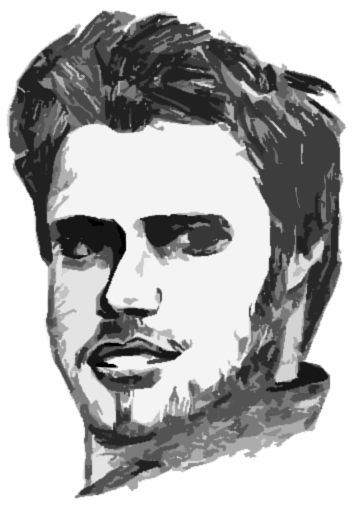
Rumi

It was an idea that crept up on me, perhaps inevitably. I mean of course inevitably. We live in a deterministic universe.

But by creep up, I mean I'm not sure where the idea came from. The ideas is, that being a sage is actually a viable thing to do with one's life. I don't know what it is, to be a sage, I'm just thinking that waking up and trying to attain a state of being day in day out is legit.

Perhaps it came from my exercise regime, or just quitting shit this year, or listening to Sam Harris talk about athiest's being too dismissive of spiritual practices, or Nassim Taleb pointing out that just because we don't understand why something works doesn't mean it doesn't work - or rather his synopsis of Nietzsche warning me not to confuse the unintelligible from the unintelligent... or some shit. I don't know.

It befuddles my mind. Why waste time trying to determine the determinants? it's done.

I found Rumi as a quote in an artist blog post about all the quotes they put in their visual diaries. The exact quote was this:

"What you seek is seeking you." - Rumi.

I found it a very comforting thought, something compells me to believe it is true. But as is the case when you have the hunger. I sought more. I had assumed because of the brevity and lack of consonant clusters that Rumi would be some Japanese artist or author. But no, he was a 13th century Persian poet. Ah, Persia is there nothing it can't do?

I would hope my blogging activities and other conduct have established my deep love of dead presidents, the ones that could actually make speeches. I remember when I first went and read those speeches on wikiquote in the idle hours I spent in Takamatsu waiting for the few brief windows in a day that I could spend time with Miki. They really moved me, Rumi's words move me in a different way.

Consider:

"If you are irritated by every rub,how will your mirror be polished?"

That's it. That is it. There is something there. That some people just get, because it is unintelligible, inarticulate but it is most definitely there. It's a place I can put my mind but it becomes disoriented and confused and irritable, yet when I don't try sometimes I feel it. And that's all it is, a feeling. But people like Rumi and probably Yagyu Sekishusai and others have felt it and they can talk around it but not describe it.

Something Rumi himself seemed to observe and comment upon:

"The men of God are like fishes in the ocean; they pop up into view on the surface here and there and everywhere, as they please."

and I'm particularly inclined to listen to Rumi because like most people I listen to, they affirm shit I really struggled to grasp myself. Like a this:

"Many of the faults you see in others, dear reader, are your own nature reflected in them."

A powerful epiphany and piece of psycho-analysis that I'm personally surprised to learn goes back to the 13th century. Makes it strange it took me so long to get onto Gabor Mate's stuff.

Or:

If you wish mercy, show mercy to the weak.

If you dig a pit for others to fall into, you will fall into it yourself.

The lion who breaks the enemy's ranks is a minor hero compared to the lion who overcomes himself.

I could cherry pick all day, but just look him up yourself. So finally, on the theme of my life, if not yours (I dunno):

If you are wholly perplexed and in straits, have patience, for patience is the key to joy.


Tuesday, May 06, 2014

Karmic Retribution

Or poetic justice. I find myself having to look in an ugly mirror and partake in the exercise of finding myself beautiful. I guess understanding in the moment and feeling compassion is consummate with forgiving myself. I guess life does make us pay for our mistakes and I made mistakes. The friends who supported me now spared from me and my obstinate misplaced confidence and esteem (because I got better) I find myself having to be those friends and watch helplessly, knowingly (well as far as I can presume to know anything).

Because much as I could claim to know what should be done, and many people outside a situation can and most people outside a situation are right - a forest tends to look like a fucking forest from the outside rather than a unique and precious cluster of trees. But I know what I did do, I suffer from the paradox of capability, the very fact I feel so capable is what rendered me for years so incapable.

So it's probably high time I used the paradoxical privacy of this blog to do my own autopsy.

It starts, in hindsight with Warren Buffett, who offered perhaps the best relationship advice there is for people like me under the guise of financial advice: 

"Many managers were apparently over-exposed in impressionable childhood years to the
story in which the imprisoned, handsome prince is released from the toad's body by a kiss
from the beautiful princess.  Consequently they are certain that the managerial kiss will
do wonders for the profitability of the target company.  Such optimism is essential.
Absent that rosy view, why else should the shareholders of company A want to own an
interest in B at a takeover cost that is two times the market price they'd pay if they made
direct purchases on their own?  In other words investors can always buy toads at the
going price for toads.  If investors instead bankroll princesses who wish to pay double
for the right to kiss the toad, those kisses better pack some real dynamite. We've observed
many kisses, but very few miracles.  Nevertheless, many managerial princesses remain
serenely confident about the future potency of their kisses, even after their corporate
backyards are knee-deep in unresponsive toads."

Also Drucker, the management guru labored the point quite intensely that you put your resources behind proven strong performers, and you don't invest in the weak or problematic performers.

I knew all this, I knew it all. I read 'Warren Buffett CEO' and Peter Drucker's 'Effective Executive' long before I got into the situation where I couldn't plainly see.

I was an overconfident princess believing in the transformative powers of my kisses. To make matters worse, or at least more damning for me, I'd even had it translated into the relationship context for me by Dr. Gordon Livingstone in 'How To Love' one of my oft-sighted books I actually read in the past 5 years. Many people waste their time and life believing that if they just love somebody enough they will cure their ills.

It seems clear now, and even in retrospect it always seemed clear. I just cherry picked my knowledge and built a narrative to keep me unaccountable. To make me special, exceptional to the rule. 

I made a miscalculation in the concept of risk, one I wrote about in my last post. The very low odds of my success I translated into a highly valuable anticipated payoff of success - hence worth my investment of time, energy and love. I equivocated it to my persistence with art, I was simply being consistent it was my nature to strive for the impossible, and if nobody did then how could we be certain of what was possible or impossible.

Conveniently though, I was ignoring the ongoing and growing body of evidence suggesting that instead of being a high risk endeavor what I was engaged in was in fact, no risk at all. It was, relative to me, just a toad - and always going to be.

And as a caveat, I don't agree at all with the notion 'people don't change'. Anybody who espouses it, has defeated themselves. I just think the best counter argument to engage in is to change yourself, do the work. Not work at changing other people. 

We can certainly change others for the worse, by inflicting trauma on them. We can help and influence others. I just believe that people should only really borrow your esteem to add it to their own, not as a a substitute. 

But what damage did I do? At what cost was my undertaking? What is karma handed to me now?

Here's what I did. I fought for my impossible dream day in day out, if not directly, psychically, going over and over the situation in my head. Attacking this seemingly insurmountable problem every which way I could imagine. So much rehearsal, experimentation. So much energy went into the disciplines I forced myself to maintain.

And almost like clockwork - every 3-6 months my optimism received an insult from reality. A crushing one, I pinned all my hopes and dreams on this endeavor. Invested in this one person (who is not to blame for my own folly). 

And at my lowest, when I was in despair, I would do something actually smart - I would pick up my phone and call somebody who loved me. And I would poor my heart out, and they would listen patiently, reassure me, build me up, invest time in me. We would have fun, I would feel better. I would quickly recharge, regroup my esteem and remember what it was like to feel capable and confident. Amazingly quickly, over one or two weeks max, usually about 2-3 interactions with my loved ones. 

That was the power and energy of their love. It is a massive, potent source of energy. 

And then I would take that energy, and use it to grind myself down to devestation and despair again over 3-6 months. 

Let us do the math - 1-2 weeks to replenish my energy by keeping good* company. 3-6 months expending that energy on bad* company.

*here I use 'good' and 'bad' not as absolute judgement of character, but in the specific effect they had on me. The people who are good for me are able to translate their love of me into consistent behavior, but for all you know they could sell poison milk to children.

Or in graph form, my energy/well-being etc could be plotted thusly:

Quick recovery, slow discharge into despair. Repeated too many times to reflect well on my character.

This is the real thing I fucked up in my life. What took me longest to figure out. It was where I was putting my time. I even drew up a list using that heuristic of 'how do they make me feel' and I knew who I should be spending my time with. I had a concrete behavioral selection criteria for who I should invest my time in.

And I just didn't do it. I didn't put the energy back into them. I took their energy and used it to push shit uphill. Again and again.

...

Here is what I have come to realise, it's not that there's no value in undertaking the impossible. There's the usual journey/destination disparity. It's that building a mediocre structure that is 'miraculous' because it's foundations are so poor is not the best use of any persons capabilities. Impossible things can be built on really great foundations, the better the foundations the further our efforts can extend to what is possible.

Since I broke my own cycle of despair, and while I don't believe in accidents I have to attribute the cycle being broken mostly to luck rather than my design, I find myself with an abundance of time and energy, that I now put into really, really good people for me. It happened so quickly, and aside from a few painful frustrations decoupling myself from the person most bad for me, on the whole I just get stronger and stronger, and feel better and better.

I am becoming my best self, and having to watch somebody now remind me so much of myself when trapped by my own hubris, even that is making me better, though I have no idea what the fuck to do as a spectator.

Friday, May 02, 2014

Flip World

As many of my friends tie nuptial knots, others pump out children and others too break up, get divorced change facebook relationship statusi to 'It's complicated' and it gets me thinking.

Firstly, I'm almost inclined like a sucker to say that in the breakup the thought of being single is one of those situations where your intuition is wrong. Except that intuition is actually easily ignored, and it's hard for me to go the way back in hindsight necessary to do anything more than speculate on whether it's intuition or cognition that screws us.

Here's what I see, a flipped out paradox:

The thought of being single terrifies us, but paradoxically there's nobody there to hurt us. By contrast the thought of being back with our partner is comforting, yet they are the precise person that has hurt us. (hopefully unwittingly).

And let me be clear, even with my long standing singledom I think risking heartbreak is a risk worth taking. But at the end of a relationship, the conclusion that needs not just to be comprehended but felt, is that you are broken up because that person is no longer the person to bet on. The 'risk' is diminishing as how they treat you becomes more predictable, more certain.

One thing that I found hard to accept, even though I knew it cognitively was when a person just isn't the best building blocks for a relationship. 

Happiness requires risk, I believe that shit. But risk is one of the most misunderstood concepts out there. There's no risk being taken when we are doomed to fail. There's even dumb risks to take when the odds are low and the payoffs actually mediocre. 

When we break up we grieve. And grief demands relief. We don't want our ex's back in truth, we want our ex's to be different people, to be who we want them to be, immediately. But if our personalities, our character consist of our predictable behaviour patterns - hence expressions like 'that is so out of character' - we aren't likely to become a person we aren't just from the trauma of a break up. 

Sure there is such a thing as post traumatic growth, but generally a relationship is ground down to breaking point by incompatibilities in our sub-conscious preferences. Reprogramming those is a LOT of work, perhaps worth doing, but that work takes time and space and should be undertaken genuinely, that is under the presumption that there is no guarantee the relationship will resume. It's work each has to do for oneself. Over time.

Sunday, April 27, 2014

Originality

I speculate on phases that I think each artist has to pass through, developmental phases like that of an infant to an adult. For example, I think each artist has to reach a stage where they are willing to actually put their work out there for consumption, another usually later stage is learning to ask people to pay for your art.

I'm not sure where it is, but I think an artist needs to free themselves from a yoke of originality. Which isn't particularly fair to label as 'originality' I just lack a better word. But that's perhaps why I feel compelled to write about it. I was watching a certain somewhat popular band play the supporting slot for Erykah Badu when it hit me, the trouble with originality.

As an ideal, it tends to be overstated. I mean, people often treat 'originality' and 'creativity' as synonyms which isn't fair, being creative if merely engaging in the act of creating. It doesn't necessitate being original as well. Many creatives are dedicated to very rigid forms, the beauty of what they create driven by the adherence to the rules of those forms.

But when I say 'originality' is over stated, I think many artists get into their head the pursuit of some holy-grail. Some wholly original work, a quantum creation plucked from the ether that bears no resemblance to any preceding piece of art. An immaculately conceived idea.

Hok sput.

It's bullshit. Hogwash. Quantum breakthroughs do occur. But it's rare. The problem I have with artists caught up in originality, is as near as I can articulate this:

It doesn't produce good art.

Whatever that means, here's what I mean - 'originality' isn't an aesthetic as such. It just means without precedent. You wan't your art not to resemble anything. It doesn't matter how it doesn't resemble anything.

That's a very hard thing to try and imagine. It's a very hard thing to avoid by accident, it would take a lot of research to figure out every form thus far created, and then avoid them all. I don't think anybody does it.

What artists tend to do when aiming for originality is attack the problem in very predictable ways. They attack the foundations, break the forms. A much lighter challenge than taking an existing form or genre and then creating a wholly new iteration of it.

So they attack the underpinning, and create... a mess. Those striving for the original tend to produce shit that hurts the ear drums or waters the eyes. They take existing rules and break them. But it's always the big obvious rules. Not a partial deconstruction, and the original works wind up being predictable and cliched. The contemporary and avant garde tend to resemble each other as much if not more than the works of antiquity.

Those striving for originality so rarely achieve it. Which is to be expected.

I find the pursuit quite juvenile, in the egocentric moody teen years of being an artist. Where one draws or paints or writes or composes to express themselves as unique, special, a rebellious identity. They create in an attempt to create themselves, a self they hope is worthwhile.

Just create because you love creating, that you deal with a subject you are into. If you can't manage that, create because you are getting paid.

I often think about Einstein and just what chain of events lead him to sit around contemplating the curvature of the universe. I mean would it ever occur to you to think about that? The geometric qualities of space and time itself? It never occured to me, and I probably got taught more in year 11 physics than was understood by most physicists of Einsteins age. Admittedly a year 11 student is never going to go deep. But I raise Einstein because that's imagination. Almost an unrivaled imagination, but I don't know. Maybe you mixed in the right circles and curvature of space and time seems a very obvious thing to concern oneself with.

I'm going to postulate that Einsteins are rare, and I imagine it takes that kind of imagination to come up with something truly original. The vast majority of people don't have it. What we see at the cutting edge of art I think, are people who aren't obsessed with being the cutting edge, and never were. They were obsessed with something, something forgotten or overlooked by most, but was commonplace to somebody somewhere. And through their obsession with this overlooked subject they made it new again.

That's not originality, that's love.

Saturday, April 19, 2014

Why do artists take drugs?

Which 'why?' are we asking, Dan Dennett may be able to differentiate and explain but I can't. I imagine the 'why' as an explanation eg. 'why artists take drugs' is no different an explanation from why anybody does.

I found this question hard to answer, because there's really less compelling reasons for an artist to do drugs than, as per the Jerry Seinfeld bit, an accountant. Yet the acceptability, indeed the expectation of artists taking drugs is categorically different from non-artistic vocations.

A career in the arts, specifically as a content creator - an artist as such, and not any of the peripheral para-artistic careers (gallery curator, record executive, talent scout etc.) - you are pursuing a profession I would characterize thusly:

low odds of success, high potential payoff.

Which is to say, if you were to compare being an artist to opening a milk bar, what you would find is that in the history of milk bar owners, you would find a lot of financially comfortable and secure small business owners achieving pretty consistent standards of living, with a peppering of failures. The reverse would be true in the history of artists, you would find a vast nameless diaspora of failure, people who slowly bled to death or simply gave up trying to eek out a living from their art, peppered with a few well success stories.

But what you will find, is that the best day of being a milkbar owner ever, wouldn't even rate compared to the best day of the successful artist. The potential upside of owning a milk bar, is kind of capped. Can you for example, imagine a milk bar owner's work leading to an email inbox flooded with thousands of messages from strangers telling them how much their work meant to them? Tricky right, you are already imagining heroic acts that have little to nothing to do with the operation of a milk bar, like rescuing a child from a burning building. But I put it to you that it's pretty easy to imagine this happening to an artist, because of their artwork.

Gee, tohm, you wrote a long two paragraphs, but what is your point? My point is, that if you are in the business of being an artist, you are going for such a reward, such an achievement. The feeling of being inundated with the validation of strangers as to just how great your work is. A level of recognition unobtainable to most. You want it, even though it may well be unobtainable to you. You are looking to overload your neural reward systems, reserved for exactly such achievements.

Now take a fairly innocuous drug like XTC, successfully re branded to MDMA. A drug I looked pretty hard at taking. I should say in due dilligence, that I never took it, nor any other restricted substance, probably because by and large my motivations were poor for raising the question in the first place and also because ultimately it breaks one of my ruling rule of thumbs - risking something important to gain something unimportant.

Anyway, the thing about drugs, is that they work and in the short-term they can 'solve' problems. But consider my risks as an artist myself - I have these dormant, latent reward systems waiting for some event in my environment to trigger - kissing my soul mate, having a successful exhibition, running faster than I've ever run before etc. One of these events causes dope to release in my brain hit all those receptors and let me know that I am doing something right.

Or I can take a drug, that hits all those receptors anyway regardless of my external reality. What could be more damaging to your career as an artist?

I'm told, MDMA feels great. And anybody who ingests it, is going to feel something.

But this is also true of running a marathon. The difference being that people who run marathons are less inhibited about broadcasting that they do and they feel people should in the public domain, more so than recreational drug addicts. But in contrast somebody who pushes marathon running, is often regarded as self-righteous, and the idea of spending a year training for a marathon to obtain that high is seen as justifiably dismissable - no doubt because of the time commitment, the difficulty of starting, the demands for lifestyle change etc.

But among artists particularly, despite the demonstrable damage and risks of drug use (legal or illicit) EVEN AFTER discounting damage caused by ineffective anti-drug legislation (eg. when weed possession was still criminal) cannot shake the stigma of somebody who declines the experiment with being 'closed minded'.

Which perhaps is the hook that gets most aspiring artists. they should be open to altered states of consciousness. But before moving too far away from the 'fucking with the reward system' counterargument, let me draw this one last line between running and being an artist (of which I am both) is that it is hard to imagine, and I imagine incredibly rare to find a runner that before/after a run shoots some morphine or other opiate to stimulate the exact same reward response that they get from running.

Yet for some reason, for an artist, in between actually completing and releasing works of art that they should stimulate the exact same reward centers through cocaine or MDMA. I can imagine, because running is addictive, injured runners getting hooked on painkillers, certainly, but I don't hear of runners taking painkillers in the off season.

Believe it or not, I often actually argue with myself. A lot, and most of this is done before writing a blog or conversing with a friend. And the best counter argument I could come up with is that the analogy is a poor one. One could argue, that recreational drug use is to an artist, what training is to a runner when compared to the actual marathon.

There's even that Bill Hicks bit that featured on the Aenema recording of Tool:

“You see, I think drugs have done some good things for us. I really do. And if you don't believe drugs have done good things for us, do me a favor. Go home tonight. Take all your albums, all your tapes and all your CDs and burn them. 'Cause you know what, the musicians that made all that great music that's enhanced your lives throughout the years were rrreal fucking high on drugs. The Beatles were so fucking high they let Ringo sing a few tunes.”

The thing is, this characterisation has always stuck in my craw, much as I love Bill Hicks. 

Read this:
Don't you drink? I notice you speak slightingly of the bottle. I have drunk since I was fifteen and few things have given me more pleasure. When you work hard all day with your head and know you must work again the next day what else can change your ideas and make them run on a different plane like whisky? When you are cold and wet what else can warm you? Before an attack who can say anything that gives you the momentary well-being that rum does?... The only time it isn't good for you is when you write or when you fight. You have to do that cold. But it always helps my shooting. Modern life, too, is often a mechanical oppression and liquor is the only mechanical relief.

It's by Ernest Hemingway, and I think better sums up the role of drugs in most artists lives. Because when I went searching for it, I found it remarkably difficult to find art produced under the influence of consciousness altering substances, which is to say, it's hard to find evidence that drug use ads much to creative output. 

The role of drugs in most artists lives, is as medication. If it aids or abets the creation of art in any way, it is probably in the alleviation of symptoms of depression and other trauma that render one unable to produce art at all. But Hemingway himself an alcoholic, wrote cold. Just as I find it hard to believe that Pink Floyd when in the studio, tripped on LSD to compose. It does not necessarily mean they didn't, just that with my layman understanding of music and composition, Pink Floyd's music (Gilmour era at least) always struck me as far too deliberate and coherant.

Compare that with every piece of art that accompanies new age spirituality. I am only an expert in what I like, but I find psychadelic art generally as ugly as shit, and if you have to drop a pill to really 'get it' then it's ugliness can be joined by it's unimpressiveness. 

People who have used MDMA have self-reported to me experiencing super enhanced empathy, having been sober around MDMA influenced people, I can assure you their empathy is actually not happening at all. In the same manner, I do have the experience of feeling extra-charming when drunk, and I have enough first and second hand experience to tell me this is not the case.

Thus drugs as training are bogus, alter your consciousness and you alter your ability to track reality. Despite the popularity of the New Age movement, it is a movement most certainly on the fringes, and not the sweeping innovation that Islam was in a time where the spread of ideas was much slower. The reason being that people eating mushrooms and connecting with a higher consciousness, the 'Other' that speaks to them the secrets of the universe, seem incapable of bringing back anything that really makes a compelling case when not tripping on shrooms. 

It is harder for me to deny, particularly speaking from zero experience, that trips can serve as inspiration. I just am living the proof that it is unneccessary, and I suspect the inspirational yield from drug experimentation I would evaluate as quite exceptionally low when compared with dating somebody, travelling, reading books, seeing movies, listening to music or even studying economics. 

Way that up against the risks of ingesting neurotoxins, associating with dealers (who are partaking in criminal activity, bringing with it risks whether the legislation is just or not) associating with drug users, your having undiagnosed mental issues...

which reminds me. My mum bought me this comic book called 'marbles' which was very much on this point, the author being diagnosed with Bipolar or Manic-Depression, the book is in essence a lengthy documentation of her reconciling this with her art. It features much drug use as well. It is well worth reading if you are interested in this stuff, my reason for raising it is because it taps into the question of correlation-causation of mental illness and creativity.

I have a very strong view on this point. I feel to the depths of my bones, this is a correlation-causation error, a myth, that is damaging to art itself. 

I got my view, like all my best stuff from basketball, an article in Slam magazine no less on race. And not even the article - one of those enlarged print excerpts layout people pepper over an article. It said to the best of my recollection 'there is a white Michael Jordan out there somewhere, except life is such that he is a dentist or lawyer or something.'

Not an exact quote, but it will serve. In the same way, allow me to bring in some economics (I am also quite vulgarly, an economist) say you are looking at two prospective careers - being an artist or being an accountant. As an accountant you are guaranteed an income every year of $100,000 for the rest of your career. But you are actually quite brilliant at art, showing so much potential that every year you have a 1 in 10 chance of making $1,000,000. But you have a 9/10 chance of making no money at all.

In economics we would call these two outcomes 'actuarial equivalents' meaning that their probable value is actually identical. After a decade you would expect to make a million dollars.

This scenario is fanciful, and lest I be criticized I know I'm leaving out the time value of money, and even beyond the realm of economics, the gamblers fallacy is actual not fallacious here - if an artist made $1,000,000 one year their chances of making the same amount the next year would sky rocket, because success like interest compounds.

But, let's say in principle, it's close enough - functional if fanciful. Here's the thing, money wise - most people choose to be an accountant. What we know, is that people are bias towards the certain $100k, over an uncertain $1M. (though you may not be persuaded if you watch enough Deal or No Deal) 

Now, add to our scenario Mental Illness, a debilitating one like bipolar, depression, schizophrenia etc. suddenly the choice is drastically altered. Many mental illnesses make being an accountant unfeasible, debilitating and at best much much more difficult than the rest of the playing field.

But not so for art. Ruby Wax in her show at last years comedy festival, pointed out that she was able to hide her depression so long, because her job enabled it. An actress can disappear for weeks at a time in a way that accountants can't. 

Being an artist is very different from other jobs, the uncertainty of outcome is actually justified. For one it is very peak and trough, times of intense (almost manic) productivity, preceded and followed by periods of intense inactivity (that can be quiet depressing). Deadlines tend to be flexible, as does payment.

Enter then a dichotomy of conditions to be an artist: The first is that you are among the minority of people who are risk seekers - the utility of losing a gamble (ie, not making any money for 9 years) doesn't effect you as much as the thrill of winning the gamble (making a million once in a decade). If you are like me, then the thought of making a steady $100k per year means nothing to you at all. Is almost incomprehensible. Winning the long odds is the only thing that gives you meaning.

The second, is that you simply don't have a choice. Art is the only job that offers you equivalent prospects to what your mental state consciously or unconsciously rules you out of. Yes, you can be an undiagnosed bipolar, depressive, schizophrenic and still gravitate towards the arts. Innate in you is the understanding that you aren't cut out for a regular job.

And so you are Ernest Hemingway, John Lennon, Janis Joplin, Karen Carpenter, Vincent Van Gough, Michelangelo ...etc. You are a working artist, with a mental illness or personality disorder, and a subsequent drug addiction. These conditions are far more common than being an entrepreneur - a risk taker. And often people that really had no choice, and subsequently took no risk, are labelled risk takers, even though they were almost certain to fail in the secure career paths available to most.

They medicate their mental illness, do their artistic works when they can, and survived to be remembered.

But just because there's a high correlation, doesn't mean we conclude that there's any truth that drug use is beneficial or necessary for artists, nor can we say the same of mental illness and hardship. 

Thankyou art, for providing some of life's worst treated but most beautiful people with hope, with a livelihood and with meaning. Art is almost certainly a better treatment for suffering than drugs are. 

But if you are an artist, I for one feel there is no reason to take drugs. No good one anyway.

Monday, April 14, 2014

Negatory

Today I saw something really cool, it was an AA 3 month medallion. My friend showed it to me. An object that in his hand I felt was a source of intense pride and intense pain.

There needs to be a word for that specific epiphany you get when you realise something well known is in fact true. It's like a blazing ray of white light illuminating something incredibly obvious. Often a truism.

It's hard to do the right thing.

For me this has finally reconciled the presence of the word 'should' in our vocabulary. I always hated the word, to me it was something always uttered as a wine, by those not wanting to deal with the world as is. Yet much as I felt 'should' was a word I never wanted to hear, there are obviously achievable and desirable states for the world, for your world to be in.

Thus while I still don't want to hear how you feel the world should be to better serve you. I want to see everyone for their own sake do what they should do.

I find it hard to elaborate from here into some examples without it seeming like I'm trying to excuse myself on the historical record. Just that if I were to take a gamble, I would say that life will throw at almost everyone problems for which the solution is unpleasant.

One of the most basic tensions in our life is between short term and long term payoffs. The stuff we should do, tends to always pay off long term, and cost us short term. It requires of us courage and patience. It may even feel bad, and exact a toll on us. When you are dealing with love, it exacts a heavy toll to do what's right.

 When a man needs a woman's love so much
It can be a beautiful love story
But not all love is beautiful 
It's that last line that is the heart of the matter. Sometimes, it seems the best course of action is to stand up to people we love and who love us. Just because that's the way it is. And this is the lasting trouble, the lasting pain and suffering that we can live with, and without.

The guiding rule-of-thumb, how do they (/does it) make you feel? is tricky here, because it's hard to remember pain, and the most painful thing to relinquish is hope. Here, it's the lesser of the shitty feelings. You can feel bad about giving them/it up, but you need to remember that it's not as bad as they made you feel.

Perhaps the saddest thing about having to say no, to take a negative stance, is that it's easier to be made to feel shit, than to be responsible for feeling shit, even if the two don't even compare.

Good luck everybody, life can most definitely be hard.

Tuesday, April 08, 2014

Egocentric

So down towards the bottom of the commitments I have made is 'listening' something, a skill set, that has been on my 'to learn' list since just about forever.

And while I'm even less committed to listening exercises than I am to drumming practice (which is to say not very committed) I do from time to time summon up the presence of mind to stop talking about myself and enquire into other people's state of wellbeing.

In fact, I have learned a few tricks. One is to associate with people it is easy to listen to. Exciting, interesting people. Another not very good one is to deflect all personal questions back onto whoever is talking to you. It may not be good, but it sets up listening as an act of martial dominance that I seem to actually be capable of getting my personality around.

For example, if somebody asks me the open ended 'how are you?/how have you been?/how is your life?' I answer them with a platitude 'good' then hit them with a much more specific and conversation inducing 'how did the vesectomy of your rabbit go?' and suddenly, I am listening to them talk.

It's pretty magical to somebody who talks about themselves all the time to get this trick down.

I'm not really conscious of how long this has been working for me, and I am conscious that some people I do the opposite to and try and shut them down (very very rare) but recently I've been noticing that I actually quite often don't have to use the trick at all.

When I start making a concerted effort to listen to people, it coincided with me having stuff I actually wanted to talk about, not just to reflexively control conversation. I noticed that people rarely pay attention to me, I am yet to get into a true duel of listeners. Once I get somebody talking about their life, they tend to just keep talking.

And it's great, it's actually great for me to learn that other people are the heroes of their own stories, to get a reminder that not everyone (read: nobody) actually needs me there at all. And it's not even a damning thing, a scathing indictment of our society.

It's natural. Normal. Good.

In the last season of Qi, they talked about an early psychology study where researchers concealed themselves under the beds of dormitory students to find out what they talked about. It turned out that 80% or something of the time, people talk about themselves.

But I wanted to point to a form of egocentricity I found counter-intuitive, and thus deeply valuable. As I wrote earlier on this blog I've never experienced first hand depression or anxiety, but I have read about it, and recall vividly, reading something to the effect of 'depressives are by nature self absorbed...'

It kind of fractured and rearranged my naive notions of depression, and over time anxiety (which I started to encounter in others long after reading the thing) as somebody who spends heaps of time worrying about shit out of their direct control, like genocide in Rwanda or something.

I've since increasingly learned that this type of egocentricity holds true. While it's natural to be the hero of your own story, in the depressed and anxious (it seems) there's a failure to do the basic differential, an error is made where people assume they are the hero of other people's stories too.

I feel like the 'basic differential' may not be obvious, so I'll illustrate it. If I wake up tomorrow having a bad hair day (currently, highly likely) I may be concerned that I will look bad, perhaps ridiculous or foolish. However, when I walk out my doors into a world populated by people, I can project my own concern for my own appearance onto all those people. The amount of time I spend concerned about my own appearance if 'normal' leaves me little time to be concerned about the appearance of others. In fact I spend almost no time concerned about the appearance of others. If this holds true of others, I need not actually be concerned about my appearance, as everyone else is most likely, preoccupied with their own.

As such, there's only a few occasions in my life where I will be concerned about my appearance, these are times where my appearance enters the domain of somebody else's ego. Like a job interview or a date. Somebody is potentially taking some onus of me, so they will actually be concerned about my appearance. The rest of the time, fuck it. I am default invisible, protected by everyone else's egocentricity.

But say I'm sitting at work, I look over at my friend Jon and he seems withdrawn and miserable - I am inclined to think 'I wonder what Jon is thinking?'

What I've come to experience in people consistently anxious, shy, withdrawn or depressed, is that they are naturally inclined not to think 'I wonder what Jon is thinking?' but instead think 'I wonder what Jon thinks of me?'

Yet these are not the typical narcissists we intuitively think of as egocentric. Note that I'm not saying obnoxious narcissists aren't egocentric, but that the shy sensitive types are often overlooked as really egocentric.

Because they are shy, and they are sensitive, in ways that are baffling and perplexing to me.

I have once pointed out to somebody particularly anxious about the good opinion of others that they shouldn't care because people don't actually care, and it didn't go down well. As in it provided them no relief, and they said I made them feel worse. Careless language I guess, and perhaps people don't possess my same level of opportunism.

The hard thing is, that its hard to notice just how many people you don't notice every day, and realise that you are most likely, not noticed by a lot of people that you will never get to know and will never come to know or care about you over the course of your life.

How many times have you been to 7-11? Did you ever stop to think that you will probably never see the person who served you ever again? It's a Louis C K bit, why don't we have farewell expressions like 'I don't care if you die.' (in the same bit, he also unnervingly pointed out that statistically somebody in the audience was likely to die that night, almost certainly before they ever saw him again.)

I've probably depressed a bunch of already depressed people. But even depressives need to be challenged from time to time. It's not tough love, it's actually argument. An attack on a self-delusion.

Consider: A ship is going down in the middle of the pacific, in the middle of a storm, in the middle of the night. The Cabin crew are roused awake by Captain Ingrid, cool-under-fire, charismatic, born-leader Ingrid. She starts issuing orders and prepping the passengers to abandon ship.

In contrast there's Steve, quiet and unassuming, his worst fears have been realised. He clings to a life vest and patiently stands out of the way as Ingrid takes charge.

I can't know, and neither can you who is the more egocentric character, but I'm willing to bet. Our societal intuition is to label charismatic Ingrid as an 'extrovert' and identify leaders as egotistical, assertive characters. Queit and polite Steve is seen as shy and sensitive (which he is) and an introvert, and therefore we assume he is relatively non-egocentric.

I bet the other way, the situation is, Ingrid is concerned about everybody's lives, and by assuming the organisational role and assuming responsibility for everyone, she is actually assuming the downside risk (drowning - death) for the sake of everyone else. Steve is concerned about his own survival, happy to defer all decision making to Ingrid and interpreting the ship wreck as God's personal vendetta against him. Even the act of getting out of the way may be more motivated by not wanting to be attacked or dragged under by a panicked fellow passenger than actually trying to cooperate so as to maximise everyone's chance of survival.

It's important to not confuse Ingrid an actual leader with many of the self-centered people who vie for leadership in the popular press. A sinking ship is a situation where the responsibilities of leadership, the costs and risks of leadership far outweigh the perks. It's a sad sign of the times that so many positions of power these days involve almost all perks and no responsibility/accountability, such that we need it actually pointed out to us that they are 'leaders'.

There's a double bind, with this lesser appreciated egocentricity. It's not an arrogant egocentricity, it's obviously crippling and costly. An affliction. Imagine having to worry excessively about your hair or appearance based on what fellow train commuters might think of you? I'm exhausted already. But it's generally not true that you don't actually care about people in this bind. Yet, should you express your concern for them, you are reinforcing the notion that they weigh on your thoughts.

I don't have the answer, and the answer can't be simple, else we'd have it already. 

Monday, March 31, 2014

Inactivity

There's this bit early on (relatively speaking) in Tron Legacy where Jeff Bridges (Flynn) devises the perfect plan. Realising that CLU has lured his son into the grid in order to create an escape for himself. Flynn suggests they simply refuse to play, they don't make their escape thus allowing the portal to close and CLU to be thwarted.

Now imagine if you will that some problem of yours were personified. And let's assume you aren't a psychopath. You take that personified person and drop them into a pit they can't climb out of. Then you shut a grate they can't open over their heads, and flood the pit with water.

Soon your problem will be solved, you don't have to do anything, just wait. Wait for the water to rise until their head hits the grate and then shortly afterwards they drown. Except remember we've assumed you're not a psychopath. So what you do have to do, is ignore their pleas for help and mercy and the begging to stop the water and set them free.

It would, I'm assuming, be very difficult.

But many of life's problems have this nature. They simply need to be deprived of oxygen, suffocated and they simply go away. A problem that is solved simply by not engaging it, not thinking about it, not caring. It can be neglected away. But it's just so fucking hard to restrain ourselves and let the problem die.

It seems our very nature is to do something, to act, to try and control, to engage. With a concerted effort, a problem can simply go away, we can become deaf to its pleas for our attention until it suffocates.

Inaction, I have thus come to appreciate, is a very sophisticated technique. It requires I feel, a lot of maturity and self control as well. (Not an actual bounded psychopathy). In some part it relates to depravation, when we are in a position to do something, and if power = the ability to act or do. It means foregoing our power over that situation in order to let the situation resolve itself.

Just as I am now learning to reconcile with my white knight tendencies, that if people can save themselves, that is best of all. I don't need the credit, or often to even assist. I'm getting the outcome I desire, at no personal cost.

It is strange though, to think you can approach your best self, by doing less. 

Wednesday, March 19, 2014

Deprivation

3 months ago, I couldn't have anticipated the colossal yield of learning that would come from quitting KFC and then subsequently, just about everything else.

I don't think I (and hopefully won't ever) understand what it's like to quit something with serious highs, and serious withdrawal symptoms. But I do believe, in a broad stroke, even with trivial addiction the principles must be the same.

After Christopher Hitchen's death, Sam Harris changed a speech he was going to deliver, to one called 'Death & the Present Moment' which you can watch on Youtube if you got the bandwidth-download limit left, where he proposes that lacking the consolation of the afterlife, all we really have to console us is the present moment, that if we can stop worrying about a future we may not experience and simply be present this can bring you peace if but for a moment.

The catch is, that when you stop believing in an eternal afterlife, and immortal soul, there is nothing to replace that comforting thought. A material view of the universe, if adopted deprives you of that, with no real compensation.

Same to, he has made the point that all of us (in western tradition) live with such deprivation anyway, when we cease to believe in Santa Claus, we simply cease to believe and there is nothing to replace the idea of Santa that is as fun or as good.

So having now gone, I dunno, almost a month without refined sugar, which basically eliminates all dessert, I sat down with a custard apple at my friends place and discovered that a custard apple does not taste anything like custard.

I also saw some comedian on a Conan clip called Arty talk about quitting heroin and getting in shape with a personal trainer who asked him what was wrong and Arty said 'I can still remember the high of heroin and I miss it.' and the trainer said 'a running high is just as good as a heroin high' of which Arty builds a hilarious bit, but not being a fan of trying to reproduce entertainment in written blog form, lets say boils down to - there is no replacement for a heroin high.

And as good as that high sounds, we simply have to face the fact that our lives appear to work much better without it. There I am deprived of a potential experience.

I'm deprived of a lot of actual joy that I have experienced in the past, and in the point of the whole exercise, have to believe I will never experience again.

This form of self deprivation though, I've discovered is a highly useful and transferable skill. Perhaps (though I can't know) a step down the path to that amazing energy bona fide addiction beaters give off.

It's the skill to say to oneself 'that would feel good, really good, really really good then and there, but cause problems down the track. Much as I want to do it, I won't because the price I'd pay is higher.'

Easy to follow, when you are talking about heroin or something. But I believe you can apply this, to not saying 'I told you so.' to a body. You could be right, completely right, you could have been hurt by people doubting and not listening to you, and then fortune has it that you are validated. You have this opportunity to stand up and bask in that validation and you instead deprive yourself, because keeping on your current track is long term better than diverting to a brief moment of self-righteousness.

Can you see? The diet I've adopted in the absence of KFC, McDonalds, Caffeine and refined sugar is pretty unexciting, unstimulating. I'm now pretty much eating to live, not living to eat. On any given day, I could go and get me some biochemical stimulation from Zinger Box meal upgraded to bacon and cheese and upsized with Pepsi or Mountain Dew, and it would probably taste even more amazing for the months I've been deprived, and yet the disruption to my current diet, and chemistry could throw me all out of wack, reset me, I could wind up pretty much alternating between KFC and McDonalds again.

I have to abstain. I won't stoop to the indignity of pretending a Custard Apple is anything like a Custard Tart. And I won't pretend that I don't want to yell 'In your fucking face' when I succeed despite my haters, but I can go with out. There's dignity to be maintained, and the price of validating my own emotions is in many cases to the detriment of someone else's, potentially harming them.

I had no idea, nor could have foreseen such insight. I guess the moral is, try new things, new ways of living regularly, mix it up because you have no idea what will pay off where.

Wednesday, March 12, 2014

"You think not telling is the same as not lying don't you."

I'm struggling, ethically, morally and I guess just regular brand struggle with this question at the very moment. With any luck I'll have figured out my own answer by the end of this post, if not the end of the sentence. I think I have. But that's okay! I can still remember the quandary.

Let's rephrase it from Jack White's beautiful lyrics into something more cold and clinical:

When does omitting information become an act of deception?

Consider if you will, that I actually did put my second degree to use, and you have come to see me in my financial planner capacity. And ima gonna give you all kinds of financial advice.

I would have to morally, ethically, legally, disclose any conflict of interest. If I advised all my clients to buy my artwork, issued under a more obscure psuedonym than 'tohm' it would be as clear cut an act of deception as can be.

Because it's self serving. I serve myself upside, foist downside onto my clients.

So naturally, if I am providing a service as a professional I have to declare any vested interests. As I would as a public servant, or any policy maker.

But if I am exposed to downside, which is to say, personal risk through disclosure, it gets murkier.

I am tempted to read Sam Harris' latest book, called 'Lying' largely because I have always endeavored to be honest, transparent open. Long before Sam wrote the book, I'd already read Abraham Lincoln's advice on the matter “No man has a good enough memory to make a successful liar.” 

 Given it's appeals to efficiency, ie. that being honest could save me effort - vis a vis, honesty is the lazy man's choice. I've been attempting to emulate Abe for quite some time.

But I heard in an interview that I shall omit to disclose by who, Sam Harris synthesized his findings into - so far as any problems we have are avoidable, we can avoid them by not lying.

Examples of egregious lies are not really of concern to me. I haven't ever, nor anticipate ever putting myself in such a desperate situation. Nor even the more garden variety 'white lies' much concern to me, I don't tell people I'm busy when I'm not, I don't tell people I like their dress when I don't, etc.

The question remains, when is not saying something - a lie. Therefore a problem. An avoidable problem.

I think I have some safe examples.

1. The pre-emptive rejection. I suspect Trevor has a crush on me. For whatever reason though, Trevor doesn't ask me out, make a move, confess his feelings whatever. Could be lack of confidence. Could be that he is reading the situation right, and knows that I would not return his sentiments.

But Trevor, ever optimistically behaves in a way around me that I actually don't appreciate, and kind of wish would stop. I only suspect Trevor is crushing though. He may only suspect that I have no interest romantically in him. His suspicion of course giving him crucial wiggle room into an act of self deception.

In the social taboo of pre-emptive rejection, I have an opportunity to not be complicit at the very least in Trevor's self deception. Telling the truth, may solve the problems of all the would-be-lunch-cutters called Tonya, Tamika, Sharon and Karen that I am interested in, but it would also put an end to the special treatment, time and attention Trevor lavishes on me. It could also 'ruin the friendship'.

I feel this scenario is clear cut, because I don't actually appreciate the fawning behaviour, that means there's more upside for me to tell the truth 'Trevor we can never be more than just good friends.' Than there is downside 'Are you fucking crazy! I'm not attracted to you!'

2. Trying to be succinct, I have a problem with a 'friend' albeit, a friendship that ends never was one, I believe that shit. I have three options - voice, loyalty or exit. We all essentially have three options. I'm not going to rehash what they mean, but I in my nature summarily reject 'loyalty' (mayhaps only a recent development) which leaves 'voice' and 'exit'.

Here I personally have a clear cut decision rule - if I value and love the person I go 'voice' I actually confront them with my problem and try to resolve it. This can be taxing and energy draining. Otherwise, I just choose 'exit' when I don't particularly value the friendship.

Exit, involves basically just ditching the person. No confrontation, you're just done with them. Is this a case whereby not 'voicing' my problems, and simply cutting them off - I'm committing an act of deception. I guess the crucial piece of information that I omit is 'by not communicating why I left your life, I actually don't care enough about our relationship to try and fix it.'

But the thing is, that my problems with a person are often not isolated. I only ever speak for myself, but simply walking away from a problem can leave that person liable to repeat the same mistakes in their other relationships. Do I have a moral obligation to say 'I'm done with you and here's why...'

In the longterm, such an exchange is pure downside for everybody. But it's hard for me to apply a golden rule, how I'd like to be treated. If my life was potentially seriously held back by the condition of my fingernails, something rectifiable, but nobody was telling me to spare the emotion of such a confrontation, long run I'd really resent being left in the dark.

...

They are two scenarios where I think omission can become, if not an outright act of deception, at least potentially do harm.

I think, I need to disclose. There remain questions of when and how for me, but I am honestly hard pressed to reason a way into feeling better by keeping people in the dark.

Please don't get paranoid reading this that I'm keeping something from you. It's incredibly rare for me ever to have a piece of information I hesitate to share. Like once every 5 years. Hence hencely, I don't really have an answer for myself yet.

Friday, March 07, 2014

Drawtangagain

Today, I ran round Princes Park in 11'44"96 which I should feel great about, but instead I exhaled an exasperated 'fuck...' because on Wednesday I ran it 11'34"57 and it's the first time I've slowed down in a number of weeks. 10 seconds is no arbitrary thing over 3.2km, wednesday me would have beat me today by 45 meters... I think... my mathematics may or may not be complete bullshit.

Anyway, I was thinking as I often do, about Kobe Bryant. I was thinking about a lot of shit though, and I don't want to get too convoluted. But basically, I'm running a lot of late, and surprisingly pretty much injury free despite only taking one rest day a week. And in the space of a month, I've gotten to be almost as fast as I was back in high school days. Kobe? In a minute. Anyway, to get that fast, at some point you need to get your mind comfortable with being physically uncomfortable for relatively long periods of time. Like 12-13 minutes is a long time to be uncomfortable when you can just decide to be comfortable. This grasshopper is the true secret of running, that I am giving away to you. It's actually, like all sports - a mind game. I understand this. But it's kind of unnatural, your bodies all like 'I am not comfortable with sustaining this level of exertion' and your mind is all 'I need to push myself harder!' or in my literal mind's case 'give it away give it away give it away now [ad infinutum]' It's a mental task that needs deep focus, and it's hard to describe as enjoyable or unenjoyable. It's literally uncomfortable, perhaps like eating corn chips, the pointy kind that you haven't chewed enough, it can be uncomfortable but still enjoyable. Kobe? Yes, back to Kobe. He's got an incredible work ethic. Day after day after day of practice and training, that's his job. For most we'd think this work ethic unusual, we'd have to take our annual leave, and then spend our annual leave training daily. And we'd feel really uncomfortable, and probably wrecked, and our bodies may even react adversely to the regime. But for Kobe, that's normal.

Then I came home and read something on my feedly feeder where an artist wrote about beating procrastination. A fine example of domain dependent thinking in me. Over two months I've gotten to a place where I just run, whether I want to or not, because on another abstracted layer of wants and desires, I want to have run. On any given day I want to be able to run 3km in a sub 12 minute time. But in order to do that, I need to keep running.

Yet I'd come to almost the reverse conclusion with my drawing. I was coming to think that procrastination was part of the creative process. Necessary. Yet, I want to have drawn, in virtually the exact same way that I want to have run, so that today I can draw, or run at the same level.

Drawing's slightly different. When I do studies, it's about accumulating knowledge, and muscle memory. Drawing is cumulative, where as physical fitness needs to be sustained.

I think broadly speaking, I procrastinate on drawing for two different motivations -

1. Problem Solving - when I want to draw something specific, there is in my experience a tremendous gap between what you think you can visualise conceptually, and what you can shake out of your wrist onto a page. I mean, when I do portraits of people I know, you learn quickly that even though you can recognise them anywhere on the street, distinguish them from every other person on the planet, you really don't know what you look like. The brain obviously uses some fucken short cut to recognise people. Perhaps a set of facial measurements or something. We think we can close our eyes and envision our closest friends whole faces, but really it's just a few features floating in some mysterious ether. And that works not just with faces but every other composition. This form of procrastination doesn't bother me.

2. Not Feeling It - more so than saying I'm scared, but being scared is a factor. I don't draw because most of the time I don't want to draw. I'm very not addicted to drawing, I possibly wouldn't even call it my passion. (I've come to believe I can live without a passion, and that Ken Robinson may even be doing more harm than he at least thinks he might be, and possibly more harm than good) but the article I read to day, directly challenged me by actually relating to my personal experience. Whenever I get in the zone drawing, it is never because I started in the zone, I got in the zone by drawing. Every single fucking time, once I actually start drawing, I start to enjoy drawing, I can get sucked in. My productivity with each exhibition ramps up.

And now I'm drawing again. And studies too, which generally lead to improvement. Improvements I'm not even conscious of.

The hard thing though, is that I've also come to realise that our societies praise of 'hard work' is a relatively new phenomena, and I think this 'protestant work ethic' where worshipped most leads to failure on a large scale.

My early phase of reconciliation is thus. Throughout my adolescence I always wanted to get a sit up and push up regime going. Just a daily routine. Every time I tried to get it started, I'd reflect on the three months that had passed betwixt then and the prior attempt (or perhaps just conscious desire) and reflect that if I'd just done 10 minutes of them each night, I'd be a lot fitter than I was then. I'd have already been where I wanted to be. Not procrastinating doesn't mean hard work. Or even 10,000 hours. It means doing some work.

I have the same simple observation, that if you manage to get one productive thing done a day, you are going to scream ahead of your peers.

Monday, March 03, 2014

Do You Ever Get Bored of the Internet?

I do. Which I find amazing. Because the internet has literally everything on it I could ever seek out.

I find though, that it's not hard for me to go without internet connectivity, and am in part grateful to get the fuck out of the house and go somewhere and do something.

Seriously, I aggregate like a million blogs, it takes me 20 minutes to check my feed aggregator. Add facebook and email, and the internet takes only 30 minutes for me to pretty much be done with the internet for the day.

Sure notifications from facebook and emails can crop up and I'll check back in, but really, why do I only really visit 6 sites? What is the boredom a product/function of?

Is it, for example, my search skills. Relatively speaking the entertainment on offer from the internet is infinite. Just I can't find that entertainment, because I don't know what to look for. A 'can't see the forest for the trees' scenario.

Or is it, ... actually I got distracted and now have no clue what my other culprit was. I had one though. Believe it.

Sunday, March 02, 2014

Vegranic

So I've been trying to do less thinking (conscious-cognitive) and trust my trusty intuition more (unconscious-magical) so here as a jumping off point is something I thought:

I can't ethically defend not being a vegan. There's no reason for me not to be a vegan.

And so I concluded, that I simply didn't care. I was able to retain a skepticism that Vegan cake-and-eat-it-too claims, like that a Vegan diet was more delicious anyway, was indeed, the claim of a moron. Don't do it! Maybe that's the first thing I will actually say, because my friend Michael warned me not to become self righteous over all the (trivial) addictions I've kicked.

Because a crisp pear is not as delicious as a snickers bar. One is a marriage of fructose and fiber, the other as many sweet delicious calories into as small a space as possible. I could imagine how I could argue that pears were actually more delicious than a snickers. Why don't I? Here's how...

If you deprive yourself of refined sugar until you are past the withdrawal symptoms and cravings, then fruit will be the sweetest thing you CAN eat, without the reintroduction of refined sugar in your diet and your brain will treat it as max deliciousness! Hence it will over power any sensory memory, assuming you have some good reason to not stock up on the cheapest calories available, and you will be genuinely convinced that pears are super delicious.

BUT I have this suspicion in my heart that if I ate a snickers tomorrow, it would taste like crack cocain to me, and I would be having a really good time.

But of course, Veganism is different (unless you do it for health reasons) because your ethical considerations, may ruin animal fats, and honey for you. It may taste delicious but hurt you on the inside. I don't actually know.

Because I'm not a vegan.

But here's my question? Why not? I can close my eyes and picture a head of cattle getting a bolt gun between the eyes, being bled out, skinned, gutted and then cut up. Largely because Jon Safran showed exactly that process in his un-aired pilots for an ABC show. I can picture the industrial scale slaughter of innocent animals, farmed animals and not be moved to become vegetarian. Not even vegetarian.

I can try and empathise with a dairy cow, being hooked up and sucked dry by a machine as part of my daily life. (don't ask me to explain) and that being my life, and how much I'd dislike a life of being milked dry day after day after day.

And yet, I don't care. These techniques don't work for me.

Anyhoo, I went camping, and here's the thing. When you go sit in some wood, you think of it as 'being alone' but when you are sitting still, you look down and then you notice that maybe not biomass way, maybe not kilo for kilo, pound for pound, there's more life clustered around you than in a CBD.

Birds be calling, ants skitter about in a big line, flys buzzing, possums scurry, marsupial mice fossick, moths flutter, kookaburras laugh, fish swim, snakes slither and they all fucking eat eachother.

I mean the food chain exists, kookaburra's eat moths, I'm fairly certain no moth has ever eaten a fucken kookaburra.

Anyway, I went camping and you get to observe the food chain, live among an ecosystem and see the relationships and all that shit.

I got some intuitive spike, that was just 'eating other animals makes sense' not really as far as saying 'eating other animals is natural and therefore good' because obviously the industrial scale farming and slaughtering and exploitation of animals is artificial, a product of civilization. But I'm cool with civilization, and you are reading this I assume on a computer, thus thusly, you must be pretty cool with unnatural things too.

But I'm just picturing a leopard dragging a springbok or something up a tree, and just feel somehow my brain has done something to just think, stripping the meat from a defunct nervous system, is okay. I'm okay with it. I'm okay with someway somehow a horrible death is just part of life, and nobody should lose much sleep for the prey.

Because it's just life. Animals are just whatevering around, trying to live, and sometimes there's a conflict of living interest, and one's life is lost for the convenience of another. And there's something unintelligible there that is not unintelligent. I don't understand it, but it's what I'd honestly have to say when confronted with the most negative vegan campaign sticker on my walk home from the supermarket.

That sticker that asks me: 'Is your body a grave yard?' I'd say 'I don't know, but I'm okay with that idea.'

Actually, I observed that my body is an infinite graveyard that I can just keep putting dead things into and having space for more as a function of time. Which isn't the case with actual graveyards and their sentimental tomb stones that stick around for centuries.

Thursday, February 27, 2014

Responsible

I'm ostensibly, big on taking personal responsibility. Avoid writing in the passive tense. Take ownership, apologise all that shit. One of the things that made it luxuriously easy for me to do, was that I've generally avoided being responsible for anything. Thus it was only on occasion I'd have to take responsibility for screwing up something with some friend.

Now though, I manage a band and so taking responsibility has finally become confronting for me, for the first time I feel the temptation to dodge responsibility where I can. See I wrote to the band members this:

first I'm going to put myself on the hook for how you can expect me to react to issues though.

I have been taught (and taught to recognize) that there are 4 ways people avoid responsibility:

1. Denial - The simplest and most common 'No that's not a problem'
2. Excuses - The next most common 'Yeah that problem has to be that way though and this is why...'
3. Blaming - Also quite common 'Yeah that's a problem, but it's Matt's fault.'
4. Changing the subject/Telling a Story - Least common and requires a degree of artistry that most people don't have 'Yes, I see, that reminds me of the first Gulf War, not the most recent which is fascinating because...' 

The only acceptable way to respond to somebody raising an issue is to say 'What can I do?' 

I probably need to print it out and put it somewhere I will notice it until it becomes a habit - the habit being to respond to issues raised with 'what can I do?', not the habits of denying problems exist, making excuses, blaming or changing the subject.

In my job I'm in the privileged position to observe the 4 ways of avoiding responsibility take place all the time. Because I'm cold calling, you wouldn't believe how rare it is for somebody to just say 'I don't want to do the survey' or 'not interested' both these responses take responsibility. Over time it becomes far more insulting (and not to mention time wasting) to hear 'I'm busy' or 'But I don't travel' or 'I'm just heading out' or 'I have guests' or 'I'll tell you what I think of the government'.

Perhaps worst of all is 'I'll let you call somebody else' literally 'please become somebody else's problem' it's one thing to not take responsibility for not doing an understandably boring and tedious and time consuming survey, it's another thing to wish that boredom and tedium on somebody else.

What becomes perplexing is why the skill of taking responsibility isn't innate. Or if it is innate, how we got trained out of it.

I guess we can look to our political 'leaders' whom generally make statements containing no information, and take credit for nothing.

Also perhaps is the society wide Japan-style demerit system we adopt, most visable on bullshit shows like the apprentice where one only gets punished for failure, rather than a merit system where people are rewarded for successes, and failure becomes inconsequential.

Of course, life is a mix some failure is so catastrophic in consequence I can hardly blame people for wanting to wriggle off the hook. There are few noble captains willing to go down with the ship. Such responsibility taking may be admirable but it's also terminal. The person who learns from their mistakes has no future in which to apply such learnings.

But much failure is ultimately inconsequential, IF you take responsibility for it.

The point of the legitimate response 'what can I do?' is that when told what you can do, you presumably will follow up with action - some kind of action, people coming to you with a problem may not be rational, nor propose legitimate solutions, the aim though through good will is to achieve a reasonable discourse.

Apologies are also meaningless unless followed up by action (or rather ceasing whatever action necessitated the apology).

Talk is cheap. Even the acknowledgement that you were in the wrong needs to be acknowledged in action.

I believe in taking responsibility because the payoffs are there. I'm a consequentialist, not a Kantian categorical imperitive type dude. I think people respect and appreciate you taking responsibility - it builds trust and attachment.

I think our aversion to responsibility may at core be similar to our attraction to fast food. The immediate short term impact of taking responsibility is that it requires effort of us. But problems and issues get resolved, relationships get lastingly easier.

But we are suckers for short term gains, our aversion to taking responsibility need not come from some deep dark sinister place, it's generally just good old fashioned laziness.

So like everything worth doing, I advocate asking 'what can I do?' because the gains generally outweigh the costs.


Tuesday, February 25, 2014

Trying to Hear a Plea

My friend Leah wrote this, which I can say if you are strapped for time, what you should read instead of what I shall write here. I guess also that I am writing this post because Leah responded to my question 'what can I do' with 'thoughts?' so really this article, is the context of what I will write here.

I also tread with trepidation of saying the wrong thing, when sharing my thoughts, and I guess much of depression itself must be discussed in the more accurate but less understood dimension of feelings as well.

Here is my clearest thought as to the Plea itself: 'speaking out about depression is an important battle against the debilitating stigma surrounding depression and mental health issues. It is not the cure to depression and mental health issues, speaking out sadly can make this issues worse for the speaker, those hearing the speakers need to not just hear, but listen.'

And so I find it odd, to be invited by Leah to share my thoughts. What I felt immediately on reading Leah's plea and this other piece she wrote 'from inside the illness' was shock. I had no idea until yesterday that Leah suffered from major depression. I also felt scared, perhaps terrified.

But to be clear, and fearing that I am in danger of saying the wrong thing. It's because depression is a terrifying concept to me that I cannot relate to in any of my conscious experiences. I am NOT scared OF Leah, I am NOT scared or terrified FOR myself.

I am scared by the idea that depression can afflict people, debilitate to the point of paralysis, cause them pain to the point were no experience at all can seem preferable to the experience of their day to day life, seemingly unconnected to environmental factors. But I am on the outside, the fear I feel is akin to the fear I feel watching a slasher film, were Leah is not even the actress, but the role of the person who has to creep through the psycho's house. I am a mere spectator trying to identify with Leah.

And that's where it is hard, I have never, ever, experienced depression. The closest I have come akin to depression is grief. I have had the moment of introspection to marvel at how hard it was when grieving to find the energy to shave my face. Yet Leah writes about a paralyzing state where she can't actually get out of bed to go to the bathroom.

Grief is clearly driven by one's environment. Environmental factors, and with the exception of the effects of denial, it's really easy to identify what is causing one grief. When I think about how bad I have felt while grieving, how difficult things become - the magnitude of actual depression is quickly beyond my ability to imagine. I cannot imagine a state of mind that saps more energy than grief, not one I feel I could survive. I already need shock, anger, denial just to survive the pain of grief.

Depression itself then, is thus far beyond any understanding for me that is not cognitive. On the same day that I read Leah's account of having to lower herself out of bed on her knees and then crawl across her living room only to fail and have to crawl back to bed, I had already been up and run an 800m and later that day ran 14km with a friend. I thus returned to my bed exhausted, but in my life exhaustion marks a good day, it is the end of a good day.

To wake exhausted, unable to leave bed is the opposite of my existence. The self defeat felt when one stops on a run must again be nothing compared to the self defeat when one fails to make it to their kitchen or bathroom.

Which means, deprived of personal experience to relate myself to Leah, I have literally no insight to offer, no advice or counsel (as opposed to when a friend is grieving). What I needs must do, is learn what to do. One of the most painful parts to read for me was:

At my weakest and in intense distress I need to find energy in order to downplay and act to make sure friends are comfortable. (This is why people with depression may decline invitations from well-meaning friends to catch up or chat. We don’t have the energy to moderate symptoms.)
I am so glad Leah wrote these pieces, and linked to so many other accounts. I had no idea. But I do feel strongly that nobody has ever really been served by not understanding. I think I/we non-sufferers, our dumb-lucky minority of people free from mental health issues, are always inclined to look for an environmental factor, something to be addressed, fixed - so we can move on. Why beyond blue does such good work and why I think this excerpt from one of the documents on Stigma Leah linked is really important to keep in mind:

There are different types of stigma associated with depression and anxiety, which include: 
 personal stigma – a person’s stigmatising attitudes and beliefs about other people 
(“People with depression should snap out of it.”) 
 perceived stigma – a person’s beliefs about the negative and stigmatising views 
that other people hold (“Most people believe that a person with depression should 
snap out of it.”) 
 self-stigma – the stigmatising views that individuals hold about themselves (“I 
should be able to snap out of my depression.”) 
 structural stigma – the policies of private and governmental institutions that restrict 
the opportunities of people with depression and anxiety (“Mental health services 
and research don’t deserve as much funding as other health problems.”). Structural 
stigma may be either intentional or unintentional. 
When one's mood, emotions and energy levels become detached from the environment, it is unsettling, it is unnatural in the Darwinian sense - every individuals survival actually depends on getting pleasure from eating high calorie foods, feeling secure in one's own home/shelter, satisfied by the attachment one gives/recieves from their partner. Without this reinforcement depression is in very alien territory to me, probably everyone including the sufferers.

So it must feel very very wrong and be very very painful. I shall endeavor to watch Malencholia, but I imagine to the limits of my imagination that this is why Kirsten Dunst bursts in to tears when the meatloaf tastes like ashes. A world in which we can't feel simple pleasures is a world now trying to kill us.

That last statement is a speculative armchair-evolutionary biologist speaking, not somebody who has experienced anhedonia or anything.

I believe Dr Gordon Livingston said 'Mental Health Requires Freedom of Choice' a key and vital distinction I feel in this conversation. For one, the very word 'depression' is bastardized, people say 'I'm so depressed' in a callous and trivial matter, eg. 'I have four assignments due next week I'm so depressed' when in fact you are not experiencing depression at all. But the other side hardest for me to comprehend, is that people just get depressed, and they can't 'perk up' as Ruby Wax was most annoyed by, and they can't just go for a run and clear their head and feel better, and unlike grief there's no reasonable guarantee that the episode will pass with time. People in other words can't choose to be depressed or not, they perhaps (because environments are complex and I feel nobody knows the answers) can't even make the indirect choices eg. eating healthy and exercising to actually bring about some relief from the symptoms. And for somebody struggling to get out of bed, suggesting a 10km jog seems stupid to me.

I do think though, that it's important to understand this shit. I feel very strongly about destigmatising mental health. As a non sufferer, I am not immune to the effects of depression. Clinical depression has cost me a relationship - My first sexual partner dumped me because I ceased to be able to make her happy, I was a misidentified environmental factor prior to her diagnosis. She is now married, and self medicates through long distance running, but it was sobering for me to find out that despite every visible evidence of a happy life - meaningful work, loving partner, passionate hobby... she still suffers from severe depression.

I've also in my life, while been a victim of sexual repression driven by homophobic stigma, despite myself being hetero normative.

My point being, that I am not the real victim, but I am a victim. Don't simply think because an issue isn't your personal one, doesn't mean it's not personal. You are being naive if you think that depression will never effect you, because you don't have depression, or how LGBTQ's are treated won't effect you because you are straight, or that racial discrimination won't effect you, because you are white. You owe it even to your potential friends and partners and family, that these issues get dealt with. That the changes occur.

My sister told me the stats run up to 60% of women suffer from anxiety or depression by adolescence. These issues are virtually guaranteed to affect you.

What I think about now though, is the next time I see Leah, or her boyfriend through whom I met her (on their first date I believe), and what I'm supposed to say or talk about, or whether to not say anything at all. Again Dr Gordon Livingstone cautioned that the longer an illness persists the more it becomes a part of a person's identity, and I'm sure Leah no more wants every conversation to be about depression even while she champions it's understanding and destigmatisation. I'm really glad and proud and relieved and inspired that Leah did share her experience with me and everyone who wishes to know about it, but I'm sure she wishes she didn't have this illness, and wants her identity to consist of what she chooses to do.

Leah is a talented and professional artist, a hero assuming the downside risk for others unable or unwilling to speak, stunning, a friend, an excellent party host and I for one am not shocked or scared enough by depression to forget these things that draw me to her.

Nor is Leah my only friend afflicted by major depression, but she is one of the few to extend to myself/us the credit that 'I don't understand' is not the same thing as 'I can't understand' so I'm going to keep reading and watching and try and make the most of this opportunity.