As much as 'the black swan' has convinced me that making predictions is generally a waste of time, yesterday I got to sit next to two Malay cliche's. One was a fat dude who was loud, the other was a thin dude who was quiet.
The had some group assignment they were working on, the fat dude had done about a paragraph and thus his loudness owed much to listing a whole bunch of excuses. As someone who is also guilty of bullshitting, and using the basic technique of speaking Authoritatively on subjects I know nothing about this guy was like that.
His mate was having none of it though, the guy tried slapping his hand down and speaking fast and loud and finishing every sentence with 'lah!' shifting the blame onto his partner.
You see it more in country towns where some meathead guy emotionally bullies their girlfriend eg. the couple turn up late to the party because the guy overslept. The guy thus attributes blame to his girlfriend for not waking him up early.
The guy was speaking too fast and saying lah too much, but it seemed like he was blaming his partner for not checking that he (the fat guy) had done the work earlier.
To his skinny mate's credit he said 'listen, I don't care just do the fucking work'.
The fat dude sat and fumed, then had another crack at saying the quiet guy never did anything but complain, always complaining, and if he was going to complain then he shouldn't complain now but in the past when he didn't complain and that it wasn't fair that he was complaining now since he didn't complain before. or some bullshit.
I really felt compelled to turn around point to the fat guy and say:
'You act like a know-all but you sound like a know-nothing, and you'll fail pretty quickly in life'
and turn to the thin guy and say:
'Keep your resolve and you'll go really far'
To be honest I wanted to swear more at the fat guy because he was not just a loser, he was a loser that was pissing me off by being a loud loser. Somethings wrong with social convention that nobody picks these dudes off sooner.
Such infantile tactics, like really, the sort of tactics parents are meant to arrest at age 5 at the latest. I might also predict the fat dude's dad is the same and has some how managed to employ his sense of entitlement to forge a heavily subsidized, globally non-competitive business, like Proton.
At any rate it is odd to come across a pair where one is as impressive as the other is unimpressive.
Financial crisis got you worried? Downtrodden? Has the collapse of everything your parents sought to build undermined your belief in the world? Does your career path now look meaningless?
Why not pick up a sword and challange someone to mortal combat?
It seems ridiculous, but when I reread Takehiko's Vagabond recently along with Taleb Kweli's 'Black Swan' I am reconsidering.
I think the world may have lost something in the extinction of the Japanese tradition of Musha Shugyo.
Some qualifications, by tradition it was not like say 'walkabout' in the Australian Indegenous example or the 'vision quest' of Native American persuasion. It was not a passage into adulthood. It was simply an optional way of life.
The beauty of Takehiko is his ability to provide such a convincing narative in his fictionalised account of Musashi's life. For example the character of Ito Ittosai a mysterious figure in Japanese history and another aparantly invincible swordsman although there are no records to indicate any formal duels just anecdotes and oral traditions.
Anyway Inoue's Ito (are you following) demonstrated the weakness of groupism in Vagabond when he handed out scores to a group of 5 swordsmen wishing to challange him. He gave them numbers ranging between 1-9 based on his judgement of their ability, giving himself 10,000 points. Denshichiro the second heir of the Yoshioka school enquires what his score is, naming his famous father. Ito responds that he uses his father's name to intimidate opponents and also has 'a babysitter, that's why you get a zero score' pointing out the Denshichiro characters key weakness throughout the story - a lack of self esteem.
I raise Vagabond and 'The Black Swan' together because Vagabond is an obvious narative, a fictionalised account of a historical figure, based on another fictional account that suggests its own explanations for what made Musashi an invincible swordsman. The Black Swan is all about the narrative fallacy and limits of knowledge.
Even Musashi's treatise on his own success at cutting men down the 'Go Rin No Sho' is a narrative. Musashi certainly states that he wrote the work because he did not believe luck played a role in his success. For the record I don't believe luck played a significant role in his success.
The problem Black Swan raises is that of silent evidence. Silent evidence is the 30 second news bit on a lottery winner that causes people to grossly overestimate their odds of winning the lottery, more precisely, the silent evidence is the 9 and a half years of 30 second news bits on every single loser from a single weeks lottery we don't see to put the one winner in perspective.
Silent evidence is Donald Trumps somewhat fickle fortune that drives people to buy his books laying out the secrets of his success. The silent evidence being the hundreds of thousands of ambitious people like Donald Trump that bought his books and still aren't rich. (and if there's any justice in the world, aren't even modestly successful).
So too it is hard to know whether there were any swordsman in Musashi's time that were just as skilled at fighting as him that happened to lose. What is the balance between Musashi truly having an invincible system of fighting (pure skill) to Musashi being the probable equivalent of a coin flipped 60 times and coming up heads all 60 times (pure luck)?
Incidently Taleb himself raises a coin toss example in The Black Swan he calls the Ludic fallacy, he describes a nerd as thinking inside the box and thus accepting that the coin is fair, when told it has come up heads 99 times and what are the odds of the next toss being tails, under the assumption it is an easily identified gambler's fallacy. The odds don't change based on historical results. The other example is the outside the box thinker that rejects the assumption and says based on the evidence the coin must be loaded. Not making the Ludic fallacy. My understanding of the Ludic fallacy is that you can't translate mathematical games to real life situations, a mistake nerds make thinking inside the box when estimating risk.
Under the Ludic fallacy you would then assume that there was a special property to Musashi that meant the chances of any given samurai fighting against him and emerging victorious where going to be 'less than 1%'
I intend to thus in exploring Musha Shugyo practitioners demonstrate what a legitimate lifestyle choice the Musha Shugyo was. Perhaps more so than many of the options presented to us by career advisors.
I will discuss it in terms of what I've read about so far in 'the black swan' because I find it highly complementary reading to Vagabond.
1. Musha Shugyo is in the province of Extremistan
In Vagabond Inoue has one character observe that Musashi has chosen a lifestyle with 'less than 1/10,000 chance of succeeding' whether young men that chose to go on the warrior's pilgrimage were actually aware of the odds or not is unknowable. It's plausible that they were overestimating the odds of success due to silent evidence, your average country samurai or farm boy entertaining delusions of grandeur as an invincible warrior based on all the stories they heard of legendary warriors that were triumphant (like Ito Ittosai in Musashi's case) and not hearing stories about the 10,000 warriors that went out into the world and failed almost immediately. The other view is that Japan has a cultural heritage of celebrating 'honorable losers' as well. People who risked all and lost were often just as celebrated as those who risked all and one. It was a romantic notion.
Furthermore bringing it back to Taleb's terminology Mediocristan is where people assume little risk for constant small rewards. 'betting dollars to win pennies' was the phraseology I liked. As such for a Japanese kid choosing career paths, being a rice farmer was the way to go. You got fed and sheltered. You worked hard, but you were defenceless against improbable large scale events like Earthquakes, Fires and War. Being a farmer is what most people chose/had forced upon them.
Over in extremistan though there was the Musha Shugyo. Wandering around Japan with no guaruntee of shelter or food, pitting your life against strong opponents in order to walk away with (most desirably) a post as a sword instructor for a fuedal lord or else dying in the attempt. One strong swordsman would win, many others would lose. Even if you won 5 iterations of mortal combat, you may lose one of the ten teaching posts available to a swordsman who won 20 duels. Your life was not worth much, but the top of the tree won big. 'betting pennies to win dollars'. You more or less threw your life away for a remote chance at the good life.
Here then is the first absence felt in modern civilization (pitting your life may still be a reality in failed states, drug gangs spring to mind too), one cannot risk one's life as a way of life. Sure there is base jumping. but it isn't the same. One all other analogies were almost never legally sanctioned. There was duelling pistols in European Aristocracy, and fencing in Renaissance Italy, Germany and so fourth. But Duels were legally sanctioned in Japan. If a formal challange was issued, murder could not be charged. The two opponents formed a contract in which the winner ended the others life (with another possibility of both dying in the act).
The closest I can think of is Gunslingers in the old west. Fastest draw in the west and what not. These too are narratives, but a clear distinction between the Musha Shugyo and Gunfighting is that Musha Shugyo was a learning and developmental process. Gunfighting was accidental.
Famous gunfighters never fought each other, and went to pains to avoid eachother, it was not a test of skill. They were crimes born of necessity, accident or compulsion and usually involved Kid Curry shooting unsuspecting policemen, or Wild Bill shooting someone while hunting and so fourth. Infact the wikipedia description of gunfighting says the main tactic of the quick draw was not the tense standoff of reflexes but trying to distract your opponent in an underhanded 'psyche out' way and then shoot them (akin to a sucker punch).
Musha Shugyo was in many ways opposite, they provided a controlled environment (that you still wouldn't trust) and the more success you had the stronger the opponents you were expected to face.
As such, the mentality of someone adopting the lifestyle was that you would likely wind up killed sooner or later. As George Orwell opens 1984 with 'Once he knew he was dead it became of the utmost importance to stay alive as long as possible'. The narrative I put forward, and the one Vagabond captures well is that death in Musha Shugyo was not a matter of if, but rather a game of when. (but isn't it anyway).
2. Swordfighting is Know How.
Taleb makes the distinction between Know-how and know-what. The difference being that know-how involve disciplines like carpentry, surgery, chemistry, physics, engineering etc. Professions where you can do something, some specified task (say lift 20kgs) with precision and correctness. Definitive correctness. If you are cutting out a kidney, the evidence is easily tested, the kidney is cut out AND the patient is alive AND better for it. This means in know-what professions you can have experts.
Know-what professions are knowledge based and thus rely on prediction and understanding. Things like Economist, Marketing, Advertising, Social Commentator, Historian. I believe Taleb describes them as moving targets where the knowledge base is subject to change. These professions cannot have experts due to the unpredictability factor.
The case for Swordfighting (kendo) being a know-what is that the opponent is always going to be a variable, the technique used to cut down 59 previous opponents has no guaruntee of working the 60th time.
That said there is plenty of basis for know how - human anatomy does not vary enough to invalidate the practitioner from predicting how to kill someone. Bleeding to death is a know-how assumption, (assuming the opponent is human). Slicing the jugular, piercing a 'vital' organ or just plain cutting someone in half should always result in death.
If you know a range of weapons you might also be able to accumulate know-how in how to deal with defence. It's worth pointing out that being a General in fuedal Japan may have been a 'know-what' profession in practice, particularly those that went up against Oda Nobunaga and Toyotomi Hideyoshi who introduced rifles for the first time.
But their are reliable (as reliable as history gets, which is to say not very reliable) accounts of Musashi defeating wielders of Halbierds, Bow and Arrow, Sickle and Chain, Staff, Swords of Various lengths, Spears etc. He prescribes being familiar with a whole range of weapons in his school. A fundemental of being a bushi.
The Yagyu school also provide evidence of swordsmanship being a 'know-what' profession. Their ultimate technique was the 'No-sword' technique, a system the Yagyu masters employed to disarm opponents. They were willing to enter mortal combat against someone weilding a sword with bare hands.
Silent evidence though casts a cloud of doubt over whether an 'invincible technique' exists. One question of silent evidence being that Musashi never faced off with the Yagyu master - Yagyu Munenori who's 'Life Giving Sword' is probably the second big treatise on swordsmanship after the 'Go Rin No Sho'. Both swordsman's schools survive incidently, I get a feeling the transmission of technique has less vagueries in the Yagyu school.
If Musashi had lost to Yagyu Munenori or Munenori lost to Musashi would we have heard of the loser today? For sure if Musashi had been killed the Go Rin No Sho would not have been written, so the survivor gets to provide a narrative.
Here though is my surviving narrative - my justification for swordsmanship being 'know-what' though I will admit, luck is still going to play a part. Taleb points out that whilst 'true randomness' and 'chaotic determinism' have a mathematical distinction practically they are irrelevant, indistinguishable.
Mathematically I believe Musashi wins, practically Musashi's book trumps the Yagyu schools. Indeed, why not let their books fight the 'know-what' argument.
The Yagyu committed to paper the 'half-moon length' or something technique. I can't remember it's name, but in practice it meant that you controlled the battle by predicting accurately the reach of your opponents attack, then controlled this distance. A two dimensional game that relied on precision forecasting - an incredible eye. The Yagyu's must have been some painters being able to translate an upright stance into reach so confidently, that's an amazing sense of proportion. The equivalent of being as accurate as 3d modelling software.
Musashi's game as committed to paper was based around the inaccuracy of forecasting, something I would hope Taleb Kweli would approve of. The margin of error in Musashi's technique was far more relevant than his predictions. The 'middle stance' is what it is called and it is about the relative position of your opponents weapon.
it requires no real degree of accuracy, it is thrilling to read Musashi put down 'If he lifts his sword high, point yours at his eyes' so too if he goes to the left - you move left, if he goes low cut up at his hands.
Furthermore, Musashi makes a point that every single 'beat' should be an attack, if your opponent deflects your sword you attack on the rebound. Musashi plays an imprecise game which is exactly his mastery.
To paraphrase a business maxim I don't know where it came from 'to double your success rate, double your failure rate'. On offense Musashi tried to get in more hits than his opponent did, controlling the pace and play and opting for a stack of individually small odds accumulating a high probability of landing a fatal hit. Furthermore on defense he kept it as broad as possible, to capture as many offensive uncertainties as possible.
On top of this the true strength of having two swords (instead of one) meant that Musashi was twice as unpredictable himself. I have assumed that the Yagyu No-sword disarming technique is dependant on the assumption that your opponent carries one weapon in two hands and not two weapons in two hands.
Even then Musashi facing off someone else adept at staying alive in a profession that has the highest probability of death outside of suicide will attract a degree of uncertainty. Which is why it remains mathematical. But even in maths - Musashi's technique certainly trumps the Yagyu's. his approach is one adapted to unknowledge.
That said if Musashi fought with his preferred weapon - the wooden practice sword, all my mathematical modelling falls apart, that I couldn't be certain of. the only thing I'm fairly certain of is that no duel between them ever happened.
But a general 'know-how' rule I believe Musashi uncovered is that techniques that are based on precision are doomed to fail sooner rather than later. Techniques based on imprecision are bound to succeed.
3. The Turkey Problem
Bertrand Russell creates a problem that Taleb raises often in 'The Black Swan'. It is the problem of knowledge in general, 'how can we draw general knowledge from specific observations' - Bertrand uses a Chicken, and being not from North America I will stick with the Chicken. A chicken might make the daily observation that a human feeds it. For 1000 days the chicken collects more evidence that the human has its best interests at heart and will protect it and feed it. On the 1001st day the chicken is cooked for Christmas dinner. The point being that the Chicken is most convinced of its safety at the highest point of danger. This is the problem Kaleb extracts to point out that if an argument is conditional on the survivors ability to make it, it should be disregarded.
Examples in black swan being arguments about why Nuclear War will never occur (which could not be made if you were killed in a nuclear war), or why 'us' New Yorkers always bounces back (which could not be made if New Yorkers were suddenly to fall to the ground and stay there).
How then can a survivor like Musashi make the observation that he is invincible, when many other people at the time were also presently alive and yet did not make the same bold claim.
Well hopefully Musashi was smart enough to describe himself as an 'invincible swordsman'. Because its patently true that he died, from cancer. Also I'm sure his technique was never so fancy that he might claim to have been able to survive standing under the payload of 'fat boy' when it detonated over Hiroshima bay. (strangely enough the building it did detonate directly over is still standing [western architecture ironically]).
Notably, Musashi survived where his most famous opponent Sasaki Kojiro did not, Sasaki could no longer make the argument he was invincible from precisely the moment he died. Does this observation make Musashi's argument invalid?
Probably.
But again it is a corner of history where narrative has to be used, without pretense to being real history. The know-what argument points to again a difference in technique.
Musashi knew something definitively that Sasaki did not. Sasaki's famed technique was 'The Swallow Cut' no diagrams or instructions remain but it was described as mimicking a swallow's tail in flight, so the general accepted hypothesis (see how much uncertainty is in history) is that it was a swift down motion, followed by a quick upstroke.
When in my minds eye I try to deglamorize sword play (think Kurosawa's ending duel in Sanjuru vs. Ang Lee's stylistic and choreographed dance piece fights of Crouching Tiger Hidden Dragon) I imagine that Sasaki probably owed much of his success to this simple deception.
He used 'tactics of mistake' that were probably actually superior to the Yagyu's technique. He used a naginata (that much IS known) that was long and straight unlike the preferred katana. So like Musashi he was unusual, normal assumptions didn't work.
the assumption you would make was that his reach was greater than normal, so when this big guy stepped forward and thrust his sword down missing you be inches, you would naturally assume that it was safe to charge in and strike (you would have to step closer because if you'd been keeping a safe distance your katana would never have outreached his naginata to hit his body) Stepping in if Kojiro had suddenly and quickly attacked with an upward stroke you would have found your assumption that the attack was finished AND more crucially the assumption that he had missed was wrong. You would have ended up running onto the end of a sword perforating your bowels, stomach, heart, neck depending on how fast you moved.
It was a dirty, sucker punch, a 'tactic of mistake' where you lure someone into committing an error by appearing to do so your self.
Again that narrative I just made up. Musashi beat Sasaki's head in with an oar then ran away (assuming an ambush, a reasonable assumption that he 'didn't know if he was safe').
Whether Musashi jumped, or attacked on Sasaki's downstroke (thus thwarting a one-trick-pony) or dodged to the side or whatever is not really known. The thing that makes me believe Musashi developed 'invincible know-how' is two-fold.
At any rate it is irelevant, Musashi won the fight, but what did this fight represent? Unlike the chicken/turkey problem, the longer a Musha Shugyo vagabond survives the more danger he percieves to himself. He percieves his risk as greatest, because in essence you are A) required to essentially throw your life away as you enter each duel and B) you are actively encouraged towards stronger and stronger opponents.
it isn't a coin toss, in other words, Musashi probably one the duel because it took him so long to get there. A younger man with less fighting experience is more likely to overestimate his abilities because his own status as a fighter reflects on his opponent. In other words, a rookie vs a rookie will probably accurately assess their own level of danger, a rookie vs a 3 win opponent might assume that the experience difference is not so great if the swordsman is still fighting rookies.
A rookie will probably feel they are in danger no matter who they fight, but if a 5 win swordsman fights a 8 win swordsman, they probably won't assume the same level of danger as a rookie vs a 3 win opponent. The distortions are going to multiply the longer you are in the game 20 vs 30? 27 vs 50? I won't pretend to know it, but Darwinian natural selection probably means their is a 'magic threshold' were the survivors of x number of duels are the one's that make no assumptions beyond 'there's an unknowable chance i will get killed, be cautious for fucks sake.'
Musashi ends his book with the book of emptiness, like Taleb points out about Nietzsche's superman - Musashi's book of emptiness is something anyone interprets as they wish. Some projecting it as mystical, others that it was some specific mind emptying technique. Myself I choose to interpret it as 'abandoning assumptions' the Zen tradition hopefully corroborates this interpretation.
In other words Musashi as the Chicken would assess only the instant predicament, the present. The previous 1000 days of evidence account for nothing, so on the 1001st day Musashi watches the human feeder with skepticism judging his actions and intents as they come.
The second piece of evidence I feel is Musashi's most extraordinary claim, more so than being invincible. Musashi claimed that through mastery of the sword, he had mastered everything.
Not exactly everything, he did not become omniscient, but rather he could become a master of something with no instruction.
I have to cede some doubt to Japan's cultural context, mastery was prescriptive. Most pursuits were vary 'know-how' oriented, seperated into schools and meme's often rigorously reinforced when transferred from master to pupil. As such mastering sculpture or sumi-e without having a teacher was probably culturally unthinkable. Yet Musashi's works survive.
admittedly they could also be evidence that Musashi had very, very good hand eye coordination. Except their is an artfulness to sumi-e that is not about capturing reality, but instead painting using an absolute economy of strokes. Similarly carving wooden statues was proscriptive as well, so Musashi was an imitator at least.
I would not imagine that he became able to predict the future or necessarily a master of 'know-what' professions. At any rate there are no masters of 'know-what' with which to benchmark him against, nor any surviving evidence that he mastered commerce or what-not.
And that's where I will leave 'The Black Swan' comparisons behind. There are western basis of comparison with Musashi Miyamoto - Michelangelo who was a master of sculpture, painting and drawing, Leonardo who was a master artist as well as engineer and mathematician, and I lost the name but I think it is Frederico Ghisliero who applied Euclidean geometry to Italian rapier street fighting.
Michelangelo and Leonardo were called 'Renaissance men' nowadays known as 'Polymath' which should really be applied to Musashi Miyamoto as well. Taleb Kweli author of 'The Black Swan' is described as a polymath, and ironically is close in approach to Musashi, both of them acknowledging the significant role of the unknown in their application.
The Renaissance Man was originally a title that was meant to indicate someone who had obtained mastery of all known areas of knowledge (something that was considered far more obtainable in the Renaissance than is now, albeit much like the Achilles vs the Tortoise motion paradox, the frontiers of knowledge will perpetually expand faster than our ability to reach it). So it is ironic that it may be aplied to someone who embraces the fact that they don't know much, cannot predict, but as such doesn't take risks blindfolded.
But returning to my original feeling, that the world has lost something by losing the tradition of Musha Shugyo, I would simply point out - if people can become polymaths by surviving a series of duels to the death, or from painting ceilings for 7 years, or from cutting apart animals and drawing their insides it is just as legitimate a way to spend your life as being a doctor or lawyer.
Our society has become geared as such where a relatively meaningless profession such as being a Lawyer or Doctor is desirable, where a lifestyle of fighting mortal combat with other willing opponents is unthinkable.
I guess you need to have an existential crisis to appreciate it really, but if I was a commodoties trader betting on a growth area this year it would be existential crisis as millions watch their parents worldview and retirement plans wiped out by market corrections. A lot of young people just starting out in life (that's anyone betwixt 2-50) are having to face facts that a lot of crucial assumptions about how we interact with the universe and just what is a valuable expenditure of the crucial resource of time are wrong. Dead wrong.
There are traders posted in skyscrapers (the epitome of human security and superiority) that have blindly eradicated the homes of millions of people. To me the idea that someone disillusioned might learn something from a lifestyle of known extreme risk, that someone might want to push their challenge of their own existence to such an extreme as to ask someone to kill or be killed is not that controversial.
If you asked me 'would I (tohm) do it?' the answer is I honestly don't know. I would unquestionably find the experience of surviving mortal combat temptingly unique and distinct from say surviving some involuntary situation. At the same time, the unknown risk is insurmountable, thanks to my cultural programming. Furthermore I doubt I could take a life even of a willing participant. Strongly doubt it. I thus far think I'm cowardly enough to avoid even defending my own life with lethal force.
If I could contemplate it from the perspective of a Japanese farm boy, weighing up between a life of secure serfdom vs an almost certain prospect of an exciting death (the 'almost' is the tantilising part) I like to think I'd choose the latter.
I like to think that as far as modern contexts allow, that is the choice I'm currently making. (substitute 'financial and reputational ruin' with 'death' in the paragraph above)
Appendix 1: Sanjuro fight scene (blink and you'll miss it)
Appendix 2: Crouching Tiger blah blah blah scene (why I'd still back Japan over China)
On Tuesday as I prepared to go to bed I realised two things.
As far as I could tell my knee was all better.
This is the precise moment my exercise regime falls apart and I go back to eating myself out of all physical fitness.
Last week my weight hit 78kg at one point. (back to 80 currently).
My metabolism is back on track making me eat two lunches per day just about. Unfortunately this puts me in a state whereby I start finding exercise a pain in the arse when all I want to do is eat, continuously, until 3 months later when I suddenly find my metabolism has slowed down so much I struggle to finish a happy meal.
That too and I didn't do a weekly post last week, because again I just couldn't be bothered. It is very hard to arrest yourself when you just don't notice that you subconsciously let all routine go.
Indeed, perhaps it is because I was going gangbusters, injury (even minor) was inevitable and the learning curve was going to taper off steeply. Getting up to 20km runs into week 3 of a training program is climbing everest in a half step.
Furthermore the benefit to running 800m is questionable. It has occured to me that whilst running 20km is physically taxing, particularly on my joints, it is not particularly mentally taxing. In fact I have concluded that counterintuitively I have taken to running longer and longer distances in my old age because they are much easier than running middle distance.
If you run 6 km then you have to worry about doing it in less than half an hour (5 min per k) to even look at yourself in the mirror. 3km you want to crack 14 min. But 10km maybe an hour is decent, and if you do it in an hour and 5 hey who's to say where you went wrong, head-wind, drink break, whatever.
I find running long distance I have generally stopped thinking about pace all together. It is alright to slow down to a shuffle-shimmy to tackle a headwind or an uphill because all you are worrying about is finishing the distance and anything that isn't a walk doesn't count as a failure.
Indeed, I now just plug in the ipod and simply switch off my brain, it only has to become active to say 'half way' and 'almost home' for those little pushes. Such that when I hit a wall on a long distance run my mind either wins straight away or gives up straight away.
On a middle distance run though (and this is what I need for the 800m) you start caring about pace and mentally you have a constant job. Only when I was really fit, and by that I appreciate now just how fucking fit I was, could I go into a trance and think about the chorus to Red Hot Chilli Peppers 'give it away now' ad infinutum, because my feet were turning over about as fast.
Right now at my current fitness, my mind has to say constantly:
You are a fucking pussy, come on you cunt, you fucking cunt, you are the biggest fucking cunt you are going to make it to that tree you fucking vagina, oh you made it to the tree congratu-fucking-lations you can't stop there you little faggot, you little bitch come on you are going to fuck this little corner like you fuck your mamma in your dreams, you run up there or I'll skull fuck you you fucking anal-cream-pie faced fucking fucktard, you fucking gimp, If you stop now I'll tattoo a vagina on your arse and post you to a mexican prison horhe, you cunt puncher fucking keep it up, COME ON go fucking faster, my fucking grandma runs faster than you, you taco munching bitch...
Etc. today's run was not yet about pace though, instead I kept reminding myself about posture.
I ran 4km today and it was just about doing it. This is what must be done when you fall of the wagon, namely... something. Something, anything must be done. And so I went through the ritual of getting changed and then making myself run, just to fucking run.
I vow hereby to run at least 3km per day for the next 20days, (next 19 including today) and that doesn't mean averaging it, or doing a 20km run and resting for 6 days. I may still do a long distance run, depending on how I am feeling, but this is simply aboot exercising consistently.
I will continue on my core exercises, and hey I may even gun for 100 consecutive pushups too if I'm going to hand John's ass to him in December. But the rest of the numbers can fuck themselves.
I hate groupism for the same reason I hate 4x4 prams and bicycles with baskets on the front. Congestion.
Whilst I have a deep felt love of asian cuisine, xen philosophy, eastern design elements, asian architecture (traditional) etc. It is impossible for me to traverse Melbourne's CBD without getting flushes of pure unbridled rage at the Asian cultural imperative to do no task, no matter how trivial, without being in a group no smaller than 5.
Now I firmly believe that people are people, I don't believe there is any genetic trait that dictates someones partiality to groupism but instead it is a cultural meme. I know that pretty much the entire Japanese education system is dedicated to memetically reinforcing groupism, and this colossal waste of energy is why Japan currently has the worst economic outlook in the world (I'm sure others will catch up though). So groupism if I had to take a stab in the dark as to why it is so prevelant amongst asian cultures, I would guess it is a meme that survived because it keeps the general ublic weak and dependant on existing institutions.
But back to congestion, at my residential college we had tables in the dining hall of 8 places. 3 on the long sides and 2 seats at the head. This design floor had not taken into account the strong groupist tendancies of the students International House was committed to housing. Such that it was not an unusual sight to see three 'outsiders' (from the perspective of a given group) sitting at one practically empty table and 16 'groupies' sitting around a table of 8.
So too I witness a group of 5 people accompanying one person to borrow a library book. I see 6 people go into a store to buy one mobile phone. Most annoying of all though is the transit effect. Instead of just being able to meet in the QV food court, these groups seem to have to travel together, clogging up lane ways and escalators and so fourth.
Now everyone without exception bemoans the loss of community values in the modern age and the disconnectedness we have from our peers. I believe the true tragedy of this development particularly in city life in the western memetic sphere, has not given rise to self esteem.
The word, the mother fucking word is 'extrinsic' in the western memoplex living extrinsicly means aquiring status symbols under the dictates of taste. While consumerism is certainly rampant in the eastern memoplex, which I lengthily discussed earlier it doesn't have to operate under the confines of taste and refinement. That's because living extrinsically as far as I have read on the topic means drawing your esteem from the group.
I'm sure self esteem or living 'intrinsic' occurs in both cultural spheres because things like introversion and other personality factors that might lead to the development of self esteem must exist equally around the world. I do know that bullying is ingrained in both Japanese education, government and the work place to punish anyone who may want to go against the group.
The net effect though is that it makes me feel like a wolf amongst sheep. These groups I see everywhere don't strike me as a security convoy as such, being that there is generally no charismatic focus surrounded by a bunch of intimidating button men. Instead I just see 5 people that have the net worth of 1.
Now I must confess to failing the 'you cannot judge a man until you have walked 1,000 miles in their shoes' test, I have not even walked the 1,000 mile ordeal that is the time taken to even try to enter an established group. Nor could I call up my Balifornian buddies and said 'Hey guys do you want to get together and do... everything together?' as alas even though we were a 'group' back in highschool, we all each had our own very different lives.
I spent my weekends being introverted, had friends from the boarding house, from the public high school down the road, we didn't even have coordinated time tables.
The advantage we all gained from such loose affiliation is the power of choice, which groupism I feel crushes. It creates an artificial homogeniety. Japan being the extreme, because negative emotions are taboo and not to be expressed at any cost it is apparantly customary for everyone to order the same thing as the boss at the restaurant, unless you invoke the very real danger of 'order envy'.
So too must everyone dress the same, so too must everyone go see the same movie. I love my friends, but to be honest if I had to do everything with them, I would fucking kill myself.
Through my reading and development I have come to realise that in my lifelong quest of discovering universals, every effort I make to determine any makes them less likely to exist. I hate universals, and the artificial homogeniety of a group is firmly entrenched in universals.
Much of why fashion I believe is bullshit, consumerism a hollow pursuit, and anarchy the best political system all stems from my disbelief in universals. Whilst I believe if you have a moral code you should apply it universaly, I don't believe in a universal moral code.
(I infact think Dawkins discussion of Evolutionary Stable Strategies does a better job of explaining the coexistence of so many morale codes eg. Consequntialism vs Absolutism etc simultaneously than any philosophical offering, I believe people have a selection of morale codes that are applied context specifically.)
This is what I hate about groupism, in order for such an artificial identity to operate, the suprression of your own will and interests must be constant. If I may make an abusive analogy, it is the same as wind resistance - the larger the object, the more drag meaning the more important aerodynamics are. That is the more rigid the 'shape' has to be.
Again with Japan (sorry I actually observe more Malay and Chinese groups in Australia that spark my rage but Japan is the only culture where I have any insight) anything popular is 'universally popular' which is why when Ayumi Hamasaki brings out a new lipstick it's market penatration can be 100% within a week. 100% that literally means almost every teenage girl, every last one has the exact same shade of lipstick for however long the fad lasts. The sheer logistics, the gamble any other country would have to make on having such huge stocks make 100% market penatration impossible. The iPhone which might be seen as 2008's 'must have' accessory in Australia wouldn't even have 100% penetration.
Fucking facebook doesn't have 100% penetration. Mobile phones don't have 100% penetration in Australia. I would guess something becomes incredibly passe, guache or just plain faggy when it hits 30% penetration in Australia.
This is because for some reason in Australia once you have more than 2 people who are the same together (which can be explained by the phenomenon of 'twins' meaning you would extend the benefit of the doubt) it just becomes sad. Moreover you may also be understanding that in a small country town every guy and girl may literally go to the same hairdresser, and have to outfit at the same clothing store explaining country town trends, but my experience shows that even then country bumkins make efforts to do some shopping in 'the big smoke' once or twice a year.
That for me is the clincher. All I have to do to shake a groups resolve and have them questioning their security, is intrude. Walk between a group. Its like a 5 (or more) way baby snatching. The problem with motherfucking living extrinsicly is that it is unstable. Groupism is very different from 'team' a team is where you take individual strengths to compensate for individual weaknesses, much like a short speedy player can be complemented equally by a tall strong albeit slow player on a team. Groupism is repressing individual strengths to give an illusory sense of security that comes from reinforced weakness.
Perhaps the most poigniant example is that of relative language abilities. Not being able to speak english well is a weakness in the context of Melbourne, it is not particularly tourist friendly, with very little multi-language signage and few bilingual locals. In a group an ESL student can feel comfortable knowing that they have the support of several other bad english speakers, with whom they can converse fluently in not just their local language but often their local dialect. (My Chinese uni-pals are all from Wuhan in China and don't seem to associate with say Shanghai students). The mutual weakness is reinforced rather than overcome, and it allows many international students to spend 3 years in a foreign country with little to no improvement in their English speaking ability.
As a case in point, Jerry was the only one of my Wuhan friends that was unable to get exempted from PSP (workplacement) semester at RMIT. While the rest of the Wuhan crew got to benefit of graduating with no work experience. Jerry was forced to endure alone at an outer suberb, very white, autowreckers business.
I was amazed that in 3 months Jerry's English took a quantum leap. He became 10 times better at public speaking and english conversation than his close friends, gaining confidence too. By forcing him to sink or swim on his own away from his group RMIT actually managed to further his education in one semester beyond what he had achieved in the previous 3 years.
It works in reverse as well. In my year 12 Japanese class I was the worst Japanese speaker out of 8. After a 3 month exchange where I had been painted into a corner where I needed to speak Japanese for myself I had improved dramatically, but one of my homestay buddies Brenton could speak Japanese at least 3 times better than I could and was miles ahead on day one.
Last year when I went to Japan, admittedly I had an advantage of having Japanese friends and a Japanese girlfriend in the interviening years since highschool, but Brenton who had been at that stage working in Tokyo for 6 months for an English speaking firm I was amazed to find could speak only shamefully poor Japanese, where whilst remaining illiterate, I could navigate the length of Japan with little or no assitance from english speakers. Having survived in the relative backwater of Takematsu where english speaking is a virtual non-event. (one of my favorite places in Japan as a result).
Self esteem is what is required to take the leap of faith out of your comfort zone and grow and develope. Groupism locks you firmly within a comfort zone as the world passes you by.
It is perhaps why every single eastern culture has only achieved their 'economic miracles' whilst playing catch-up and have universally (I know, I know) faltered at the very brink of becoming leaders like Japan in 1989 and China in 2008. COnversly Brazil seem to be the unspoken of hero's of development. They have a true functional democracy and I have read been developing steadily with none of the risk exposure that China, India and Russia have carried. They have even been trying to win on environmental fronts, as China and Russia race to claim oil reserves that are becoming accessable thanks to climate change melting of polar icecaps!
Brazil's democracy I kid you not shits all over Westminster and America, they have a president from a peasant background and actual choices on policy that Chomsky points out would be unthinkable in the west.
I just wish Universities would step up and institute 'group busting' activities, like primary schools used to change seating plans periodically (and even in highschool Brenton and I were forced to sit in chairs that placed us at the greatest diagonal distance possible in year 10 science) much as I wish lecturers would say 'Hey look kids, it's first year, it's a cakewalk. We just ask you to attend the classes and tutes, maybe a bit of studying the week before the exam, but other than that do us a favor and live your life'.
The 'GFC' is thus far more enjoyable than unenjoyable for me. I have no debt, and perhaps more crucially no real assets. I'm at the begnning of my work life which more crucially I still don't value very much.
Sweetest of all from my vantage point though is that the Global Financial Crisis reveals just what a total piece of shit Thomas Friedman's book 'The World Is Flat' really is. I still don't know if it is one hugely successful practical joke, like China Mieville's 'The Scar' where the characters all chase after the 'Magus Fin' as in 'maguffin' so too does a book called 'The World Is Flat' turn out to be as grosse a misreading of the times and environment as the early notion that the 'World is Flat'.
How is it that Friedman and I can look at the same thing and come to such startling polar opposite conclusions. Namely he looks at the overwhelming number of formally educated, hard working, maths/science/engineering/IT masters graduates being produced by India and China and percieve them as the greatest threat to Western Economic dominance while I on the other hand look at the overwhelming number of formally educated, hard working, maths/science/engineering/IT masters graduates being produced by India and China and conclude that they will most certainly almost never be a threat, ever.
Infact the most threatening things about the 'Big Emerging Markets' is the Small Established Markets dictating the rules of play to them. Western institutions namely the IMF, WTO, World Bank, Ivy League and a smattering of corporations run largely by morons ensure that these nations charge headlong into some universal dead end.
This struck me today in particular because I wanted to sit down for a while and do some drawing feeling footsore in the city. I went to the Business Library in RMIT. It is Tuesday (meaning University students might actually be in attendance) but it's also week 3 (which means the majority should be engaging in skipping classes by now) but alas, the Library! The fucking Library! was packed. Packed with international students hitting the books. Hitting the books in week 3!
I managed to graduate from Business school having never borrowed a book, nor ever, ever having gone to the library for any other reason to meet with a study group to decide who was the most trustworthy one person to do all the work.
How ironic then that I was pissed off that these international students were as I saw it wasting the schools resources (desk space) by engaging in the very activities that the school and library intended. Instead of allowing me (not currently studying) to draw (not a waste of time).
This struck me as laughably odd. Normally I am quite respectful of students. I use the lab computers for example only if it isn't busy and there are plenty of spares, and fuck off if it gets busy. I don't go in at all in the latter half of semester when all the assignments are due. But today seeing students collapsed onto text books and note books in the library in week 3 of the semester, I just thought - what a complete waste of fucking energy.
Infact even looking at that statement, I'm actually sure if the students were to expend all that energy fucking, it would be energy better spent.
Because University isn't that hard, and it certainly isn't that rewarding.
I remember one of the first classes I decided to skip as often as was humanly possible was 'business computing' where we were taken through the features of 'the office suite' on Microsoft. For a student that completed high school on a laptop, this seemed like a slap in the face with distended testicles.
Having worked though now I can appreciate that a Uni has to have standards and one of those inevitably has to be - that their graduates are not confused and overwhelmed by Word, Excel Spreadsheets, Access Databases and emailing. Having actually had my career fasttracked at one point by rudimentary excel abilities I now realise that the average Business graduate when compared to say the average Nike Shoe is in fact a pretty shoddy and unreliable product.
For example most marketing courses still allow 80% of students to graduate without knowing a working definition of 'Brand Equity' the exact Big-Red-Button-that-You-Do-Not-Push of the whole profession.
So the idea that there is anything to be gained by studying textbooks picked out by lecturers that allow incompetent people to graduate and carry their brand on their resume as the run company after company into the ground is completely laughable.
I've mentioned it before but I'll raise it again because it demonstrates both the stupidity of University and of Economics and Thomas Friedman in general -
To an economist KFC is an incredibly stupid food to eat - not only is it expensive straight up, but the hidden cost of the health hit you take makes it even more expensive than it appears.
So why is it that at KFC the 'stupid' members of the public can form the super efficient 'Omni-queue' Where everyone forms one line and the person at the front goes to whichever of 4 registers opens first and yet RMIT students can't even figure out how to queue for the computers in the computer lab. They instead choose to wander around aimlessly hoping they walk past some random computer at the exact moment that someone decides to pack up and leave.
Education is low in my esteem because it fails to pass the basic test of empiricism. Namely it sets so much of its criteria around hard work, the exact same mistake that in my view Thomas Friedman makes in 'The World is Flat' despite almost no historical evidence that hard work gets you anywhere ever.
I used to have a lecture for 'Advanced Marketing' that I swear awarded grades based on the weight of the final submission. A HD group submitted I report that, I kid you not, was signed by each member in a fountain pen, wrapped in a ribbon and presented in a gift box, the report itself being as thick as a phonebook.
I'm telling you now, both as an employee and as a manager, I would rather see a report written on the back of an envelope than giftwrapped, hand signed and weighing a kilo. The only presentation I as a manager would want giftwrapped in a box, would be a severed finger by way of apology for being a douchebag employee/yakuza member.
And yet, this notion of hard work is a prevailing ideal of academics? How? Serfs in a field work hard. Enemies of Stalin work hard digging holes and filling them in on the siberian Tundra. Every winner in history has done the exact opposite of working hard, they played hard.
So too I would like to read Malcolm Gladwell's Outliers, simply because I refuse to believe that he honestly concludes that 10,000 hours is what it requires to master something. This by far is the dumbest path to success that has been put forward yet. I'd also like to see why it sells, since my experience of people in general want to always get to some lofty ideal without putting in any effort. Just observe the endless revenue stream that is diet pills, shakes, etc and their attempt to move towards the ideal of losing weight without having to sacrifice/change anything in your lifestyle at all. Or treadmills you 'can use in front of the TV!' or even Australia's dismal Climate Change response (fighting climate change whilst not wanting to lose any jobs, consumer comforts or change our energy policy).
How do these people like Friedman and Gladwell make all this free money from putting out easy to swallow 'science type stuff' books. Globalisation is great, it's simple! and '10,000 hours is the line between success and failure'.
I mean really? That was the regressive common denominator? I can sight Twix examples that would confound that theory... at least. Mozart wrote 'Twinkle Twinkle Little Star' when he was 5 and was composing from thereafter. If you deduct 2 years for shitting in diapers, learning to walk and talk, 10,000 doesn't stretch far. The second is speeking, writing, running and so fourth - if I practiced sprinting for 10,000 hours I would still not be able to run it under 10 seconds. I have practiced speaking and writing for at least 10,000 hours and am by no means exceptional at it at all.
I presume again he deals with these objections of prodigies, polymaths and skill inflation in proposing the '10,000 hour' rule and maybe there are a bunch of quit pro quos that accompany it. It is also something that can easily be proven wrong, find someone who practiced something for 10,000 hours and is not very good at it, like say almost everyone who auditions for American Idol, So you think you can dance or most artists in the world.
Sure they may have technical ability, they just may have no imagination, no charisma no nothing.
For me the ideal remains the polymath, or more specifically Musashi Miyamoto's Heiho - the idea you can obtain a state of mind such that you need no instruction in anything and yet can master it.
All this said, I don't believe hard work is the answer, and I don't believe it ever posed a threat.
My old housemate Liam, said 'Hardwork is always admirable' a sentiment any George Orwell fan should be proud of. Alas is digging a trench, whilst qualifying as hard work really valuable? Is running around a track continuously really valuable? You can probably imagine situations where they might be. (you can hopefully imagine situations where they might be). Alas 'always' is the criterion for admirable. The truth is value is value. It's much more important than how hard you work to obtain it.
If there was one single piece of advice I wish I could give to every university graduate in the world it is this:
'Hard Work is disgraceful if it is work nobody values' in my brief career I have seen too many bright young things get mired down in the misery of unappreciated workaholia.
They are almost universal too. They work overtime at the bequest of nobody, based on an assumption that that's the way to get ahead and then get ticked off that this unsolicited effort isn't recognised with reward or even recognition. This allows exponential growth of the chip on their shoulder which sadly leads to often to redoubled efforts to work harder, like that fucking horse in Animal Farm.
Listen, the will and enthusiasm that is present in the young students of the Big Emerging Market is refreshing and admirable, they do arguably have an advantage in that they don't take their lifestyles for granted. They may also be making a mistake that US military policy also doesn't take resource supported lifestyles for granted.
What the Subcontinental and Asian cultures seem to take for granted though are bogus universals that simply don't exist.
People are people, so we are really talking about memes again that hold certain cultures/arguable civilizations back. But a manager that is certain to choke and die early vs a manager with a chance of survival have a clear cut rule which I call the 'Variability rule' of management.
Put simply, managers who don't realise that personalities can vary from person to person are doomed to failure. Managers that realise they do might succeed.
In the case of working with other people, being able to entertain the possibility that other people might think differently is a tremendous advantage. It is the old saying 'If the Map doesn't match the territory, the Map is wrong'.
Belief in universals, like hard work, the prestige of being a doctor, that wealth equates to happiness and most crucially that official status is more important than self esteem are 'Map over ground' thinking. No matter how insistent these memes are, if you walk around long enough insisting the Map is more correct than reality, sooner or later you are going to fall into a ravine.
Not having access to student academic records, I can't verify my suspicion, but I have seen enough articles to suggest it may be the case - many international students, despite all the efforts they put in above and beyond local lazy's obtain barely any advantage over local students. Many I understand simply fail.
I'm still waiting for China to invent something useful/helpful to the world at large, other than a massive market to hide the fact that our materialistic growth fetish is unsustainable and not improving anyone's life.
At any rate in the Global Financial Crisis my predictions are looking much better than Friedman's, and nobody reads my blog at all. (I guess under money making criterion, his predictions are still looking much, much better than mine).
Whilst leafing through GQ while waiting for my friend man to finish shaving his back on friday night I came to the sudden and startling conclusion that fashion is inexcusable bullshit. Perhaps the most nauseating article (treating the 'So you want to date a supermodel' article where they interviewed a real super model on what she wants in a man as a nauseating-statistical outlier) was where they interviewed ten designers about how to make your style 'unique' with grabbing headlines like 'be a man where jewelery' and 'go short' (about wearing shorts with a blazer and tie to give you that casual feel... if you want an even more casual feel, some may be fascinated to experiment with the even more potent combination of shorts and a t-shirt).
Anyway let me take aim on fashion proper. What I particularly don't agree with is that 'you're clothes make a statement about who you are' or a notion that 'clothing is a form of communication'. Whilst paradoxically I would say at the basest level there is no argument to be had that fashion is a communication, I just don't think it's an important one that deserves to consume all the energy it does and prop up the massive industry it does.
For one thing, clothing is a poor communicative device because it's frequency is so poor. You change the message once daily, unless it conveys things that Sherlock Holmes would pick up, such as 'your shoes are pretty old' or 'you walked here in the rain' that may be different messages than the ones you put on in the morning.
But otherwise it's only really going to change daily, and probably the message rotates through quite predictably as you coordinate outfits and such. So the only messages you are stuck with are the ones you like to communicate constantly.
Now while the most obvious and popular communique is presumably 'status' namely a message that says 'my status is higher than yours' I think in practice it fails.
Time to pull a useful definition of communication out of Drucker's library: 'Communication is what the listener does' it has also been defined well by unspecified individuals as 'a shared understanding of meaning'
Without breaking down communication models too much, let's just say writing and reading are two different things, speaking and listening to are two different things. So too it seems is picking your outfits and seeing someone's outfit.
Whilst most people seem to set out to communicate 'my status is higher than yours' or perhaps more homogeneously 'I am important/valuable/meaningful/interesting' the message that is most commonly embodied by a humans clothes is this:
"I do as I'm told."
It simply has to be this way. Not too that even subcultures are not exempt. Perhaps the most illustrative example being 'punk culture' as a fashion. Because almost anyone in the world can recognise someone as a punk, unless you are a member of the original Sex Pistol's lineup, you aren't really rebelling. You are wearing a uniform.
And the guidance to wearing uniforms is incredibly complex. I'm not sure where the international date line for fashion is, but I have a feeling that if you were to segment the market into age groups you'd find the following brackets acceptable:
0-12 Los Angeles Time 13-25 Tokyo and New York time. 26-40 Milan, Paris time 41-65 Washington Time
Post 66 people become refreshingly utilitarian and are usually so set in their ways and alienated from society in general that they were an odd combination of what is cheap and what hasn't been devored by moths over the past 60 or so years. (Clint Eastwood in tracksuit pants in Gran Torino is one of the few 'Hollywood Styles' I can actually respect).
But at any rate the above is just an estimation from where societal uniform policy is handed down from.
But you see if you believe in ideas such as 'fashion' and 'in vogue' and 'seasons' then there really is no option for you but to do as you are told. And unfortunately with so many people barking at you there's no way you could ever actually be 'in vogue' or get it right.
And why? Why fucking bother. If clothes are truly a communication then why doesn't it apply to other mediums of communication?
Let's switcheroo two scenarios.
If speech (and hearing) were to swap and operate like fashion (vice versa in a minute) then we would buy a glossy magazine that would have a selection of double page spreads every month on which were printed opinions devised by old people in italy that tuck skivvies into their pants.
people would then take a small selection of these opinions such as 'true cost economics is too difficult to impliment' given that much editorial has revealed this opinion is in style. They would 'wear' this opinion on a tuesday, mothing it continuously to everyone they meet. Maybe in the evening they change their opinion into something a little sexier like 'burlesque is a sophisticated artform rather than a striptease' which they would have to hastily strip down and throw on another opinion for work again on Wednesday.
If in turn a costume truly worked towards the communication model of 'a shared understanding of meaning' then like words we would have the ability to ask questions and clarify.
So you would go to a job interview in cuff links and a shirt with a collar pin and silk italian tie and what not, and the interviewer looks at you and says 'So you are a plucky upstart with no real experience?' and the interviewee says 'oh no that's not what I meant, I meant to say this...' and takes off the cufflinks and tie pin and rolls up his sleeves, loosening the tie a bit and the interviewer says 'ah I see...' then takes off his own tie and the interviewee thinks 'touche!'
It just doesn't fucking happen. It's bullshit.
I intend to spend more time picking shit through fashion but to cap it off I'll just say this,
If communication is truly in the ears of the beholder (ironically 'beauty is in the eyes of the beholder' whilst succinctly summing up the fashion fallacy needs to be illustrated through comparisons with speech.)how then can there be supposed 'experts' on fashion?
I understand that you can be considered an expert communicator, but the key trick to expert communication is audience analysis - knowing exactly who your audience is and keeping your message as tight to their personal preferences as possible. This maximises your chance of achieving a 'shared understanding of meaning'
And yet the vast volumes of fashion magazines out there with the vast and often contradictory opinion on what will be the seasons 'big thing' comes under almost no scrutiny at all.
Fashion is worse than other 'expert' forecasts that we have all been learning in the economic downturn are not particularly useful. Each year there are a steady stream of big fashion shows where celebreties watch tens of thousands of ideas be visualised on a catwalk and of these tens of thousands of ideas only a few are whittled down to actual fashion items for the season and I would wager almost nobody predicts correctly what the seasons 'big thing' is going to be at the start of it.
Yet the industry almost allows Versace, Louis Vitton, Burberry etc to decree what the styles are going to be, even though these tyrants of fashion much like the CCP are ignored by almost everyone outside of the party itself.
I appreciate that the 'out-there' designs that hit the catwalk are exagerated semi abstract pieces designed to inspire the lower castes of fashion into devising something practical, but really in the end people go their own way.
Such that a brand like Versace or Gucci is in fact more likely to be late to the party in releasing (this season) a pair of stockings that are overpriced to win some of the young asian melbourne market that are currently sporting the stockings and skirt look (to highly variable degrees of success). Yet nobody seems to notice that in the stakes of the 'I do as I'm told' brand of clothing, the big house brand names generally also 'do as their told'.
Most prestige brands in practice are often so risk averse and thus consumed by risk averse people that they only adopt something new (for them) once it is proven and old (for teen fashion).
Much in the same way that being a punk, nearly 40 years after it was actually rebellious is now a very safe and certified way to feel rebellious and shocking, without the inconvenience of having to be rebellious and shocking.
Many a young ambitious Japanese worker has been reassured by these words spoken by seniour management when the organisation has proved perplexingly resistent to innovation and change. 'The Talented Hawk Hides It's Claws' basically means in practice that to avoid causing jealousy amongst your superiors you should basically operate as a dumb robot until 'the time is right to strike'. The first problem with this advice is that Japan on the whole has produced about 5 innovators in the past 5 decades. Soichiro Honda, that guy from Nintendo, The guy that designed the walkman, Nigo of BAPE and the guys from 'Mr. Children'.
It would seem that oportunities to strike are few and far between.
Furthermore I like calling analogies into literal contexts to evaluate their merits.
I put to you that whilst this particular piece of advice seems all mystical and nature inspired, if you look at nature there isn't a single furry little thing that isn't petrified of Hawks, and generally speaking any bird. They know exactly how dangerous a fucking hawk is whether it is hiding it's claws or not. Even if it is a harmless seagull most of the creatures labelled as 'prey' are not going to take that chance.
The Hawk infact hides it's claws for aerodynamic reasons. The act of hiding it's claws gives it greater speed and manueverability in the air which if anything should make its appearance more terrifying not less.
The fact that such a well known analogy could have such a gaping flaw calls into question why it has permeated so fa. Why does this stupid meme replicate?
Well because the analogy should be 'The first born shark eats all the feotuses' Someone who is already 'there' as in occupying a managerial position doesn't want any young talent rocking the boat. So the idea is simply to crush people when they are young into accepting a whole stack of norms designed primarily for preserving the status quo.
In other words, wait around so long to get to the position that I will be old and retired and won't care if you have it anyway, by then you will be such a bitter disgruntled prick that you will put all your energy into ensuring the next generation have no chance to shine either.
The system works, unless you are actually in business to make money. Japan has always been wonderful at designing incredibly tight self sustaining systems of power. Since the Tokugawa shogunate though they have also always been terrible at percieving the proper scope of systems they are within.
The only surprising element of Japan's sinking into depression is that they actually admitted it, which means they must actually be sinking into some kind of calamity, since they've been really great at hiding true unemployment in superflous construction work, pretending bad debts are in fact good.
And I would leave a lot of the blame at the feet of a system that expends far more energy preserving an image than actual productive efforts. From Education right through to retirement Japan spend 60-80% of time and effort establishing 'cultural norms' such as 'The Talented Hawk Hides It's Claws' but if you think about this A hawk would have to be incredibly talented to eat a rabbit without using it's claws at all. The most likely outcome for most hawks using this advice would be a slow painful death at the hands of starvation.
Better advice is that of Mark 'Marky Mark' Twain: "Respect your superiors, If you have any."
Exactly the people who could have saved Japan have been successively discouraged and crushed by this 'sage-like' advice. The business of business is business. It simply is never 'about you' and the irony of this notion, that business should concentrate on business is that if followed correctly then the human cost would be much less if companies did actually pursue profits instead of all the other petty human concerns such as status, power, seniority, recognition, political influence, street cred etc.
On the Eve of the Apocalypse where warheads are flung around the world at neighbouring states in a spiteful act of stupidity and the world is destroyed 83 times over by the US stockpile alone, imagine two men sitting on a hilltop watching as wave after wave of radiation saturates their bodies as atomic mushrooms spring up into the sky making any prospect of a future life impossible.
"Hey Terry" one of them smirks "The world has been destroyed in a wall of fire, just as revelations predicted. I guess the bible was right after all. Bet you regret being an athiest right now!"
The other saddened by events says "No Dave, you see even with so many deaths we still haven't seen any evidence of the afterlife. This is simply a tragedy, and you are no more sure of your souls existence than you were yesterday, and onwards back through time. You still have to comprehend the horror of 'what if I'm wrong, what if there is no god' where I can look back and contemplate the life I've had."
And the two sit in silence as their retinas burn away and their skin burns off and their insides boil and melt, into the abyss.
I didn't get my final figures for last weak up along with many things I neglected on friday but I did:
ending weight 79.6kg (no difference) running: 33km (1 x 10km, 1 x 20km, 1 x 3km) sprints: 0 cycling: 150km
All in all a pretty light on week. The only new thing was I started 'strengthening my core' which is all about injury prevention. My right knee for reasons unkown tends to take all the cornering impact in my running and I must have a muscle imbalance. It gets sore but not seriously so. Infact it stops getting sore the more I exercise it. At any rate knees are not good things to have on your mind. I don't want to spend the rest of my life hoping around on a gimpy leg.
So I started working out my core stability muscles, glutes, abs, obliques and back. I hate doing crunches and shit, so doing the running exercises like 'superman' and 'bridge' and the dreaded 'metronome', 'plank' and 'side plank' are less painful for me because it isn't strength building exercise just stability building.
That said they aren't pleasant and I've been tardy. But I have done two full sets of the exercises and will endeavor to do at least 3 sets per week. So from here on out I'll record my core sets.
The second aspect is the relationship with fear. This is probably the thing that running has been most instructive in above and beyond any other activity I've engaged in.
Going to state meets like I did back in highschool, you competed with a very different field of athletes to school. In my own school I was the fastest for anything over 3km and generally knew the level of competition and was comfortable with all the expectations.
Lining up at a meet with strangers though made me feel sick, every minute that ticked away before the race started was met with incrementally increasing dread. Much like getting injections, you end up just wanting it to be over.
If it was possible to run a cross country course with your eyes closed, state level meets might have actually been as pleasant as getting an injection.
Intimidated I would hang back rather than engage in shouldering my way into a good starting position. I just wanted to see the rest of the field take off and find a comfortable space to run within.
This strategy allows you to observe the runner getting pushed into the mud on the start line and trampled by two or three sets of spike shoes once the gun goes.
I never wanted to risk that in order to be competitive. Back then I was a poontang.
Reading Vagabond the other day though, I found a particular quote quite profound 'fear and strength are not necessarily contradictory'
From that I know that understanding fear is a key part of strategy. It is how we differentiate winning from losing. Engaging in an activity that contains no fear is rather pointless. Like jogging my way to victory in school competition. It was only when runners like Ben and Tim pushed me that I really pushed myself.
So too fear of injury means you can adjust your training to become stronger, rather than blindly pushing on and ending it all prematurely. So really the 800m is as legitimate a pursuit of knowledge as any other.
I shall extrapolate this lesson out into all aspects of life.
After the launch party, I was walking to the train station and I felt something, something new. And I can only describe it as 'incredibly small' I never would have guessed that that's what I would have felt looking forward from the past. I will endeavor to feel it someday again.
On the train home I sat in my corner on a small seat and listened to Ugly Duckling, and laughed like some creep to myself.
I don't know how the bastard did it, but in a career generally characterised by some of the shittiest comic book writing ever.
Frank Miller is 'the beatles' of comics. I remember reading an interview with Les Clapool (apparantly conducted within ear shot of Larry 'Ler' Lalonde) where the interviewer asked Les who his influences were and Ler turned around and said 'dude, just say the beatles' then Les talked about the beatles for 10 minutes and how the were unavoidable as an influence.
So too do I recall listening to an english radio station in Japan and the hosts introduced this new Bri'ish band whose name I can't remember but they listed their influences as 'Pink Floyd, Lead Zeppelin, Black Sabbath, Radio Head etc... but NOT the Beatles' then they played a track and afterwards the hosts said 'sounds like the Beatles' and it was true.
Most of the Beatles tracks are candy pop that seemed hardcore back when you had Chuck Berry and Elvis as just about the only rock and rollers on the planet (Frank Sinatra was considered hard-core and schoolgirls got wet over him back then) but these days it's been done and doesn't need doing again, but was done again by the Monkees and then Oasis.
All that said amongst all the candy-pop theirs offerings like 'Helter Skelter' the first Heavy Metal track or at least the precurser to all Metal, and then theirs subject matter of Maxwell Silver's Hammer, Bungalow Bill and even 'Octopus's Garden' I've heard refers to fingering a girls pussy. Great concepts executed as pop tracks that the Spice Girls could cover.
So too is Frank Miller, 300 is incredibly idealistic and poorly written, Ronin is one of the worst comics ever written, Sin City is a big ball of cliche, The Dark Knight Returns again is poorly written, The Dark Knight Strikes Again is all over the place, and Allstar Batman and Robin is considered some of the most attrocious writing ever to grace the comic book world. There are even competitions where scans have been made of Jim Lee's Allstar Batman & Robin artwork to see if you can write a better dialogue/story than Frank Miller.
But amongst all this Batman: Year One is one of the seminal defining works in comic book history. As Sale says all Batman writers owe the grim-dark-loner image to Miller. He reinterpreted the pipe smoking Billionaire playboy into traumatised kid dressing up as a bat because he can't deal with his grief.
This more than anything else characterises Miller as a writer, he has brilliant, revolutionary ideas that can provide quantum leap developments to staid and tired characters like Batman and yet... he just can't seem to execute them.
Really from the earliest I have cringed at how bad the dialogue is. If you want a demonstration go see Sin City. Every single fucking character talks in a gravelly noir voice that you almost think 'what terrible direction, all these characters are one dimensional, who made that bonehead decision' and then go read the Sin City comics and you realise that 'Frank Miller made that decision' because that's exactly how every character is written.
So too with Batman: Year One, and even more so in Dark Knight Returns and Dark Knight Strikes Again. All the shouting in 300 is exactly how its written, and Alan Moore does a hilarious stab at Frank Miller's Daredevil.
So to me, like the band I heard in Japan I would never set out to create something 'milleresque' but would be almost happy if I did. He does do some things well, even if dialogue isn't his forte and his real quantum leap for any character is just to take an existing one and make them dark and gritty, or in the case of Allstar Batman take a dark and gritty character and make them darker and even grittier.
Here is what one can take from Frank Miller and be proud of:
1. Pacing 2. Composition
1. As Alan Moore says in his 'Writing for Comics'
A fast action scene, maybe a fight scene, would very possibly work better if it moved as fast as possible. Compare some of Frank Miller's silent fight scenes - which move very fast, flowing from image to image with the speed of a real life conflict, unimpeded by the reader having to stop to read a lot of accompanying text- and the fight scenes of lesser writers where any sense of movement in the scene is undercut by the antagonists mouthing huge chunks of dialogue at one another.
Which is true and correct, Frank Miller is often noted for the fact that you can read one of his comic books in ten minutes. He will use four pages to demonstrate someone busting down a door and goes lavishly on the visuals.
None of which is a bad thing, after all the whole advantage of comic books is that it is a visual medium.
I happen to think for action sequences and pacing Takehiko Inoue's work in Vagabond probably makes Miller almost entirely redundant. Except that Miller doesn't have long philosophical flashbacks in the midst of fight sequences, where Vagabond does this all the time.
That said Vagabond is all about the inherant interest of conflict, so it kind of makes sense, but man was Dragonball Z painfully drawn out in this regard. Before any punch was ever thrown you had to spend a week watching whatever spectators of any match give their lengthy contemplations of power levels until the reader dropped dead from starvation and the fight scene never occured.
So yes, Miller is a very good example for pacing and visual storytelling from the western perspective if you want to avoid Japanese cliche.
2. Miller isn't a great drawer, he uses fine lines to draw chunky images and then a lot of play between light and dark. You can see how he is influential on Tim Sale in this regard. That said it is actually a lot like me thus far, my lack of drawing ability being apparant my style is recognisable whereas someone who has mastered the art of 'How To Draw Manga' for example has no style of their own and their work will be generally unrecognisable. Much like I wouldn't be able to tell Eichiro Ooda's work on One Piece from whatshisface's work on Naruto just by looking at pictures of characters.
Although kids consider manga exciting and probably superior in drawing style to the western comic world, it is objectively speaking, really boring and staid. So Frank Miller's compositions are quite painterly without the style, Sin City probably captures this element more than any other.
Scenes like Marv with his women in the first Sin City novel and all the textures being cut from black and white are incredibly good. And then reversing the image so you just see these lips floating on a matt black face.
By restraining himself and embracing his limitations he pushes further than other artists of the era. Much like the Beatles restrained themselves with Ringo Star.
Overall I'd prefer to draw like Frank Miller than like Jim Lee, Todd McFarlane or any of the really busy artists.
I was searching for references sake for Perry Farel's 'Letters to Xiola' last week and it turns out that google's top result for this poem would be exactly the page I found back in 1998 when searching for a transcript on the antique that is Yahoo!
And I felt nostalgic. Because (I'm aware I'm being hypocritical) but I just think that all the leaps and bounds the internet has made, although I would never refute how good they appear to be on paper are just plain shit.
User generated content is overhyped. Infact Tim Sale in his book black and white summed up my feelings exactly in describing the 'black and white' comic explosion of the 80's (arguably the exact trend that has made it to Melbourne now in the form of zines).
"It was a lot like punk rock, you suddenly had this broadly accepted notion that everyone had a right to say what they wanted. But just because you have the right to say something doesn't mean you have anything worthwhile to say"
And there too I am being hypocritical. While I have never uploaded anything to Youtube, I have drawn my own comic and I do generate blog posts as a 'user'
But my main objection is how carried away we all get with new possibilities. I don't know what it is called, but I can think of numerous examples. Like in the late 90's reign of terror known as 'New Metal' every kid wanted a 7-string Ibanez or a 5-string bass. But the contradiction was that people hadn't actually mustered up any talent on the oh-so-seemingly-pedestrian 6-string guitars, or 4-string basses. Which mind you Korn and Limp Bizkit never managed to actually generate any significant contribution to the guitar, when compared to someone like Tom Morello who blew the 6-string wide open with his new style of play.
Or the desire for a carbon fibre road bike, when you can't currently push your aluminium or steel framed one to 30km (a barely competitive race pace). Or wearing a hugo boss suit to a job interview for KPMG when you have no professional work experience whatsoever.
It's basically the mismatch between desiring the most powerful tools at the most amatuer level.
It's something we all feel. And perhaps the name is impatience. Funnily enough what is left behind is often what we deem 'art' those antiquated methods that get picked up and refined and perfected into something actually new, actually impressive, actually inspirational.
Instead of watching some fat guy in a leotard achieve world wide fame for posting his impersonation of Beyonce's 'All the Single Ladies' which is really quite crap, is there anyone out their compiling a book of what people managed to do with html script?
I had a resume in HTML, or at least that was how it appeared to Bryce when I sent it to him, he commented that you should be suspicious of anyone that uses HTML anymore. I believe it was some finugled version of html that my brother programmed for me while it was cutting edge. It did all the formatting for you no sweat no matter how much you fucked around with the contents.
A few years on and I think that although that resume was probably the very definition of uncool at the time, how much I like the retro aesthetic now of all the geocities pages that first populated the internet. Impossible to navigate, and the quality of information was totally unreliable.
Even though rationally I know there is far more content on the internet now than 10 years ago, it used to feel like a much bigger much less comprehensible world, thanks largely no doubt to lack of common standards, good search engines, and talent on part of the public.
But basically I dub this the retronet! and it was a refreshing deviation from searching for something and having wikipedia come up as the first search result.
Furthermore I was talking to my brother and he said all his old school friends that used to post on a outlook message board on 'The Wheel of Time' series aparantly still all have geocities style personal webpages.
Last thought on the retronet, the general tastelessness of MySpace pages, and the shitty content therein demonstrate that our means on the internet clearly extends beyond the grasp of a population that generally has nothing worthwhile to say.
One cannot love geometry and art without loving MCE, Perhaps it is simply impossible for one to not love Escher.
Whilst I could postulate that the intrinsic mathematical principles in his works resonate with all of us on a universal level, he has this to say on reality:
As far as I know, there is no proof whatever of the existence of an objective reality apart from our senses, and I do not see why we should accept the outside world as such solely by virtue of our senses.
Which is the kind of sentiment that is adopted by players of 'Deal or No Deal' when they spend $43,000 for a 1/5 to actually do better than it.
That said Escher often covered theme's like recursion as below:
And other perpetual energy machines that are also under laws of physics impossible:
But rather than explore mathematical principles and impossibilities through architecture, tessellation and metamorphoses, I have to say I am a big fan of his line work and composition.
Much like Alan Moore, Escher is a man who takes the full potential of his medium, being the 2d image and with a little thought exploits it.
What I like most in his architectural work and optical illusions is his use of vanishing points and creating 3d perspectives. Which in turn allow him to build structures that could never be built in a 3d medium. Or at least if they were to be built in a 3d medium would only be viewable from one given perspective (the perspective that escher gives the image).
I have seen a model constructed of Escher's 'ascending and descending' and whilst from the correct perspective looked as though someone had built his impossible staircase, from others it looked like the sydney opera house as the dimensions of each step were required to become ever more distorted.
What really though allows Escher's 2d images to trump the 3d medium is that he can place people on his structures that are not distorted such that your minds eye must construct the building as impossibly as it appears, to have staircase that climb onto their lowest step and waterfalls that feed themselves.
For me that's the ultimate in any medium, to find a message that could not be communicated in another medium.
I also though really like Escher's early wood cut prints, particularly the landscape reflected in puddles ones. Escher I have a particular soft spot for because he did the majority of work in black and white. Much like my studio art folio in year 11, where my visual diaries contained black and white sketch after sketch after sketch until I settled on my triptych design, whence then it was pointed out to me that I intended to paint them in colour and hadn't done any exploration of colour.
To me colour is a given, if I'm going to do them at all. I only really struggle with the flesh tones, and otherwise, it is much much easier to translate colour from mind to page than it is to translate form from mind to page.
And again Escher uses straight lines to great effect, particularly in the woodblock prints. Alas I work with pens and pencils, and have only dabbled with lino=print. Wood block for reasons I don't understand in both eschers work and the Traditional Japanese prints seem to give the most defined lines in visual art. Perhaps because there is only one roll of the brush to the entire piece.
Alas, avast and so on, perhaps Escher is also the hardest to stylistically emulate. He is down officially as a Graphic Designer, suggesting that technique is the word to use more than style, and whilst I love the straight line, I hate using rulers. I work in jagged compositions not measured compositions.
Techniques such as vanishing points and perspective I feel is a matter of practice, that whence 10,000 hours or whatever Malcolm Gladwell thinks the magic number is I would be an accomplished imitator not someone who had developed their own style. I could then go on to illustrate development proposals for strip malls in what used to be neighbourhoods with character and culture like my beloved Brunswick.
Oh well, if I had the mind to concieve of tessalations and perpetual motion machines I would have done so by now.
Whilst it is easy to say 'the internet has opened up many exciting possibilities for artists' it's hard to point at an actual example. It seems we are all still obsessed with the renaissance masters -> pop art. Whilst living in the 'post art' era. Advertisers are treated like artists. Along with graphic designers, marketers and architects. It's also true to say the reverse. Indeed, it seems that art has also been living the capitalist dream. Abstract painting could be described as 'office wall paper' a reflection of the nature of business today, communicate no information that could make you in anyway liable for anything. No opinions, no meaning. Hollow missives and what not.
But alas I rant on, on cgtalk which I check about as often as NBA.com which is to say, more than email, gmail or facebook combined, I stumbled across an artist who's popularity amongst the forums at first confused me, and then proceeded to blow me away.
I don't know his name as such, or more acurately, what his real name is and what is an avatar name on the forums, so I'll simply refer to him as fiduciose, which is the name of his website.
First some examples of his work. Most of which can be found on his website www.fiduciose.net and will only use the ones he has already shared on cgtalk and hope he doesn't mind. If he does, I'll pull them down.
I have to say that as a lover of straight lines and geometry in composition, this is truly exciting. The cutaway element too, of solid, inanimate objects falling, flowing away. For me the business in his imagery and preservation of form and more particularly motion makes his compositions something I really want to sink my teeth into moving forward probably more than any other artist.
Even better for me was the WIP thread of the latest cgtalk challange.
The revealing element was the composition drawing: link via cgtalk.
How someone can build up form from these abstract lines was beyond me. I certainly can't think like that. I always start with a finished image in my head, then block out the geometry first, then draw up the detail. The overall result I'm afraid is often static. Compared to his final image:
Which to me is probably his most inspiring work. I particularly like the way that it's a picture I can look at for 45 straight minutes and still not know what I'm looking for. Yet the composition still sends my eyes around I suspect in the way the artist always intended them to study the picture.
They almost put Inoue Takehiko's brilliant work in Vagabond to shame. I still completely feel the sensation of a lance shattering an opponent, even though I can't percieve it in the painting anywhere.
That to me is the holy grail of the static image.
Furthermore, even his 'master and servant' offering seems to use a different approach, it is not lost to me the significance of building curves out of straight lines, streams out of jigsaw puzzle pieces.
I don't think I'd ever try either approach directly, I lack the imagination to arrange so many moving parts into one picture, and the technique to build up so many layers in either photoshop or more intimidatingly, on a page, but I am inspired to perhaps use some 3d software to compose intersecting plane compositions that I can then ink looser forms on top of.
So really it might be cheaters imitation, but I do keep in mind with all inspiration that the world doesn't need more imitation to advance, it needs people to find their own style and offer it up to the world. So any artists I try to take away from, it's more I set out for their end destination but take my own path.
The other half is that in the spirit of supporting new emerging artists, I promise as soon as I have both the money and subject matter, Skan Srisuwan would be an artist I would definitely commission. I just hope he manages to stay in a reachable price range while I get there.

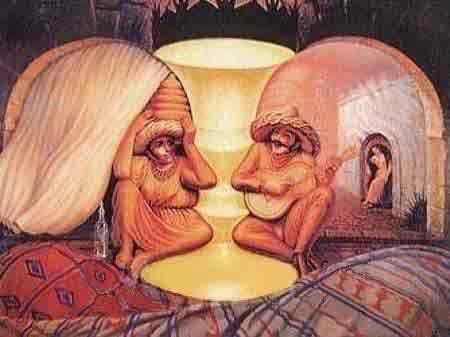

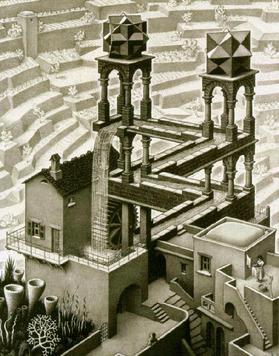
 link via